# About
Name: NeuroWarranty
Description: A new-age digital Warranty Solution that amplifies your business growth.
URL: https://www.neurowarranty.com/blog
# Navigation Menu
- Home: https://www.neurowarranty.com/
- Digitize Warranties: https://www.neurowarranty.com/warranty-management-solution
- Collect Consumer Data: https://www.neurowarranty.com/collect-offline-consumer-data
- Blog: https://neurowarranty.com/blog
- Book A Demo: https://calendly.com/aabhishekbindal/neurotags-demo
# Blog Posts
## Dyrect or Claimlane? Comparing Warranty Software for Ecommerce Brands (2026)
Author: Abhishek Agrawal
Author URL: https://www.neurowarranty.com/blog/author/abhishek-agrawal
Published: 2026-08-25
URL: https://www.neurowarranty.com/blog/dyrect-vs-claimlane-warranty-software-ecommerce
Dyrect and Claimlane both handle warranty claims for ecommerce brands, but they approach the problem from opposite directions.
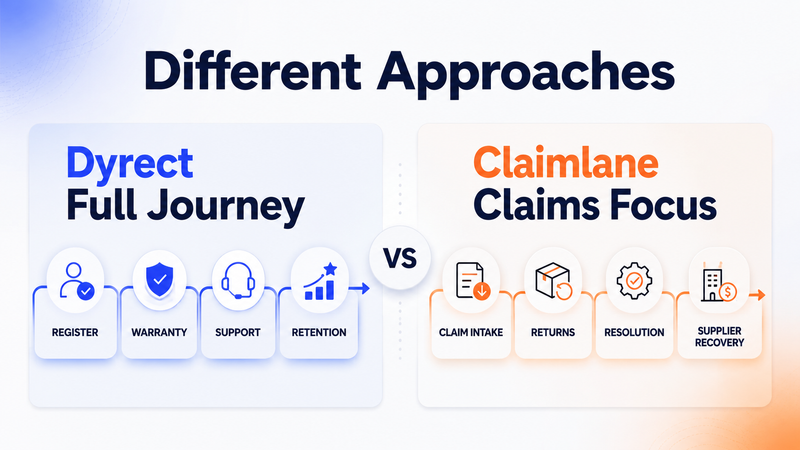
Dyrect starts at the moment of purchase, capturing customer data through QR codes and embedded registration, then carries the relationship through claims, repairs, and ongoing engagement. Claimlane starts when something breaks, giving your team structured workflows to process claims, recover costs from suppliers, and resolve tickets faster.
If you're running an omnichannel ecommerce brand on Shopify, Amazon, retail, and your own D2C store, this comparison will help you understand which platform fits the way your business actually works.
**TLDR:**
> \- Dyrect and Claimlane are both warranty software for ecommerce brands, but they solve different problems.
>
> \- Dyrect covers the full post-purchase journey: product registration, claims management, AI support, digital warranty cards, and extended warranty sales.
>
> \- Claimlane focuses on claims processing, returns automation, and supplier cost recovery.
>
> \- For omnichannel ecommerce brands, Dyrect delivers broader coverage across the entire customer lifecycle.
## What Ecommerce Brands Actually Need from Warranty Software
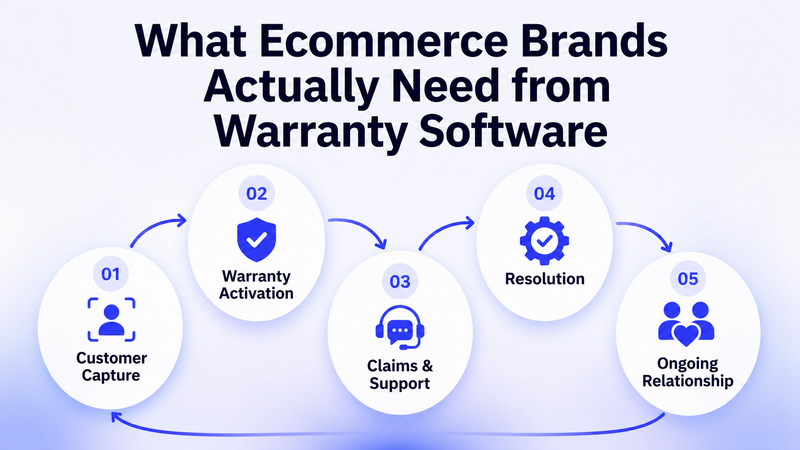
[Warranty management for ecommerce](https://www.neurowarranty.com/blog/best-warranty-management-software) looks different from warranty management for enterprise manufacturers. When you sell physical products through Shopify, Amazon, retail stores, and your own website, your warranty workflow has to handle five distinct stages.
**Stage 1: Customer capture.** Someone buys your product from Best Buy or Amazon. You shipped the product, but you have zero data on who bought it. Your warranty software should give that person a way to register, so you know who owns your product and can reach them directly.
**Stage 2: Warranty activation.** Once registered, the customer needs a digital warranty card confirming their coverage period, purchase date, and product details. Paper warranty cards get lost. Digital ones stay accessible forever.
**Stage 3: Claims and support.** When something goes wrong, your customer needs a fast, clear way to submit a claim. Your team needs structured data (photos, serial numbers, proof of purchase) collected upfront so they can resolve the issue without 5 back-and-forth emails.
**Stage 4: Resolution and cost recovery.** Claims need to move through approval, repair, replacement, or refund workflows. If the defect traces back to a manufacturer or supplier, your platform should help recover those costs.
**Stage 5: Ongoing relationship.** After the claim closes, what happens? The best warranty software keeps the customer engaged: digital product manuals, service center access, extended warranty offers, and re-engagement campaigns that drive repeat purchases.
Most warranty platforms cover stages 3 and 4. The difference between Dyrect and Claimlane shows up in how each platform handles the stages before and after the claim.
## How Dyrect and Claimlane Approach Warranty Management Differently
Here's the full feature comparison:
Feature
Dyrect
Claimlane
**Product registration (QR + web)**
Core feature, included
Add-on module (Custom plan)
**Digital warranty cards**
Included, auto-sent via email/SMS
Tracks warranty periods internally, no customer-facing cards
**Claims management**
Full workflow with ticketing
Full workflow with ticketing
**AI-powered support**
AI warranty support agent: troubleshoots, captures receipts via OCR, detects fraud, deflects 80% of queries
AI Agent: analyzes images/videos, applies policy rules, auto-resolves claims
**Self-service portal**
Self-service portal for registration, claims and returns
Self-service portal for claims and returns
**Supplier cost recovery**
Dealer and OEM chargeback management
Dedicated supplier forwarding module with credit note tracking
**Digital Product Passport**
Included (manuals, guides, service centers, warranty status)
Unavailable
**Extended warranty sales**
Built-in: create, sell, and manage protection plans
Unavailable as a platform feature
**Loyalty programs**
QR-based loyalty with tiered rewards
Unavailable
**Anti-counterfeiting**
AI-backed authentication with QR verification
Unavailable
**Marketing integrations**
Klaviyo, Mailchimp, HubSpot, ActiveCampaign, Omnisend, Twilio, and 15+ more
Klaviyo, Intercom, Zendesk, Gorgias, Salesforce
**Ecommerce integrations**
Shopify, WooCommerce, BigCommerce, Squarespace, Wix
Shopify, WooCommerce, Magento, BigCommerce, Commercetools, Shopware, PrestaShop, and 10+ more
**Shipping integrations**
Via ecommerce platform
ShipStation, EasyPost, FedEx, UPS, DHL, Sendcloud, AfterShip, and 15+ carriers
**ERP integrations**
Via REST API
Microsoft Dynamics 365, SAP, NetSuite, Navision
**Implementation time**
Under 30 minutes on Shopify
2-4 weeks (simple), 4-8 weeks (complex)
**G2 rating**
[4.9/5](https://www.g2.com/products/dyrect/reviews)
[4.8/5](https://www.g2.com/products/claimlane/reviews)
**Base pricing**
Tiered plans starting with a free tier
Core: $800/month (2,000 tickets). Add-ons: custom pricing
**The structural difference:** Claimlane was built as a returns and claims management system for retailers, and has expanded into warranty territory. Dyrect was built as a warranty-first platform for consumer product brands, covering registration through post-purchase engagement.
Both platforms process claims well. Where they diverge is everything that happens before and after the claim.
## Product Registration and Customer Capture
Over 50% of consumer brand sales happen through offline retail or marketplaces like Amazon, where the sales channel shares zero customer data with the brand. Your brand ships the product. Someone buys it from Target or Amazon. You have absolutely no record of who that person is.
**How Dyrect handles registration:** Dyrect generates unique QR codes that go directly on your product packaging. When a customer scans the code with their phone camera, they land on a mobile-optimized registration flow. The registration captures their email, phone number, purchase channel, geographic location, and proof of purchase.
It validates the serial number using AI to block duplicates and counterfeits. Once complete, the customer receives a digital warranty card via email or SMS, and their data flows directly into your marketing tools (Klaviyo, Mailchimp, HubSpot, or any connected CRM).
For online buyers, Dyrect embeds a registration widget directly on your Shopify or WooCommerce store, syncing order data automatically. Every customer from every channel, online or offline, gets a path to register.
**Registration results:** Brands using Dyrect report [3x more registrations](https://www.dyrect.co/product/product-registration-software) compared to previous systems, with a 28% increase in repeat sales driven by the first-party data captured at registration.
**How Claimlane handles registration:** Claimlane offers a warranty registration portal where customers can submit product details, upload proof of purchase, select their purchase channel, and enter the purchase date. The system tracks warranty periods per product and syncs data to CRM tools. Marketing opt-in collection is included in the registration flow.
**Key difference:** On Claimlane, warranty registration is an add-on module available on the Custom plan (pricing requires a sales conversation). The Core plan at $800/month covers claims and returns processing, but registration requires an upgrade. On Dyrect, omnichannel product registration is the foundation of the platform, available from the first tier.
For ecommerce brands selling across Shopify, Amazon, and retail, this distinction matters. Registration is where the customer relationship begins. If registration sits behind a pricing upgrade, many growing brands delay implementing it, which means they keep losing customer data from their offline and marketplace channels.
## Warranty Claims and AI-Powered Resolution
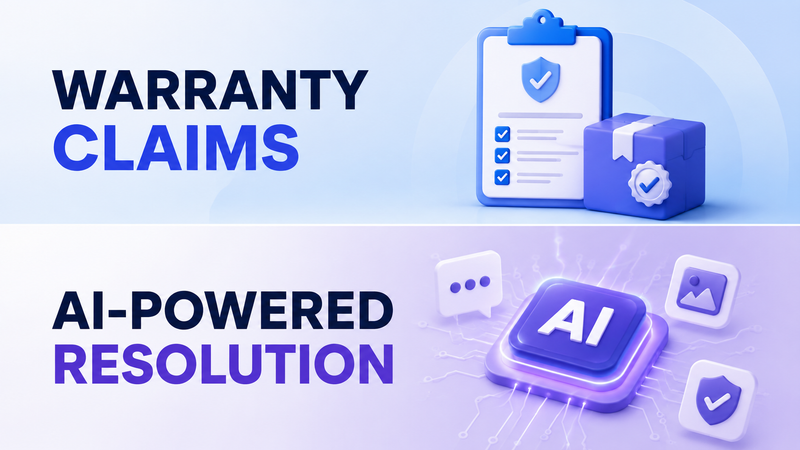
Both platforms have invested heavily in AI. Here's what each AI actually does, because the capabilities are meaningfully different.
### Dyrect's AI Warranty Support Agent
[Dyrect's AI agent](https://www.dyrect.co/warranty-support-ai-agent) sits at the front of the support journey, before a claim is even filed. When a customer reaches out with a product issue, the AI agent:
**Troubleshoots first.** Using your brand's own product manuals, warranty terms, and FAQs, the agent walks the customer through potential fixes. Many support requests resolve at this stage without becoming formal claims.
**Captures data automatically.** If the issue requires a claim, the customer uploads a photo of their receipt. Dyrect's OCR reads and extracts the purchase date, retailer name, serial number, and amount automatically. Zero manual data entry.
**Detects fraud.** The AI cross-checks serial numbers, purchase dates, and claim history to flag duplicate or suspicious submissions before they reach your team.
**Routes intelligently.** Every issue gets classified by product, severity, and complexity, then routed to the right person. When the AI hands off to a human agent, the complete conversation history and all captured data transfer automatically.
**The result:** Dyrect states their AI handles [80% of warranty support volume](https://www.dyrect.co/warranty-support-ai-agent) without human involvement, responding in under one minute, 24/7, in any language.
### Claimlane's AI Agent
Claimlane's AI Agent operates at the claim resolution stage. After a customer submits a claim through the self-service portal with photos and documentation:
**Analyzes visual evidence.** The AI reviews product images and videos to assess the issue.
**Applies policy logic.** It checks the submission against configured warranty rules per product and supplier, determining eligibility and recommending the right resolution (replacement, refund, repair, or rejection).
**Auto-resolves eligible claims.** Simple, clear-cut cases get resolved without human involvement. Complex ones get routed to an agent with the AI's recommended action attached.
Claimlane positions this as the first AI agent purpose-built for warranty claims and returns, and their case studies highlight significant reductions in resolution time and team size for high-volume ecommerce operations.
### Where the two AIs differ
Capability
Dyrect AI
Claimlane AI
**Primary function**
Troubleshoot and deflect before a claim is filed
Resolve claims faster after submission
**OCR receipt scanning**
Yes, automatic extraction
Collects proof of purchase via upload
**Fraud detection**
Built-in, pre-approval
Through workflow rules
**Troubleshooting from brand manuals**
Yes, grounded in your product guides
Focused on claim resolution logic
**Claim auto-resolution**
Routes to team with full context
Auto-approves eligible claims
**Deflection rate**
80% of queries resolved without a ticket
Reduces agent workload on eligible claims
Dyrect's AI focuses on preventing unnecessary claims by solving problems early. Claimlane's AI focuses on processing claims faster once they're submitted. Both reduce your team's workload, through different mechanisms.
## What Happens After the Claim Is Closed
This is where the two platforms diverge most clearly.
**On Dyrect,** the customer relationship continues after claim resolution. Every registered product lives inside a Digital Product Passport, a persistent digital home the customer can access anytime from their phone (without downloading an app). Inside, they find:
- Current warranty status and coverage details
- Complete claim history
- Digital product manuals, installation guides, and care instructions
- Nearest authorized service and repair centers
- Offers for extended warranty plans and accessories
- Brand social channels and review collection prompts
This ongoing engagement layer turns warranty from a cost center into a revenue driver. Brands use it to sell [extended protection plans](https://www.dyrect.co/product/extended-warranties) (keeping 100% of premium revenue, rather than sharing commissions with third-party providers like Extend or Clyde). They use it to promote accessories and new products to verified owners. They use it to collect reviews from customers who've had positive support experiences.
**On Claimlane,** the claim closes and the platform journey ends. Claimlane excels at efficient claim resolution and supplier cost recovery, but the product scope stops at the claim lifecycle. Post-resolution engagement, digital product passports, digital manuals, extended warranty sales, and loyalty programs fall outside the platform.
For ecommerce brands where repeat purchases and customer lifetime value drive profitability, this gap matters. Warranty interactions are high-trust moments. The customer reached out with a problem, and you solved it. Capturing that goodwill with an upsell, a review request, or a loyalty offer is where warranty becomes revenue.
## Integrations and Tech Stack Fit for Ecommerce

Your warranty platform needs to plug into the tools you already use. Both Dyrect and Claimlane integrate with major ecommerce platforms, but their integration philosophies reflect their different starting points.
**Dyrect's integration stack is built around marketing and customer data.** Registration data flows directly into [Klaviyo, Mailchimp, HubSpot, ActiveCampaign, Omnisend, Sendinblue, Drip, GetResponse, and MailerLite](https://www.dyrect.co/integrations) for email campaigns. SMS marketing connects through Twilio, Plivo, and Gupshup. WhatsApp communication is built in. Service CRM integrations cover Zendesk, Zoho Desk, and Freshdesk.
This means every customer who registers a product immediately enters your retention marketing workflows. You can trigger post-registration email sequences, warranty expiration reminders, extended warranty offers, and re-engagement campaigns, all from first-party data your brand owns.
**Claimlane's integration stack is built around operations and logistics.** 75+ integrations cover ecommerce platforms (Shopify, WooCommerce, Magento, BigCommerce, Commercetools, Shopware, PrestaShop), ERP systems (Microsoft Dynamics 365, SAP, NetSuite, Navision), shipping carriers (ShipStation, EasyPost, FedEx, UPS, DHL, Sendcloud, AfterShip, and several Nordic/European providers), and helpdesks (Zendesk, Gorgias, Dixa, Intercom, Salesforce). Klaviyo appears on Claimlane's integration list as well.
Claimlane's ERP and shipping depth is stronger, particularly for brands with European operations or complex supply chain workflows. If your warranty process involves creating shipping labels, syncing with Business Central, and reconciling supplier credit notes, Claimlane's operational integrations are deep.
**For ecommerce brands prioritizing customer data and retention marketing,** Dyrect's integration stack feeds warranty data directly into the tools that drive repeat purchases. For brands prioritizing claims logistics and ERP reconciliation, Claimlane's stack handles the operational backend.
## **Dyrect or Claimlane: Pick the Right Fit Based on How You Sell**
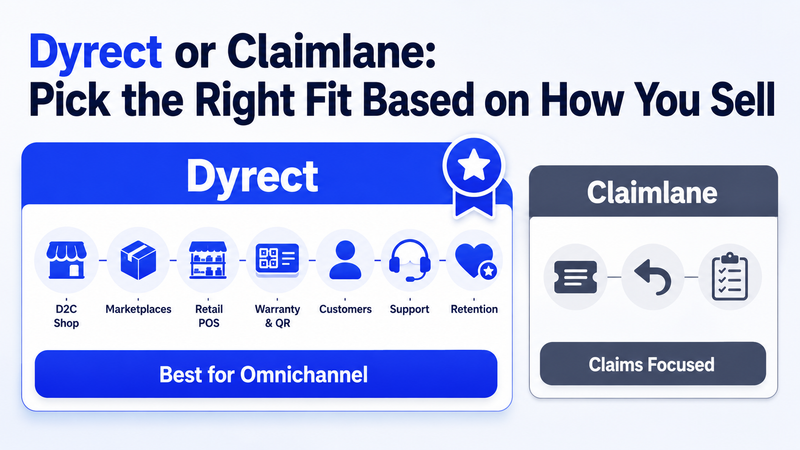
**Your brand sells D2C on Shopify and through Amazon, Target, and independent retailers.** You need to capture customers from every channel, especially the ones where you get zero data from the sales platform. You want warranty registration to feed your Klaviyo flows and drive repeat purchases. You want to sell extended warranty plans directly. Dyrect covers this entire workflow from registration through revenue.
**Your brand is a European retailer or distributor selling other companies' products.** You receive warranty claims from customers, forward them to manufacturers, and need to recover costs through supplier credit notes. Your claims volume is high, and you need AI to process them faster. Claimlane's B2B supplier forwarding and AI-powered claim resolution are built for exactly this workflow.
**Your brand is growing fast on Shopify and you're just starting to formalize warranty operations.** You need something live this week, with registration, claims, and customer-facing warranty portals working from day one. Dyrect's Shopify app installs in under 30 minutes with full product sync. Claimlane's implementation runs 2-4 weeks for simple setups and 4-8 weeks for more complex configurations.
## Frequently Asked Questions
### Is Claimlane good for D2C ecommerce brands?
Claimlane handles claims and returns well for ecommerce, with strong Shopify and WooCommerce integrations. Its core strength is claims processing efficiency and supplier cost recovery. For D2C brands that also need product registration, digital warranty cards, ownership experience tools, and extended warranty sales, Dyrect offers broader lifecycle coverage.
### Does Claimlane support product registration?
Yes, through an add-on module available on the Custom plan. The Core plan at $800/month covers claims and returns, while warranty registration requires an upgrade. Dyrect includes omnichannel product registration (QR code on packaging + ecommerce widget) as a core feature across all plans.
### Which platform has better AI for warranty support?
Both have strong AI with different focuses. [Dyrect's AI warranty support agent](https://www.dyrect.co/warranty-support-ai-agent) troubleshoots product issues before they become claims, scans receipts via OCR, and deflects 80% of queries without human involvement. Claimlane's AI Agent analyzes submitted claim photos and auto-resolves eligible cases based on policy logic.
### How much does Claimlane cost?
Claimlane's Core plan starts at $800/month (€700/month) and includes 2,000 tickets/year. Features like warranty registration, AI Agent, automations, serial number validation, and custom integrations require the Custom plan at undisclosed pricing.
### How much does Dyrect cost?
Dyrect offers tiered pricing with registration, claims, digital warranty cards, and customer portal included across plans. Specific pricing is available on [Dyrect's pricing page](https://www.dyrect.co/pricing).
### Can Dyrect handle supplier chargebacks?
Yes. Dyrect includes dealer and OEM chargeback management with item-level traceability, so your team can reconcile chargebacks accurately against specific products and claims.
### Which warranty software works best for Shopify stores?
Both integrate with Shopify. Dyrect offers a native Shopify app rated [4.9 on the Shopify App Store](https://www.dyrect.co/warranty-registration-for-shopify) with automatic product sync and order data connection. Claimlane connects to Shopify through its standard integration for order lookup and claim workflows.
### Which platform is better for omnichannel ecommerce brands?
For brands selling across Shopify, Amazon, retail stores, distributors, and offline channels, [Dyrect's omnichannel registration](https://www.dyrect.co/product/product-registration-software) (QR codes on packaging + web widgets) captures customer data from every sales channel. Combined with the ownership experience layer and marketing integrations, Dyrect is built for the omnichannel ecommerce use case.
### Does Dyrect offer extended warranty sales?
Yes. Dyrect enables brands to create, price, sell, and manage their own [extended warranty and protection plans](https://www.dyrect.co/product/extended-warranties) directly through the platform. Your brand keeps 100% of the premium revenue.
### How long does implementation take for each platform?
Dyrect's Shopify app goes live in under 30 minutes. Claimlane's implementation takes 2-4 weeks for simple Shopify setups and 4-8 weeks for enterprise configurations.
---
This blog is powered by Superblog. Visit https://superblog.ai to know more.
---
## 10 Best Warranty Management Software (2026)
Author: Abhishek Agrawal
Author URL: https://www.neurowarranty.com/blog/author/abhishek-agrawal
Published: 2026-08-10
Tags: Digital Warranty Management, warranty management softwares, Warranty Tracking System
Tag URLs: Digital Warranty Management (https://www.neurowarranty.com/blog/tag/digital-warranty-management), warranty management softwares (https://www.neurowarranty.com/blog/tag/warranty-management-softwares), Warranty Tracking System (https://www.neurowarranty.com/blog/tag/warranty-tracking-system)
URL: https://www.neurowarranty.com/blog/best-warranty-management-software
**TL;DR**
> Warranty management software is a digital platform that automates the entire product warranty lifecycle, from registration and claims processing to validation, repair or replacement tracking, and supplier recovery. It replaces manual spreadsheets and emails with a centralized system that reduces operational costs, prevents fraudulent claims, and speeds up resolution times.
>
> **Best Warranty Management Software by Category (2026):**
>
> **E-commerce, D2C, and Omnichannel Brands**
>
> [Dyrect](https://dyrect.co) combines QR-based product registration across every sales channel with claims automation, digital warranty cards, and Shopify-native integration. NeuroWarranty offers QR-based warranty activation with a focus on retail and marketplace registration.
>
> **Enterprise Manufacturers and OEMs**
>
> Pega Warranty handles multi-tier dealer claims, supplier chargebacks, and recall campaign management. PTC Warranty specializes in root-cause analytics and predictive warranty cost modeling. SAP Warranty Management embeds warranty workflows directly inside existing ERP operations.
>
> **Field Service and Technician Operations**
>
> FieldEZ combines warranty eligibility verification with on-site scheduling, technician dispatch, and mobile proof capture.
>
> **Returns and Reverse Logistics**
>
> ReverseLogix manages high-volume return operations with inspection workflows, parts harvesting, repair tracking, and warehouse integration.
>
> **IT Hardware and Managed Services**
>
> ScalePad automatically retrieves warranty data from OEM databases and tracks hardware lifecycle across client environments.
>
> For the full breakdown of all ten platforms with feature comparisons, evaluation criteria, pricing, and real case studies, keep reading.
## Introduction
If you are exploring the best warranty management software, chances are your current system feels scattered. Maybe claims arrive through email, registrations sit in spreadsheets, and your support team keeps asking finance or operations for updates. Or perhaps you already [use a helpdesk](https://www.dyrect.co/blog/warranty-management-in-zoho-vs-dyrect), an ERP, and an ecommerce platform, yet they barely talk to each other when a warranty claim comes in. That gap slows responses, increases manual effort, and makes reporting harder than it should be.
You might also be asking a bigger question. Should a warranty management system only handle claims, or should it also cover [product registration](https://www.dyrect.co/blog/product-registration-tracking-software), serial number tracking, returns coordination, and analytics? And if you are growing across channels such as your own website, marketplaces, retail stores, and distributors, the need for a structured warranty management portal becomes even more important.
However, all tools serve different types of businesses. A fast growing D2C brand on Shopify has very different needs compared to a global manufacturer with dealers and supplier recovery programs inside SAP.
So the real question is not "Which is the best warranty software?" The correct question is “ **Which** [**warranty management system**](https://www.dyrect.co/guide/warranty-management-software) **fits your team, products, and customers?**” Well, you are in the right place.
## **How the Best Warranty Management Software Helps Businesses**
A modern warranty management system does much more than collect claims. It becomes the operational backbone that [connects customers](https://www.neurowarranty.com/blog/how-warranty-management-plays-a-vital-role-in-customer-re-engagement), products, and internal teams in one structured environment.
First, it centralizes product registration. When a customer purchases a product online or in a retail store, registration links that product to a real person, a purchase date, and often a serial number. This creates a verified database of active warranties. Consequently, your team can instantly check eligibility without digging through invoices or emails.
Second, a strong warranty management portal standardizes claim intake. Instead of unstructured messages, customers submit claims through guided forms that collect proof of purchase, issue details, and images. Therefore, support agents spend less time asking follow-up questions and more time resolving issues.
Third, analytics become meaningful. With structured data, patterns begin to surface. You can see which SKUs generate the highest claims, which suppliers are linked to recurring defects, and which regions show abnormal failure rates. Over time, this insight supports product improvement, supplier conversations, and more accurate financial forecasting. So, a strong warranty claims management software should help you answer questions like:
- Which products generate the highest claim rates?
- Which regions report recurring issues?
- How long does an average claim take to resolve?
- Which suppliers contribute to higher defect costs?
Finally, integration changes everything. When your warranty claims management software connects with ecommerce platforms, ERPs, helpdesks, shipping tools, and CRMs, workflows move without manual copying. A claim can automatically trigger a replacement order, notify finance, update inventory, and send a customer update email. That level of coordination reduces internal friction and improves customer satisfaction at the same time.
### **What** Manual **Warranty Management Actually Costs Your Business**
Most teams underestimate how much they spend on warranty management because the cost is hidden inside support hours, scattered tools, and slow resolution cycles. Here is a simple way to calculate it.
Cost Factor
How to Calculate
Example (200 claims/month)
Support time per claim (manual verification, emails, follow-ups)
Average minutes per claim x hourly support cost
45 min x $25/hr = $18.75 per claim
Monthly support cost on warranty alone
Cost per claim x monthly claim volume
$18.75 x 200 = $3,750/month
Annual support cost
Monthly cost x 12
$45,000/year
Fraudulent or ineligible claims approved (estimated 2-4% of total)
Average product cost x fraudulent claims per month
$80 avg product x 6 false claims = $480/month ($5,760/year)
Lost customers from slow resolution (estimated 15-20% of claimants do not return)
Lost customers x average lifetime value
30 lost customers/month x $120 LTV = $3,600/month ($43,200/year)
**Total estimated annual** [**cost of manual warranty management**](https://www.dyrect.co/warranty-cost-calculator)
**$93,960/year**
Compare that to the cost of dedicated warranty management software, which for most D2C and ecommerce brands ranges from $600 to $25,000 per year depending on volume and features.
The math is not close. Manual warranty management is almost always more expensive than software. The cost is just harder to see because it is buried inside payroll, product write-offs, and customer churn.
## Warranty management system vs warranty management software
The terms warranty management system and [warranty management software](https://www.dyrect.co/blog/best-warranty-management-software-for-shopify-2026) are often used together, but they can signal different buyer needs.
Warranty management software usually refers to the application a team uses to manage registrations, claims, serial numbers, customer updates, and reporting.
A warranty management system refers to the broader operating structure behind the process. That system may include the software platform, claim policies, approval rules, customer portal, repair process, replacement process, finance workflow, product data, and integrations with ecommerce, ERP, CRM, or helpdesk tools.
Well, a business can have warranty software but still lack a strong warranty system. For example, a team may collect claims through a portal but still approve replacements manually, store product defect notes in spreadsheets, and update customers through separate email threads.
A strong warranty management system connects every stage of the warranty lifecycle. The customer registers the product, the product record links to a warranty period, the claim connects to the customer and product, the team reviews eligibility, the final resolution is tracked, and the data becomes useful for reporting.
This is the difference between storing warranty information and actually managing warranty operations.
## Key Features of Warranty Management Software
**Product Registration and Warranty Activation:** Capture customer data at the point of registration through QR codes, web forms, or ecommerce widgets. Validate serial numbers automatically. Activate warranty coverage the moment a customer registers.
**Claims Intake and Automated Adjudication:** Accept claim submissions through self-service portals. Check serial numbers, purchase dates, and warranty terms instantly. Auto-approve claims that meet predefined rules without manual review.
**Workflow Routing and Resolution Management:** Route approved claims to the right resolution path: replacement, repair, refund, or field service dispatch. Track each claim from submission through every stage to closure.
**Supplier Recovery and Chargebacks:** Track defective parts back to original manufacturers or suppliers. File recovery claims with item-level traceability and supporting documentation.
**Fraud Detection and Prevention:** Flag duplicate serial numbers, claims outside warranty windows, and suspicious patterns like multiple claims from the same address. Block fraudulent submissions before they reach the review stage.
**Analytics and Defect Reporting:** Monitor claim volumes, resolution times, and defect trends by SKU. Surface recurring product issues before they escalate into costly recalls or reputation damage.
**Customer Communication and Self-Service:** Provide branded portals where customers submit claims, upload photos, and track resolution status. Send automated updates via email, SMS, or WhatsApp at each stage.
## Best Warranty Software Comparison Table (2026)
**Note**: This comparison includes full warranty management platforms, enterprise warranty systems, field service tools, RMA platforms, and support tools that can be used for warranty-related workflows. The best choice depends on the type of business, claim volume, product complexity, customer experience needs, and integration requirements.
## Ten Best Warranty Management Software for Modern Brands
Software
Best For
Product Registration
Claims Workflow
Serial Tracking
Customer Portal
Analytics
Starting Price
Implementation
Best Business Fit
Dyrect
D2C, ecommerce, omnichannel brands
Yes (QR + Shopify widget)
Yes (automated)
Yes (AI-powered)
Yes (branded)
Yes (SKU-level)
$49/month
1-4 weeks
Brands selling through Shopify, Amazon, retail, and marketplaces that need first-party data capture and claims automation
Pega Warranty
Enterprise manufacturers with dealer networks
Limited
Yes (multi-tier approvals)
Yes
Yes (dealer-facing)
Yes (root-cause)
Enterprise ($50K+/year)
3-6 months
Large manufacturers managing dealer claims, supplier chargebacks, and recall campaigns
FieldEZ
Field service and technician-led operations
Limited
Yes (dispatch-integrated)
Yes
Limited
Yes
Custom
2-4 weeks
Service organizations with on-site technicians needing warranty verification before dispatch
NeuroWarranty
D2C and retail QR-based registration
Yes (QR-based)
Yes
Yes
Yes
Yes (claim patterns)
Custom (request demo)
1-2 weeks
Consumer brands focused on QR warranty activation and retail customer data capture
SAP Warranty Management
Large SAP-centered enterprises
Limited
Yes (ERP-integrated)
Yes (defect code catalogs)
Limited
Yes (BW/Analytics Cloud)
Enterprise ($50K+/year)
6-12 months
Organizations already running SAP ERP that need warranty workflows embedded in core operations
PTC Warranty
Industrial OEMs and manufacturers
Limited
Yes
Yes (parts-level)
Limited
Yes (predictive)
Enterprise ($50K+/year)
6+ months
Automotive, industrial, and consumer electronics OEMs focused on root-cause analysis and warranty cost reduction
ReverseLogix
Enterprise returns and reverse logistics
Limited
Yes (inspection workflows)
Yes
Yes (B2C + B2B portals)
Yes (AI-powered)
Custom (enterprise tier)
2-4 months
High-volume operations needing inspection, repair, parts harvesting, and warehouse integration
Zendesk
Support teams handling warranty via tickets
No
Adapted (ticket-based)
No
Yes (help center)
Basic
$55/user/month
1-2 weeks
Teams already on Zendesk with low warranty volume who want to handle claims within existing support workflows
ScalePad
IT hardware warranty lifecycle (MSPs)
Auto-retrieved from OEM
Limited
Yes (OEM database)
Limited
Yes (lifecycle)
Custom
1-2 weeks
Managed service providers tracking hardware warranties across client environments
RenewityRMA
Customizable RMA and service workflows
Limited
Yes (configurable stages)
Yes
Yes (self-service)
Basic
$299/month
2-4 weeks
Small to mid-size manufacturers needing flexible RMA workflows without heavy coding
### 1\. Dyrect
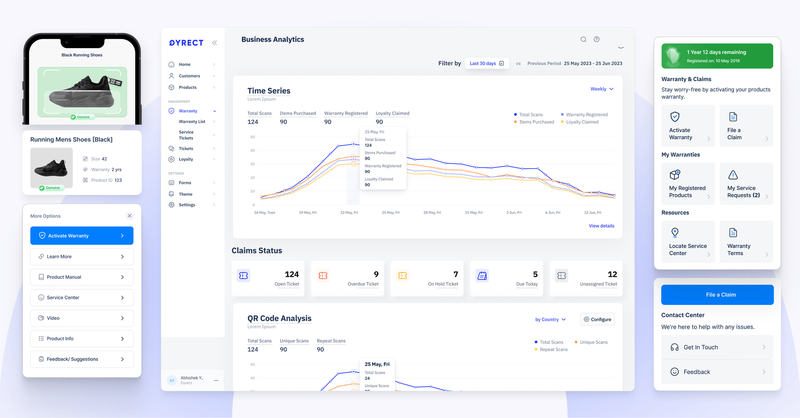
[Dyrect](https://www.dyrect.co/product/warranty-registration-software) is one of the most-powerful warranty management systems for modern consumer brands and product companies operating across multiple sales channels. It connects product registration, serial number tracking, warranty claims management, repair and replacement workflow automation, returns coordination, and analytics within one structured warranty management platform.
For ecommerce brands, Dyrect integrates directly with platforms such as Shopify, WooCommerce,, and custom storefronts, so order data syncs automatically into warranty records. For offline and retail sales, QR based product registration allows customers to activate warranties in seconds through a mobile browser. This approach collects accurate purchase data whether the sale happened online, in store, or through distributors.
When a warranty claim is submitted, Dyrect routes it through defined workflow stages. Teams can validate serial numbers, review proof of purchase, assign internal owners, and update claim status from one dashboard. Moreover, built in analytics highlight approval rates, recurring product issues, and claim costs over time, which helps leadership make informed decisions on product quality and service policies.
Dyrect works especially well for growing D2C brands, omnichannel retailers, and product manufacturers that want a unified warranty management system instead of stitching together a helpdesk, spreadsheets, and a separate RMA tool.
**Pros**
- End to end warranty management portal
- 24/7 Customer Support and Onboarding Assistance
- Strong ecommerce and omnichannel integrations
- QR based registration for retail and distributor sales
- Integrated claims, tracking, and analytics
- Clean customer facing portal
- Warranty Registration and Claims plans start at $49 per month
**Cons**
- Advanced configurations may require onboarding support
- Enterprise level customization depends on plan tier
### **Warranty registration and activation**
[Dyrect enables digital product and warranty registration through QR codes](https://www.dyrect.co/blog/best-warranty-registration-software), embedded website forms, and ecommerce order sync across platforms such as Shopify and other storefront systems. Registrations connect directly to product SKUs, serial numbers, and order data, giving your team structured records from day one. Customers receive a branded digital warranty confirmation inside a dedicated warranty management portal.
### **Centralized warranty operations**
Dyrect brings registrations, claims, and customer records into one unified dashboard. Support, operations, and leadership teams access the same source of truth, which improves visibility and reduces internal back and forth. This centralized structure makes reporting and tracking far more organized.
### **Structured claims process**
[Dyrect allows you to define exactly how a warranty claim should move inside your team](https://www.dyrect.co/new-features/claims-management-system). For example, you can decide who reviews new claims first, who approves replacements, and when a case should move to a senior team member. Once these steps are defined, every claim follows the same path automatically.
### **Automation and eligibility validation**
Dyrect automatically validates warranty eligibility based on purchase date, product type, and coverage rules. Notifications, internal routing, and milestone updates run through automation, helping teams handle growing claim volumes with clarity and control.
### **Returns, replacements, and tracking**
[The platform supports RMA creation and replacement coordination within the same workflow](https://www.dyrect.co/blog/how-to-manage-claims-and-returns-rma-on-shopify-cm3ndsmv1004tvnqrhbux1i8o). Teams can monitor claim progress, return status, and resolution history from a single interface. This connected view keeps customer communication aligned with operational execution.
### **Analytics and post purchase insights**
Dyrect provides dashboards that highlight registration rates, claim trends, turnaround times, and product level defect signals. These insights help leadership make informed decisions about quality improvements, inventory planning, and customer experience enhancements.
Also, Dyrect is trusted by 500+ growing brands (as of 2026) and rated 4.8⭐ on [G2](https://www.g2.com/products/dyrect/reviews) and 5⭐ on the [Shopify App Store](https://apps.shopify.com/dyrect-warranty-registrations).
### 2\. Pega Warranty
Pegasystems offers Pega Warranty as part of its enterprise process automation ecosystem.
This solution handles complex workflows across dealers, suppliers, and internal service networks. It automates claim validation, multi tier approvals, supplier chargebacks, and financial settlements.
Because it integrates deeply with CRM and service modules, warranty information becomes part of a broader 360 degree customer view.
**Pros:**
- Advanced rule based automation
- Strong supplier recovery functionality
- Ideal for high claim volumes
**Cons:**
- Implementation effort can be substantial
- Better suited for enterprises with structured IT teams
### 3\. FieldEZ
FieldEZ combines field service management with warranty tracking.
Technicians can verify warranty status directly from their mobile devices before starting repairs. This reduces billing confusion and ensures coverage accuracy during service visits.
The platform also handles scheduling, spare parts tracking, and job assignments. Therefore, it works well when warranty claims connect directly to on site service operations.
**Pros:**
- Mobile friendly technician interface
- Integrated service and warranty workflows
- Real time communication updates
**Cons:**
- More operationally focused than marketing driven
- May feel heavy for purely ecommerce brands
### 4\. NeuroWarranty
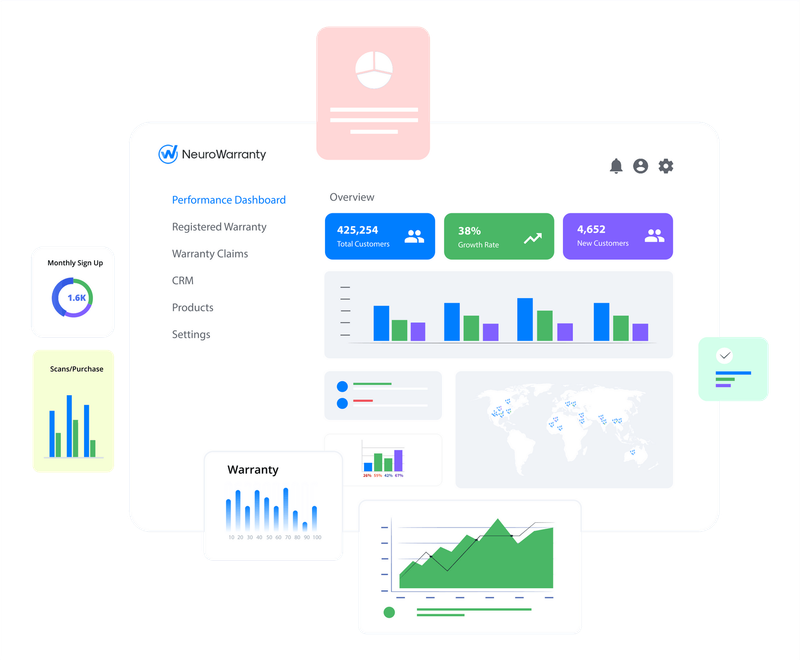
[NeuroWarranty](https://www.neurowarranty.com/blog/warranty-for-marketplace-sellers) has a digital warranty activation and claims solution built around QR technology.
The core idea is straightforward. Every product carries a unique QR code. After purchase, customers scan the code and land on a mobile optimized page to activate their warranty instantly. This removes paperwork, reduces registration friction, and captures verified first party customer data directly at the point of ownership.
Once activated, the platform supports structured warranty claim submission, serial number validation, and automated routing to internal teams. Brands gain access to a centralized dashboard that tracks registrations, claim status, and defect trends. Because the entire flow runs through web based interfaces, customers interact without installing additional applications.
**Pros:**
- Fast QR driven product registration
- Mobile friendly activation and claims flow
- Useful for collecting verified customer data from retail and marketplace sales
**Cons:**
- Limited enterprise level supplier recovery features
- Primarily optimized for physical consumer goods brands
### 5\. SAP Warranty Management
SAP SE offers warranty management as part of its broader ERP and service ecosystem. Rather than acting as a standalone tool, it embeds warranty workflows directly inside core business operations such as sales, service, logistics, and finance.
When a warranty claim is submitted, the system validates entitlement using product master data, serial numbers, and coverage rules stored inside SAP. Dealer claims, customer claims, and supplier recovery processes flow through structured approval chains. Financial postings, reimbursements, and credit notes automatically align with accounting modules, which ensures consistency across departments.
Because warranty data connects with inventory, service orders, and quality management, enterprises gain visibility from claim intake to settlement. That unified structure supports compliance, reporting, and long term product analysis at scale.
**Pros:**
- Deep integration with ERP, finance, and service modules
- Strong multi tier dealer and supplier workflows
- Enterprise grade reporting and compliance control
**Cons:**
- Requires SAP ecosystem familiarity
- Configuration and deployment demand structured planning
### 6\. PTC Warranty
PTC Inc. offers warranty management as part of its service lifecycle management suite. It supports registration, claims processing, supplier recovery, and detailed analytics.
PTC places strong emphasis on identifying root causes behind recurring claims, which helps engineering teams improve product quality over time.
**Pros**
- Advanced analytics and reporting
- Enterprise level workflow automation
- Suitable for high volume warranty environments
**Cons**
- More aligned with manufacturing than retail
- Implementation can require cross functional coordination
### 7\. ReverseLogix
ReverseLogix specializes in managing returns across ecommerce, retail, and B2B channels. Warranty returns integrate into the broader reverse logistics workflow.
Custom workflows guide products through inspection, repair, refurbishment, or replacement.
**Pros**
- Strong reverse logistics automation
- Customizable return workflows
- Suitable for large retailers and manufacturers
**Cons**
- Implementation effort can be significant
- Smaller teams may find it heavy
### 8\. Zendesk (Used for Warranty Workflows)
Zendesk functions primarily as a helpdesk platform. However, many teams adapt it to manage warranty claims through structured ticket workflows.
Agents collect serial numbers and proof of purchase within tickets. Automation rules route claims internally.
**Pros:**
- Familiar interface for support teams
- Unified customer communication
- Strong ticket tracking
**Cons:**
- Limited built in warranty validation
- Manual steps increase at scale
### 9\. ScalePad
ScalePad focuses on tracking hardware warranties for IT service providers.
It automatically retrieves warranty data from OEM databases and alerts teams before coverage expires. Therefore, MSPs manage client hardware lifecycle proactively.
**Pros:**
- Automated OEM warranty lookups
- Expiration alerts
- Strong MSP integrations
**Cons:**
- Designed for IT asset tracking rather than consumer product warranties
### 10\. RenewityRMA
RenewityRMA provides a configurable RMA and warranty portal.
Businesses design their own workflows without heavy coding. Customers submit RMAs online, and teams track each step from request to resolution.
**Pros:**
- Highly flexible process configuration
- Clear digital trail of claims
- Suitable for mid sized manufacturers
**Cons:**
- Requires process clarity during setup
- Less known compared to enterprise brands
## How to Choose the Right Warranty Claims Management Software for Your Business
Well, choosing the right warranty claims management software starts with understanding your own workflow. Map how claims enter your system, who reviews them, how approvals happen, and how returns or repairs are handled. The clearer your internal process, the easier it becomes to evaluate which warranty management system truly fits.
Next, consider your business model. A **fast growing D2C** brand selling through ecommerce and marketplaces may **prioritize product registration**, **customer portals**, and **CRM integrations**. Meanwhile, a **manufacturer** with dealers and suppliers may **need layered approvals**, serial tracking, and **supplier recovery capabilities**. The scale and complexity of your operations should guide your decision.
Then, evaluate integration depth. **Your warranty management portal should connect smoothly with your ecommerce platform, helpdesk, ERP, and finance tools**. When systems communicate properly, claim resolution speeds up and reporting becomes accurate.
Lastly, think long term. The right solution should **support growth**, **higher claim volumes**, and **expanding sales channels** without creating new silos. When your warranty management software aligns with both customer experience and operational efficiency, it becomes a strategic asset rather than an operational burden.
## FAQs
### **1\. What is the best warranty management software for D2C brands?**
For D2C brands selling through ecommerce, marketplaces, and retail, the best warranty management software is one that connects product registration, claims processing, and customer communication in one system.
You should look for QR based registration, ecommerce integration, automated eligibility checks, and a customer friendly warranty management portal. Platforms like Dyrect are designed specifically for D2C environments where customer experience and structured workflows matter equally.
### **2\. Which warranty claims management software is easiest to use?**
The easiest warranty claims management software is one that offers a clean dashboard, guided workflows, and minimal manual configuration.
For growing brands, ease of use often means fast setup, prebuilt automation, and clear claim tracking without heavy technical setup. Tools built specifically for product brands are typically easier to operate compared to enterprise systems designed for complex dealer networks.
### **3\. What is the best warranty management system for mobile accessories brands?**
Mobile accessories brands often face high claim volumes due to cables, chargers, earbuds, and cases.
In this category, the ideal warranty management system should support serial tracking, proof of purchase uploads, and automated claim validation. QR code registration on packaging is especially helpful because it increases registration rates and reduces fake claims. A structured warranty management portal also helps manage replacements quickly while keeping communication organized.
### **4\. How does a warranty management portal improve customer experience?**
A warranty management portal gives customers one place to register products, submit claims, and track status updates.
Instead of sending multiple emails or calling support, customers log in and see real time progress. This transparency builds trust and reduces inbound support tickets. For ecommerce brands, this directly improves post purchase satisfaction.
### **5\. Can warranty management software integrate with ecommerce platforms?**
Yes. Modern warranty management software integrates with ecommerce platforms such as Shopify, WooCommerce, Magento, and custom storefronts.
Integration allows automatic syncing of order data, product SKUs, and customer details. As a result, warranty eligibility checks happen faster and claims can be validated without manual lookup. This integration also improves reporting accuracy.
### **6\. What industries benefit most from warranty claims management software?**
Several industries benefit heavily from structured warranty claims management software, including:
- [Consumer electronics](https://www.dyrect.co/solutions/electronics)
- [Mobile accessories](https://www.dyrect.co/solutions/mobile-accessories)
- [Home appliances](https://www.dyrect.co/solutions/household-appliances)
- [Fitness equipment](https://www.dyrect.co/solutions/exercise-and-fitness)
- [Beauty and Personal Care](https://www.dyrect.co/solutions/beauty-and-personal-care)
Any business that sells physical products with defined coverage periods can benefit from a centralized warranty management system.
### **7\. What features should I look for in the best warranty management software in 2026?**
In 2026, the best warranty management software should include:
- Digital product registration
- Serial number validation
- Automated eligibility checks
- Configurable claim workflows
- RMA and returns coordination
- Analytics dashboards
- CRM and ecommerce integrations
These features ensure operational clarity while improving customer communication.
### 8\. How can brands reduce fake warranty claims?
Brands can reduce fake warranty claims by verifying order numbers, purchase dates, invoices, serial numbers, product photos, and claim history before approving a request.
For example, if the same serial number appears in multiple claims, the team can flag it for review. If the product was purchased outside the warranty period, the claim can be marked as expired or moved to manual approval. This protects the brand from unnecessary replacements and keeps claim decisions fair.
### 9\. What is QR based warranty registration?
QR based warranty registration allows customers to scan a QR code on the product, packaging, invoice, or insert card to activate their warranty online.
This is useful for brands that sell through retail stores, marketplaces, distributors, or offline channels. In these cases, the brand may lack direct customer data after purchase. A QR registration flow helps collect customer details, product information, purchase date, and serial number in a structured way.
### 10\. What is the difference between a warranty claim and an RMA?
A warranty claim is the customer’s request for support under a product warranty. An RMA, or return merchandise authorization, is the return process used when the product needs to be sent back for inspection, repair, replacement, or refund.
For example, a customer may submit a warranty claim for a faulty charger. The team reviews the claim and checks eligibility. If the product must be returned, an RMA is created to track shipping, warehouse receipt, inspection, and final resolution.
### 11\. How can warranty data help improve product quality?
Warranty data can show which products, SKUs, batches, regions, or issue types create the most claims.
For example, if one model receives repeated complaints for the same issue, the product team can investigate the part, supplier, packaging, or manufacturing batch. Over time, this data can reduce repeat failures, improve product design, and lower service costs.
### 12\. When should a business move away from spreadsheets for warranty claims?
A business should move away from spreadsheets when claim volume becomes hard to track. Common signs include missed updates, duplicate records, unclear ownership, slow approvals, poor reporting, and repeated customer follow-ups.
Spreadsheets may handle a small number of claims. But as the business grows, teams usually need automated eligibility checks, customer status updates, claim routing, registration data, and product-level reporting.
### 13\. How can warranty software help manage replacement requests?
Warranty software helps manage replacement requests by connecting the original claim, approval decision, replacement product, customer address, shipping status, and final resolution in one flow.
This gives support, operations, and warehouse teams a shared view of what needs to happen. It also reduces confusion around whether a replacement has been approved, shipped, delivered, or closed.
### 14\. How much does warranty management software cost?
Warranty management software pricing usually depends on claim volume, number of users, product catalog size, integrations, automation needs, and support requirements.
A growing ecommerce brand may need product registration, claims, customer portal, and ecommerce sync. A larger manufacturer may need dealer workflows, supplier recovery, ERP integration, and advanced reporting. Before choosing a platform, ask how pricing scales as claim volume and product count increase.
### 15\. How do I choose the right warranty management solution for my business?
Start by mapping your current warranty process. Check how customers register products, how claims arrive, what information your team reviews, who approves claims, how replacements or repairs happen, and how customers receive updates.
Then choose a solution that matches your sales channels and team structure. A D2C or omnichannel brand should prioritize ecommerce integration, QR registration, automated eligibility checks, customer portal, replacement tracking, and warranty analytics.
**16\. How much does warranty management software cost?"**
Replace with: Pricing depends on platform type and business size. Enterprise solutions like SAP, PTC, and Pega typically cost $50,000-$200,000+ per year with 6-12 month implementations. Mid-market platforms designed for D2C and ecommerce brands range from $600-$25,000 per year depending on claim volume and catalog size. Entry-level tools like [Dyrect](https://dyrect.co) start at $49/month with flat, predictable pricing.
**17\. What is QR-based warranty registration?**
Replace with: QR-based warranty registration uses unique QR codes printed on product packaging or inserts. After purchase, the customer scans the code with their phone camera and lands on a branded registration page. Warranty activation takes under 30 seconds. This works regardless of where the product was purchased. Customers who bought from Shopify, Amazon, retail stores, or marketplaces all scan the same code, giving the brand verified first-party data from every channel.
---
This blog is powered by Superblog. Visit https://superblog.ai to know more.
---
## 5 Best Shopify Apps for Warranty Management Compared (2026)
Author: Abhishek Agrawal
Author URL: https://www.neurowarranty.com/blog/author/abhishek-agrawal
Published: 2026-08-10
Category: Shopify Apps
Category URL: https://www.neurowarranty.com/blog/category/shopify-apps
Tags: Shopify Warranty Registration, Shopify Warranty Management
Tag URLs: Shopify Warranty Registration (https://www.neurowarranty.com/blog/tag/shopify-warranty-registration), Shopify Warranty Management (https://www.neurowarranty.com/blog/tag/shopify-warranty-management)
URL: https://www.neurowarranty.com/blog/best-shopify-apps-for-warranty-management-compared-2026
[Warranty management](https://www.dyrect.co/guide/warranty-management-software) can sound like a back-office task until the support inbox starts filling up with the same questions.
“Is my product covered?”
“I bought this from a retail store. Can I still claim the warranty?”
“I lost my invoice. Can you check my serial number?”
“I submitted a claim last week. Any update?”
“This is the second unit that failed. Can I get a replacement?”
For a Shopify brand, these questions can turn into messy internal work. A customer service agent checks the order history. Someone else checks a spreadsheet. A warehouse person confirms whether a replacement can be shipped. A manager asks whether this product failure has happened before. The customer waits, then sends another message.
The bigger issue is visibility. Warranty claims are rarely just support tickets. They carry useful data on product quality, customer ownership, sales channels, repeat defects, faulty batches, retailer performance, claim resolution speed, and missed revenue opportunities. When warranty work runs through inboxes and spreadsheets, the team loses the complete picture.
This problem gets even harder for brands selling through more than Shopify checkout. A customer may buy from a retail store, Amazon, Flipkart, an offline event, a distributor, or a dealer. Shopify order history will show direct online orders, but warranty coverage often needs to extend beyond that. If the brand cannot connect the product to the owner, the support team has to manually verify invoices, serial numbers, purchase dates, and eligibility.
That is the real reason [warranty registration](https://www.dyrect.co/blog/best-warranty-registration-software) and [product registration](https://www.neurowarranty.com/blog/best-product-registration-software) matter. They create an ownership record. They tell the brand who bought the product, which product they own, when the warranty started, which channel the purchase came through, and whether the customer qualifies for service.
For 2026, warranty management for Shopify needs to cover more than claim intake. A strong app should connect registration, serial number validation, customer portals, claim status, repair or replacement workflows, analytics, email alerts, integrations, and revenue opportunities. The dedicayed tools give teams a single place to view ownership, coverage, product failures, support progress, and customer engagement.
And that's the lens used for this comparison.
## Best Shopify App for Warranty Management: Quick Answer
Dyrect ranks as the best Shopify app for warranty management in 2026 for brands that need product registration, warranty claims, QR registration, serial number validation, customer portals, replacement workflows, analytics, and support integrations in one place.
If your brand sells across Shopify, retail stores, marketplaces, distributors, dealers, or offline channels, choose a warranty management app that can collect ownership data beyond Shopify checkout. That usually means QR registration, serial number validation, customer self-service, claim tracking, email updates, analytics, and replacement workflows.
## Shopify Warranty Management Software: Quick Comparison
App
Best fit
Free plan
Starting price
Product registration
Warranty claims
Serial number support
Customer portal
QR registration
Replacement workflows
Analytics
Dyrect
Omnichannel brands that need full warranty registration and claims management
Yes
$49/month for warranty registrations and claims management
Yes
Yes
Yes
Yes
Yes
Yes
Yes
My Product Registration
Shopify merchants that want flat-price registration and claims
No
$15/month
Yes
Yes
Yes
Yes
Limited
Limited
Basic
Propel
Smaller stores that need affordable registration and claim intake
Yes
$9.95/month
Yes
Yes
Yes
Limited
Limited
Limited
Basic
Resolvi
Teams that need claim review, fault tracking, and claim outcomes
No
$49/month
Limited
Yes
Limited
Yes
Limited
Yes
Yes
SeriaLogic
Stores that need serial number automation
No
$9.99/month
No
No
Yes
Limited
No
No
Limited
## How We Evaluated the Best Shopify Warranty Apps
To [compare the apps](https://www.dyrect.co/blog/best-warranty-management-software-for-shopify-2026), we looked at the warranty tasks Shopify merchants usually need after selling physical products. That includes product registration, warranty registration, claim submission, customer status updates, serial number checks, replacement handling, and warranty reporting.
Each app was reviewed across these criteria:
- Product and warranty registration depth
- QR code registration support
- Serial number validation and duplicate claim control
- Customer portal and claim status visibility
- Claims dashboard and internal claim review
- Repair, replacement, refund, or store credit workflows
- Shopify product and order sync
- Email alerts and customer communication
- Analytics for claims, defects, sources, and resolution time
- Integrations with support, CRM, and email tools
- Pricing clarity and plan fit
- Shopify App Store rating and public review volume
The strongest warranty management app should help brands answer practical support questions: who owns the product, when coverage started, whether the serial number is valid, whether the customer qualifies for service, what action should happen next, and which products are creating repeat claims.
## **Why Shopify Brands Need Warranty Management Apps**
Warranty and product registration are closely linked. When a customer registers a product, the brand gets verified ownership data. This can include product details, purchase channel, serial number, warranty period, customer contact details, location, and product usage context.
That data becomes extremely useful later.
If a product fails, the support team can verify coverage faster. If a specific SKU receives repeated claims, the product team can spot quality issues sooner. If retail buyers register products through QR codes, the marketing team can finally reach customers who purchased outside Shopify. If someone registers a product, the brand can offer an extended protection plan, accessories, care kits, replacement parts, or product education at the perfect point in the post-purchase journey.
A dedicated warranty app can also reduce manual work. Instead of searching inboxes, checking spreadsheets, and asking customers for the same details again, the team can use a structured portal and dashboard.
The strongest apps usually include product registration, QR code registration, serial number validation, claim submission, customer portal, email alerts, Shopify order sync, replacement workflows, analytics, and integrations with support or marketing tools.
## **Two** Types **of Shopify Warranty Apps (And Why You Might Need Both)**
Shopify warranty apps fall into two categories that solve different problems. Most comparison posts only cover one. Understanding the difference helps you pick the right tool or combination of tools.
**Type 1: Warranty management apps.** These handle product registration, warranty activation, claim submission, serial number validation, customer portals, repair and replacement workflows, and analytics. The goal is operational: manage what happens after a product fails. Examples: Dyrect, My Product Registration, Propel, Resolvi, SeriaLogic.
**Type 2: Extended warranty and protection plan apps.** These let you sell warranty or protection plans at checkout as an upsell. The customer pays extra for coverage beyond the standard warranty period. The goal is revenue: earn additional margin on every order. Examples: Extend, SureBright, Navidium, Mulberry.
Here is how to figure out which type you need:
Your situation
What you need
App type
Customers contact support with warranty claims and your team handles it through email and spreadsheets
Warranty management (registration, claims, tracking)
Type 1
You want to offer extended protection plans at checkout and earn revenue on every order
Extended warranty selling
Type 2
You sell through Shopify, retail, marketplaces, and need to capture customer data from all channels
Warranty management with omnichannel registration
Type 1
You sell high-value products and customers expect the option to buy extra coverage
Extended warranty selling
Type 2
You need both: manage OEM warranty claims AND sell extended coverage
Both types, or a platform that covers both
Type 1 + Type 2
Some platforms cover both. Dyrect handles warranty registration, claims management, and extended warranty upsells during the registration journey. SureBright focuses on selling brand-owned protection plans with basic OEM registration. Most other apps cover only one side.
If you only need one type today, start there. But if you sell physical products with warranty periods and also want to offer paid protection plans, look for a platform that connects both so customer data, product records, and warranty status stay in one system.
## **Ten key Features to Look For in a Shopify Warranty App**
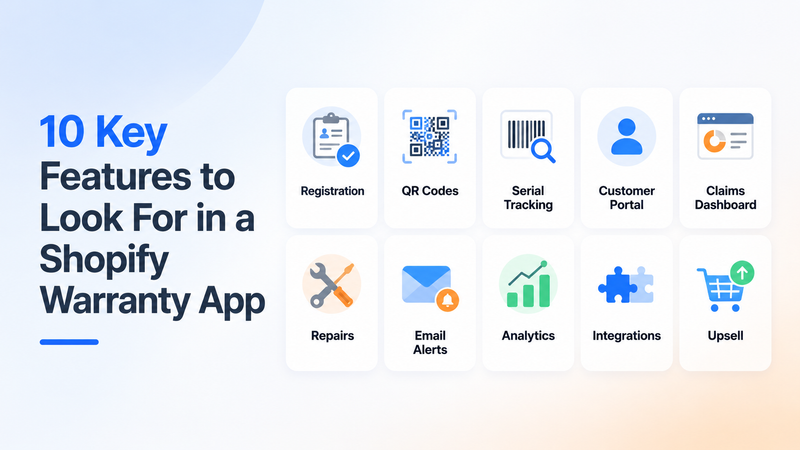
Warranty management has several moving parts, so the right Shopify app should cover more than claim submission. It should help the team collect product ownership data, verify warranty eligibility, manage customer requests, track product issues, and turn post-purchase interactions into useful business insight.
### **1\. Product and warranty registration**
Product registration is the base of warranty management. Customers should be able to register purchased products through the website, customer portal, QR code, product packaging, or warranty card. This is especially useful when a brand sells through Shopify, retail stores, offline events, marketplaces, distributors, or partner channels.
Registration should collect details such as customer name, email, phone number, product, purchase date, serial number, purchase source, and warranty period. Once stored properly, the team can verify ownership faster and reduce repeated back-and-forth during support conversations.
### **2\. QR code registration**
QR-based registration is useful for brands with physical products. Customers can scan a code from packaging, manuals, inserts, retail shelves, or product labels and register the item in a few steps.
For omnichannel brands, QR codes fill an important data gap. Retail and offline buyers often remain invisible inside Shopify. QR registration gives those customers a path to connect with the brand directly after purchase.
### **3\. Serial number validation**
Serial number tracking is essential for products with warranty risk, replacement value, authenticity concerns, or unit-level service needs. Consumer electronics, accessories, baby products, fitness gear, appliances, tools, furniture, beauty devices, and smart home products often need this feature.
The app should let the team validate serial numbers, prevent duplicate registrations, connect each claim to a real product unit, and trace issues by SKU, batch, or purchase channel.
### **4\. Customer warranty portal**
Customers should have a place to view registered products, warranty coverage, digital warranty cards, claim history, and service status. A customer portal reduces repetitive emails and gives buyers more clarity during the claim process.
For support teams, the portal also creates cleaner communication. Instead of scattered messages across email and social channels, customers can follow a structured claim path with the right product details already attached.
### **5\. Claims management dashboard**
Claim handling needs structure. The app should give the team a dashboard to review claims, check product details, assign requests, update status, request extra information, approve claims, reject invalid requests, and track resolution time.
The dashboard should also show where claims are coming from. Shopify orders, retail purchases, marketplace buyers, offline customers, and partner-channel customers can create different support patterns. Seeing these sources clearly can improve staffing, product decisions, and channel planning.
### **6\. Repair, replacement, refund, and store credit workflows**
Warranty claims often require action after approval. The app should support repair workflows, replacement orders, refunds, gift cards, store credit, or service estimates depending on the brand’s policy.
For Shopify merchants, replacement order creation is especially useful. When a claim gets approved, the team should be able to create or trigger the required next step inside Shopify with minimal manual entry.
### **7\. Email alerts and customer updates**
Customers expect updates after submitting a warranty registration or claim. The app should send registration confirmations, digital warranty cards, claim status updates, approval messages, rejection messages, repair updates, and warranty expiration reminders.
These updates reduce uncertainty and cut down support tickets. They also create natural touchpoints for education, care instructions, product tips, accessories, or extended protection offers.
### **8\. Analytics and reporting**
Warranty data should answer practical business questions.
Which products receive the most claims? Which serial numbers or batches show higher issue rates? Which sales channels create more warranty requests? How long does the team take to resolve claims? Which claim reasons appear repeatedly? Where are revenue opportunities being missed?
A useful warranty app should show these insights in a live dashboard. Export options can also help operations, product, CX, and leadership teams review patterns over time.
### **9\. Integrations with support, CRM, and email tools**
Warranty activity should connect with the tools already used by the team. Look for integrations with help desks, CRM systems, and email platforms such as Gorgias, Zendesk, HubSpot, Klaviyo, Mailchimp, or Zoho Desk.
When integrations are available, warranty events can trigger better customer communication. Registration can start an email flow. Claim status can appear inside a support ticket. Customer ownership data can enrich CRM records.
### **10\. Upsell and extended protection options**
Warranty registration is a useful moment for revenue expansion. Customers have already bought the product and returned to engage with the brand. During registration, the brand can offer extended protection, accessories, care kits, replacement parts, refills, or related products.
The best app for this use case should let the team place relevant offers inside or after the registration journey. Done carefully, this can support retention and increase customer lifetime value while still serving the customer’s original warranty needs.
## **Benefits of Using a Dedicated Warranty App vs a Manual In-House Process**
Warranty management usually starts with a basic system.
Someone creates a form.
Responses go into a spreadsheet.
Support checks Shopify orders manually.
Claims get handled through email.
Product photos arrive in separate threads.
Serial numbers need manual verification.
Replacement orders get created one by one.
For a small volume, this can survive. Once the brand grows across Shopify, retail, marketplaces, offline sales, and partner channels, the process becomes scattered.
A dedicated warranty app gives the team one place for registrations, claims, customer details, product data, warranty status, serial numbers, and next actions.
### **Manual Process vs Dedicated Warranty App**
**Area**
**Manual Process**
**Dedicated Warranty App**
Product registration
Collected through forms or emails
Stored in a structured warranty system
Claim intake
Customers send details through email or support chat
Customers submit claims through a branded portal
Serial number checks
Team checks manually
App validates serial numbers
Customer updates
Support sends updates one by one
Automated emails and claim status updates
Replacement handling
Team creates replacement orders manually
App can support repair, replacement, refund, or credit workflows
Reporting
Data sits across sheets and inboxes
Dashboard shows products, claims, sources, and resolution trends
Revenue opportunities
Often missed
Registration can trigger upsells, accessories, or extended protection offers
Warranty management is more than after-sales support. It is a way to collect ownership data, verify claims, reduce manual admin, improve customer communication, and find retention opportunities.
Manual workflows usually react after a problem arrives. Dedicated warranty apps create a structured system before claims pile up.
For Shopify brands selling physical products, especially across online and offline channels, a warranty app turns scattered post-purchase work into a cleaner operating system for support, product data, and customer retention.
## What Warranty Management Actually Costs (And Saves) on Shopify
The cheapest Shopify warranty app costs $9.95/month. The most complete options run $49/month. Here's how the math works for a brand processing 200 warranty claims per month.
Cost Factor
Manual Process
With Warranty App
Support time per claim (avg 45 min at $25/hr)
$3,750/month
$625/month (automated intake cuts handling to ~10 min)
Fraudulent claims approved (2-4% of volume)
$480/month
Under $100/month (serial validation blocks duplicates)
Lost customers from slow resolution
$3,600/month (15-20% churn on poor experiences)
Under $500/month (self-service portal + real-time updates)
Extended warranty upsell revenue
$0
$1,200-$3,000/month (5-15% conversion at registration)
**Net monthly impact**
**-$7,830 in costs**
**+$75 to +$1,875 net positive**
At 200 claims/month, a $49/month warranty app pays for itself within the first week. At 50 claims/month, the breakpoint is closer to 30 days. Below 50 claims/month, a $9.95-$15/month lightweight app like Propel or My Product Registration covers the basics without overspending.
The hidden cost most brands miss: unregistered customers. Every product sold through Amazon, retail, or a marketplace that goes unregistered is a customer the brand will never reach again. No email. No upsell. No feedback loop. Warranty registration through QR codes on packaging captures these buyers at the one moment they are actively engaging with the product.
## **5 Best Shopify Warranty Management Apps for Modern Brands**
Warranty management apps can look similar at first glance, but the real difference appears once the team starts handling registrations, claims, serial numbers, retail buyers, replacement orders, and customer follow-ups at scale.
Some apps are built for full warranty operations. Some focus mainly on product registration. Some are better for claim review. Some support warranty workflows through serial number automation.
Here is the practical comparison.
### **1\. Dyrect:** Warranty **Registration and Claims Management**
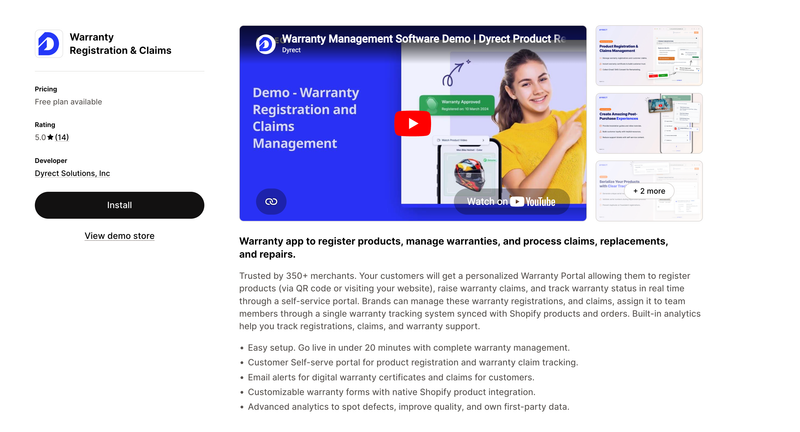
**Best for:** Shopify and omnichannel brands that want warranty registration, claims, customer portal, analytics, integrations, and revenue opportunities in one system.
Dyrect is the most complete option in this list for brands that treat warranty management as a serious post-purchase operation. It covers product registration, warranty registration, claim handling, customer self-service, serial number tracking, repair and replacement workflows, team assignments, analytics, and post-registration engagement.
The biggest advantage with Dyrect is how well it supports brands selling across multiple channels. Shopify checkout data alone cannot capture every customer. A customer may buy from a retail store, offline event, marketplace, dealer, distributor, or partner channel. Dyrect gives those buyers a path to register the product through QR codes or brand-owned registration journeys, so the brand can collect ownership data beyond Shopify orders.
That is especially valuable for categories such as consumer electronics, mobile accessories, appliances, beauty devices, baby products, fitness gear, smart home devices, tools, furniture, lifestyle products, and D2C consumer goods.
### **Major features:**
- Product and warranty registration through QR code or website
- [Claims management with claim tracking](https://www.dyrect.co/product/warranty-management-software)
- Self-serve customer warranty portal
- [Digital warranty cards](https://www.dyrect.co/new-features/digital-warranty-card)
- Shopify product and order sync
- Serial number support
- Team assignment for registrations and claims
- Email alerts for registrations and claims
- Defect and warranty support analytics
- Fraud claim prevention on higher plans
- Repair and replacement workflows
- Automatic Shopify order creation for replacements
- Billing, invoices, and estimates on advanced plan
- Custom upsell or cross-sell during registration
- Customer communication inside warranty workflows
Dyrect also supports revenue opportunities during the warranty journey. Product registration is a high-intent moment. The customer has already purchased, owns the product, and is taking action with the brand. Dyrect can use that moment to offer extended protection plans, accessories, service add-ons, care kits, related products, or upgrade paths.
For support teams, Dyrect gives visibility into what is happening inside warranty operations. Teams can understand where claims are coming from, which products fail more often, how fast requests get resolved, and which customer or product patterns need attention.
For leadership teams, this dashboard view is useful because warranty data becomes more than support history. It becomes product insight, customer insight, channel insight, and retention insight.
### **Integrations:**
Dyrect integrates with Gorgias, HubSpot, Klaviyo, Mailchimp, Zendesk, and [Zoho Desk](https://www.dyrect.co/blog/warranty-management-in-zoho-vs-dyrect).
These integrations are important for growing Shopify teams because warranty activity can connect with email marketing, CRM, and support workflows. A registration can trigger a Klaviyo journey. A claim can appear in a help desk. Customer ownership data can enrich the brand’s CRM.
### **Pricing:**
[Dyrect](https://www.linkedin.com/products/dyrect-co-warranty-management-software/) has a free plan available.
Warranty registrations and claims management plans start from **$49/month**. Paid tiers also include a $19/month registration-focused plan and a $149/month advanced claims plan with repair, replacement, billing, invoice, and service visibility features.
### **Reviews:**
Dyrect has a **5.0** [**Shopify App Store**](https://apps.shopify.com/dyrect-warranty-registrations) **rating from 14 reviews**. This platform is also [**rated 4.8 on G2**](https://www.g2.com/products/dyrect/reviews) **.**
### **Why Dyrect ranks first:**
Dyrect gives the broadest warranty management coverage for modern Shopify brands. It handles registration, claims, serials, customer portal, data capture, analytics, upsell, CX integrations, repairs, and replacements. For brands selling online, offline, through retail, and through partner channels, Dyrect is the most seamless choice in this comparison.
### **2\. My** Product **Registration**
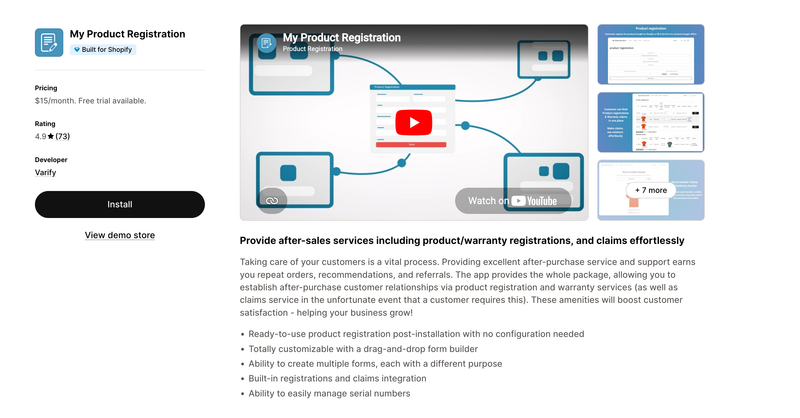
**Best for:** Shopify merchants that want a mature product registration and warranty claims app at a predictable monthly price.
My Product Registration is one of the more established apps in the warranty and product registration category. It launched in 2017 and has built a steady presence among Shopify merchants that need registration pages, warranty records, claim management, and serial number handling.
Its appeal is clarity. Merchants get unlimited registrations, unlimited registration pages, unlimited statuses, product registration, claims, serial numbers, customer account access, and support under one flat plan.
### **Major features:**
- Product registration
- Warranty registration
- Claim management
- Drag-and-drop registration builder
- Multiple registration pages
- Serial number management
- Customer access to registrations and claims
- Serial number lookup
- Authenticity checker
- Shopify POS support
- Shopify Flow support
- Email notifications
- Unlimited registrations
- Unlimited statuses
My Product Registration is practical for brands that want to launch product registration and claims with less pricing complexity. The app can support multiple product lines, different warranty journeys, and serial-based products.
The customer-facing side is useful as well. Buyers can register products and view registered items or claims through customer access. That can reduce repeated back-and-forth between customers and support.
For brands using Shopify POS, the app can also support retail-connected product registration needs. This is useful for stores selling through physical locations while still managing post-purchase records inside Shopify.
### **Integrations:**
My Product Registration connects with customer accounts, Shopify POS, Shopify Flow, Shopify Admin, Klaviyo, Mailchimp, and SMTP.
Klaviyo and Mailchimp support can help merchants place product registration activity into email journeys. Shopify Flow support can assist with internal automation and operational routing.
### **Pricing:**
My Product Registration costs **$15/month**.
The plan includes every feature, unlimited registrations, unlimited registration pages, unlimited statuses, and support.
### **Reviews:**
My Product Registration has a **4.9 Shopify App Store rating from 73 reviews**.
### **Best use case:**
My Product Registration is a dependable option for Shopify merchants that mainly need registration, claims, serial numbers, and customer access at a flat price. It is especially suitable for brands that want a practical registration system with proven review volume.
### **Where Dyrect goes further:**
Dyrect gives broader warranty infrastructure for omnichannel customer capture, self-serve warranty portal depth, claims analytics, customer communication, fraud prevention, repair and replacement workflows, automatic Shopify order creation, and upsell during registration.
### **3\.** Propel
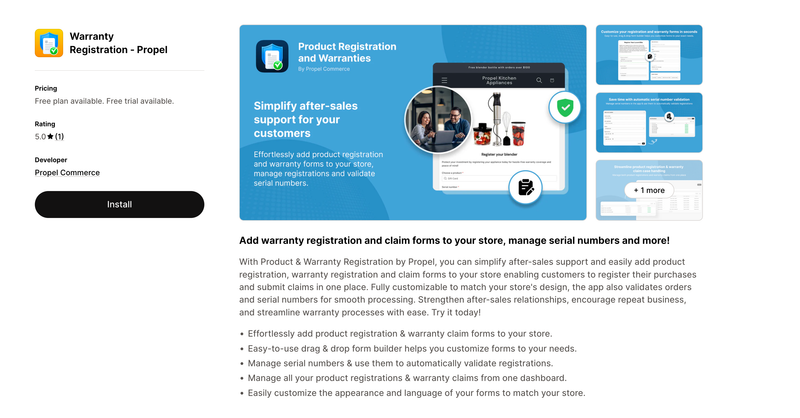
**Best for:** Smaller Shopify stores that need affordable warranty registration and claim intake.
Propel is a lightweight warranty registration app designed to help merchants collect product registrations and warranty claims through branded pages. It is suitable for teams that need a cleaner process than email and spreadsheets, while keeping the workflow fairly lean.
Propel focuses on product registration, warranty registration, claim submission, custom registration pages, and serial number validation. Its drag-and-drop builder allows merchants to create registration and claim journeys using custom fields and branded design elements.
### **Major features:**
- Product registration pages
- Warranty registration pages
- Warranty claim pages
- Drag-and-drop builder
- Serial number management
- Automatic serial number validation
- Custom fields
- Custom appearance
- Custom language
- Registration and claim dashboard
- Mobile-friendly customer experience
- Priority support
Propel can suit merchants that sell products requiring basic warranty tracking, such as gadgets, accessories, small appliances, tools, hobby products, home products, and entry-level electronics.
Its serial number validation feature is useful for preventing incorrect registrations and matching product records with customer claims. The dashboard gives the team one place to see registrations and claims.
### **Pricing:**
Propel has a free plan.
The Pro plan costs **$9.95/month** and includes unlimited registrations, unlimited registration pages, serial validation, warranty claims, and priority support.
### **Reviews:**
Propel has a **5.0 Shopify App Store rating from 1 review**.
### **Best use case:**
Propel is best suited for stores that want an affordable way to collect registrations and claims, validate serial numbers, and move away from scattered email-based warranty requests.
### **Where Dyrect goes further:**
Dyrect is better suited when the brand needs omnichannel ownership capture, customer portal, analytics, repair and replacement workflows, upsell paths, fraud prevention, CX integrations, and more complete claims management.
### **4\.** Resolvi
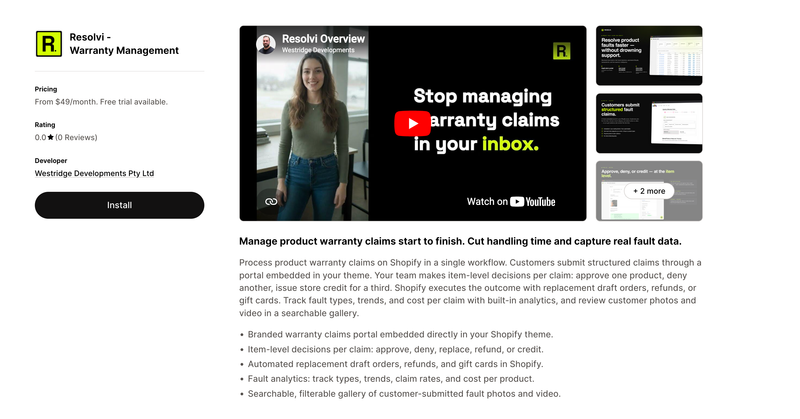
**Best for:** Shopify teams that want claim review, product fault visibility, and structured claim outcomes.
Resolvi is a newer app built specifically for warranty claim workflows. It focuses on structured claim submission, claim review, item-level decisions, product fault tracking, and outcome execution inside Shopify.
Customers can submit warranty claims through a branded portal embedded in the Shopify theme. The team can review claims with product details, customer-submitted information, and uploaded proof. From there, the claim can move toward approval, denial, replacement, refund, or store credit.
### **Major features:**
- Branded claims portal
- Structured claim submission
- Item-level claim decisions
- Approve, deny, replace, refund, or credit outcomes
- Replacement draft order creation
- Refund workflows
- Gift card or store credit support
- Fault type tracking
- Claim trend analytics
- Claim rate reporting
- Cost-per-product reporting
- Customer photo and video evidence gallery on higher tiers
- CSV export on Pro plan
- Third-party or stockist claims on Pro plan
Resolvi’s best angle is claim intelligence. For teams that receive a steady volume of warranty requests, fault categories and media evidence can give product teams clearer visibility. Product managers can review recurring failure types. Support leaders can see claim cost patterns. Operations teams can understand which products create more warranty work.
This can be useful for apparel, consumer goods, accessories, gear, home products, and product categories where visual evidence and fault classification matter.
### **Integrations:**
Resolvi integrates with customer accounts and Richpanel.
Gorgias, ReAmaze, and Zendesk were listed as coming soon in the app details we reviewed.
### **Pricing:**
Resolvi pricing starts at **$49/month** for the Core plan.
Other tiers include $79/month, $169/month, and $299/month based on case volume and advanced features.
### **Reviews:**
Resolvi is newly launched and currently has review history still pending on Shopify.
### **Best use case:**
Resolvi is a fit for teams that want warranty claims structured by fault, outcome, cost, and visual proof. It can be useful when claim analysis and item-level resolution are more important than broad post-purchase engagement.
### **Where Dyrect goes further:**
Dyrect has a wider warranty management footprint, covering product registration, omnichannel customer capture, QR registration, customer portal, claims, repair and replacement workflows, analytics, upsell, fraud prevention, and support or marketing integrations.
### **5\.** SeriaLogic
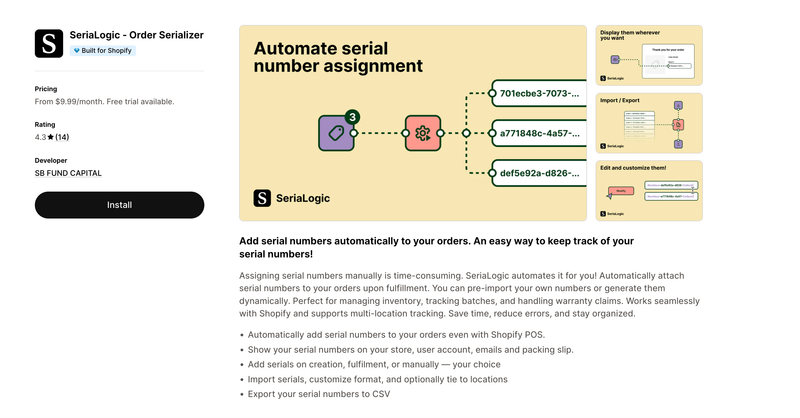
**Best for:** Shopify stores that need serial number automation for warranty traceability.
SeriaLogic is different from the other apps in this list. It is mainly an order serialization and serial number management app, but it supports warranty operations by giving each product unit a trackable identity.
For brands selling serialized products, warranty management depends heavily on product-level traceability. If a customer submits a claim, the team needs to know which exact unit was sold, when it was fulfilled, which order it belonged to, and which serial number was assigned.
SeriaLogic helps with this by automatically attaching serial numbers to Shopify orders.
### **Major features:**
- Automatic serial number assignment
- Serial assignment during order creation, fulfillment, or manual action
- CSV serial number import
- Manual serial number entry
- Dynamic serial number generation
- Shopify POS support
- Shopify Flow support
- Multi-location serial tracking
- Custom serial prefix and suffix
- Serial display on store, emails, customer accounts, and packing slips
- Serial export to CSV
SeriaLogic is useful for electronics, accessories, tools, equipment, high-value products, parts, collectibles, and products where unit-level traceability is essential.
Its Shopify POS support also helps stores that sell serialized products in physical locations. Multi-location tracking can support merchants with more than one warehouse, store, or fulfillment point.
### **Pricing:**
SeriaLogic starts at **$9.99/month**.
Higher plans cost $24.99/month and $49.99/month, with order volume and support differences across tiers.
### **Reviews:**
SeriaLogic has a **4.3 Shopify App Store rating from 14 reviews**.
### **Best use case:**
SeriaLogic is best for brands that need serial number automation and inventory traceability as part of warranty operations.
### **Where Dyrect goes further:**
SeriaLogic supports warranty through serial tracking. Dyrect handles the larger warranty process: product registration, customer portal, claims, customer communication, analytics, repairs, replacements, integrations, and upsell opportunities.
## **How to Choose the Right Warranty App for Shopify**
Choosing the right Shopify warranty app starts with one question: **what should your warranty process actually solve?**
For modern physical-product brands, warranty management should reduce admin, verify claims faster, capture ownership data, improve customer communication, and show where [warranty costs](https://www.dyrect.co/warranty-cost-calculator) are increasing.
Here’s the quick checklist:
**What to check**
**Why it matters**
**Product registration**
Captures customer and ownership data after purchase
**QR registration**
Useful for retail, offline, marketplace, and partner-channel buyers
**Serial number tracking**
Helps verify products and reduce invalid claims
**Customer warranty portal**
Lets customers view coverage, submit claims, and track status
**Claims dashboard**
Gives the team one place to manage every request
**Analytics**
Shows product failures, claim sources, and resolution time
**Repair and replacement workflows**
Reduces manual effort during approvals and service handling
**Upsell options**
Allows extended protection, accessories, or care-plan offers during registration
**Integrations**
Connects warranty data with support, CRM, and email tools
The right app should also help reduce warranty cost. That happens when the team can spot repeated product issues, reduce duplicate or invalid claims, verify serial numbers, route requests faster, and avoid manual errors during replacements or refunds.
Overall, Dyrect is the best fit when warranty management needs to cover the full journey: registration, claims, customer portal, serial tracking, analytics, integrations, repairs, replacements, and upsell opportunities. It is especially useful for Shopify brands selling across online, offline, retail, marketplace, and distributor channels because it captures customer ownership data beyond Shopify checkout.
## Bonus: How to Track Product Defects in Shopify
Shopify can show order and customer data, but product defect tracking usually needs structured warranty claim data. A warranty app like Dyrect can help teams connect each defect report to a product, SKU, serial number, purchase channel, claim reason, evidence, and resolution cost.
Brands can track product defects using fields such as:
- Product name
- SKU
- Variant
- Serial number
- Batch or production run
- Purchase date
- Purchase channel
- Claim reason
- Fault category
- Customer photos or videos
- Claim outcome
- Replacement cost
- Repair cost
- Resolution time
- Repeat claim count
This data can help support, product, operations, and leadership teams spot patterns. If one SKU receives repeated claims, the product team can review quality. If one channel creates higher warranty volume, the operations team can inspect fulfillment or partner sales activity. If replacement costs rise, leadership can review policy, suppliers, packaging, or product design.
For Shopify brands, product defect tracking becomes stronger when product registration, warranty claims, serial numbers, and claim outcomes live in the same system.
## **The Bottom Line**
Warranty management should give the team answers, not extra admin.
When a customer contacts support, the team should know: product registered or not, coverage active or expired, serial valid or suspicious, claim history available or missing, replacement eligible or outside policy. When those answers live in separate places, every claim takes longer than it should.
For Shopify brands, the bigger opportunity is using warranty data earlier. If one SKU keeps creating claims, that is a product signal. If retail customers register through QR codes, that is a new customer database. If support spends hours checking the same warranty details, that is a process gap. If replacements are being approved manually with little visibility, that is a cost-control issue.
So the best warranty app is the one that reduces guesswork. Choose based on your current friction. If claims are scattered, ownership data is weak, serial checks are manual, or warranty cost is hard to track, a dedicated app becomes a practical operational layer.
## FAQs
Q: Do Shopify warranty apps support stores in the USA, Australia, and New Zealand?
A: Shopify warranty apps like Dyrect can support stores in the USA, Australia, New Zealand, and other Shopify-supported regions. Merchants should check whether the app supports custom warranty periods, regional policy text, email notifications, customer registration forms, and Shopify order sync.
Q: What is the difference between product registration and warranty registration?
A: Product registration collects ownership data after a customer buys a product. Warranty registration connects that ownership record to warranty coverage, warranty period, service eligibility, and future claim handling.
Q: What is the best Shopify warranty app for electronics brands?
A: Dyrect is the best Shopify warranty app for electronics brands that need registration, claims, serial number validation, QR registration, customer portal, analytics, and replacement workflows. SeriaLogic is also useful for electronics brands that mainly need serial number automation.
Q: How does the Shopify warranty claims process work?
A: A Shopify warranty claims process usually starts with product registration or claim submission. The team then verifies product ownership, purchase date, warranty status, serial number, claim reason, and proof. After review, the claim can lead to repair, replacement, refund, store credit, service estimate, or rejection.
Q: What does a Shopify warranty management app actually do?
A: A Shopify warranty management app manages product registration, warranty validation, claim submission, claim tracking, customer communication, and reporting from one place. Depending on the app, it can also handle serial number checks, digital warranty cards, repair workflows, replacement orders, refunds, store credit, and integrations with tools like Klaviyo, Gorgias, Zendesk, HubSpot, or Mailchimp.
Q: Is product registration the same as warranty registration?
A: Product registration and warranty registration are closely connected. Product registration records who owns the product, when it was purchased, where it was purchased, and which item or serial number belongs to the customer. Warranty registration adds coverage details, such as warranty start date, warranty length, eligibility, and claim rules. For Shopify brands, both usually belong in the same workflow.
Q: Do Shopify warranty apps help with products sold outside Shopify?
A: Yes, some warranty apps can capture customers who bought through retail stores, marketplaces, offline events, distributors, or partner channels. QR code registration is especially useful here. A customer can scan a code from packaging, a manual, or a warranty card, then register the product directly with the brand even when the purchase happened outside the Shopify store.
Q: Can a warranty app reduce warranty costs?
A: Yes, when it has the right features. Serial number validation can reduce duplicate or invalid claims. Claim dashboards can reduce manual review time. Product analytics can show which SKUs create repeated issues. Repair and replacement workflows can reduce errors during claim resolution. Over time, better claim visibility can help teams control replacement costs, support workload, and product defect patterns.
Q: Why is serial number tracking important for warranty management?
A: Serial number tracking connects a warranty claim to a specific product unit. This is important for electronics, accessories, appliances, tools, fitness products, beauty devices, and other products with warranty risk. It helps verify whether the product is genuine, whether it has already been registered, whether coverage is still active, and whether the same unit has already had a claim.
Q: Can warranty registration help with customer retention?
A: Yes. Warranty registration gives the brand a clear post-purchase touchpoint with the customer. After registration, the brand can send product care tips, usage guides, claim updates, warranty reminders, accessory suggestions, extended protection offers, or replenishment prompts. This turns warranty registration into a useful customer engagement channel rather than a one-time admin step.
Q: What should customers be able to do inside a warranty portal?
A: Customers should be able to register products, view warranty coverage, access digital warranty cards, submit claims, upload photos or proof, check claim status, and see service updates. A clear portal reduces repeated support questions and gives customers a more organized way to manage warranty requests.
Q: Which Shopify warranty app is best for omnichannel brands?
A: Dyrect is the best fit for omnichannel Shopify brands in this comparison. It supports QR-based registration, product registration, claims, customer portal, serial tracking, analytics, integrations, repairs, replacements, and upsell opportunities. This is useful for brands selling through Shopify, retail stores, offline events, marketplaces, distributors, or partner channels.
Q: Can warranty apps connect with support and marketing tools?
A: Yes, several apps offer integrations with help desk, CRM, and email platforms. These integrations matter because warranty data should be available where customer conversations already happen. For example, a claim can appear in a support tool, while a product registration can trigger an email flow or update a customer profile.
Q: When should a Shopify brand move away from manual warranty tracking?
A: The breakpoint is around 50-100 warranty claims per month, or when the brand sells through more than one channel beyond Shopify. At that volume, support teams spend 45+ minutes per claim on manual verification and customer communication.
Missed warranty expirations become lost upsell revenue. Duplicate or fraudulent claims slip through without serial number validation. At 200+ claims per month, the support labor cost alone exceeds $3,750/month. A warranty app at $15-$49/month reduces that to under $625/month through automated intake, self-service portals, and instant eligibility checks.
---
This blog is powered by Superblog. Visit https://superblog.ai to know more.
---
## Dyrect Review: The Most-Powerful Warranty Management Platform in 2026?
Author: Abhishek Agrawal
Author URL: https://www.neurowarranty.com/blog/author/abhishek-agrawal
Published: 2026-08-10
Meta Title: Dyrect Review: The Best Warranty Management System in 2026?
Tags: Warranty Management, Warranty Management System
Tag URLs: Warranty Management (https://www.neurowarranty.com/blog/tag/warranty-management), Warranty Management System (https://www.neurowarranty.com/blog/tag/warranty-management-system)
URL: https://www.neurowarranty.com/blog/dyrect-warranty-management-system-review

Warranty operations rarely get much attention until the cracks start showing. [Product registrations](https://www.neurowarranty.com/blog/how-to-enhance-your-customer-experience-with-product-registration-software-clfwdfcjv168401jo257pn12w9) sit in one tool, claim requests land in inboxes, service updates live in spreadsheets, and customer records stay scattered across different systems. That setup creates extra admin work, slower handoffs, and limited visibility into what is actually happening after purchase. For teams handling registration, claims, repairs, replacements, and support queries together, the gap between sale and service can get messy surprisingly quickly.
To understand how Dyrect's [Waranty Management Software](https://www.dyrect.co/guide/warranty-management-software) handles that part of the business, our team spent time reviewing the platform closely from an operator’s point of view. We went through the registration journey, checked how claim handling is structured, reviewed the service workflow logic, and looked at how extended warranty offers and reporting fit into the wider system.
Dyrect has gained attention for bringing several important warranty functions into one connected setup. That alone makes it worth a closer look. In this review, we break down what Dyrect does well, how its warranty management software fits modern ecommerce needs, and whether it lives up to the promise of being a serious platform for teams that want cleaner warranty operations and stronger post-purchase control.
## **What is Dyrect?**
[Dyrect](https://www.dyrect.co/product/warranty-registration-software) is a warranty management software platform for brands that want one system for warranty registration, claims handling, service workflows, extended coverage, and reporting. In practical terms, it brings key post-purchase warranty tasks into a single setup, so teams do not need to rely on disconnected forms, inboxes, spreadsheets, and support tools for every step.
The platform is geared toward ecommerce and omnichannel operations. It supports product and warranty registration through digital flows, helps log and validate claims, tracks repair or replacement activity, and gives customers access to a self-serve portal for warranty details and claim status. It also includes serial number validation, which can help reduce duplicate or invalid claims before they move further into the process.
Another notable part of Dyrect is its commercial angle. Beyond service administration, it also supports extended warranty offers and post-purchase upsell opportunities. That gives merchants a way to present protection plans at multiple points in the buying journey and manage those plans within the same platform. For Shopify merchants, this is particularly relevant because Dyrect also offers native ecommerce integration and a Shopify app.
On the reporting side, Dyrect includes dashboards for registration rates, claim volume, resolution speed, defect trends, and revenue-related opportunities. That makes it more than a ticketing layer. It gives teams operational visibility tied to warranty performance.
Taken together, Dyrect sits in the category of dedicated warranty software, not a general helpdesk tool with limited warranty features added on. Its value depends on how much a brand needs structured warranty operations, customer registration data, service tracking, and post-purchase revenue tools in one place.
## **Warranty registration and first-party customer data collection in one warranty management system**
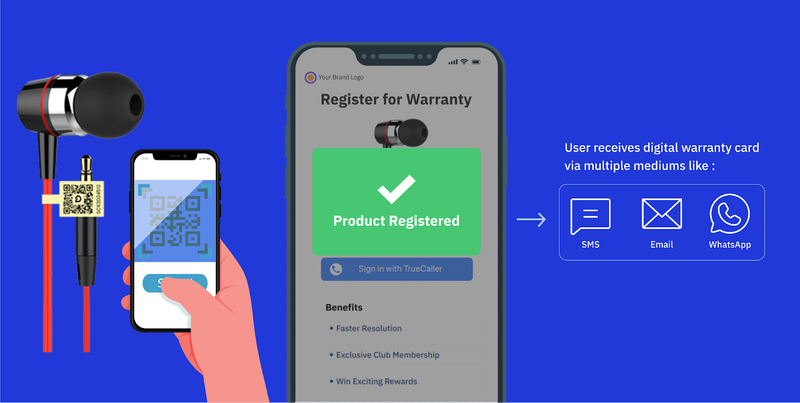
[Product registration](https://www.dyrect.co/product/product-registration-software) is one of the strongest parts of the platform. Dyrect supports omnichannel registration through QR code, website registration pages, and automatic registration for Shopify orders. That gives brands multiple ways to connect with buyers, even when the sale did not happen directly on the brand’s site. Someone who bought through a marketplace or retail outlet can still register through a branded flow and become a known customer.
This is one of Dyrect’s biggest advantages for modern brands. Every completed registration helps convert an otherwise anonymous buyer into a contact the brand can reach again. That has direct value for retention, remarketing, support, and service communication. For teams that want better ownership of customer relationships after sale, this is a major win.
Dyrect also supports digital warranty records and a self-serve customer portal. From the customer side, that removes friction. They do not need to search old emails or paper slips to check coverage. From the brand side, it cuts down repetitive support queries and gives a cleaner operational history tied to each unit.
Another strong point is how registration can feed revenue. Dyrect supports **post-registration upsells**, which means brands can place follow-up offers right after someone completes registration. That is smart placement. The customer has already confirmed ownership and is paying attention. It is a useful moment to present a relevant add-on, service offer, or protection plan.
In our review, this part of the platform felt commercially strong without feeling forced. Registration is doing two jobs at once. It captures warranty details and customer data, then opens a path for future retention or immediate incremental revenue. That is far more useful than a bare-bones warranty form.
For any brand trying to manage warranties across multiple channels, this registration infrastructure is a major reason Dyrect deserves attention.
## Warranty claims management and service workflows that help teams manage warranties better
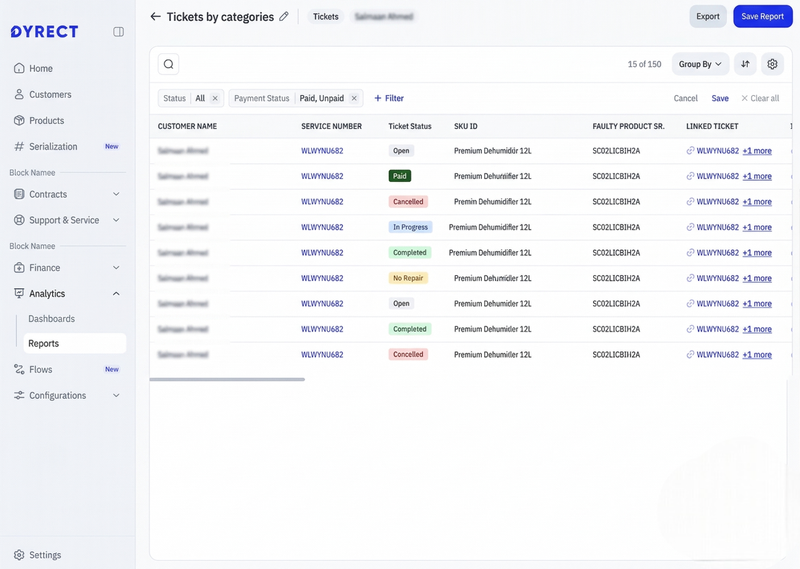
Well, warranty claims are often the part that exposes whether a platform is truly operationally useful or only good in a demo. Dyrect performs well here because it handles more than ticket intake. It organizes claim validation, assignment, service status, and resolution tracking in one structured flow.
The core benefit is visibility. Claims do not sit scattered across support inboxes or desk tools with missing context. Dyrect logs each claim in a unified system, then links it back to registration data, product information, and customer details. That cuts duplication and gives support teams clearer ownership.
A major plus is **automatic serial number validation**. This helps screen fraudulent, duplicate, or invalid claims before they move deeper into the workflow. That is valuable for any brand dealing with claim abuse, poor proof quality, or unclear ownership records. Fraud prevention is often overlooked in many warranty tools, yet it has a direct cost impact. Dyrect treats it like a built-in operational safeguard.
The workflow side is also strong. Dyrect supports automatic ticket assignment, priority handling, real-time status tracking, and service workflow visibility. Brands can track repair, replacement, shipment, dealer payment, and OEM chargeback activity inside one process.
From our evaluation, the claims flow appears designed for teams that need accountability. A claim can be logged, validated, assigned, updated, and resolved with clear status checkpoints. That structure helps internal teams move faster and helps customers stay informed.
This also has customer-facing value. Buyers want to know whether their claim is approved, whether a replacement is in transit, or whether a repair is still under review. Dyrect’s status visibility and self-serve access support a cleaner support journey. Fewer manual back-and-forths generally mean lower support load and better customer trust.
If you want a [warranty claims management system](https://www.dyrect.co/product/warranty-management-software) that extends beyond form submission into real service operations, Dyrect is strong here as well. It helps teams manage warranties with more discipline, better fraud control, and a clearer path from issue intake to final resolution.
## Extended Warranties and Upsell Integration Across the Customer Journey
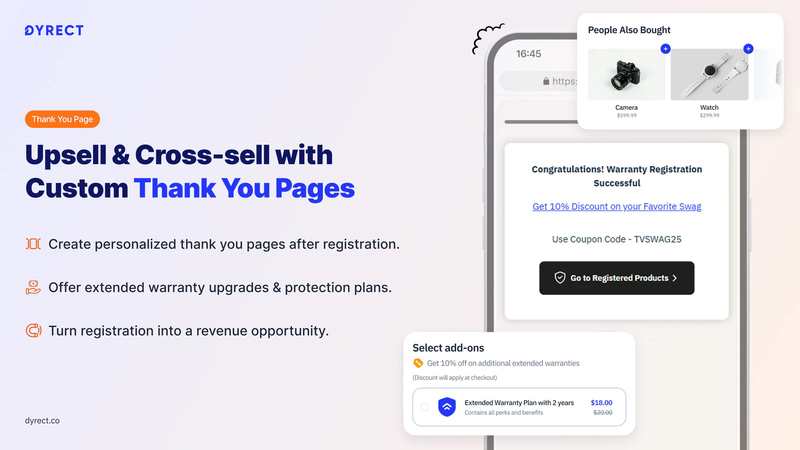
One thing we noticed while reviewing Dyrect is that the platform is not static. It continues to evolve based on how brands are actually using warranty systems in real scenarios. Over time, the focus has clearly expanded beyond only handling registration and claims to also supporting revenue opportunities tied to warranties.
A few months back, Dyrect introduced support for **extended warranties and integrated upsell flows**. This was one area we paid closer attention to during testing because it directly connects warranty operations with revenue generation. Many warranty tools stop at service management. Dyrect is trying to go one step further by allowing brands to offer additional protection plans within the same system.
The extended warranty setup allows brands to present protection plans at multiple points in the customer journey. This includes placement on the product page, during checkout, and after purchase. The idea here is not new in ecommerce, but having it tied directly into a warranty management system makes it more consistent from an operational point of view. The same platform that handles registration and claims also manages the coverage plans being sold.
From a setup perspective, Dyrect connects these offers with the existing product and order data, especially for Shopify users. Once a customer opts in, the plan is attached to their warranty record and becomes visible in the same system used for claims and tracking.
There is also a self-serve layer for customers. Buyers can view their extended coverage alongside their standard warranty inside a portal. This reduces confusion later when a claim is raised, since coverage details are already documented and accessible.
In terms of performance, this feature works as expected from an operational standpoint. The integration between warranty records and extended plans is consistent, and the flow does not feel disconnected from the rest of the system.
Overall, the addition of extended warranties shows how Dyrect is adapting its warranty software based on evolving brand needs.
## **Warranty tracking, insights, and** analytics **that show the complete picture**
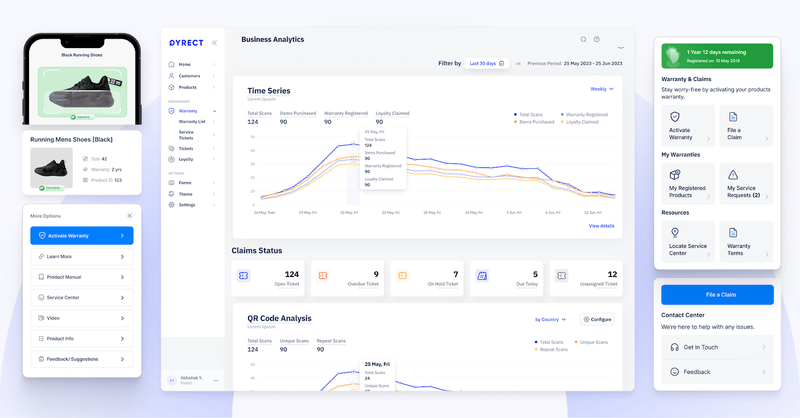
Warranty data often exists, but it is not always easy to read or use. Dyrect tries to solve this by bringing everything into one place and presenting it in a way that is easier to understand.
Inside the platform, you get a central dashboard that shows what is happening across registrations, claims, and service activity. This includes how many products are registered, how many claims are coming in, how long it takes to resolve them, and how different products are performing over time. Instead of checking multiple tools or exporting data, teams can view these details in one screen.
One useful part is **warranty tracking at the product level**. You can see which products are getting more claims and which ones are performing without issues. This helps identify patterns early. If a certain model is generating more complaints, it becomes visible quickly, which can help teams take action before it turns into a larger problem.
The platform also tracks how claims move through the system. You can see whether claims are being approved quickly, whether they are getting delayed at certain steps, and how long it takes to close them. This is helpful for internal teams that want to improve service speed and reduce backlogs.
Another practical feature is visibility into customer activity. Since Dyrect connects registration, claims, and warranty status, it becomes easier to understand the lifecycle of a product after purchase. Teams can see when warranties are nearing expiry and use that information for follow-up actions if needed.
The analytics are not overly complex, which works in their favor. The data is presented in a way that most teams can understand without needing advanced reporting skills. It gives enough detail to support decisions without becoming difficult to navigate.
In short, for brands that want one dashboard for **warranty registration, warranty tracking, warranty claims management, and more visibility**, Dyrect checks a lot of boxes.
## **Pricing, fit, pros, cons, and final verdict on this warranty software**
Pricing matters, especially for growing ecommerce brands that want a serious warranty management system without jumping straight into enterprise contracts.
Dyrect’s entry pricing starts at **$49 for warranty and claims management plans**, which gives it a practical starting point for smaller brands or teams that want a more organized warranty setup without a huge upfront commitment. From there, pricing can scale based on feature depth and operational needs. For many brands, that entry point makes Dyrect more accessible than heavyweight enterprise tools.
### **Best fit for**
- Shopify brands that need warranty registration, claims handling, and order-linked workflows in one place
- Omnichannel sellers that want product registration across retail, marketplace, and direct channels
- Teams that need first-party customer data after purchase
- Brands planning to offer extended warranties inside their own flow
- Operations teams that want clearer warranty tracking and reporting
### **Less ideal for**
- Very small sellers with low registration volume and only occasional claims
- Teams looking for a broad customer support tool first and a warranty layer second
### **Pros**
- Registration, claims, service activity, and analytics sit inside one platform
- Serial number validation adds useful control during claim review
- Shopify app and ecommerce integration make it more relevant for D2C teams
- Extended warranty support gives brands another post-purchase revenue option
- Customer self-serve access can reduce support dependence for routine warranty questions
### **Cons**
- Some smaller teams may not use the full feature set early on
- The value increases when registration volume and claim volume are already meaningful
- Brands with very basic warranty needs may find a lighter setup enough for their current stage
## Final verdict
Dyrect is a serious contender for any brand searching for [modern warranty management software](https://www.neurowarranty.com/blog/best-warranty-management-software) that goes beyond claim intake and actually supports customer data collection, service operations, plan monetization, and analytics.
It helps brands **manage warranties** in a more organized, scalable, and commercially useful way. The platform is especially compelling for Shopify brands and omnichannel operators that want stronger ownership of the post-purchase customer journey.
That said, the platform is more aligned with mid-sized and growing brands. Teams with very low volume or minimal warranty activity may not fully benefit from everything it offers right away. The value becomes clearer when there is enough data and workflow complexity to justify a dedicated system.
In terms of market feedback, Dyrect holds [**4.9-star ratings on Shopify**](https://apps.shopify.com/dyrect-warranty-registrations) and around [**4.8 on G2**](https://www.g2.com/products/dyrect/reviews), which reflects consistent user satisfaction across different types of businesses.
Taking everything into account, in our review, Dyrect earns a **4.9⭐ out of 5**. It performs well across core warranty functions, offers practical extensions into analytics and revenue, and continues to evolve based on how brands use warranty software in real scenarios.
---
This blog is powered by Superblog. Visit https://superblog.ai to know more.
---
## 7 Best Warranty Tracking Software, Ranked (2026)
Author: Abhishek Agrawal
Author URL: https://www.neurowarranty.com/blog/author/abhishek-agrawal
Published: 2026-08-10
Category: Warranty Management
Category URL: https://www.neurowarranty.com/blog/category/warranty-management
Tags: Warranty Tracking System, Warranty Tracking
Tag URLs: Warranty Tracking System (https://www.neurowarranty.com/blog/tag/warranty-tracking-system), Warranty Tracking (https://www.neurowarranty.com/blog/tag/warranty-tracking)
URL: https://www.neurowarranty.com/blog/best-warranty-tracking-software-ranked
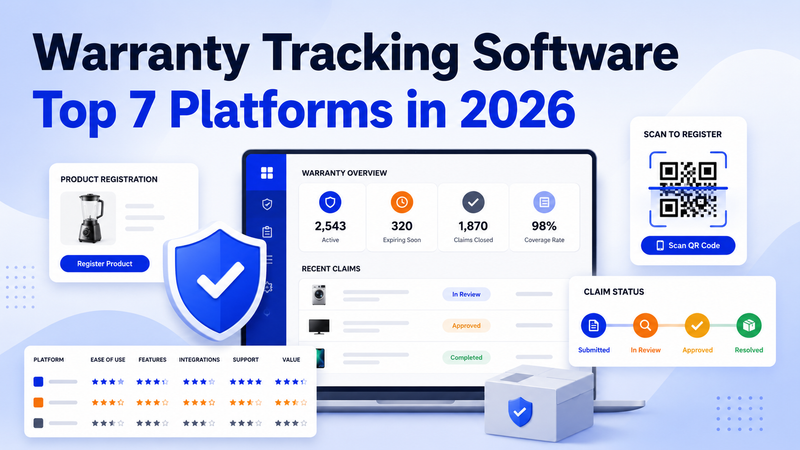
#### **TL;DR**
> - Warranty tracking software gives product brands visibility into registrations, claim patterns, warranty expiry timelines, and SKU-level defect rates across every sales channel.
>
> - For D2C and omnichannel brands, [Dyrect](https://www.dyrect.co/features) offers the most complete tracking layer with real-time dashboards, channel-level registration data, and automated expiry alerts.
>
> - For enterprise manufacturers, Pega and SAP provide deeper supply chain tracking. Full comparison below.
Most consumer product brands start tracking warranties the same way. Claims come into a shared inbox. Someone logs them in a spreadsheet. Support agents verify purchases by asking customers to email invoice photos. Serial numbers live in one file, registration data in another, and customer details in a third.
It works when the brand sells through one channel and handles 10 claims a week. It stops working the moment sales expand into retail stores, marketplaces, and distributor networks. Suddenly, half the customers filing warranty claims have zero purchase record in the system. The support team spends more time verifying eligibility than resolving issues. Product defects go undetected because warranty data sits in disconnected spreadsheets where patterns never surface.
**Warranty tracking software** exists to replace this scattered process with a structured system. Registrations, warranty status, claim progress, serial number validation, and product-level analytics move into one platform where the entire team has visibility.
But the category is broad. Some platforms are built for enterprise manufacturers managing dealer networks and supplier recovery across regions. Others are built for D2C and retail brands that need omnichannel registration, customer-facing portals, and post-purchase engagement. Picking the wrong category fit creates more friction than it solves.
This guide compares the **seven best warranty tracking software** platforms for D2C, ecommerce, and retail brands in 2026. Each tool is evaluated on registration capabilities, claim tracking, integrations, analytics, and how well it serves brands selling across multiple channels.
## **What Breaks When Brands Track Warranties Manually**
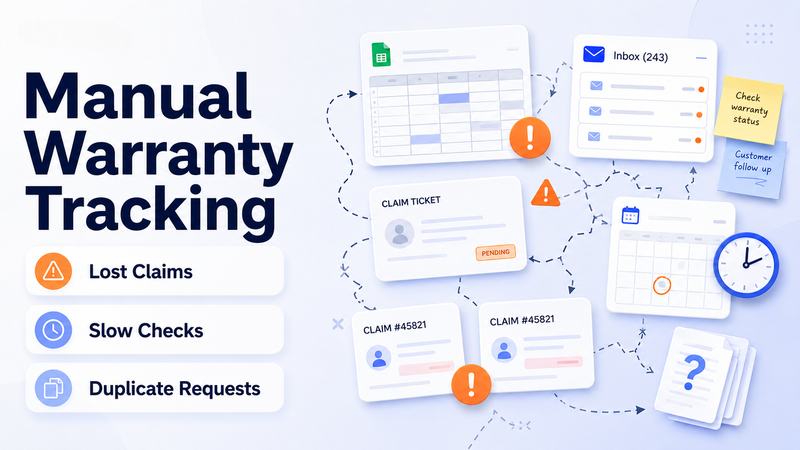
Manual warranty tracking works at low volume. Once the claim count crosses more than 100 per month, the cracks become expensive. Here are the specific failure points most teams encounter.
**Retail and marketplace customers stay invisible.** Over 50% of consumer brand sales happen through offline retail stores and marketplaces like Amazon. These channels share zero customer data with the brand. If a customer buys from a retail store, the brand has zero way to know who that buyer is, what product they own, or when the warranty started. Every claim from these buyers requires manual verification through email threads and invoice photos.
**Claims verification eats support hours.** Without structured registration, every warranty claim becomes a detective exercise. Agents dig through order records, ask customers for proof of purchase, cross-check serial numbers manually, and wait for replies. What should take 2 minutes takes 20.
**Defect patterns stay hidden.** When warranty data lives in spreadsheets, the team loses the ability to see which SKUs generate the most claims, which batches have recurring issues, and which regions show abnormal failure rates. Product teams and R&D departments miss signals that could improve future production.
**Duplicate and fraudulent claims slip through.** Without serial number validation and purchase verification, brands process duplicate claims and fraudulent requests. These costs add up fast for consumer electronics, appliances, and high-value product categories.
**Revenue opportunities disappear.** The moment a customer registers a product or files a warranty claim is a high-intent interaction. Brands running warranties through email threads miss the chance to offer extended protection plans, accessories, care kits, or replacement parts when the customer is most engaged.
Each of these failure points costs money, time, and customer trust. Warranty tracking software addresses all of them by creating a structured data layer where every product, every customer, and every claim has a verified record.
## What Should Brands Be Tracking?
Before evaluating tools, it helps to know what warranty data actually matters. These are the six metrics that give brands real visibility into their post-purchase operations.
**Registration rate by channel.** What percentage of customers register their product across Shopify, Amazon, retail, and marketplace purchases? Low registration from a specific channel signals a friction problem in that experience, or a missed QR placement opportunity on packaging.
**Claim rate by SKU.** Which products generate the highest volume of warranty claims relative to units sold? Tracking at the SKU level surfaces defective batches, design flaws, or supplier quality issues before they become expensive recalls.
**Average resolution time.** How many days pass between claim submission and final resolution? Tracking this over time shows whether process changes are working or whether specific claim types consistently bottleneck.
**Warranty expiry timeline.** How many active warranties are approaching expiry in the next 30, 60, and 90 days? This is the window for extended warranty upsells, re-engagement campaigns, and accessory recommendations.
**Fraud flag rate.** What percentage of incoming claims trigger fraud indicators like duplicate serial numbers, claims outside the warranty window, or multiple claims from the same address? A rising flag rate means either fraud is increasing or your detection rules need recalibration.
**Repeat claim patterns.** Are the same customers filing claims across multiple products? Are the same product lines generating repeat issues? Pattern visibility is what separates reactive claim processing from proactive product improvement.
The best warranty tracking software surfaces these metrics automatically. Spreadsheets require someone to build and maintain these views manually, and they break the moment data lives across multiple channels.
## **What Warranty Tracking Software Actually Does**
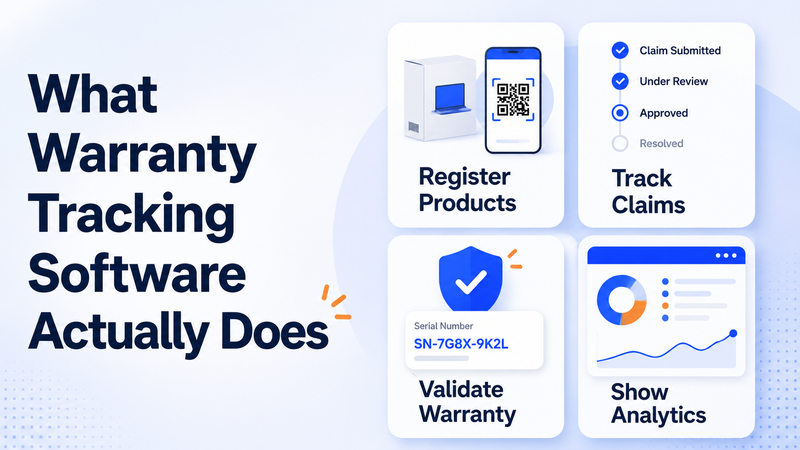
**Warranty tracking software** is a system that captures product registrations, monitors warranty status, tracks claim progress, validates ownership data, and reports on warranty patterns across your product catalog.
It functions as the data and visibility layer for everything that happens after the sale. Here is what it tracks:
**Registration data.** Customer name, email, phone number, product purchased, purchase date, purchase channel, serial number, and warranty period. Registration connects the product to a real person and creates a verified ownership record.
**Warranty status.** Active, expiring, and expired warranties visible in one dashboard. Automated reminders alert the team and the customer before coverage ends.
**Claim progress.** Structured intake from customers with issue descriptions, photos, documents, and defect codes. Each claim moves through defined stages: submitted, under review, approved, in repair, replacement shipped, or closed.
**Product-level data.** Which products generate the most claims, which failure types occur most frequently, which suppliers are linked to defective batches, and where resolution times slow down.
Here is an important distinction worth understanding early. **Warranty tracking** and **warranty management** are related but different. Warranty tracking is the data and visibility layer: registration capture, warranty status monitoring, claim progress visibility. Warranty management is the operational layer built on top: workflow automation, team assignments, supplier coordination, repair routing, and financial settlements.
Most modern platforms cover both. However, understanding which problem feels more urgent helps brands pick the right starting point. If the core issue is "we have zero visibility into who owns our products and what their warranty status looks like," tracking is the first priority. If the core issue is "our claims process takes too long and costs too much," management is the priority.
#### Warranty Tracking vs. Warranty Management: Where Each Starts and Stops
These terms overlap, but they solve different problems.
**Warranty tracking** is the visibility layer. It answers questions like: How many products are registered? Which warranties expire this month? Where are claims coming from? What SKUs have the highest failure rates? Tracking is about seeing what's happening across your warranty operations in real time.
**Warranty management** is the operational layer. It answers: How do we process this claim? Who approves it? What resolution does the customer receive? How do we recover costs from the supplier? Management is about automating the workflows that act on what tracking reveals.
Warranty Tracking
Warranty Management
Core function
Visibility into data
Automation of workflows
Primary user
Brand leads, marketing, CX teams
Warranty ops managers, service teams
Key output
Dashboards, reports, pattern alerts
Processed claims, resolutions, chargebacks
Pain it solves
"We have no idea what's happening"
"Processing takes too long and costs too much"
Example question
"Which channel has the lowest registration rate?"
"How do we auto-approve claims under $50?"
Brands with fewer than 100 claims per month often start with tracking. Visibility alone uncovers enough insight to justify the investment. As volume grows, management capabilities like claims automation, eligibility rules, and supplier recovery become essential.
For a full breakdown of claims automation, workflow features, and operational tools, see our [warranty management software comparison](https://www.neurowarranty.com/blog/best-warranty-management-software).
## **7 Features** That **Separate Good Warranty Tracking Software from Spreadsheets**
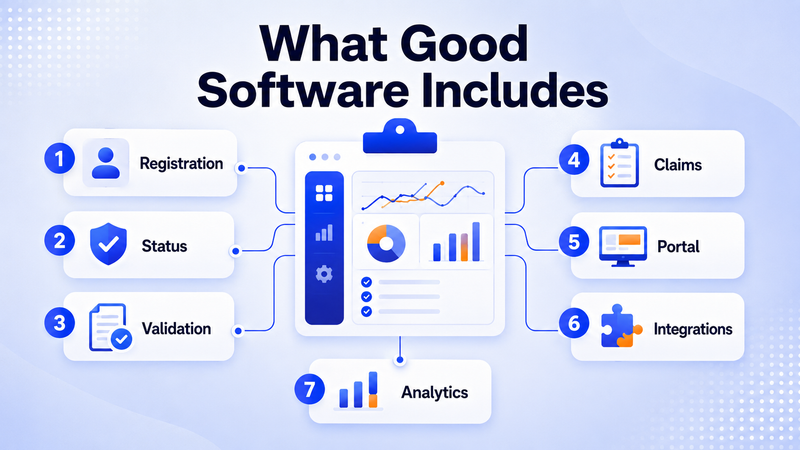
Before diving into the tool comparison, here are the features that define whether a platform genuinely solves the warranty tracking problem or simply digitizes a spreadsheet.
### **Omnichannel Product Registration (QR, Web, Shopify, Retail)**
Registration is the foundation. If customers can register through the brand's website, Shopify checkout, QR codes on product packaging, retail inserts, or dealer portals, the brand captures ownership data from every sales channel. Without omnichannel registration, offline and marketplace buyers remain invisible, and the warranty database stays incomplete.
QR code registration is especially valuable for brands selling physical products through retail. Customers scan a code from the packaging, fill in their details, and the brand instantly has a verified record of who owns the product, when it was purchased, and through which channel.
### **Real-Time Warranty Status Dashboards**
The team should see every product's warranty status at a glance. Active warranties, approaching expirations, and expired coverage should be visible without running manual reports. Automated expiry reminders help the team plan ahead and help customers renew or purchase extended coverage before their window closes.
### **Serial Number and Purchase Validation**
For products with high replacement value, serial number validation at registration prevents duplicate registrations and fraudulent claims. The system should check whether the serial number exists in the brand's product database, whether it has already been registered, and whether the purchase date falls within the warranty period. AI-powered validation catches inconsistencies faster than manual checks.
### **Structured Claim Intake with Photo and Document Upload**
When a customer files a warranty claim, they should follow a guided form that collects every detail the team needs: product information, issue description, photos of the defect, proof of purchase, and serial number. Structured intake eliminates the back-and-forth emails that slow down resolution and frustrate customers.
### **Customer-Facing Warranty Portal**
Customers should be able to view their registered products, check warranty status, file claims, upload documents, and track resolution progress through a branded portal. When customers can self-serve, support tickets drop, and the overall post-purchase experience improves significantly.
### **Integration with Existing Tech Stack**
Warranty tracking software should connect with the tools the team already uses: Shopify, WooCommerce, BigCommerce, ERPs, CRMs, helpdesks like Zendesk or Freshdesk, marketing platforms like Klaviyo, and shipping tools. Without integrations, warranty data stays siloed, and teams end up copying information between systems.
### **Warranty Analytics and Defect Pattern Reporting**
Raw data without analysis is storage, and storage without analysis is waste. Good warranty tracking software surfaces patterns: which SKUs fail most, which batches show recurring defects, which regions have higher claim rates, and where resolution times are lagging. This data feeds directly into product improvement, supplier conversations, and financial forecasting.
## **7 Best Warranty Tracking Software for D2C, Ecommerce, and Retail Brands (2026)**
Tool
Best For
Registration Dashboard
Channel-Level Tracking
Expiry Alerts
Defect Analytics
Starting Price
Dyrect
Omnichannel brands
Yes, real-time
Shopify, Amazon, retail, marketplace
Yes
SKU-level failure patterns
$49/month
NeuroWarranty
D2C and retail
Yes
QR-based, multi-channel
Yes
Claim pattern reports
Custom
Pega Warranty
Enterprise manufacturers
Custom dashboards
Dealer network level
Configurable
Root-cause analytics
Enterprise
SAP Warranty Management
Large SAP users
BW/Analytics Cloud
ERP-integrated
Configurable
Defect code catalogs
Enterprise
PTC Warranty
Industrial OEMs
Yes
Supplier and dealer level
Yes
Predictive warranty analytics
Enterprise
ReverseLogix
High-volume returns
Returns-focused
B2C and B2B portals
Limited
AI-powered pattern detection
Custom
RenewityRMA
Small-mid manufacturers
Basic
Single-channel
Manual
Standard reporting
$299/month
### **1\. Dyrect: The Most Complete Warranty Tracking Platform for Modern Brands**
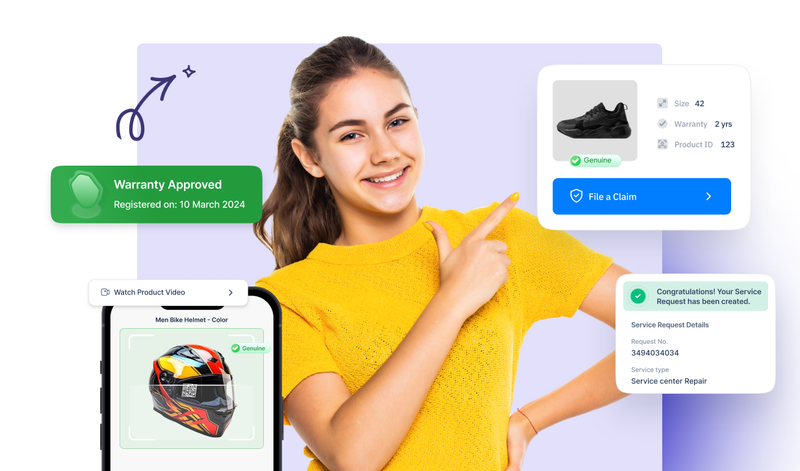
Dyrect's tracking software gives brands a real-time view of registrations as they come in, broken down by channel. Brands can see how many registrations came from Shopify vs. Amazon vs. retail QR scans on a single dashboard. Warranty expiry timelines are tracked automatically, and SKU-level analytics surface which products generate the highest claim volume relative to sales.
The platform also tracks claim resolution time per agent and per product category, giving ops teams a performance baseline without needing to pull reports manually.
The biggest advantage Dyrect brings is **omnichannel registration**. Most warranty tracking tools assume every customer comes through the brand's own website. In reality, a significant portion of buyers purchase from retail stores, Amazon, Flipkart, distributors, dealers, or offline events. These customers remain invisible to the brand unless they have a way to register the product.
Dyrect solves this with QR codes on product packaging, embedded widgets on Shopify or any ecommerce store, and registration journeys accessible from retail inserts, manuals, or product labels. Every buyer from every channel gets a path to connect directly with the brand.
Once registered, the brand has verified first-party data: customer name, email, phone number, purchase date, sales channel, product, serial number, and warranty period. This data becomes the backbone of every warranty interaction that follows.
**Best suited for:** D2C, ecommerce, and retail brands of all sizes that sell across multiple channels and want warranty tracking, registration, claims, and post-purchase revenue opportunities in one system.
#### **Omnichannel Registration and First-Party Data Capture**
Dyrect's registration engine captures customers from every sales channel. Online buyers register through an embedded widget on Shopify, WooCommerce, or any ecommerce store. Offline and marketplace buyers scan a QR code on the product packaging and complete registration in seconds. The result: the brand builds a verified customer database that includes buyers who would otherwise remain completely unknown.
Registration also serves as a marketing moment. During registration, customers can opt into email and SMS communication, giving brands a consented, first-party data channel. According to Dyrect data, brands see a **28% increase in repeat sales** when they connect with customers through registration-driven engagement.
#### **Claims Tracking and Resolution Workflows**
Dyrect's claims module handles the full claim lifecycle. Customers submit claims through a structured form that collects issue details, photos, serial numbers, and proof of purchase. The team reviews claims through a centralized dashboard where every ticket is assigned, tracked, and updated through defined stages.
Repair workflows, replacement order creation, refund processing, store credit issuance, and dealer chargeback management all run within the same platform. Teams report **50% faster claims processing** compared to email-based workflows.
"They have helped us in a big way in implementing paperless warranty claims processing solutions for our brand. They have great technology, and the implementation and integration set up was really quick." — **Gurumukh Uttamchandani, Executive Director, Syska LED Lights**
#### **Warranty Analytics and Product Intelligence**
Dyrect's analytics dashboards surface patterns that manual tracking misses. Teams can see which SKUs generate the highest claim volume, which batches show recurring defects, which sales channels produce the most warranty registrations, and where claim resolution times need improvement.
Over time, this data supports product improvement, supplier accountability, and more accurate warranty cost forecasting. Brands using structured warranty systems are **40% more successful** at identifying and resolving recurring product issues.
[**Dyrect's G2 Rating**](https://www.g2.com/products/dyrect/reviews) **:** 4.8 ★
[**Dyrect's Shopify App Store Rating**](https://apps.shopify.com/dyrect-warranty-registrations) **:** 5.0 ★
**Key Features**
- Omnichannel product registration (QR code, Shopify, web embed, retail)
- AI-powered serial number validation
- Digital warranty cards replacing physical cards
- Drag-and-drop no-code form builder
- Claims ticketing with repair, replacement, and refund workflows
- Customer-facing warranty portal
- Extended warranty and upsell offers at registration
- Integrations with Shopify, WooCommerce, Zendesk, Freshdesk, Klaviyo, and more
- Analytics dashboards for claim patterns, product issues, and registration performance
**Pros**
- Covers registration, tracking, claims, and post-purchase engagement in one platform
- Works across every sales channel including offline retail and marketplaces
- Captures first-party data from previously invisible customers
- Extended warranty and upsell capabilities create revenue from the warranty moment
- 1 million+ warranties registered on the platform
**Cons**
- Pricing is custom, so smaller brands need to book a demo to evaluate fit
- Advanced features may be more than what a very early-stage brand needs immediately
### **2\. NeuroWarranty: QR-Based Warranty Activation and Claims for Product Brands**
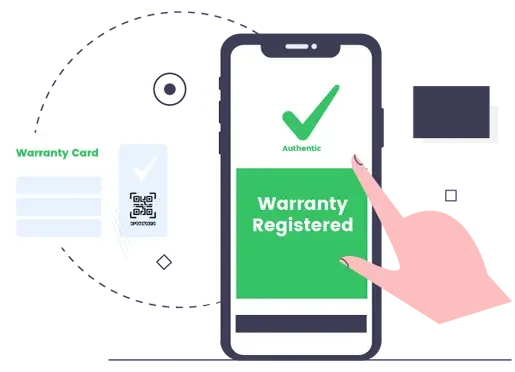
NeuroWarranty offers a [digital warranty management solution](https://www.dyrect.co/guide/warranty-management-software) built around QR code technology. Brands replace traditional paper warranty cards with QR-based digital activation, allowing customers to scan and register products instantly. The platform handles warranty activation, claims submission, and customer communication in a structured digital environment.
[NeuroWarranty has been recognized on G2](https://www.g2.com/products/neurowarranty/reviews) as one of the top warranty management software platforms in 2026. The solution is designed for consumer product brands in categories like electronics, appliances, personal care, home products, and baby gear, where warranty registration and claims tracking are essential for customer satisfaction and operational efficiency.
**Best suited for:** D2C and retail brands wanting a straightforward QR-based digital warranty system with claims processing and customer data collection.
**Key Features**
- QR code-based warranty registration and activation
- Digital warranty cards replacing paper inserts
- Claims submission and tracking dashboard
- Customer data collection during registration (email, phone, product, channel)
- Analytics dashboards for warranty activity and claims data
- Integration with brand workflows and customer communication tools
**Pros**
- Clean QR-based registration experience for customers
- Replaces paper-based warranty systems effectively
- Collects verified customer data from offline and retail buyers
- Strong presence in consumer electronics and appliance categories
- Ranked among top warranty software on G2 for 2026
**Cons**
- Feature depth for post-purchase engagement and upsell flows is lighter compared to Dyrect
- Integration ecosystem is growing but may require custom work for certain tools
**Pricing:** Custom pricing based on brand requirements.
### **3\. Pega Warranty: Enterprise Warranty Processing for Complex Manufacturer Networks**
Pega Warranty is part of the Pegasystems enterprise process automation ecosystem. It handles warranty claim validation, multi-tier approvals, supplier chargebacks, parts return logistics, repair order management, and financial settlements. The platform is built for manufacturers operating complex dealer and supplier networks where warranty claims flow through multiple parties before resolution.
Pega integrates deeply with CRM and ERP systems, making warranty information part of a broader 360-degree customer and product view. The platform supports campaign management for recalls, diagnostic decision trees for technicians, and bulk supplier claim processing.
**Best suited for:** Large manufacturers with dealer networks, authorized service providers, and complex multi-party warranty claim flows.
**Key Features**
- Warranty claim validation with automated eligibility checks
- Repair order management for dealers and technicians
- Supplier recovery and chargeback processing
- Parts return authorization and logistics tracking
- Integration with CRM, ERP, and financial systems
- Campaign management for product recalls
- Diagnostic tools for service technicians
- Analytics and reporting on warranty trends and costs
**Pros**
- Handles complex multi-party warranty workflows (manufacturer, dealer, supplier, customer)
- Strong supplier recovery capabilities reduce warranty costs
- Deep integration with existing enterprise systems
- Configurable workflows adapt to different industries and claim types
**Cons**
- Designed for enterprise-scale manufacturers, so it may be over-engineered for D2C or mid-market brands
- Implementation timelines can stretch to several months
- Requires dedicated technical resources for configuration and maintenance
- Customer-facing warranty registration is minimal compared to purpose-built consumer platforms
**Pricing:** Enterprise pricing. Contact Pegasystems for a custom quote.
### **4\. SAP Warranty Management: Warranty Tracking Within the SAP ERP Ecosystem**
SAP offers warranty management as a module within its broader ERP suite. The solution handles warranty claim processing, entitlement validation, defect coding, financial settlement, and supplier recovery. For organizations already running SAP across finance, logistics, and customer service, warranty management plugs directly into existing master data, service records, and financial ledgers.
SAP's standard warranty functionality covers claim automation, defect code catalogs integrated with Quality Management, and automatic financial postings. For more complex warranty operations, SAP ACS (Advanced Claims Settlement) extends the platform with multi-tier supplier recovery, advanced analytics through SAP BW or SAP Analytics Cloud, and audit tools for monitoring dealer and service center performance.
**Best suited for:** Large enterprises already running SAP ERP that want warranty tracking integrated with their existing finance, service, and logistics modules.
**Key Features**
- Warranty claim processing with automated eligibility validation
- Defect code catalogs integrated with SAP Quality Management
- Financial postings and warranty cost tracking within SAP FI/CO
- Supplier recovery and reimbursement management
- Advanced analytics through SAP BW or SAP Analytics Cloud
- Integration with Sales and Distribution, Materials Management, and Customer Service modules
- Audit and compliance reporting for dealer warranty claims
**Pros**
- Deep integration with the full SAP ecosystem (finance, logistics, quality, service)
- Keeps warranty data within the same environment as other enterprise processes
- Advanced analytics for warranty cost trends, failure rates, and supplier performance
- Suitable for large, multi-region manufacturing operations
**Cons**
- Standard warranty module handles simple, linear warranty processes; complexity requires SAP ACS or custom ABAP development
- Equipment master allows limited warranty date slots, so multiple warranty types per product need custom work
- Customer-facing warranty registration requires significant configuration effort
- Implementation timelines range from weeks to six months depending on scope
- Licensing and implementation costs are substantial
**Pricing:** Part of the SAP ERP licensing model. Enterprise pricing varies based on modules, user count, and implementation scope.
### **5\. PTC Warranty: Warranty Cost Optimization for Industrial OEMs**
PTC Warranty (formerly Servigistics) is a warranty management platform designed for manufacturers and service organizations focused on reducing warranty costs and improving product quality through warranty data analysis. The platform handles warranty claim processing, contract management, supplier recovery, parts return logistics, and warranty analytics.
PTC was named a Leader in the IDC MarketScape 2024 for worldwide warranty service management applications. The platform is used by automotive, industrial, and consumer electronics manufacturers that process high volumes of warranty claims and need structured supplier recovery processes.
**Best suited for:** Industrial OEMs, automotive manufacturers, and large service organizations focused on warranty cost reduction and supplier recovery.
**Key Features**
- End-to-end warranty claim processing and validation
- Warranty contract and coverage management
- Supplier recovery and chargeback automation
- Parts return logistics and tracking
- Knowledge management for service technicians
- Warranty analytics and product quality reporting
- Integration with field service, CRM, and ERP systems
- Service parts optimization (Servigistics)
**Pros**
- Recognized industry leader for warranty service management
- Claims up to 50% reduction in warranty claims costs and 75% reduction in processing overhead
- Strong supplier recovery capabilities
- Comprehensive analytics for product quality and warranty cost optimization
- Covers the full warranty chain from customer claim to supplier reimbursement
**Cons**
- Built for industrial-scale operations, making it too heavy for consumer D2C brands
- Implementation and onboarding requires dedicated project resources
- Customer-facing warranty registration and post-purchase engagement are minimal
- Pricing is enterprise-level and may require long-term contracts
**Pricing:** Custom enterprise pricing. Contact PTC for a quote.
### **6\. ReverseLogix: Warranty Returns and Repair Management at Scale**
ReverseLogix is a returns management system (RMS) that handles the full lifecycle of returns, warranty claims, and repairs across B2C and B2B channels. The platform stands apart through its depth in reverse logistics: product registration at purchase, self-service customer portals for claim submission, automated routing based on warranty status, multi-level repair tracking, parts harvesting, and quality inspection workflows.
ReverseLogix serves enterprise customers including Genesco (1,400+ retail stores), Amer Sports, and Samsonite. The platform has approximately 84 employees and positions itself in the enterprise reverse logistics market rather than chasing smaller ecommerce merchants.
**Best suited for:** Brands and manufacturers with high-volume warranty returns that need structured repair workflows, warehouse integration, and returns disposition management.
**Key Features**
- Self-service warranty claim portals for B2C and B2B customers
- Automated claim routing based on warranty status, fault type, and contract terms
- Multi-level repair tracking from diagnosis to component replacement to quality checks
- Parts harvesting and recycling from returned products
- AI-powered fraud detection for suspicious return patterns
- Warehouse workflow management for returns processing
- Integration with Shopify, WooCommerce, Magento, Salesforce, SAP, Oracle, and FedEx
- Sustainability tracking and recommerce capabilities
**Pros**
- Exceptional depth in reverse logistics and repair operations
- Handles both B2C and B2B warranty returns in one platform
- AI capabilities for fraud detection and automated routing
- Strong integrations across ecommerce, ERP, and logistics platforms
- Turns returns from a cost center into a value recovery engine
**Cons**
- Setup and configuration often require dedicated resources
- Designed for large operations; may feel heavy for brands processing fewer than 100 claims per month
- Product registration and first-party data capture capabilities are lighter than warranty-first platforms
- Pricing is enterprise-tier and requires a custom quote
**Pricing:** Custom pricing. Contact ReverseLogix for plans.
### **7\. RenewityRMA: Configurable RMA and Repair Tracking for Manufacturers**
RenewityRMA is a cloud-based return merchandise automation (RMA) solution built for manufacturers, electronics companies, and service organizations that need structured processes for handling product returns, repairs, and warranty claims. The platform differentiates through deep configurability: every field, workflow stage, automation rule, and customer portal can be customized to match the brand's specific process without coding.
The platform supports custom RMA processes for different product lines and service locations, each with its own workflow stages, data fields, automation triggers, and customer communication templates. Customers use a self-service web portal to submit RMAs, track status, browse a knowledge base, and communicate with service agents.
**Best suited for:** Small to mid-size manufacturers and device companies that need a configurable RMA and repair workflow system.
**Key Features**
- Fully customizable RMA workflows with configurable stages, fields, and automation
- Customer-facing web portal for RMA submission, status tracking, and support
- Serial number management and registered product tracking
- Parts and labor management with quote generation
- Knowledge base for customer self-service
- Automated email notifications for status updates and task assignments
- Integration with Salesforce and Zendesk
- Reporting and analytics on return trends, repair performance, and warranty data
**Pros**
- Highly configurable: software adapts to the brand's process rather than forcing a standard template
- Affordable starting price compared to enterprise warranty platforms
- Customer portal reduces inbound support calls and email volume
- Strong reviews for customer support and responsiveness from the RenewityRMA team
- Supports multiple concurrent RMA processes for different product lines
**Cons**
- Initial setup requires investment in configuration since the flexibility comes with a learning curve
- Limited ecommerce platform integrations (Shopify, WooCommerce) compared to warranty-first tools
- Better suited for manufacturer RMA workflows than D2C warranty registration and post-purchase engagement
- Does offer an API, but third-party integration options are more limited than larger platforms
**Pricing:** From $299/month to $599/month depending on the plan.
## **Warranty Tracking vs. Warranty Management: Which Do You Need?**
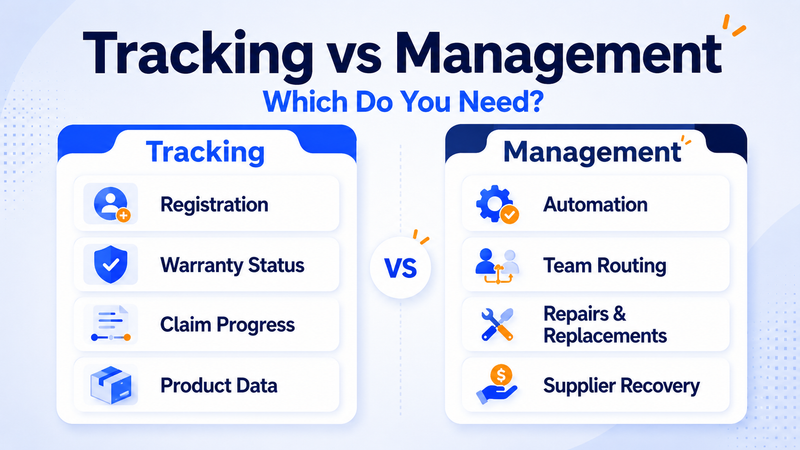
These two terms appear everywhere in warranty software conversations, and they signal different buyer needs. Understanding the difference helps brands pick the right platform and avoid paying for capabilities they will use in 12 months rather than today.
**Warranty tracking** is the data and visibility layer. It answers: Who owns this product? When does the warranty expire? Has a claim been filed? What is the current status? Which products generate the most claims? Warranty tracking gives the team a structured view of registrations, warranty coverage, and claim progress across the product catalog.
**Warranty management** is the operational layer built on top. It answers: How should this claim be routed? Who handles this type of issue? Can we auto-approve straightforward claims? How do we coordinate a replacement shipment? What do we recover from the supplier? Warranty management adds workflow automation, team assignments, approval rules, repair routing, and financial settlement to the tracking layer.
Most growing brands need both. However, if the primary pain today is "we have zero visibility into our warranty data," start with a platform that excels at registration and tracking. If the primary pain is "claims take too long and cost too much to process," start with a platform strong in [workflow automation and claims management](https://www.dyrect.co/product/warranty-registration-software).
Platforms like Dyrect and NeuroWarranty cover both tracking and management in one system, which is why they work well for consumer brands that want to solve both problems without implementing two separate tools.
For a detailed comparison of operational warranty management platforms, see our guide on the [best warranty management software in 2026](https://www.neurowarranty.com/blog/best-warranty-management-software).
## **Choosing the Right Warranty Tracking Software for Your Brand**
Selecting the right platform depends on three variables: your channel mix, your claim volume, and where you expect to be in 12 months.
If your brand sells through its own website, retail stores, and marketplaces, and you need to capture customers from every channel, look for a platform with omnichannel registration and first-party data collection. Dyrect is the strongest choice for this use case because it turns warranty registration into a direct connection between brand and buyer, regardless of where the product was purchased.
If your brand is an enterprise manufacturer with complex dealer networks and multi-party claim flows, platforms like Pega Warranty, SAP Warranty Management, or PTC Warranty fit the operational scale and integration depth required.
If your primary problem is returns and repair logistics rather than warranty registration and customer data, ReverseLogix covers the reverse logistics workflow with depth other platforms lack.
And if you need a configurable RMA system at a reasonable price point, RenewityRMA delivers strong customization for small to mid-size manufacturing teams.
The costliest decision is staying on spreadsheets and email threads long after they have stopped working. By the time warranty claims reach 200+ per month, manual tracking costs more in lost time, missed data, and frustrated customers than any software subscription.
## **Frequently Asked Questions**
### **What is warranty** **tracking software?**
Warranty tracking software gives brands visibility into their warranty operations. It tracks product registrations, monitors warranty status and expiry dates, surfaces claim patterns by SKU and channel, and reports on metrics like resolution time and fraud flag rates. It is the data and visibility layer, distinct from warranty management software which automates the operational workflows like claims processing and supplier recovery.
### **What warranty** metrics **should product brands track?**
Six metrics matter most: registration rate by sales channel, claim rate by SKU, average claim resolution time, warranty expiry timeline (30/60/90 day windows), fraud flag rate, and repeat claim patterns. Tracking these surfaces product quality issues early, identifies upsell opportunities before warranties expire, and reveals which channels need registration experience improvements.
### **How do you track** warranties **across Shopify, Amazon, and retail?**
QR codes on product packaging create a single registration entry point regardless of where the product was purchased. When a customer scans the code, the system captures which channel the product was bought from alongside the customer's contact information. Brands can then track registration rates, claim volumes, and defect patterns per channel from one dashboard.
### **What is the** difference **between warranty tracking and warranty management software?**
Warranty tracking is the visibility layer. It shows what's happening: registrations, expiring warranties, claim volumes, defect trends. Warranty management is the operational layer. It automates what happens next: claim processing, eligibility verification, resolution workflows, supplier chargebacks. Smaller brands often start with tracking. As claim volume grows past 100+ per month, management capabilities become necessary.
### **What is a** warranty **tracking dashboard?**
A warranty tracking dashboard is a real-time interface showing key warranty metrics in one view. Standard panels include: total active registrations, registrations by channel, claims submitted vs. resolved, average resolution time, top claimed SKUs, upcoming warranty expirations, and fraud flags. The best dashboards update in real time and allow filtering by product line, date range, and sales channel.
### **How do you track** warranty **expiry dates automatically?**
Warranty tracking software calculates expiry dates from the registration or purchase date based on the warranty policy assigned to each product category. As warranties approach expiry (typically at 90, 60, and 30 day intervals), the system can trigger automated notifications to the customer. These touchpoints become opportunities for extended warranty offers, product care reminders, or re-engagement campaigns.
### **Is warranty tracking** software **worth it for small brands?**
Brands processing fewer than 50 claims per month can often manage with spreadsheets. The breakpoint is around 100 claims per month, or when the brand sells through more than one channel. At that volume, manual tracking leads to missed expiries, invisible defect patterns, and lost re-engagement opportunities that cost more than the software.
### **Can** warranty **tracking software identify product defects?**
Yes. By tracking claims at the SKU level, the software surfaces which products generate disproportionate claim volume. Patterns become visible: a specific batch with higher failure rates, a product category with recurring complaints about the same component, or a seasonal spike tied to shipping damage. This data reaches product and quality teams before issues escalate into recalls or reputation damage.
### **How do you track warranty claims without spreadsheets?**
Warranty tracking software replaces spreadsheets with structured systems. Customers register products through QR codes or web forms. Warranty status updates automatically based on registration dates and configured warranty periods. Claims flow through guided forms that collect every detail the team needs.
Dashboards show active warranties, pending claims, resolution progress, and product-level patterns. Automated notifications keep customers updated without manual emails. And the result is faster resolutions, cleaner data, and zero reliance on manual record-keeping.
---
This blog is powered by Superblog. Visit https://superblog.ai to know more.
---
## 5 Best Product Registration Software in 2026
Author: Abhishek Agrawal
Author URL: https://www.neurowarranty.com/blog/author/abhishek-agrawal
Published: 2026-07-10
Category: warranty registration software
Category URL: https://www.neurowarranty.com/blog/category/warranty-registration-software
Meta Title: 5 Best Product Registration Software (2026)
Tags: Consumer Data Collection, product registration software, warranty registration software
Tag URLs: Consumer Data Collection (https://www.neurowarranty.com/blog/tag/consumer-data-collection), product registration software (https://www.neurowarranty.com/blog/tag/product-registration-software), warranty registration software (https://www.neurowarranty.com/blog/tag/warranty-registration-software)
URL: https://www.neurowarranty.com/blog/best-product-registration-software
If you are searching for product registration software, chances are you want a better way to connect post-purchase data, customer relationships, and service communication in one place. We are long past the stage when a registration page was only a small form added after checkout.
In [2026](https://www.neurowarranty.com/blog/best-warranty-management-software), product registration software plays a much bigger role. It helps create a direct connection with the buyer, gives you cleaner first-party data, supports loyalty programs, and opens more room for post-purchase engagement such as product education, accessories, premium services, and extended warranty registration.
It also helps you understand your business with much more clarity. You can see which channels bring registered customers, which products create the highest engagement, how quickly registrations come in after purchase, and which opportunities can grow customer value over time. When all of this sits in one dashboard, decision-making gets easier and your post-sale journey becomes much more organised. That is a big reason product registration software has become such an important part of the modern customer journey.
There is also a strong communication and safety angle. Research cited in a UK government-backed product registration study found that only 53% of consumers had registered a recent large domestic appliance purchase.
It clearly shows why improving registration rates matters so much. Better registration creates a stronger line of communication after purchase and gives you a far better foundation for customer support, loyalty, and long-term growth.
## **What is Product Registration Software?**
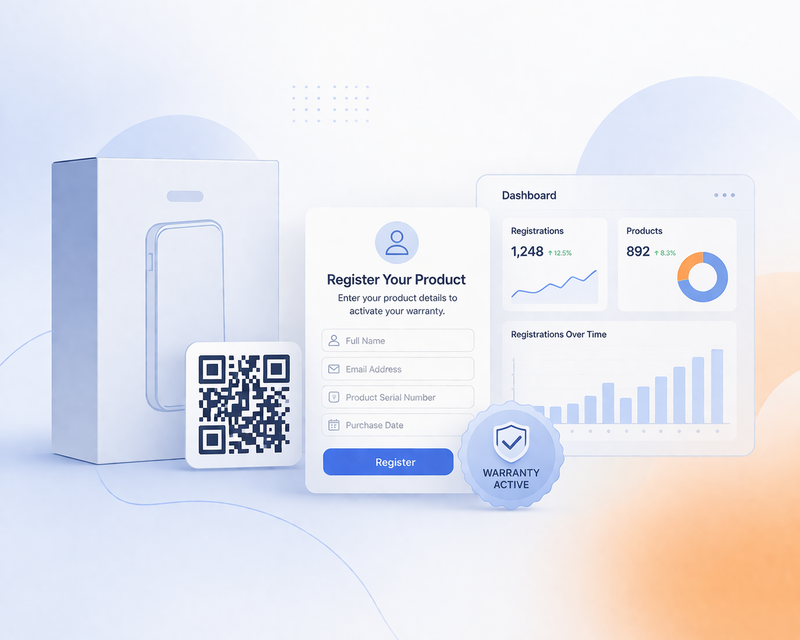
[Product registration software](https://www.neurowarranty.com/blog/advantages-of-product-registration-software-or-neurowarranty-cl651zne4205311kp71z2umej9) is a digital system that helps you collect customer and product details after a purchase. It usually gathers information like customer name, email address, phone number, purchase date, product model, serial number, seller information, and proof of purchase. Once this information enters the system, it becomes much easier to manage registration records in an organised and useful way.
This software usually works through branded registration pages, QR codes, online forms, eCommerce integrations, or links shared through packaging, email, or SMS. A customer completes the registration, and the brand receives a verified record connected to a specific product and buyer. This creates a stronger post-purchase connection and gives teams a clearer view of who bought the product, which channel the sale came from, and how the product performs after purchase.
Product registration software also supports warranty registration, customer engagement, loyalty campaigns, extended protection plan offers, and post-purchase communication. In many cases, it also connects with CRM platforms, helpdesk tools, email marketing systems, and analytics dashboards, which helps different teams work with the same customer and product data.
## **How Product Registration Software Creates Value for Your Business**
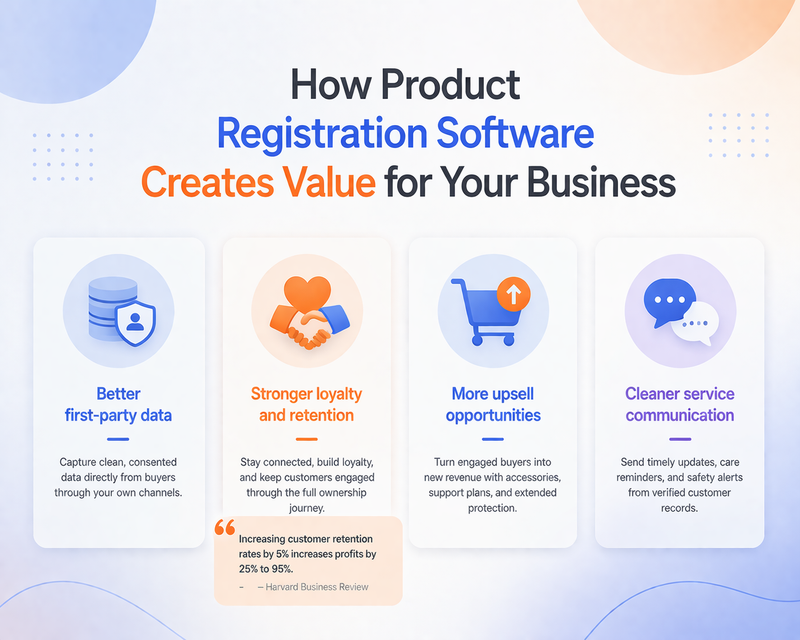
### **Better first-party data**
One of the biggest reasons companies invest in product registration software is first-party data. When registration happens directly with the buyer, you get cleaner records from your own channels and post-purchase touchpoints. Twilio describes first-party data as information collected directly from customers through owned channels, and that matters even more in a market that values privacy, consent, and stronger customer relationships.
That data can support customer education emails, onboarding content, accessory recommendations, service reminders, loyalty campaigns, and future product launches. It also gives you a stronger view of who actually uses the product, especially when sales happen through retail stores or marketplaces.
### **Stronger loyalty and retention**
A registration journey creates a fresh opportunity to stay connected after purchase. That can support loyalty programs, exclusive content, member offers, care tips, and extended warranty registration. It can also help you keep the relationship active during the full ownership cycle.
This matters financially too. Research cited by [Harvard Business Review](https://hbr.org/2014/10/the-value-of-keeping-the-right-customers) says a 5% increase in customer retention can lift profits by 25% to 95%.
### **More upsell opportunities**
Registration can also support post-purchase revenue. A buyer who registers a product is already engaged. That creates a strong point for accessories, premium support, service plans, and extended protection offers. Microsoft notes that extended warranties can be sold during purchase and also for a limited period after purchase. That makes registration a very natural point for this conversation.
### **Cleaner service communication**
Once registration data is in one place, communication becomes easier. You can send care reminders, onboarding content, service updates, product tips, recall communication, and account-based updates from a verified customer record. The UK government-backed study on product registration also highlights the value of registration for recall communication and product safety outreach.
## **Key Features to Look for in Product Registration Software**
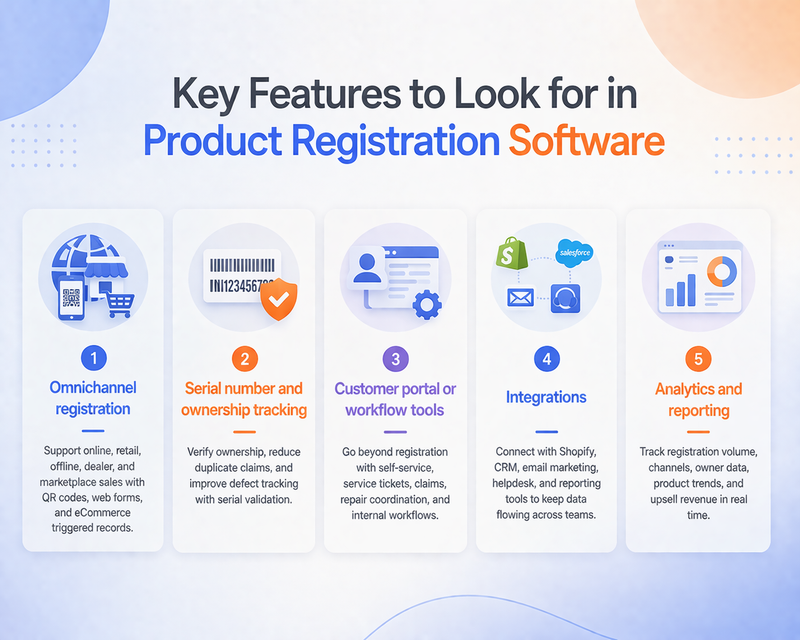
### **1\. Omnichannel registration**
The strongest tools support online, retail, offline, dealer, and marketplace sales. That means QR registration from packaging, web forms, eCommerce-triggered registration records, and clean paths for people who bought in stores.
### **2\. Serial number and ownership tracking**
This is a major feature for warranty registration. It helps verify product ownership, reduce duplicate claims, and improve defect tracking. If serial validation is important for your category, this deserves extra attention.
### **3\. Customer portal or workflow tools**
Some tools only handle registration. Others extend into self-service portals, service tickets, claims handling, repair coordination, and internal workflows. If service operations matter in your business, this should be high on your checklist.
### **4\. Integrations**
Registration software works best when it connects with Shopify, CRM tools, email marketing apps, helpdesk software, and reporting tools. That keeps data flowing across teams.
### **5\. Analytics and reporting**
A dashboard should show registration volume, channel source, owner data, product trends, and revenue from upsells in real time or close to real time.
## **5 Best Product Registration Software in 2026**
### 1) Dyrect
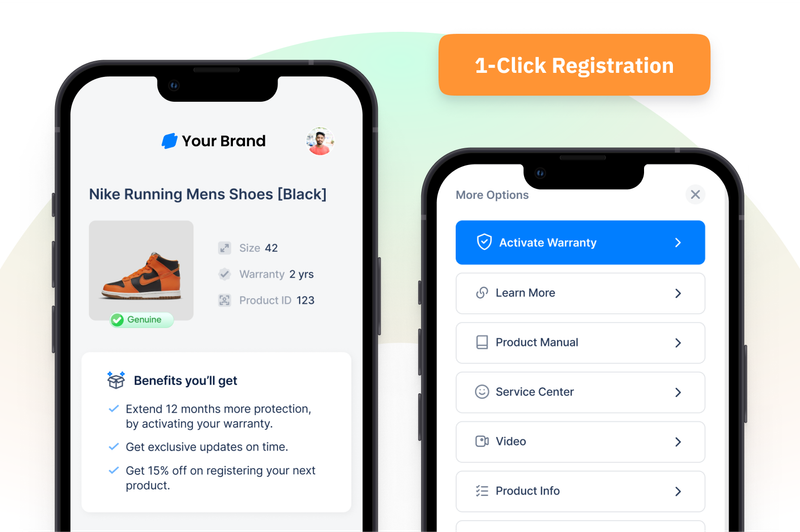
[Dyrect](https://www.dyrect.co/product/product-registration-software) is one of the strongest all-round options in this category. It works especially well for Shopify merchants, omnichannel product businesses, consumer electronics companies, accessories brands, home product sellers, smart device businesses, and D2C operations that want registration, warranty activation, customer data capture, and post-purchase engagement inside one system.
What stands out most with Dyrect is its [omnichannel setup](https://www.dyrect.co/features#product-registration). It supports product registration through Shopify, QR codes, and branded web registration pages. It also supports serial number validation, duplication checks, QR generation, and serial number generation. That makes it especially useful for categories that depend on product-specific ownership data.
Dyrect also covers a wide list of industries. From what we reviewed, it is positioned for consumer electronics, mobile accessories, baby gear, beauty and personal care, furniture, fitness products, household appliances, TV and audio products, cycling, outdoor gear, and smart home or network devices. That wide industry coverage gives it a lot of flexibility.
Another major strength is the customer-facing side. Dyrect offers a self-service warranty portal, product registration via QR code or website, and real-time warranty status tracking. For Shopify users, it can automatically create warranty records after order fulfillment, which is a very useful feature for online sales.
Dyrect also shines on the revenue side. The platform positions registration as a strong place to surface accessories, upgrades, extended protection plans, and warranty upsell opportunities. If you want product registration software that also supports loyalty and post-purchase sales, Dyrect clearly leans into that use case.
Its integration stack is also strong. Dyrect connects with tools like Gorgias, HubSpot, Klaviyo, Mailchimp, Zendesk, and Zoho Desk, and it also offers wider integration support through its broader integration layer.
For social proof, Dyrect has very strong feedback in the channels we checked. Its [Shopify](https://apps.shopify.com/dyrect-warranty-registrations) app listing carries a 5.0 rating, and its [G2 profile shows 4.8 out of 5 from 37 reviews](https://www.g2.com/products/dyrect/reviews).
**Best for:** Shopify merchants, D2C brands, consumer electronics, accessories, home and smart device products, and omnichannel businesses that want product registration and warranty registration in one place.
### 2) NeuroWarranty
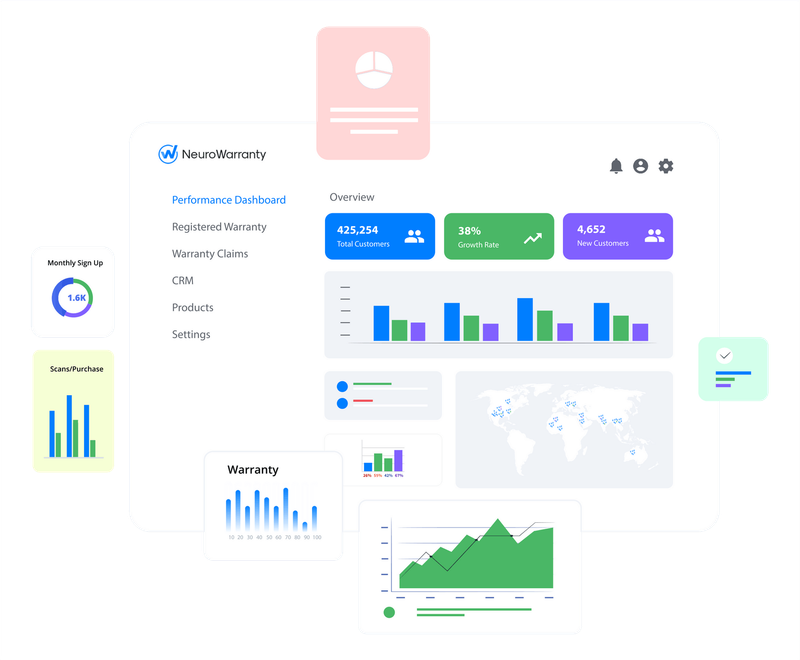
[NeuroWarranty](http://neurowarranty.com) is a strong pick for businesses that want a QR-first registration journey. It is built to help capture end-customer data after retail and marketplace purchases and turn that into a digital warranty registration flow with strong mobile convenience.
One thing we liked right away is how clearly NeuroWarranty is built for post-purchase data capture. The platform leans into app-free registration, mobile-friendly onboarding, digital warranty records, and customer data export. It also supports a digital warranty card, which is useful for both the customer and the internal team handling post-purchase interactions.
NeuroWarranty is especially appealing for businesses that sell through retail and Amazon-type channels. The platform is positioned to help capture customer data from those channels and support future direct engagement. That makes it very useful for companies trying to strengthen their direct customer relationship after the initial sale.
It also includes analytics, dashboards, QR and batch management, and an inbuilt CRM layer. The setup looks friendly too. Based on the platform information we reviewed, businesses can roll out paperless warranty programs very quickly, and API connectivity is available for wider CRM integration.
NeuroWarranty is a strong fit when you want a clean and efficient path from scan to registration to digital warranty access. It also supports loyalty and future marketing through the customer data gathered during registration.
Its review footprint is smaller than Dyrect’s, though the visible feedback is still solid. G2 shows NeuroWarranty at 4.5 out of 5 from 2 reviews.
**Best for:** Retail-heavy businesses, marketplace sellers, and teams that want mobile-friendly product registration software with digital warranty registration built in.
### 3) Neurotags
Neurotags is another good option because it sits at the intersection of product registration, packaging engagement, digital warranty, loyalty, and brand protection. This makes it a strong choice for businesses that want to turn the product package into a customer engagement channel.
Its core flow is clear. A customer scans a QR code, enters details plus invoice information, and then receives a digital warranty card through email or SMS. That journey feels very natural for packaged consumer goods and retail purchases.
Neurotags also goes beyond registration. It positions itself with a customer data platform angle, which means the data captured during registration can support loyalty, engagement, and repeat-purchase activity later. If your team cares about connecting packaging to long-term customer value, Neurotags is worth serious attention.
Industry coverage is broad too. Neurotags highlights categories such as electrical and electronics appliances, electronics accessories, jewellery, cosmetics, spirits and wines, cannabis, and more. That broad scope gives it a distinctive place in this category.
Another area that makes Neurotags different is brand protection. The platform ties QR activation and product engagement to authentication-related use cases, which can be especially helpful in product categories with a strong packaging identity.
On the review side, G2 shows Neurotags at 3.8 out of 5 from 10 reviews.
**Best for:** Businesses that want warranty registration, loyalty activity, packaging-led engagement, and product authentication inside one platform.
### 4) Tavant
Tavant sits on the enterprise side of the category. It is designed for manufacturers and larger organizations that want product registration as part of a wider warranty management environment.
From what we reviewed, Tavant supports product registration through web and mobile platforms and includes a wide enterprise module set. That includes warranty administration, supplier recovery, audit management, service campaigns, reporting, and broader operational workflows. So the overall picture here is a platform built for scale and structure.
Tavant also has strong alignment with Salesforce. Its AppExchange footprint and product messaging point to a CRM-friendly enterprise setup, which can be very appealing for teams already working in that ecosystem.
This is the kind of platform that makes sense when product registration sits inside a larger operational environment with multiple teams and processes connected to it.
For social proof, G2 shows Tavant Warranty Management at 4.5 out of 5 from 1 review.
**Best for:** Manufacturers and enterprise teams that want product registration software tied closely to wider warranty operations and enterprise workflows.
### 5) Qualtrics XM
Qualtrics XM sits a bit differently from the other names here because it is not a typical warranty portal platform. Still, it can work very well for product registration when the priority is form flexibility, workflow routing, enterprise controls, and deep integration with the rest of the business stack.
This platform is especially useful when you want product registration forms to capture structured information such as serial number, purchase date, retailer, SKU, customer consent, and ownership details, then route that data into connected systems. That can make it a very strong option for teams with mature CRM, service, and marketing operations already in place.
Qualtrics XM stands out for integrations. From what we reviewed, it supports connections with Salesforce, Zendesk, ServiceNow, Marketo, and Google Sheets through its workflow and extension framework. That gives it a lot of power as a registration intake layer.
It also gives teams strong control over survey logic, workflow automation, and enterprise governance. So if your registration process needs deeper routing and structured data handling, Qualtrics XM can be a strong fit.
**Best for:** Enterprise teams that want flexible product registration forms, deeper workflow logic, and strong integration depth across internal systems.
## **How to Choose the Best Registration Software for your business?**

The right choice comes down to the kind of registration journey you want to create.
**Dyrect** fits best for businesses that want the most complete post-purchase setup in one place. It works especially well for omnichannel sales, Shopify stores, consumer electronics, accessories, home products, smart devices, and D2C brands. It gives you product registration, warranty registration, serial number automation, customer portal tools, integrations, and upsell opportunities during registration. When your priority is turning registration into a strong data and revenue channel, Dyrect is the strongest fit.
**NeuroWarranty** fits best for teams that want a QR-first and mobile-friendly registration flow. It is a strong match for retail-led sales, marketplace sales, and businesses that want digital warranty registration with a smooth customer journey. It is a good option when speed, ease, and direct customer data capture matter most.
**Neurotags** fits best for businesses that care deeply about packaging-led engagement. It works well when product registration, loyalty, digital warranty, and brand protection need to work together. For categories such as electronics accessories, cosmetics, jewellery, and packaged consumer products, Neurotags brings extra value through QR engagement tied closely to the product itself.
**Tavant** fits best for larger manufacturers and enterprise teams. It suits businesses that want product registration inside a broader warranty and after-sales environment. When the setup includes multiple teams, structured workflows, and enterprise systems such as Salesforce, Tavant makes strong sense.
## **Final Thoughts**
Choosing product registration software is really about choosing what kind of post-purchase relationship you want to create.
The right platform helps you capture first-party customer data, make warranty registration easier, connect online and offline buyers, and create new opportunities for loyalty and extended protection offers. It also gives you a cleaner customer database that can support email marketing, customer support, onboarding, and retention over time.
If your priority is an all-in-one platform with omnichannel registration, serial number automation, warranty registration, and post-purchase upsell potential, **Dyrect** is a strong choice. If QR-led registration is the main priority, **NeuroWarranty** is a solid option. If you want packaging-led engagement and loyalty, Neurotags deserves attention. For enterprise operations, Tavant and Qualtrics XM fit better depending on how much workflow depth and integration flexibility you need.
---
This blog is powered by Superblog. Visit https://superblog.ai to know more.
---
## How to Fix Warranty Claims Management Across Every Sales Channel (2026 Guide)
Author: Abhishek Agrawal
Author URL: https://www.neurowarranty.com/blog/author/abhishek-agrawal
Published: 2026-07-10
Category: Warranty Management
Category URL: https://www.neurowarranty.com/blog/category/warranty-management
Tags: Warranty Claims Management, Claims Management Software
Tag URLs: Warranty Claims Management (https://www.neurowarranty.com/blog/tag/warranty-claims-management), Claims Management Software (https://www.neurowarranty.com/blog/tag/claims-management-software)
URL: https://www.neurowarranty.com/blog/fix-warranty-claims-management-across-every-sales-channel
### **TL;DR**
> If you want the short version before reading the full guide:
>
> - Warranty claims management breaks down for omnichannel brands because each sales channel creates different data gaps. Customers who bought through retail, marketplaces, or distributors arrive at your support team with missing purchase records, making eligibility checks slow and manual.
>
> - The warranty claims process has six stages: intake, eligibility, evidence, decision, communication, and data. Most brands handle the first three poorly and skip the last one entirely.
>
> - Manual claims management works at low volume. Beyond roughly 50 claims per month, the per-claim cost and resolution time compound faster than your team can absorb.
>
> - Dedicated platforms like [**Dyrect**](https://www.dyrect.co/product/warranty-registration-software) connect warranty registration, claims management workflows, and customer communication into one system, so omnichannel brands can validate and resolve claims without manually chasing purchase data across channels.
>
> - The goal of this guide is to give you everything you need to build and run a warranty claims operation that holds up at scale across every channel you sell through.
### **Introduction**
If you landed here, you are probably managing warranty claims through some combination of a shared inbox, a spreadsheet, and a lot of manual back-and-forth with customers. Or maybe you have a system that worked fine when you were handling 20 claims a month, and now you are at 150 and it is visibly breaking. Or perhaps you are building this process for the first time and want to get it right from the start.
All three situations are reasonable. Warranty claims management rarely gets the structural attention it deserves until it starts costing you something: a frustrated customer who posts a public review, a support team that spends three days processing a single claim, or a product quality issue you found out about two months after it started showing up in claims data.
This guide covers the full picture. What warranty claims management actually means for a brand selling through multiple channels. What each stage of the claims process requires to function well. Where omnichannel complexity makes every stage harder. How to compare manual and automated approaches honestly. What to look for in a system if you decide to invest in one. And how to build something sustainable, rather than patching the current process every six months as volume grows.
## Why Warranty Claims Management Breaks Down for Omnichannel Brands
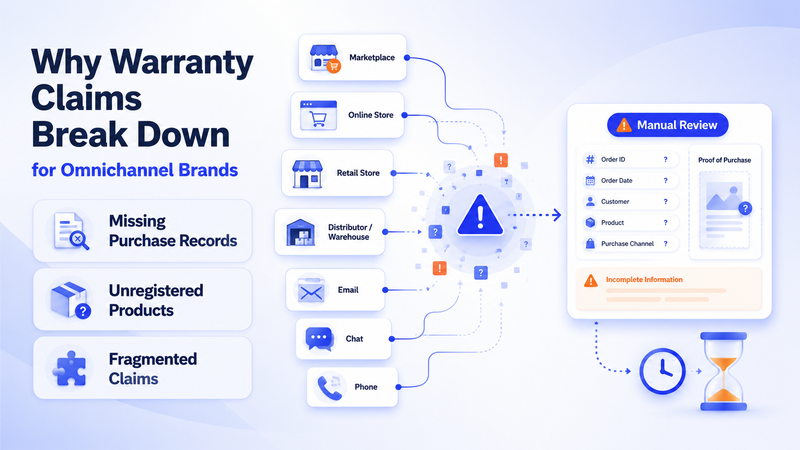
Here is the situation many omnichannel brands find themselves in. A customer contacts support with a warranty issue. Your team asks for their order number. The customer bought through Amazon. There is no order number in your system. Your team asks for proof of purchase. The customer uploads a screenshot from the Amazon app. Your team now has to verify that the purchase date falls within the warranty period, confirm the product model, check whether this SKU is covered, and decide whether the proof is sufficient. All of this happens manually. The customer waits.
That single claim might take 30 to 90 minutes of real team time across multiple exchanges. At 20 claims a month, that is manageable. At 200, it is unsustainable.
The root cause is almost always a data gap created at the point of sale. When a customer buys through your Shopify store, you have the order, the product, the purchase date, and the customer's contact information. When the same customer buys through a retail partner, a marketplace, or a distributor, you have none of that. Warranty claims require product ownership data. Omnichannel sales scatter that data across systems you don't control.
This is the specific problem that makes warranty claims management harder for omnichannel brands than for pure DTC brands. It is worth understanding before designing your process, because the process itself changes depending on what data you can reliably count on having.
**The three gaps that compound everything:**
**Gap 1: Missing purchase records.** You know the product exists. You do not know who bought it, when, or through which channel. Claims from marketplace buyers, retail customers, and distributor channels all arrive without order data attached.
**Gap 2: Unregistered products.** Warranty registration rates average below 20% across most product categories. When customers skip registration, there is no ownership record in your system at the time of the claim. Your team builds it from scratch under time pressure.
**Gap 3: Fragmented claim submission.** Customers contact brands through whatever channel feels easiest: email, social media DM, the website contact form, or by calling a phone number on the packaging. Each channel produces a different format, a different information set, and a different handoff path to your team.
When all three gaps exist simultaneously, which is the default state for most omnichannel brands, warranty claims management becomes a reactive, manual, channel-by-channel scramble. Building a structured process starts by acknowledging these gaps and designing around them.
## What Warranty Claims Management Is (And Two Things It Gets Confused With)
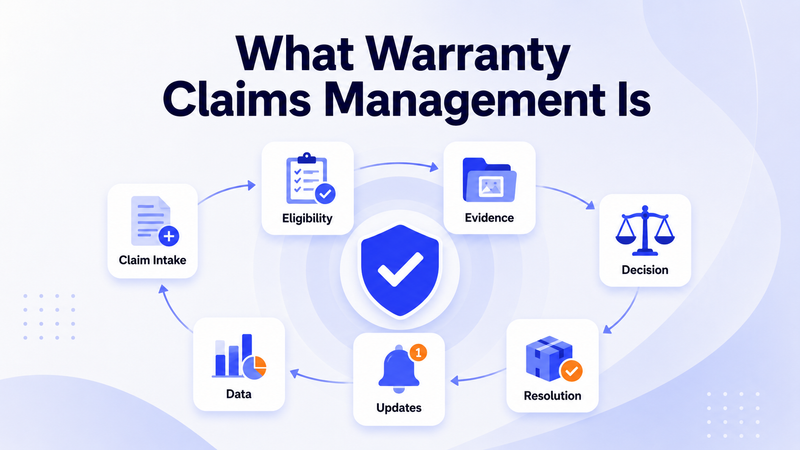
Before going into the process steps, it helps to define the term precisely, because it gets used loosely in a lot of places.
**Warranty claims management** is the operational discipline of handling customer requests for coverage under a product warranty. It covers every step from the moment a customer reports a problem to the moment the claim is resolved and the customer's experience is recorded.
This is distinct from two things that often get conflated with it:
**Returns management** handles short-term post-purchase decisions: wrong size, change of mind, damaged on arrival. Returns are typically resolved within a return window (14 to 30 days) and involve refunds or exchanges. Warranty claims are triggered by product failure or defect, often occur months or years after purchase, and require eligibility verification against a warranty policy. The resolution options overlap (replacement, refund) but the workflow is different.
**General customer support** handles questions, complaints, and service requests across a wide range. Warranty claims are a specific type of support request with structured requirements around evidence, eligibility, and resolution. A helpdesk can receive warranty claims as tickets, but it cannot validate them against warranty terms, check purchase dates against coverage periods, or route them through an approval workflow without custom configuration or manual work.
**What warranty claims management specifically includes:**
- Claim intake: receiving and structuring the claim from the customer
- Eligibility verification: confirming the product is under warranty coverage
- Evidence collection: gathering proof of purchase, defect documentation, and product details
- Decision-making: approving, escalating, or declining the claim based on policy
- Resolution execution: processing a repair, replacement, refund, or partial resolution
- Customer communication: keeping the claimant informed at each stage
- Data capture: recording claim outcomes, defect patterns, and cost data for future use
An efficient warranty claims management system handles all of these stages in a connected flow. A fragmented process handles them in disconnected steps, with manual handoffs between each one.
## The Warranty Claims Process: Step by Step for Product Brands
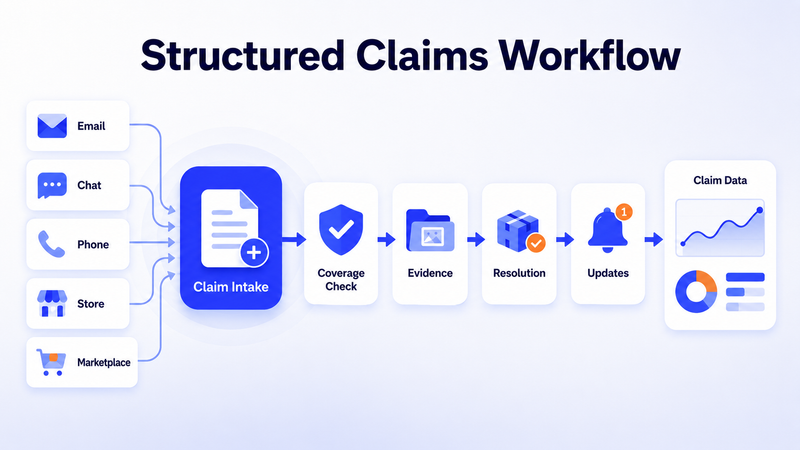
This section walks through each stage of the warranty claims process with specifics for product brands. The goal is to give you a working blueprint you can compare against your current process and identify where the gaps are.
#### **Step 1: Claim Intake — How and Where Claims Arrive**
Claim intake is the stage where a customer reports a problem and your team receives it. For most brands handling this manually, claims arrive through four or five different channels: email, a contact form on the website, social media messages, live chat, and occasionally phone calls.
The problem with multi-channel intake is inconsistency. An email claim contains what the customer chose to write. A contact form captures what fields you set up. A social media message contains whatever the customer typed. By the time all of these reach your team, the information is in five different formats, stored in five different places, and requires a different set of follow-up questions for each.
Structured intake solves this by funneling all claim submissions through a single form or portal that captures the same information every time: customer name, email, product purchased, purchase date, purchase channel, proof of purchase, description of the defect, and supporting photos or video. When intake is structured, every claim arrives with the same baseline of information, and your team can move directly to eligibility rather than spending the first exchange asking for missing details.
**If your current intake process looks like this:**
- Claims arrive by email
- Your team asks for order number, purchase date, and product photos in the first reply
- The customer responds over the next two to four days
- Your team manually checks the information against your records
**Then this is what it costs:**
- 2 to 5 days added to resolution time per claim from intake alone
- 3 to 8 minutes of team time per email exchange
- Inconsistent information quality across claims, which creates inconsistent decisions
Structured intake through a dedicated claim portal cuts this to a single submission event. The customer fills in all required information once. Your team receives a complete claim record.
#### **Step 2: Eligibility and Validation — Checking Coverage Before a Human Touches It**
Eligibility verification is the stage where your team confirms that the claim qualifies for warranty coverage. This requires knowing three things: whether the product is covered under your warranty policy, whether the purchase date falls within the coverage period, and whether the reported issue falls under the warranty terms.
For a DTC Shopify brand, eligibility checks are manageable. The order is in your system, the purchase date is on record, and your team can cross-reference quickly. For an omnichannel brand, eligibility checks are significantly harder because the purchase data often lives somewhere else or does not exist in your system at all.
The two most common eligibility verification failures:
**Failure type 1: The customer provides proof of purchase but your team has to manually check it.**
Someone on your team reads the date, compares it to the warranty period, checks the product SKU against your warranty coverage list, and makes a judgment call. At low volume, this is fine. At high volume, judgment calls become inconsistent and errors compound.
**Failure type 2: The customer cannot provide proof of purchase.**
This happens regularly for retail and marketplace buyers. The customer has the product but the receipt is gone. Your team has to decide whether to request alternative verification or decline the claim with no purchase record.
Automated eligibility checks solve the first failure by comparing submitted data against stored product and warranty records without human involvement. Serial number verification, purchase date calculation, and coverage matching happen in seconds. The second failure requires a process decision: what alternative verification will your brand accept, and how is that decision recorded consistently?
#### **Step 3: Evidence Collection — What to Ask For and Why Most Brands Ask Too Much**
Evidence collection is the stage where your team gathers the documentation needed to assess the defect and make a resolution decision. The standard requirements are proof of purchase, photos or video of the defective product, and a description of the problem.
Most brands ask too much at this stage, which slows resolution and frustrates customers. Asking a customer to provide a full unboxing-style video of a product defect, multiple high-resolution images from specific angles, and a written explanation of the failure history is appropriate for a high-value repair claim. Applying the same requirements to a $40 accessory with a visible manufacturing defect adds friction without adding value.
A better approach is tiered evidence requirements based on claim value and product category:
**Claim Value**
**Evidence Required**
Under $50
One clear photo of the defect + self-reported description
$50 to $200
2 to 3 photos + proof of purchase + defect description
$200 to $500
Multiple photos or short video + purchase proof + serial number
Above $500
Full documentation package + possible physical inspection or return
Setting evidence requirements by tier means low-value claims resolve faster, your team's time concentrates on complex cases, and customers are not asked to provide documentation that would cost more effort than the claim is worth.
#### **Step 4: Decision and Resolution — Repair, Replace, or Refund**
The decision stage is where your team determines what the resolution will be. For most product brands, the three options are repair, replacement, or refund. Some brands also offer partial credit or store credit as alternatives.
The decision logic should be documented and consistent. When decisions are made informally or case by case, two customers with identical claims receive different outcomes depending on which team member handled them. Over time, this creates internal confusion, inconsistent cost per claim, and customer complaints about unfair treatment.
A documented decision framework looks like this:
**If the product is within warranty and the defect is covered:**
- Repair: applicable when the product can be serviced and returned to working condition within a reasonable time frame
- Replacement: applicable when the defect cannot be repaired efficiently or the product is below a cost threshold where repair is viable
- Refund: applicable when the product is discontinued, replacement stock is unavailable, or the customer has had repeated failures on the same product
**If the product is within warranty but the defect falls under an exclusion:**
- Partial coverage: applicable when some portion of the issue is covered
- Paid repair: applicable when the brand offers service outside warranty terms
**If the product is outside the warranty period:**
- Goodwill resolution: applicable when the brand chooses to assist outside coverage terms as a retention decision
- Declined claim: applicable when the claim is outside coverage and goodwill resolution criteria are satisfied
Writing this out and training your team on it removes the ambiguity that causes inconsistent decisions. It also makes it possible to automate routine decisions later, because the logic is already documented.
#### **Step 5: Customer Communication — The Step That Determines Whether You Keep the Customer**
Customer communication during a warranty claim is the single biggest driver of customer satisfaction and retention outcomes. Research from Narvar found that close to 60 percent of consumers expect warranty issues to be resolved within 24 to 48 hours. More significantly, customers who receive proactive status updates during a claim are measurably more likely to buy again, even when the claim itself was for a product failure.
The implication is that how you communicate during a claim matters as much as how quickly you resolve it.
**The communication moments that matter most:**
1. Claim acknowledgement (within minutes of submission, automated): confirms receipt and sets expectations for response time
2. Eligibility decision (within 24 hours): confirms whether the claim is approved, under review, or requires additional information
3. Resolution confirmed (within 48 to 72 hours for straightforward claims): communicates what the resolution is and what happens next
4. Resolution in progress (if repair or replacement involves shipping): tracking information, estimated arrival, next steps
5. Claim closed: confirmation of resolution and an invitation to share feedback
Brands that send these communications manually struggle to maintain consistency at volume. A single support agent managing 30 open claims cannot reliably send five status messages per claim on schedule. Communication quality degrades as volume grows.
Automated notification systems attached to claim status stages solve this by triggering the right message at the right moment based on where the claim is in the workflow, without requiring manual action from your team.
#### **Step 6: Claim Data — What Happens After Resolution (and Why Most Brands Ignore It)**
The final stage of the claims process is the one most brands skip entirely: capturing and using the data that every claim generates.
Every warranty claim contains information about a specific product, a specific failure mode, a specific customer, and a specific resolution cost. When this data is recorded and analysed, it tells you which products generate the most claims, which defects appear repeatedly, which SKUs are costing you the most in replacements, and which customers have had multiple claim events.
Brands that track this data use it in three ways:
**Product quality feedback:** Recurring defects on the same SKU signal a manufacturing or design issue. If 15 percent of claims for one product reference the same component failure, that is a quality signal your product team needs to act on. Without structured claim data, this pattern often surfaces only when it is already costing significant revenue.
**Supplier accountability:** For brands manufacturing through third parties, claim data provides the evidence base for raising defect issues with suppliers and recovering costs on products that fail within warranty at above-average rates.
**Post-purchase retention:** Customers who had a claim resolved well are a retention opportunity. Their purchase history, product registration, and claim resolution data are all in the system. Brands that follow up with relevant offers, product education, or loyalty incentives at this moment see measurably higher repeat purchase rates than brands that close the ticket and move on.
## Where Omnichannel Makes Claims Management Harder
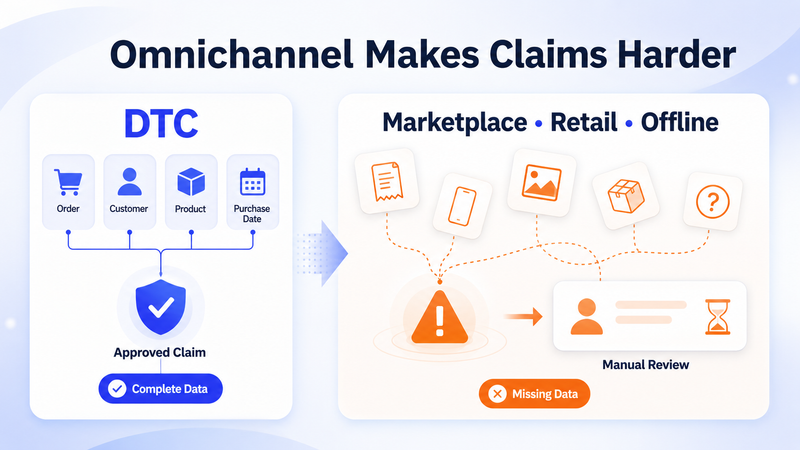
The six steps above describe the claims process in its standard form. Here is what happens to each step when you add omnichannel complexity.
**Claims Stage**
**DTC Shopify**
**Marketplace (Amazon/eBay)**
**Retail Partner**
**Distributor/Offline**
Intake
Order data pre-populated
Customer provides marketplace screenshot
Customer provides paper receipt or nothing
Customer has product, no documentation
Eligibility
Instant via order sync
Manual date verification from uploaded image
Manual date check, often disputed
Serial number check if registered, guesswork otherwise
Evidence
Collected via portal, linked to order
Collected via portal, no order link
Collected via email or portal, no order link
Collected via email, no system record
Decision
Automated rules can apply
Manual review required
Manual review required
Manual review required
Communication
Automated via order + claim system
Automated for claim status, not order status
Partially automated
Largely manual
Data
Complete: order, product, customer, claim
Partial: product and claim, customer incomplete
Partial: claim data only
Minimal: claim data only if logged
The pattern is clear. DTC orders produce the cleanest warranty operations because the brand controls the purchase data. Every channel beyond DTC introduces a different combination of missing data, and each missing piece requires manual effort to fill.
**The two most effective ways to close omnichannel data gaps:**
**QR-based product registration at point of sale.** Including a QR code in product packaging gives every customer, regardless of purchase channel, a path to register their product before a claim event occurs. When customers register, they provide their contact details, purchase information, and product data. This builds the ownership record that makes eligibility checks fast at claim time.
Brands that drive high registration rates, typically 30 to 60 percent when registration is frictionless and incentivised, significantly reduce the manual work burden at the claims stage because the data exists before the claim arrives.
**Serial number capture during registration.** Serial number verification at registration links each physical unit to a specific customer and purchase date. When a claim comes in, the serial number on the product can be looked up against the registration database and matched to an owner, a purchase date, and a coverage period. This works across every channel because the serial number travels with the product.
## Manual vs. Automated Warranty Claims Management: A Comparison
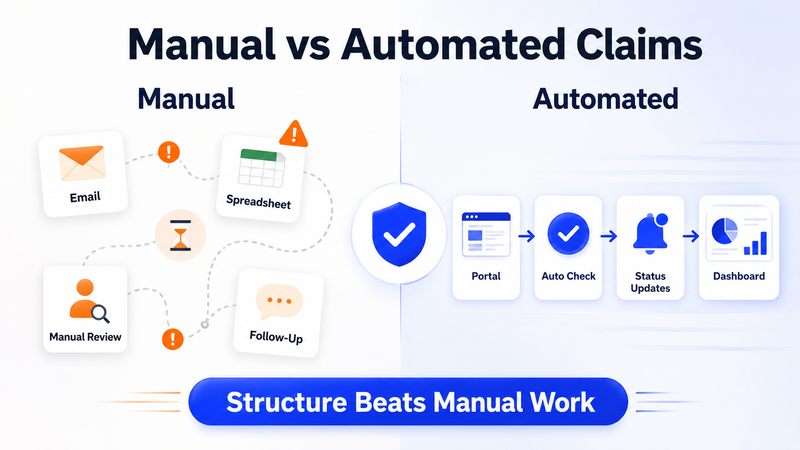
At some point in every warranty operation, the question shifts from "how do we handle claims" to "do we need software to handle them properly." This section gives you an honest comparison so you can make that decision based on your actual situation.
### The Manual Claims Management Process
A manual warranty claims operation typically looks like this:
- Claims arrive by email or contact form
- A team member reads the claim, requests missing information, and manually checks eligibility
- Approved claims are logged in a spreadsheet
- Resolutions are processed manually: replacement orders created in Shopify, refunds issued through the payment processor, repair tickets managed by email
- Customers receive status updates when someone on the team remembers to send them
- Claim data exists in the spreadsheet but is rarely analysed
**This works well when:**
- Claim volume is below 30 to 50 per month
- Your product range is small and warranty terms are simple
- Your team has dedicated time for warranty claim handling
- The majority of your customers buy through a single channel with clean purchase data
**This starts breaking when:**
- Volume exceeds 50 claims per month and resolution time begins to slip
- Multiple team members are handling claims with no shared system, causing inconsistent decisions
- Omnichannel complexity means routine eligibility checks take 20 to 40 minutes each
- Customers are following up on open claims because they received no status update
- Leadership wants reporting on claim costs and resolution rates, and the spreadsheet cannot produce it
### The Software-Managed Claims Process
A warranty claims management system automates the routine stages and gives your team a structured workspace for the complex ones.
**Stage**
**Manual**
**Software-Managed**
Claim intake
Email, form, or social — inconsistent format
Structured portal with required fields — consistent format every time
Eligibility check
Manual date comparison, sometimes disputed
Automated check against product and purchase database
Evidence collection
Requested by email, tracked informally
Uploaded to claim record, attached to product and customer profile
Decision
Made case by case, varies by team member
Applied from documented rules, automated for routine cases
Customer communication
Sent manually when team has time
Triggered automatically at each status change
Resolution processing
Manual replacement order or refund in each tool separately
Integrated with Shopify for replacement creation, refund processing, or store credit
Claim data
Spreadsheet, rarely used
Dashboard with defect patterns, SKU-level data, cost per claim, approval rate
**Processing time comparison across brands that have made this transition:**
Companies that move from manual to structured warranty management commonly report:
- Average claim resolution time drops from 5 to 12 days to 1 to 3 days
- Per-claim handling cost falls by 20 to 40 percent through reduced manual work
- First-contact resolution rate (claims closed without customer follow-up) rises significantly when intake captures full information upfront
- Customer satisfaction scores improve even when the resolution itself is unchanged, because communication is faster and more consistent
#### **The Trade-off Conversation**
Software investment for warranty claims management comes with real costs: monthly subscription fees, setup time, team training, and integration work with your existing tech stack. For brands at low volume or with very simple product ranges, the ROI case is thin. Manual management with a well-designed process and a clean spreadsheet can serve you adequately.
The trade-off math changes when:
- The cost of your team's time on manual claims exceeds the software subscription cost
- Claim volume is growing faster than your team capacity
- Omnichannel complexity means eligibility checks require significant manual effort per claim
- You are losing retention opportunities because customers are dissatisfied with claim handling
A rough rule: if your team spends more than 8 to 10 hours per week on warranty claim handling, and claim volume is growing, the software ROI conversation is worth having seriously.
## How to Build a Sustainable Warranty Claims Management Process
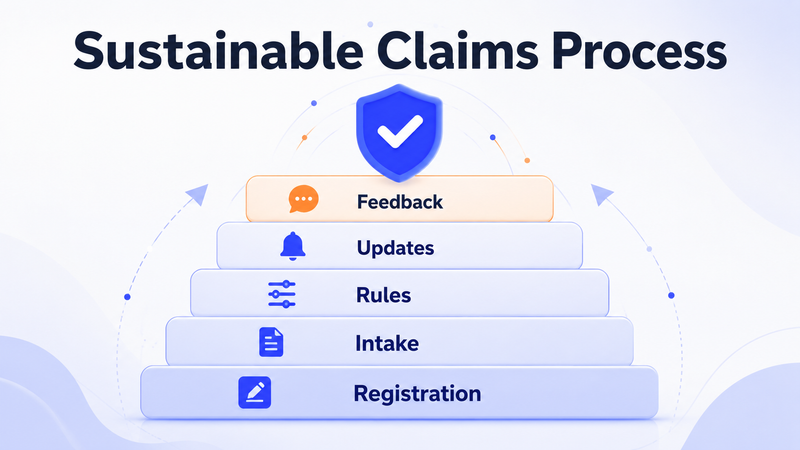
A sustainable warranty claims process is one that holds up as your volume grows, your channel mix expands, and your product range becomes more complex. Most brands build their initial process reactively, optimising for the current volume rather than designing for where they will be in 18 months.
Here is what a sustainable process architecture looks like:
#### **Layer 1: The Registration Foundation**
The most important thing you can do for warranty claims management before a single claim arrives is drive product registration. Every registered product is a piece of purchase data that exists in your system before the customer needs anything. When registration rates are high, eligibility checks are fast, evidence requirements are reduced, and communication is pre-populated with the customer's details.
Building a registration-first process means:
- Including QR codes on all product packaging regardless of where the product is sold
- Making the registration form short: name, email, product, purchase date, purchase channel
- Giving customers a reason to register: digital warranty certificate, product guides, coverage confirmation
- Syncing Shopify DTC orders to registration automatically so your direct buyers are registered without friction
#### **Layer 2: The Claim Intake Structure**
Once registration is in place, claim intake becomes significantly cleaner. Customers who registered can start a claim from their existing product record. Their details pre-fill. The product is already linked. The coverage period is already calculated.
For customers who did not register (which will always be a portion of your base), intake needs to be structured well enough to collect the minimum required data in a single submission.
Your intake form should capture, at minimum: customer email, product name or model, purchase date, purchase channel, defect description, and one photo of the product. Optional but valuable: serial number, order number or invoice, and resolution preference.
#### **Layer 3: The Decision Framework**
Before you handle your first claim in any new system, document your decision rules. This is a one-time investment that pays for itself continuously:
- Which defects are covered under your warranty terms
- Which defects are excluded
- What resolution you offer for each defect category (repair, replace, refund)
- What alternative verification you accept when customers lack proof of purchase
- What your goodwill policy is for out-of-coverage claims where retention warrants an exception
Once documented, these rules train your team consistently. Later, they can be configured into an automated system so routine cases resolve without manual review.
#### **Layer 4: The Communication Cadence**
Set a standard communication timeline and stick to it:
- Acknowledgement: within 2 hours of claim submission (automated)
- Eligibility decision or information request: within 24 hours
- Resolution confirmed: within 48 hours for standard cases
- Status updates during repair or replacement: at each shipping milestone
- Claim closed: within 24 hours of resolution delivery
Customers who know what to expect from your process are significantly more forgiving when timelines extend slightly. Customers who hear nothing for days escalate regardless of the ultimate resolution.
#### **Layer 5: The Feedback Loop**
Close the loop by reviewing claim data monthly. Look for:
- SKUs with above-average claim rates
- Defect types that appear repeatedly across the same product
- Channels generating disproportionately high claim rates (which may indicate a quality or logistics issue specific to that channel)
- Resolution cost trends over time
This review is a 30-minute monthly exercise if your data is structured. It is the mechanism that turns warranty claims from a pure cost line into a product quality signal.
## What to Look for in a Warranty Claims Management System
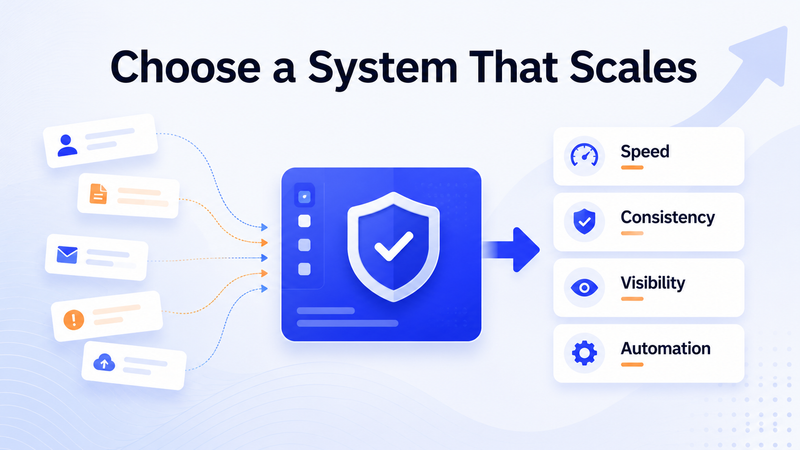
Now, if your volume, complexity, or omnichannel reach has outgrown a manual process, here is how to [evaluate software options](https://www.neurowarranty.com/blog/best-warranty-management-software). The criteria below are written specifically for product brands, not enterprise manufacturers or home warranty companies.
#### **Omnichannel Claim Intake**
[A system built for DTC Shopify brands](https://www.dyrect.co/blog/best-warranty-management-software) may handle online order-linked claims well but struggle with retail buyers, marketplace customers, or customers who bought through a distributor. Look for platforms that offer QR-based registration linked to the claims workflow, so customers from any channel can be identified and verified at claim time.
If the platform requires an order number to initiate a claim, it will fail for every customer who bought outside your direct store.
#### **Automated Eligibility Checks Tied to Real Product Data**
The system should be able to verify warranty coverage automatically, without a team member reading a date on a screenshot. This requires the platform to hold your product catalogue, warranty terms by SKU, and purchase records from registered customers. When a claim comes in, the system checks coverage and either validates or flags it before your team sees it.
Platforms that rely on manual eligibility verification remove most of the operational benefit of having software in the first place.
#### **Configurable Resolution Workflows**
Your resolution logic is specific to your product range, warranty terms, and operational setup. The platform needs to be configurable to your rules, rather than forcing your process into its default workflow. Look for the ability to set decision rules by product category, claim value, and defect type, and to route complex cases to specific team members.
[Dyrect](https://www.neurowarranty.com/blog/dyrect-warranty-management-system-review) handles this through configurable claim stages, team assignment, and status tracking that gives service teams visibility across all open claims without switching between tools.
#### **Customer-Facing Status Tracking**
Customers want to know where their claim is without contacting support. A self-serve portal or automated notification sequence that updates claim status at each stage reduces inbound support volume on open claims and improves the experience significantly.
Look for platforms that send automated notifications at claim submission, eligibility decision, resolution confirmed, and closure, with the ability to customise the message content to your brand voice.
#### **Analytics That Feed Back Into Product and Operations**
The data from your claims should be accessible and usable, covering claim volume by SKU, defect type distribution, resolution cost per claim, average cycle time, and approval rate. If the platform produces only a raw list of tickets, you are doing the analysis yourself in a spreadsheet, which defeats part of the purpose.
Look for dashboards that surface defect patterns at the SKU level, so your product and operations teams can act on quality signals without a manual data pull each time.
## Frequently Asked Questions
#### **What is warranty claims management?**
Warranty claims management is the operational process of receiving, verifying, resolving, and recording customer requests for coverage under a product warranty. It covers every stage from the moment a customer reports a problem to the moment the claim is closed and the outcome is recorded. For product brands, this typically involves claim intake, eligibility verification, evidence collection, a resolution decision, customer communication, and data capture. Brands manage this process manually through email and spreadsheets at low volume, and through dedicated software systems at higher volume or greater channel complexity.
#### **How is warranty claims management different from returns management?**
Returns management handles post-purchase decisions driven by customer preference, size issues, or arrival damage, typically within a short return window. Warranty claims management handles product failures and defects that arise during the warranty period, which may be months or years after purchase. The two processes overlap at the resolution stage (both may result in replacement or refund) but differ significantly in workflow: warranty claims require eligibility verification, evidence of defect, and coverage confirmation before resolution can proceed. Returns typically require only confirmation of the return window and product condition.
#### **At what point does manual warranty claims management stop working?**
Manual management holds up reasonably well below 30 to 50 claims per month for brands with a simple product range and primarily DTC sales. Above that threshold, resolution times lengthen, communication consistency degrades, and team time on warranty work begins to exceed the cost of software. The threshold drops significantly for omnichannel brands, where manual eligibility checks on marketplace or retail purchases add 20 to 40 minutes of team time per claim.
#### **How does product registration affect the warranty claims process?**
[Product registration](https://www.dyrect.co/product/product-registration-software) is the single most effective investment you can make in your claims process before any claim event occurs. When customers register, they provide their contact details, purchase information, and product data. This record exists in your system before they need anything. At claim time, registration data allows automatic eligibility checks, faster intake, and pre-populated communication. Brands with registration rates above 30 percent see measurably faster average resolution times compared to brands where most customers arrive at claim time with missing purchase data.
#### **What information should a warranty claim form collect?**
At minimum: customer name, email address, product name or model number, purchase date, purchase channel (where the product was bought), a description of the defect or problem, and at least one photo of the affected product. For higher-value claims: serial number, order number or invoice upload, and resolution preference. The goal is to collect everything your team needs to make an eligibility decision in a single submission, so the first reply from your team is the decision, not a request for more information.
#### **How long should a warranty claim take to resolve?**
For straightforward claims where the customer submits complete information: 24 to 48 hours from submission to resolution confirmation. For claims requiring additional evidence or manual review: 3 to 5 business days. For claims involving physical repair: dependent on logistics, but the brand's communication timeline should set clear expectations at each stage. Narvar data indicates close to 60 percent of customers expect warranty issues resolved within 24 to 48 hours, and satisfaction drops steeply when resolution time exceeds 5 days with limited communication.
#### **How do omnichannel brands handle warranty claims from retail or marketplace buyers?**
Retail and marketplace buyers arrive without order records in your system. The most reliable approach is a QR-code-based registration flow on product packaging that captures purchase data at activation, before any claim event. For customers who skipped registration, alternative verification can include a photo of the retail receipt, a screenshot of the marketplace order confirmation, or serial number lookup against your product database. Documenting which alternative verification methods your brand accepts, and applying them consistently, prevents case-by-case disputes and inconsistent decisions.
#### **What does warranty claims data reveal about product quality?**
Every claim contains a signal about the product: which component failed, how long after purchase the failure occurred, and how common that failure mode is across the installed base. When claim data is structured and reviewed regularly, SKUs with above-average claim rates become visible quickly. Recurring defect types on the same product point to a manufacturing or design issue that the product team can investigate. Brands that use claim data actively spend less on warranty over time because they catch quality issues before they scale, rather than after they have produced hundreds of resolved claims.
#### **Should warranty claims management software integrate with Shopify?**
For Shopify brands, integration with the store is genuinely useful. When the [claims management platform](https://www.dyrect.co/guide/warranty-management-software) syncs with Shopify order data, DTC customers can be verified automatically at claim time using their order number or email. Replacement orders can be generated in Shopify directly from an approved claim without manual steps. Dyrect's Shopify integration connects product registrations, warranty records, and claims data to order history and customer profiles, so the support team works from one view rather than switching between Shopify admin and a separate claims tool.
#### **What is the difference between warranty claims management and after-sales service?**
After-sales service is the broader category covering everything a brand does for a customer after the sale: product education, customer support, warranty coverage, extended warranty, repairs, replacements, accessories, loyalty programs, and repurchase opportunities. Warranty claims management is the specific operational discipline within after-sales that handles defect-related requests under warranty coverage. Brands that treat warranty claims as part of a connected after-sales system, rather than as an isolated support function, typically generate more repeat revenue from the post-purchase relationship.
---
This blog is powered by Superblog. Visit https://superblog.ai to know more.
---
## How to Build a Scalable Warranty Management Process for 2026 and Beyond
Author: Abhishek Agrawal
Author URL: https://www.neurowarranty.com/blog/author/abhishek-agrawal
Published: 2026-07-08
Category: Warranty Management
Category URL: https://www.neurowarranty.com/blog/category/warranty-management
Tags: Warranty Management Process, Warranty Management Software
Tag URLs: Warranty Management Process (https://www.neurowarranty.com/blog/tag/warranty-management-process), Warranty Management Software (https://www.neurowarranty.com/blog/tag/warranty-management-software)
URL: https://www.neurowarranty.com/blog/how-to-build-a-scalable-warranty-management-process-for-2026-and-beyond
## TL;DR
> Building a warranty management process that scales means moving through six stages: warranty policy definition, product registration, claims intake, validation and approval, resolution and fulfillment, and ongoing analytics. Each stage compounds on the previous one. Skip or weaken any of them and the cracks show up fast as volume grows.
>
> If you want to automate this entire process without stitching together spreadsheets, helpdesk tickets, and manual follow-ups, [Dyrect](https://www.dyrect.co/product/warranty-registration-software) is the purpose-built [warranty management software](https://www.dyrect.co/guide/warranty-management-software) for D2C and Shopify brands. It handles product registration via QR code, automated claims workflows, serial number validation, resolution tracking, and post-purchase analytics in one system, so your team stops doing warranty detective work and starts running a process that actually scales.
Every D2C brand eventually hits the same wall. Orders are growing, products are shipping, and somewhere in between, warranty requests start arriving - in email inboxes, in DMs, in support tickets with no order number attached and no way to verify coverage without hunting through three spreadsheets.
And the response, usually, is to add another column to the sheet.
For a while, that works. Then it doesn't. A claim sits in a folder for two weeks. A customer emails for the fourth time. Someone on the ops team realizes they have no idea how many claims are open right now, let alone how long they've been pending.
This isn't a staffing problem. It's a process problem. And the fix isn't hiring another support agent, it's building a plan for warranty management designed to scale before you need it to.
This guide walks you through what a scalable warranty management process actually looks like, stage by stage, and what separates brands that handle warranty well from the ones that let it quietly erode customer trust.
## What Is Warranty Management (And Why the Standard Definition Misses the Point)
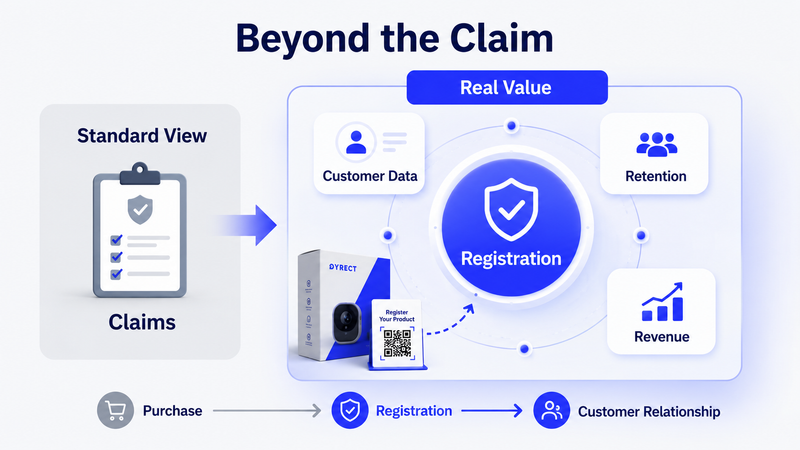
_Most definitions of warranty management sound like this: the process of tracking and administering product warranties, from registration to claims resolution. Accurate. Also dangerously incomplete._
For a D2C or [Shopify-native brand](https://www.neurowarranty.com/blog/best-shopify-apps-for-warranty-management-compared-2026), warranty management is more than claims processing. It's the only structured post-purchase touchpoint you own. Your customer bought the product. You shipped it. And then, unless something breaks, you never talk to them again.
Warranty registration is the moment in between. It's when a customer takes an action to connect with your brand after the sale. If your warranty management process is well-designed, that moment becomes a source of first-party data, a CRM touchpoint, a repeat purchase trigger, and a customer satisfaction signal. If it's poorly designed, or doesn't exist as a designed process at all, that moment never happens.
[Industry data](https://www.nector.io/blog/where-do-all-the-warranties-go-why-most-brands-lose-touch-after-purchase) puts average warranty registration rates below 10% for brands using traditional methods. Over 90% of your customers disappear after the purchase. You don't know who they are. You can't market to them. You can't identify defect trends early. You can't offer extended warranty upsells. The sale closes, and the relationship quietly dies.
**Building a warranty management process that scales isn't just an operational goal. It's a retention and revenue decision.**
## The Warranty Management Process: Six Stages Every Brand Needs
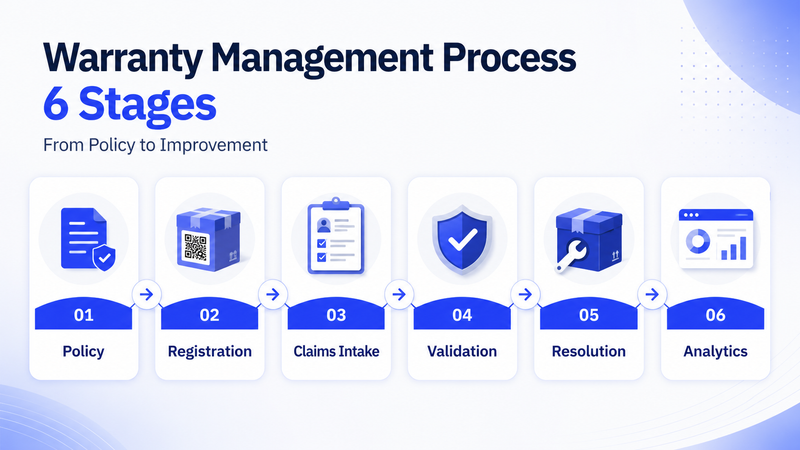
A well-built warranty management process moves through six clearly defined stages. Each one builds on the previous. Skipping or weakening any stage creates problems that compound over time.
### Stage 1: Warranty Policy Definition
Before you can manage warranties, you need to know what your warranty actually covers. This sounds obvious. Yet the default for growing product brands is to write warranty terms vaguely, on the fly, usually copied from another brand's website.
Your warranty policy needs to answer five questions clearly:
**What's covered?** Manufacturing defects, workmanship failures, component failures under normal use. Be specific about product categories if you sell multiple SKUs with different durability profiles.
**What's excluded?** Accidental damage, misuse, unauthorized modifications, normal wear and tear. Clear exclusions protect you from fraudulent claims and set honest expectations with customers.
**For how long?** Duration varies by product category. Consumer electronics typically run one to two years. Appliances can run longer. If you're considering a lifetime warranty as a differentiator, factor in the claims cost modeling before committing.
**What's the remedy?** Repair, replacement, or refund. Define the hierarchy. What gets repaired versus replaced? Under what conditions do you issue a full refund? Ambiguity here creates inconsistency in claims handling and customer frustration.
**How does a customer claim it?** Define the process upfront. Customers shouldn't have to guess whether to email support, fill a form, or call a number.
A clear warranty policy isn't just legal protection. It's the foundation of a consistent claims process. Without it, every claim becomes a judgment call. At low volume, that's manageable. At scale, it's chaos.
### Stage 2: Product Registration
Product registration is where the warranty management process actually begins for your customer. It's also where the buyer relationship either forms or quietly disappears.
Traditional warranty registration involves a paper card in the box, an email instruction, or a link buried in the order confirmation. The registration rate for these methods is typically below 10%. Customers either don't notice, don't bother, or don't complete the form before they forget about it.
The shift that changes this is reducing friction to near zero. QR code-based registration on packaging or inside the box lets a customer register their product in under a minute from their phone. No login required, no long form, no manual serial entry. They scan, confirm, done. Brands using this approach see dramatically higher registration rates.
Registration data is the operational backbone of everything that follows. When a customer registers, you capture their contact information, purchase date, product SKU, and serial number in one go. That data feeds your claims validation process, your CRM, your defect analysis, and your re-engagement campaigns. Without it, every claim that comes in starts from scratch: you have to verify everything manually, hope the customer kept their receipt, and cross-reference order systems one by one.
Equally important: Shopify order data only captures customers who bought directly from your store. If you sell through retail, Amazon, distributors, or offline events, warranty registration is the only mechanism for capturing those buyers into your system. Brands without a registration process for offline buyers are operating with a significant blind spot into who actually owns their products.
### Stage 3: Claims Intake
When a customer has a problem, how they file a claim shapes the entire experience. A slow, confusing intake process is where warranty operations first break under pressure.
At low volume, email works. Customers write in, your team replies, things get resolved. But email is unstructured. Every claim arrives in a different format. Some customers include serial numbers. Some don't. Some attach photos. Some send three follow-ups before you've even read the first message. Your team spends time gathering information instead of resolving issues.
A scalable claims intake process does two things. First, it gives the customer a structured path to submit a claim: a form that captures serial number, issue description, photo evidence, and purchase proof upfront, rather than chasing for it afterward. Second, it routes incoming claims automatically based on predefined rules, by product type, issue category, and claim value, so the right person gets the right claim without manual triage.
The registration data you captured in Stage 2 is what makes intake fast. When a customer has already registered their product, your system can pre-fill the claim form with their product details and warranty coverage dates. Validation becomes instant. You already know what they own and when they bought it. The customer just describes the problem.
Without that registration foundation, every claim intake restarts the verification process from zero.
### Stage 4: Validation and Approval
Claim validation is where brands bleed time and money if the process isn't structured. Validating a claim means confirming three things: the customer owns the product, the product is within the warranty period, and the reported issue falls within warranty coverage.
Manually, this means checking order records, cross-referencing serial numbers, reviewing photos, and making judgment calls on whether an issue is a manufacturing defect or accidental damage. For a support team handling dozens of claims daily, that's a half-day task before you've resolved a single one.
Automated validation connects claim submissions directly to your product and order database. When a claim comes in, the system checks coverage dates, validates serial numbers, and flags out-of-scope issues automatically. Claims that pass validation move to the next stage. Claims that don't pass get a structured response, not a vague email from whoever happened to open the inbox that morning.
Serial number validation is particularly important for electronics, appliances, and any product category prone to fraudulent claims. Without it, you're relying on customer-provided information and the judgment of individual team members. With it, you have a verifiable audit trail for every decision.
**Claim approval rates typically run between 70% and 85% for well-managed warranty programs.** Below 70% often indicates overly restrictive policies or poor communication of what's covered. Above 90% may signal insufficient validation. Tracking this number over time tells you whether your policy and process are calibrated correctly.
### Stage 5: Resolution and Fulfillment
Resolution is what the customer actually experiences. Everything before this is internal. This is where the warranty promise becomes real.
Resolution pathways split into three main tracks: repair, replacement, or refund. Each requires a different operational workflow. Repair typically involves a return shipping label, service center routing, and a defined turnaround time. Replacement triggers inventory allocation and outbound logistics. Refund involves payment processing and, often, product return.
Customer satisfaction at this stage doesn't live or die on which resolution path you take. It lives or dies on communication. Customers filing warranty claims are already in a moment of frustration. A claim they can't track, an update they have to chase, or a timeline you can't clearly communicate makes the experience worse, not just neutral.
A scalable resolution process keeps the customer informed at every status change. Claim received. Validation complete. Replacement approved. Shipped. Delivered. Each status triggers an automated notification so your team isn't fielding status calls while trying to process the actual resolution.
Define your resolution SLAs before you need them. What's your target turnaround for standard claims? For high-value claims? For cases that require repair rather than replacement? Setting these internally means you can measure against them, and communicating them to customers sets expectations that prevent the "why is this taking so long" follow-up.
### Stage 6: Data, Analytics, and Continuous Improvement
Warranty resolution isn't the end of the process. The data from every claim you receive is operational intelligence, and the brands that treat it that way compound an advantage over time.
Claim data tells you which SKUs are generating the most failures and why. It tells you whether a defect pattern is product-design related or manufacturing-process related. It tells you which resolution types cost the most, which suppliers are generating above-average warranty returns, and whether your claims rate is trending up or down over time.
**Brands that close the loop between warranty data and product development consistently reduce their claims rate over time.** They catch defects earlier, fix them faster, and design the next product version with real-world failure data rather than assumptions.
Beyond product quality, registration and claims data feeds your marketing layer. A customer who registered their product eight months ago and is now approaching their warranty expiration is a natural candidate for an extended warranty offer. A customer who filed a claim six weeks ago and had it resolved quickly is a candidate for a re-engagement sequence. Warranty data, when connected to your CRM and marketing tools, becomes a retention engine.
## What a Warranty Management Plan Should Include
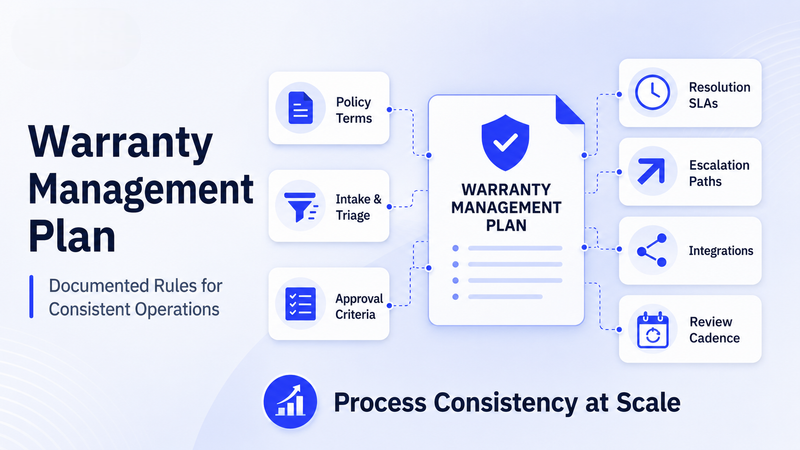
A warranty management plan is the documented framework that governs how your warranty process operates. Not the software. The operational rules that the software runs on.
Your warranty management plan should cover:
**Policy terms.** What's covered, what's excluded, duration, and remedy structure. This lives as a customer-facing document on your website and as an internal reference for your claims team.
**Intake and triage rules.** Which channels do claims come through? How are they classified? Who handles high-value claims versus standard ones?
**Approval criteria.** What does your team check to validate a claim? In what order? What qualifies as an acceptable photo of damage? What serial number format are you validating against?
**Resolution SLAs.** Repair turnaround targets. Replacement shipping timelines. Refund processing windows. These become your measurable service standards.
**Escalation paths.** What happens when a claim falls outside standard coverage? Who makes the call on grey-area cases? How are high-value or high-profile cases escalated?
**Integration with other systems.** How does warranty data flow to your CRM? Your helpdesk? Your inventory and logistics tools? Gaps here create data silos that undermine every other part of the process.
**Review cadence.** How often do you review your claim data for product defect trends? Who owns that review? What triggers a policy update?
Without a documented plan, your warranty management process is only as good as your best team member's memory. When they're off, or when volume spikes, consistency breaks down.
## Signs Your Warranty Process Is Breaking Down
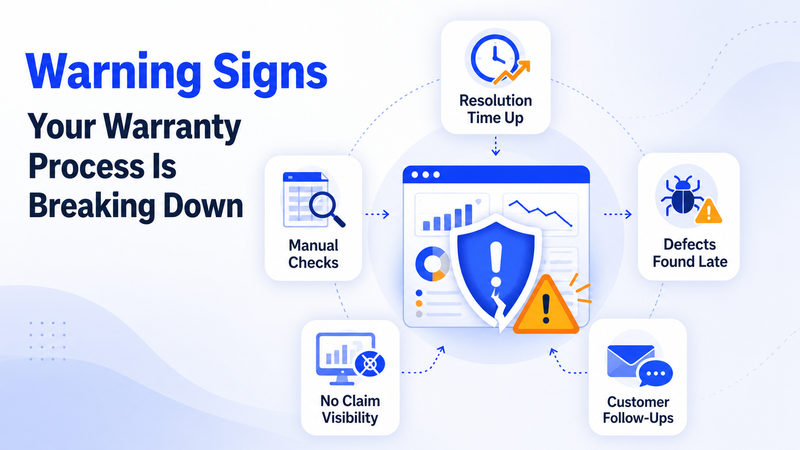
The breakdown rarely announces itself. It happens gradually, claim by claim, until the symptoms are obvious and the damage to customer experience is already done.
Watch for these signals:
**Resolution time keeps creeping up.** If average time to resolve a claim was four days six months ago and is now nine days, your process hasn't scaled with volume. The manual steps that were fast at low volume are now bottlenecks.
**Your team is doing detective work on every claim.** If someone has to log into Shopify, search an order, export a CSV, open a spreadsheet, and cross-reference a serial number just to confirm a customer is covered, that's improvised verification, not a process. At scale, it breaks.
**You're finding out about product defects from customers, not from your data.** If a quality issue reaches ten claims before anyone flags it as a pattern, your analytics layer isn't working. You're reactive instead of proactive.
**Warranty claim volume is a black box to leadership.** If the CEO asks "how many claims did we resolve last month" and the answer requires someone to count rows in a spreadsheet, your reporting is broken.
**Customers are following up on their own claims.** Every follow-up email a customer has to send is a signal of process failure. If claim status check-ins are generating support tickets, your communication loop isn't closed.
## What Are the KPIs for Warranty Management?
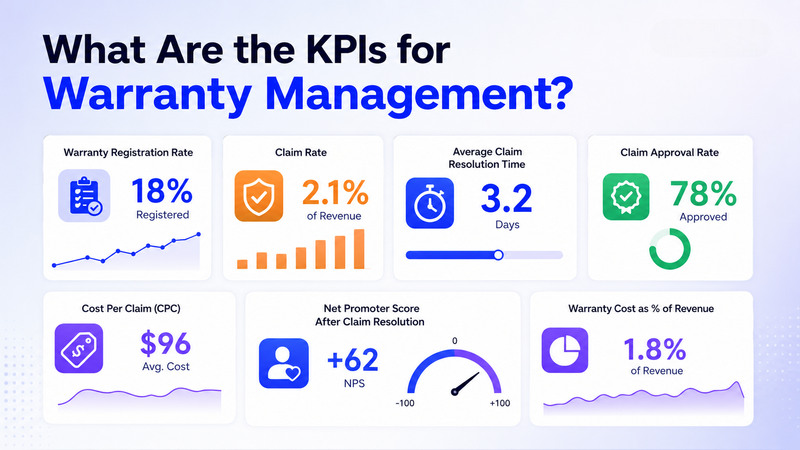
Tracking the right metrics is what separates a warranty program that improves over time from one that just processes claims and moves on. These are the core KPIs every brand running a warranty management process should measure.
### Warranty Registration Rate
The percentage of products sold that are registered by customers. Low registration rates, below 15–20% for D2C brands using digital methods, indicate friction in the registration experience, insufficient post-purchase communication, or both.
This is the leading indicator for everything downstream. Low registration means incomplete data, harder claim validation, and weaker post-purchase engagement.
### **Claim Rate (** Warranty **Claims Rate)**
The percentage of products sold within a given period that generate a warranty claim. Industry ranges typically run from [0.5% to 5% of revenue](https://www.warrantyweek.com/archive/ww20190627.html), varying significantly by product category.
Monitoring claim rate by SKU and over time tells you whether product quality is improving, whether a specific batch has a defect issue, and how your overall warranty cost burden is trending relative to revenue.
### **Average Claim** Resolution **Time**
The average time from claim submission to final resolution, whether that's a repair delivered, replacement shipped, or refund issued. This is the single most important operational efficiency metric in warranty management.
Automated systems can close standard claims in 2–3 days. Manual processes typically average 7–14 days. The gap compounds at scale. A brand resolving 500 claims a month with a 10-day average is carrying significantly more in-progress claims at any given moment than one averaging 3 days.
### **Claim Approval** **Rate**
The percentage of submitted claims that are approved. The benchmark is 70–85% for well-run programs. Below 70% signals either overly strict policies or poor upfront communication of what's covered, leading customers to file claims they shouldn't expect to win. Above 90% may indicate insufficient validation.
### **Cost Per** Claim **(CPC)**
Total warranty costs divided by the number of claims processed in a period. This includes replacement parts or products, shipping, labor, and any third-party service costs. CPC is the primary metric for warranty budget management and extended warranty pricing decisions.
### **Net Promoter** Score **After Claim Resolution**
Post-claim NPS is one of the strongest predictors of long-term customer value. Research supports what's known as the [service recovery paradox](https://en.wikipedia.org/wiki/Service_recovery_paradox): customers whose problems are resolved quickly and generously often become more loyal than customers who never had an issue at all. A post-claim NPS of +50 to +70 indicates your warranty experience is a competitive advantage. Negative NPS means claims are actively driving customers away.
### **Warranty Cost** as **Percentage of Revenue**
The executive-level metric that connects warranty operations to business profitability. It answers: how much of every dollar earned goes back into fulfilling the warranty promise? This figure typically runs between 0.5% and 5% depending on category. Reducing it over time, through better product quality and process efficiency, is the long-term goal.
## How to Scale Your Warranty Management Process
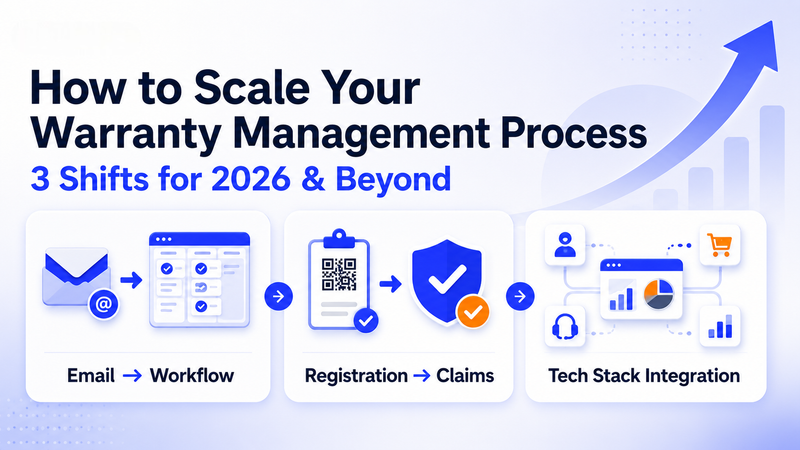
The six process stages above give you the framework. Scaling requires three additional shifts in how you think about and operate warranty management.
### **Move From** Email **to Structured Workflow**
Email-based claims handling has a ceiling. It works for the first 50 claims a month. By 200, it's showing cracks. By 500, it's consuming your support team. The shift to a structured workflow means claims arrive through a defined intake form, route automatically to the right team or stage, trigger automated communications at each status change, and live in a single system that everyone can see in real time.
This isn't about adding headcount. It's about ensuring the same person who's handling 50 claims today can handle 300 tomorrow without the process breaking.
### **Connect** Registration **to Claims**
The biggest efficiency gain in any warranty management system comes from linking registration data to the claims process. When a customer's product information is already in the system, claim validation takes seconds instead of minutes. There's nothing to look up, cross-reference, or verify manually. The data is already there.
Brands that implement [QR code-based product registration](https://www.dyrect.co/product/product-registration-software) see higher registration rates, faster claims processing, and cleaner product data compared to brands relying on email-in or paper-based registration. The registration investment pays dividends every time a claim comes in.
### **Integrate** Warranty **With Your Tech Stack**
A warranty management process that lives in its own silo creates data gaps everywhere else. Warranty events should flow into your CRM so your marketing team knows when a customer registered, filed a claim, or is approaching expiration. Claims data should connect to your helpdesk so support agents have context before they reply. Registration data should inform your product team's defect analysis.
[Dyrect integrates with Klaviyo, Mailchimp, Zendesk, Zoho Desk, and Shopify](https://www.dyrect.co/integrations), which means warranty events automatically trigger the right downstream workflows: re-engagement emails at registration, claim status updates through your helpdesk, and expiry-based extended warranty offers through your marketing stack, without anyone manually moving data between systems.
## How Dyrect Builds a Warranty Management Process That Scales
Dyrect is purpose-built for D2C and Shopify-native brands that need a complete warranty management system, not a generic helpdesk with a claims module bolted on.
### **Product** Registration **That Captures Every Buyer, Not Just Shopify Orders**
Dyrect's [product registration software](https://www.dyrect.co/product/product-registration-software) supports QR code-based registration from packaging, website registration flows, and automatic registration for Shopify orders. A customer who bought from your website gets registered automatically. A customer who bought from a retailer, Amazon, or a trade show scans the QR code on the box and registers in under a minute.
This matters because Shopify order data only tells you about direct online buyers. For any brand with omnichannel distribution, the gap between "units shipped" and "customers registered" represents a lost audience. Dyrect closes that gap by giving every buyer a path to register, regardless of where they purchased.
Once registered, customers receive a digital warranty card that lives in their phone. No physical card to lose, no email to search for. Every registration becomes a verified customer record tied to a specific product and purchase date.
##### **Claims Management Built for Volume**
[Dyrect's claims management system](https://www.dyrect.co/product/warranty-registration-software) routes, validates, and tracks every claim through a structured workflow. When a registered customer files a claim, their product details are pre-filled. Automated validation checks coverage eligibility, serial number, and claim completeness before it ever reaches your team. Claims that pass route to the right approval stage based on your defined workflow. Claims that don't pass generate a clear, consistent response.
Your team gets a single dashboard showing every claim's current status, assigned owner, and time in queue. No spreadsheet. No inbox search. No manual cross-referencing across four different systems to answer the question "where is this customer's claim right now?"
Customizable approval workflows mean you can define different handling paths for different claim types. High-value claims route to senior review. Standard claims auto-approve against predefined criteria. Repair cases generate RMAs. Replacement cases trigger inventory allocation. Everything moves through defined stages, not ad hoc email chains.
##### **Analytics That Connect Warranty to Product and Revenue**
Dyrect's reporting layer goes beyond claim counts. Brands get visibility into registration rates by product, claim rates by SKU, resolution time by claim type, and defect pattern analysis across their product range. When a specific SKU starts showing an elevated claim rate, the analytics surface it before it becomes a customer experience problem.
On the revenue side, Dyrect connects warranty registration to extended warranty and ownership experience workflows. A customer who registers a product is a high-intent audience. Dyrect lets you trigger extended warranty offers, cross-sell campaigns, and loyalty touchpoints directly from the registration and claim journey, turning the post-purchase experience from a cost line into a revenue channel.
## FAQs
Q: What is a warranty management process?
A: A warranty management process is the end-to-end operational framework a brand uses to handle everything that happens after a product is sold. It covers warranty policy definition, product registration, claims intake, validation and approval, resolution and fulfillment, and data analysis. A structured process ensures claims are handled consistently, resolution times are predictable, and warranty data feeds back into product quality and customer retention decisions.
Q: What should a warranty management plan include?
A: A warranty management plan should document your warranty policy terms, claims intake and triage rules, approval criteria, resolution SLAs, escalation paths, system integrations, and review cadence. It's the operational rulebook that governs how your warranty process runs day to day. Without a documented plan, process consistency depends entirely on individual team members rather than defined standards.
Q: What are the KPIs for warranty management?
A: The core KPIs for warranty management are: warranty registration rate, claim rate as a percentage of units sold, average claim resolution time, claim approval rate, cost per claim, post-claim NPS, and warranty cost as a percentage of revenue. Tracking these consistently over time lets you identify where the process is performing well and where efficiency or quality improvements are needed.
Q: How do I increase my warranty registration rate?
A: The biggest driver of registration rate is reducing friction. QR code-based registration that takes under one minute significantly outperforms email links, paper cards, or manual entry flows. Communication timing matters too: a prompt on the product packaging, in the unboxing experience, and in a post-delivery email gives customers multiple chances to register. Brands using Dyrect's QR-based registration flows consistently see higher registration rates than those using traditional methods.
Q: What is warranty management software?
A: Warranty management software is a dedicated platform that handles product registration, warranty tracking, claims validation, resolution workflows, and analytics in one system. It replaces the combination of spreadsheets, email inboxes, and manual verification that brands rely on at low volume. As claim volumes grow, purpose-built warranty management software ensures consistency, reduces resolution time, and gives teams real-time visibility into their warranty operations.
Q: When should a D2C brand move from manual to dedicated warranty management software?
A: The tipping point for growing product brands is somewhere between 100 and 200 warranty interactions per month. Below that, manual processes are manageable with discipline. Above it, the manual overhead starts consuming meaningful support team time, resolution times extend, and data quality degrades. If your team is spending more than a couple of hours per day on warranty administration, a dedicated platform will recover that time and improve the customer experience.
Q: What's the difference between a warranty and an extended warranty?
A: A standard warranty comes included with the product purchase and covers defects within a defined period, typically one to three years for consumer products. An extended warranty is an additional coverage plan a customer can purchase to extend that coverage beyond the standard period. Extended warranties are a significant revenue opportunity for product brands. AppleCare generates over $8.5 billion annually for Apple. D2C brands that structure extended warranty offers into the registration and ownership journey can turn a cost-center function into a direct revenue stream.
Q: How does warranty management connect to first-party data?
A: Every warranty registration is a verified data collection event. The customer provides their contact information, product details, and purchase date in exchange for activating their warranty coverage. For brands dealing with the ongoing decline of third-party cookie tracking, warranty registration is one of the highest-intent first-party data moments in the entire customer journey. Platforms like Dyrect connect registration data directly to CRM and marketing tools so that data flows immediately into segmentation, re-engagement, and lifecycle campaigns.
Q: Can warranty management software integrate with Shopify?
A: Yes. Dedicated warranty management platforms like Dyrect integrate directly with Shopify to automatically register customers from Shopify orders, sync product data, and connect warranty events to your existing post-purchase workflows. Shopify's native functionality doesn't include warranty management, so a dedicated integration is the standard approach for Shopify-native D2C brands.
Q: What's a good average warranty claim resolution time?
A: For D2C brands, the target should be 3–5 business days for standard claims and 7–10 days for claims requiring physical repair. Manual processes typically average 7–14 days across all claim types. Automated warranty management systems with predefined approval workflows consistently bring standard claim resolution times down to 2–3 days. Faster resolution is directly correlated with higher post-claim NPS and repeat purchase rates.
---
This blog is powered by Superblog. Visit https://superblog.ai to know more.
---
## How to Prevent Warranty Fraud in the AI Era (2026 Guide)
Author: Abhishek Agrawal
Author URL: https://www.neurowarranty.com/blog/author/abhishek-agrawal
Published: 2026-06-29
Category: Warranty Management
Category URL: https://www.neurowarranty.com/blog/category/warranty-management
Tags: Warranty Fraud, Warranty Fraud Detection
Tag URLs: Warranty Fraud (https://www.neurowarranty.com/blog/tag/warranty-fraud), Warranty Fraud Detection (https://www.neurowarranty.com/blog/tag/warranty-fraud-detection)
URL: https://www.neurowarranty.com/blog/how-to-stop-warranty-frauds
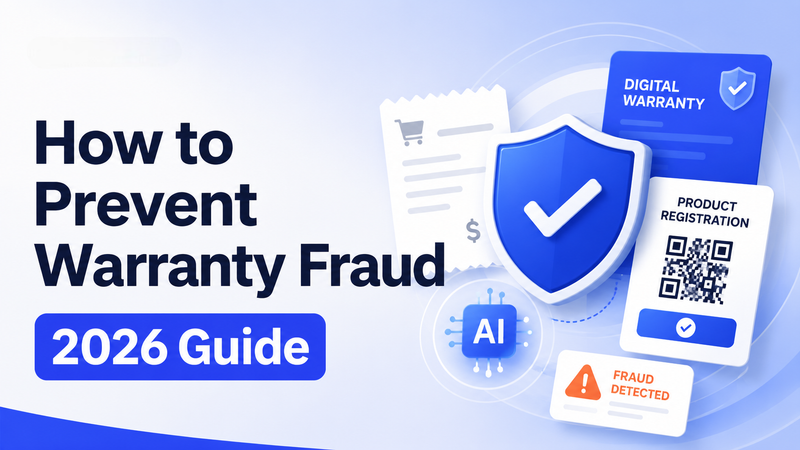
> ### **TL;DR**
>
> Warranty fraud costs brands an estimated $25 billion every year, and AI has made the problem worse. Fraudsters now generate photorealistic fake receipts, fabricate product damage photos, and build synthetic customer identities in seconds.
>
> The most effective approach is prevention at the registration layer. When every product is tied to a verified owner through QR-based registration, serial validation, and proof of purchase capture before any claim is filed, the highest-volume fraud types (serial reuse, fake receipts, unregistered product claims) get blocked at the source.
>
> [Dyrect's digital warranty management platform](https://www.dyrect.co/product/warranty-management-software) handles this end-to-end: registration, serial validation, digital warranty cards, and automated claims eligibility. It gives brands a single system to prevent fraud while keeping the experience seamless for real customers.
What used to take a fraudster an hour, forging a receipt, faking a damage photo, now takes 30 seconds. AI-generated fake receipts went from [0% to 70.8%](https://www.forbes.com/sites/jamesbroughel/2026/06/28/ai-generated-fake-receipts-are-changing-expense-fraud/) of all flagged fraud documents in just 14 months. **Warranty fraud prevention** in 2026 is a fundamentally different challenge than it was two years ago.
The old playbook of manual claim reviews and gut-feel approvals can't keep up. Fraudsters now use generative AI to create photorealistic thermal-paper receipts, submit doctored images of "damaged" products, and spin up synthetic customer identities at scale. Meanwhile, legitimate customers get caught in the crossfire when your team tightens approvals out of fear.
This guide covers every fraud type your brand faces today, the new AI-powered tactics reshaping the threat, the detection methods worth investing in, and the step-by-step prevention system that stops fraudulent warranty claims before payout. Whether you're processing 50 claims per month or 5,000, the framework works the same way.
## What Is Warranty Fraud?
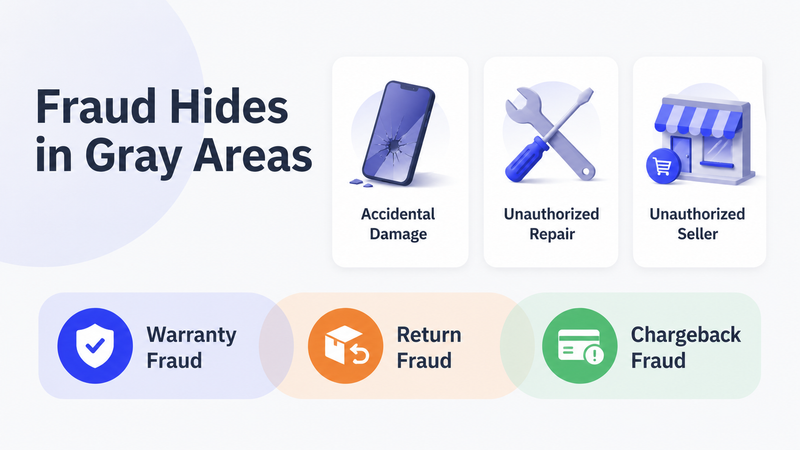
Warranty fraud happens when someone intentionally misrepresents facts to receive warranty benefits they're entitled to under your brand's terms. The legal definition varies by market, but the operational definition stays consistent.
Three conditions make a warranty claim fraudulent:
1. **The claim misrepresents a fact.** The customer says the product failed under normal use. In reality, they dropped it.
2. **The misrepresentation is material.** It changes the outcome of the claim decision.
3. **Your brand acts on it.** The fraud completes when the payout, replacement, or credit goes out.
Here's what makes warranty fraud especially difficult to manage: most of your losses come from gray-area cases, rather than obvious fakes. Accidental damage claimed as manufacturing defects. Unauthorized repairs repackaged as warranty-eligible issues. Products bought through unauthorized sellers submitted under your brand's official warranty.
Your claims team faces these judgment calls daily. Without clear validation systems, gray-area calls trend toward approval because your team would rather err on the side of customer satisfaction. Fraudsters know this, and they exploit the approval bias systematically.
**Warranty fraud vs. return fraud vs. chargeback fraud:** these three overlap but differ in mechanics. Return fraud exploits your return policy (wardrobing, empty box returns, counterfeit swaps). Chargeback fraud uses the bank dispute process to reverse legitimate charges. Warranty fraud specifically targets your warranty program, claiming benefits for repairs, replacements, or credits under warranty terms. Many organized fraud operations hit all three simultaneously.
## How Much Does Warranty Fraud Cost Brands in 2026?
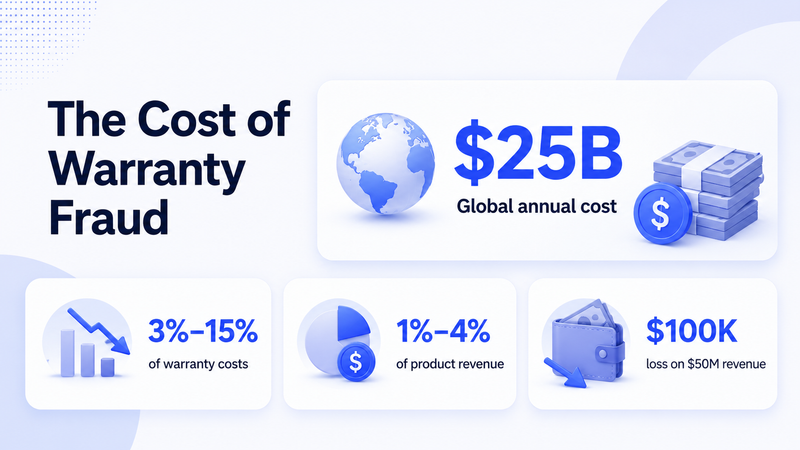
Industry estimates put the annual cost of fraudulent warranty claims at [**$25 billion globally**](https://paulcurwell.com/2025/09/09/the-25-billion-question-how-much-are-you-losing-to-warranty-fraud/). For individual brands, the math is stark: **3% to 15% of total warranty costs are attributed to fraud**, depending on your product category and sales channels.
For context, [warranty costs typically run 1% to 4% of total product sales revenue](https://www.warrantyweek.com/archive/ww20190620.html). If your brand does $50 million in annual revenue with a 2% warranty cost ($1 million), and 10% of those claims are fraudulent, you're losing $100,000 per year on warranty fraud alone. Scale that to a billion-dollar brand, and the [losses reach **$30 to $50 million annually**](https://www.darra.ai/blog/warranty-fraud-2024-analysis) when you include direct costs, operational overhead, and brand damage.
But the claim payout is the smallest part of the real cost. Here's where warranty fraud actually bleeds your brand:
**Direct payout cost.** Refunds, replacements, and repairs on illegitimate claims.
**Operational cost.** Every fraudulent claim consumes agent time, quality review cycles, and management attention. Your claims team spends hours investigating instead of serving real customers.
**Inventory disruption.** Fraudulent replacement shipments mess with your stock levels, especially on high-demand SKUs. You're sending products to fraudsters while legitimate customers wait.
**False positive damage.** When fraud rates climb, your team starts denying legitimate claims out of suspicion. Real customers get punished for the behavior of bad actors, and they take their frustration to social media and review platforms.
**Brand trust erosion.** Customers who experience a slow, suspicious, or denied warranty process lose faith in your brand. PwC research shows customers are more inclined to buy from brands with superior post-sales experiences. The inverse is equally true.
## 12 Types of Warranty Fraud Every Brand Should Know
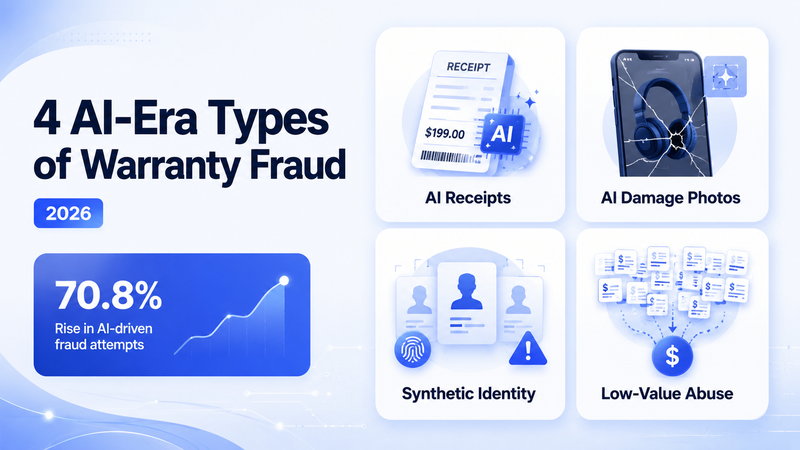
Understanding the full taxonomy matters because each fraud type requires a different detection and prevention approach. Here are the eight classic types and four AI-era additions your brand faces in 2026.
#### **1\. False Defect Claims**
The customer says the product failed. It didn't. The item works perfectly fine, but the customer wants a free replacement or refund. This is the most common type of warranty fraud and the hardest to detect without photo or video evidence requirements at claim intake.
**Red flag:** Claims submitted with vague descriptions like "stopped working" and zero supporting documentation.
#### **2\. Serial Number Tampering and Reuse**
Fraudsters remove, alter, or duplicate serial numbers to make ineligible products appear warranty-eligible. The same serial might show up across multiple customer accounts, or a serial from a genuine product gets applied to a counterfeit unit.
**Red flag:** The same serial number appearing in claims from different customers, different regions, or different purchase dates.
#### **3\. Return Swap Fraud**
The customer files a warranty claim, receives a replacement, and returns the "defective" unit. Except the returned unit is counterfeit, a different (older) product, or has been stripped of valuable components. The fraud closes when nobody checks the returned unit's serial against the original case record.
**Red flag:** Returned units with mismatched serial numbers, missing components, or different manufacturing dates than the original claim.
#### **4\. Backdated Purchase Fraud**
Fraudsters edit receipts or invoices to change the purchase date, making an expired warranty appear active. This was already common with basic Photoshop edits. In 2026, it's dramatically easier (more on that in the AI section below).
**Red flag:** Purchase dates that cluster suspiciously close to the oldest eligible date for warranty coverage.
#### **5\. Intentional Damage Near Warranty Expiry**
The customer deliberately damages a product in the final weeks of warranty coverage to get a free replacement. The new replacement comes with a fresh warranty, effectively extending their coverage indefinitely.
**Red flag:** Unusual spikes in claims submitted within the last 30 days of warranty windows.
#### **6\. Gray Market and Unauthorized Channel Claims**
Products bought through unauthorized resellers, gray market channels, or liquidation outlets get submitted under your brand's official warranty. The customer may have paid a fraction of retail price and expects full warranty service.
**Red flag:** Claims from customers whose purchase channel or region doesn't match your authorized distribution network.
#### **7\. Service Center and Dealer Collusion**
Your own service network becomes the fraud vector. Service centers bill for repairs that didn't happen, inflate labor hours, replace parts that were functioning fine, or collude with customers to split the payout.
**Red flag:** Individual service centers with claim rates significantly above the network average, or repeated high-value repairs on the same product categories.
#### **8\. Supplier-Side Fraud**
Suppliers inflate defect rates in chargeback files, submit duplicate claims, or substitute lower-grade components while billing at original-spec prices. This is the most expensive fraud type because your brand depends on the supplier's own data for chargeback validation.
**Red flag:** Defect rates from a specific supplier that don't match your internal quality data, or chargeback values that consistently exceed expected ranges.
#### **9\. AI-Generated Receipt and Invoice Fraud (New in 2025-2026)**
This is the fastest-growing fraud type in 2026. Fraudsters use generative AI tools like ChatGPT, Gemini, or dedicated image generators to create photorealistic purchase receipts and invoices from scratch. These fakes include thermal paper textures, realistic creases, camera blur, and accurate merchant formatting.
[AppZen platform data](https://www.accountingtoday.com/news/use-of-ai-receipts-in-expense-fraud-soars) shows AI-generated fake receipts accounted for 0% of flagged fraudulent documents in March 2025. By mid-May 2026, that figure reached **70.8%**, based on 1,471 AI-generated fakes from 745 individuals at 174 companies.
**Red flag:** Receipts with perfect formatting but subtle inconsistencies in merchant details, tax calculations, or font rendering. Receipts submitted as images rather than forwarded order confirmation emails.
#### **10\. AI-Manipulated Product Damage Photos (New in 2025-2026)**
Instead of actually damaging a product, fraudsters use AI image editors to add realistic cracks, stains, mold, or malfunctions to photos of perfectly functional items. Brands like Boll & Branch and Bogg have reported surges in AI-doctored damage images submitted as warranty evidence.
Returns abuse driven by AI-doctored images increased **15% in the second half of 2025** alone, and the same tactic applies directly to warranty claims that require photo documentation.
**Red flag:** Damage patterns that look visually perfect but inconsistent with how the product's materials actually fail. Multiple claims from different customers with strikingly similar damage images.
#### **11\. Synthetic Identity Fraud (New in 2025-2026)**
Fraudsters build entirely fabricated customer profiles, combining real and fake identity elements, to file warranty claims at scale. AI tools automate everything from account creation to behavioral patterns across browsing, purchasing, and post-purchase interactions.
One documented fraud ring caused an estimated **$4.2 million in losses within 48 hours** using synthetic identities, spoofed devices, and automated transaction flows reaching 180 per minute.
**Red flag:** Clusters of new customer accounts with similar registration patterns, device fingerprints, or shipping addresses.
#### **12\. Low-Value Threshold Exploitation (New in 2025-2026)**
Fraudsters deliberately keep individual claim values small, typically around $100, to stay below auto-approval thresholds. Each claim looks harmless in isolation. But across hundreds or thousands of small claims filed by a fraud ring, the cumulative losses are massive.
**Red flag:** High volume of small-value claims from accounts with limited purchase history or minimal brand engagement.
## How AI Has Changed Warranty Fraud in 2025-2026
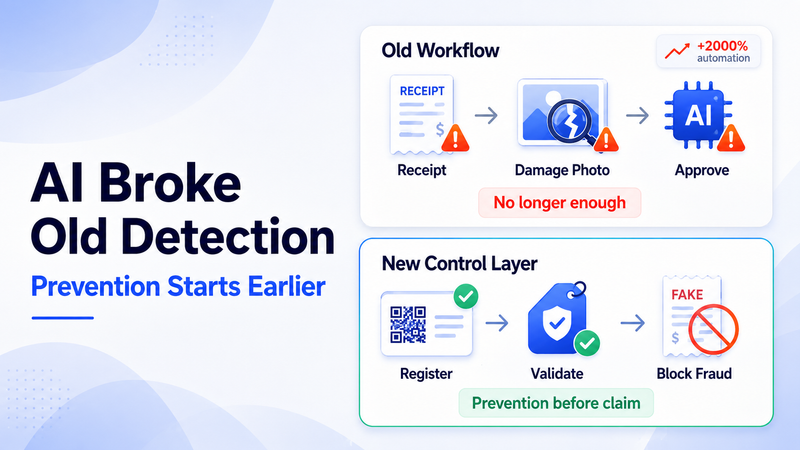
The AI shift deserves its own section because it represents a structural change, rather than an incremental one.
**Before AI (pre-2024),** warranty fraud required effort. Forging a receipt meant Photoshop skills and time. Faking product damage meant physically altering the item. Running multiple claims meant creating and managing separate identities manually. The effort itself acted as a natural deterrent.
**After AI (2025-2026),** the effort barrier collapsed. Here's what changed:
**Receipt generation became instant.** Generative AI tools produce thermal-paper receipts with realistic textures, creases, and camera blur in seconds. Free tools like ChatGPT and Google Gemini handle this with a simple prompt. The fakes are so convincing that one ICAEW expert noted even trained reviewers struggle to distinguish them from originals.
**Damage documentation became fabricated.** AI image editors create convincing photos of product damage: cracks on screens, water stains on fabrics, mold on surfaces, broken components. Brands across consumer products are reporting these in warranty claim submissions.
**Identity creation became scalable.** Synthetic identity tools generate complete customer profiles with matching email addresses, phone numbers, shipping addresses, and behavioral patterns. Fraud rings use these to file claims across multiple accounts simultaneously.
**The volume game shifted.** Agentic AI tools, automated systems designed to execute multi-step workflows, now handle the entire fraud chain: create account, simulate purchase behavior, file claim, submit generated evidence. Over the second half of 2025, agentic activity surged by over 2,000%.
**The detection problem fundamentally changed.** When fraud artifacts (receipts, photos, identities) are AI-generated, the signals your team traditionally looked for disappear. Pixel-level inconsistencies in edited receipts become irrelevant when the receipt was generated from scratch. Metadata checks fail when the image was created by AI rather than captured by a camera.
For warranty teams, this means the old process of "review the receipt, check the photo, approve the claim" is broken. Prevention at the point of product registration, before any claim is filed, becomes the critical control layer.
## How to Detect Warranty Fraud: 3 Methods Compared
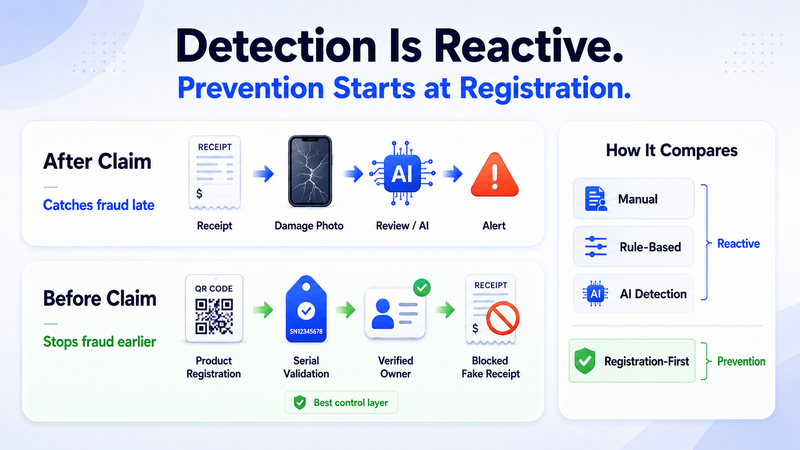
Every brand sits somewhere on the detection maturity curve. Here's what each level catches, what it misses, and when it makes sense.
### Manual Review: What It Catches and What It Misses
Manual review means your claims agents visually inspect receipts, read claim descriptions, and use judgment to approve or deny. It catches obvious fakes: clearly photoshopped receipts, claims on products you've discontinued, or customers who call in with stories that contradict their submitted documentation.
What it misses: patterns across claims. The human reviewer sees each claim in isolation. They can't spot that the same serial number showed up in three different claims this month, or that 40 claims from the same zip code all arrived in the same week. Manual review also fails completely against AI-generated evidence because the fakes look legitimate at the individual claim level.
**Best for:** Very small brands processing fewer than 50 claims per month.
### Rule-Based Systems: The 15-25% Ceiling
Rule-based detection applies predefined flags: duplicate serial numbers, claims exceeding a dollar threshold, claims filed within X days of purchase, or multiple claims from the same email address. These catch structured, pattern-matching fraud.
**The problem:** rule-based systems catch **15 to 25% of fraud** at best. They miss AI-generated receipts (which pass format checks), synthetic identities (which don't trigger duplicate-email rules), and coordinated low-value attacks (which stay below dollar thresholds by design).
Rules also generate false positives. Legitimate customers who file two claims in a year get flagged alongside actual fraudsters, creating friction that damages the real customer relationship.
**Best for:** Mid-size brands with defined warranty policies and moderate claim volume.
### AI-Powered Detection using solutions like Dyrect: Reaching the 60-75% Catch Rate
AI-powered detection analyzes patterns across your entire claim history: customer behavior over time, geographic clustering, claim timing relative to purchase and warranty expiry, image analysis for AI-generated artifacts, and cross-referencing across customer accounts.
Where rule-based systems check individual data points, AI detection checks **relationships between data points**. It identifies that three "different" customers all share a device fingerprint, that a cluster of claims from one region uses suspiciously similar language, or that submitted photos contain generative AI metadata.
AI-powered detection reaches **60 to 75% fraud identification rates** by analyzing patterns across customers, geographies, and time, rather than validating claims one by one.
**Best for:** Brands at scale processing hundreds or thousands of claims monthly.
#### **The Real Comparison**
**Method**
**Fraud Caught**
**What It Misses**
**False Positive Rate**
**Best For**
Manual review
Obvious fakes
Patterns, AI evidence, volume attacks
Low (but slow)
<50 claims/month
Rule-based
15-25%
AI receipts, synthetic identities, coordinated rings
High
Mid-size brands
AI detection
60-75%
Novel, first-of-kind attack vectors
Low-medium
Brands at scale
Registration-first prevention
Blocks fraud before claim
Requires adoption at registration
Minimal
Every brand
The fourth row matters most. Detection, regardless of method, is reactive. It catches fraud after the claim is filed. **Prevention at the registration layer** stops fraud before the claim ever enters your system.
## The 5-Layer Warranty Fraud Prevention Framework
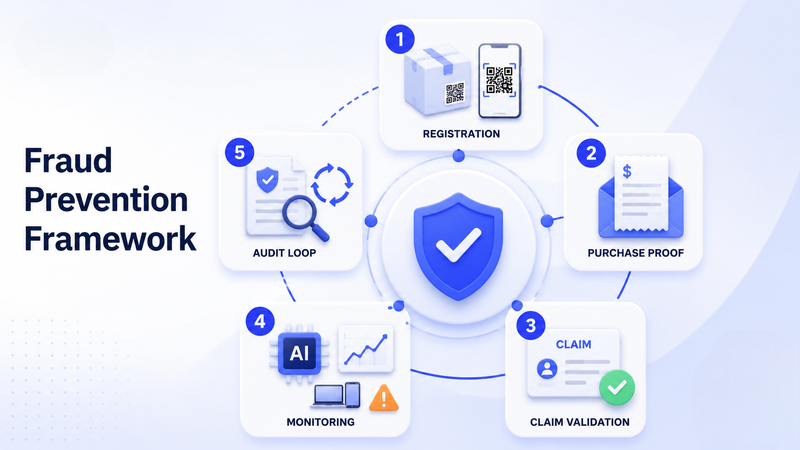
Detection catches fraud after it happens. Prevention stops it before the payout. Here's the five-layer system that works.
### Layer 1: Product Registration at Point of Purchase
This is the most underused anti-fraud layer in warranty management. When you require product registration before warranty activation, you create a verified link between the product (via serial number), the buyer (via identity), and the purchase (via proof of purchase), all captured at the moment of peak engagement.
Every claim filed later gets validated against this registration record. If the product was registered by Customer B, and Customer C files a warranty claim on the same serial, the system flags it immediately.
**How to implement it:** Use QR codes on product packaging for offline and marketplace buyers. Embed a registration widget on your ecommerce store for direct buyers. Capture name, email, phone, purchase channel, and proof of purchase at registration. Validate the serial number at scan to block duplicates and counterfeits.
### Layer 2: Proof of Purchase Verification
Require invoice or order confirmation upload at the point of registration, rather than at the point of claim. When proof of purchase is captured early, your system has a baseline to compare against. If a claim later arrives with a different receipt, or with an AI-generated receipt for a different purchase date, the discrepancy surfaces instantly.
**Key detail:** Accept forwarded order confirmation emails or direct retailer integrations over screenshot uploads. Screenshots are the easiest documents to forge. Forwarded emails carry header metadata and are significantly harder to fake.
### Layer 3: Claim Intake Validation
When a registered customer files a claim, validate three things before any human review:
1. **Serial match.** Does the serial on the claim match the serial on the registration record?
2. **Warranty status.** Is the product still within the warranty window based on the original registration date?
3. **Evidence requirements.** Has the customer submitted the required photos, videos, or description that meet your policy's documentation standards?
Claims that pass all three move to standard processing. Claims that fail any check get routed to a review queue with the specific discrepancy flagged. This keeps legitimate claims flowing fast while isolating suspicious ones.
### Layer 4: Pattern Monitoring Across Claims
Even with strong registration and intake validation, sophisticated fraudsters adapt. Pattern monitoring watches for signals across your entire claim database:
- Same serial number across multiple accounts
- Claim frequency from individual customers exceeding normal rates
- Geographic clustering of claims in specific regions or zip codes
- Timing patterns (bulk claims filed within the same narrow window)
- Language similarity across claim descriptions from different customers
- Device or IP address overlap across "different" customer accounts
Pattern monitoring is where AI-powered detection earns its value. The signals above are invisible in individual claim review but obvious when analyzed at scale.
### Layer 5: Policy Enforcement and Audit Loop
Your warranty policy is the legal foundation of your fraud prevention system. Every layer above enforces rules defined in your policy. The audit loop ensures those rules stay current.
Run quarterly audits of claim data to identify:
- New fraud patterns your current rules miss
- Policy gaps that fraudsters exploit (e.g., missing exclusions for gray market products)
- False positive rates that punish legitimate customers
- Service center or dealer anomalies
Update your policy, registration requirements, and detection rules based on what each audit reveals. Fraud tactics evolve, and your system has to evolve with them.
## How QR-Based Warranty Registration Stops Fraud Before It Starts
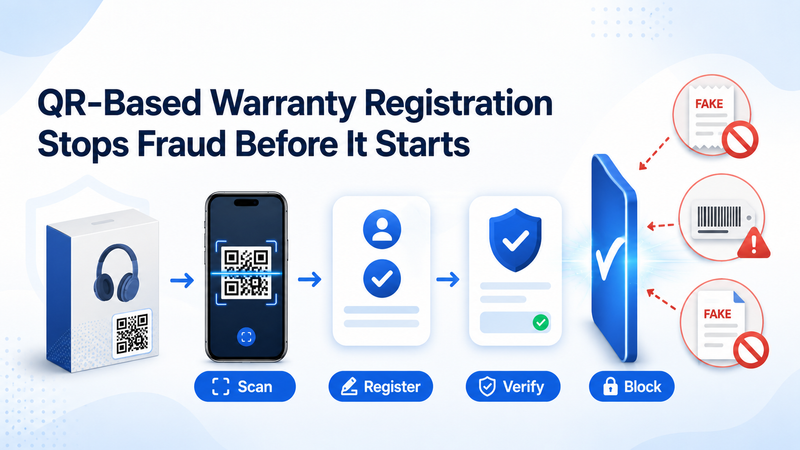
Every detection method discussed above kicks in after a claim is filed. The structural advantage of registration-first [warranty management](https://www.neurowarranty.com/blog/best-warranty-management-software) is that it prevents fraud upstream, at the moment the customer scans the QR code, before any claim enters your system.
Here's how [Dyrect's product registration software](https://www.dyrect.co/product/product-registration-software) makes this work for consumer product brands:
### QR Code Registration That Captures Every Buyer
Dyrect places a unique QR code on every product's packaging. When a customer scans it with their smartphone, they land on a branded [warranty registration page](https://www.dyrect.co/product/warranty-registration-software) where they enter their details, upload proof of purchase, and activate their warranty. This works for every sales channel: direct ecommerce, Amazon, retail stores, or marketplace purchases.
The moment registration completes, Dyrect creates a verified ownership record: this specific customer, bought this specific product (validated by serial number), from this specific channel, on this specific date.
Every warranty claim filed later gets checked against this record. If the registration doesn't exist, or the serial doesn't match, or the claimant differs from the registered owner, the system flags the discrepancy before any payout is considered.
### AI-Powered Serial Number Validation
Dyrect's serial validation uses AI to detect duplicates, counterfeits, and tampering at the point of registration, rather than at the point of claim. If someone tries to register a serial that's already been registered, or enters a serial that doesn't match your product database, the registration fails immediately.
This kills serial reuse fraud, counterfeit claims, and gray market warranty exploitation at the earliest possible point.
### Digital Warranty Cards Replace Forgeable Paper
Physical warranty cards get lost, copied, or forged. [Dyrect's digital warranty cards](https://www.dyrect.co/new-features/digital-warranty-card) are generated automatically at registration, tied to the customer's verified identity and serial number, and stored digitally. There's nothing to lose, nothing to photocopy, and nothing to fake.
### Claims Eligibility Tied to Registration
When a customer files a warranty claim through Syrect’s [claims management system](https://www.dyrect.co/guide/warranty-management-software), the platform validates the claim against the registration record in real time. Serial match, warranty window, ownership verification, and evidence requirements are all checked automatically. Legitimate claims flow through fast. Suspicious claims get flagged with specific reasons.
The result: brands using registration-first systems see fraud rates drop significantly because the system eliminates the most common fraud vectors (serial reuse, fake receipts, unregistered products, counterfeit claims) before any human review is needed.
**Gurumukh Uttamchandani, Executive Director at Syska LED Lights**, shared: "They have helped us a big way in implementing paperless warranty claims processing solutions for our brand. They have great technology, and the implementation and integration set up was really quick."
**Dyrect's platform stats:** 4 million+ warranties registered. 100,000+ warranty claims processed. Rated [5 stars on Shopify](https://apps.shopify.com/dyrect-warranty-registrations) and [4.8 stars on G2](https://www.g2.com/products/dyrect/reviews) with multiple badge wins.
## How to Write a Fraud-Resistant Warranty Policy
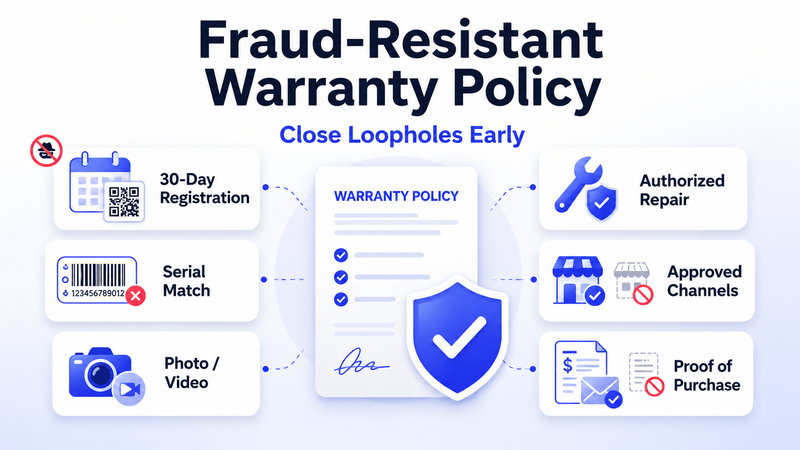
Your [warranty policy](https://www.dyrect.co/blog/how-to-create-a-warranty-policy-for-your-brand) is the document your claims team, your customers, and (if it comes to it) your legal team all rely on. Vague policies invite abuse. Specific policies close loopholes. Here are the components every fraud-resistant warranty policy should include:
**Mandatory registration window.** Require product registration within 30 days of purchase to activate warranty coverage. This creates a clean ownership record and blocks backdated claims filed months later.
**Serial number requirement at claim.** Every claim submission should require the product's serial number. If the serial doesn't match a registered product, the claim routes to manual review.
**Photo and video evidence standards.** Specify what documentation you require for different claim types. Cosmetic damage might need three photos from different angles. Functional failures might need a short video demonstrating the issue. Define these per product category in your policy.
**Explicit exclusion for unauthorized repairs.** If a customer takes the product to an unauthorized service center, warranty coverage ends. State this clearly, and require service history disclosure at claim time.
**Gray market and unauthorized channel exclusion.** Define which sales channels your warranty covers. If you sell through authorized retailers and your own website, state that products purchased through unauthorized third parties are excluded from warranty.
**Claim frequency limits.** Set maximum claim frequency per customer per product. If a customer files three claims on the same product in six months, the system should escalate for review.
**Proof of purchase specifications.** Define what counts as valid proof: forwarded order confirmation emails (preferred), retailer-issued invoices, or receipts. Explicitly state that screenshots of receipts may require additional verification.
**Modification and accidental damage exclusion.** Clearly state that damage resulting from customer modification, unauthorized repair, accidental drops, water exposure, or use outside the product's intended purpose falls outside warranty coverage.
## 8 Red Flags Your Brand Is Being Defrauded Right Now
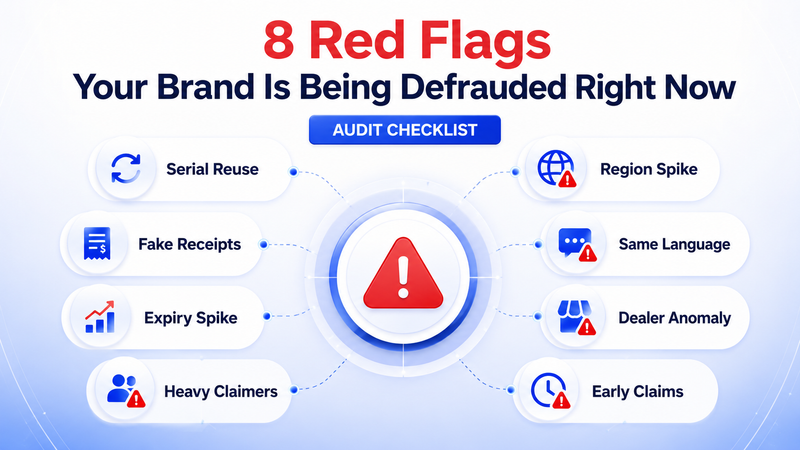
Use this as an audit checklist. Pull your last 90 days of warranty claims and check:
**1\. Same serial numbers appearing across multiple claims or customer accounts.** This signals serial reuse or counterfeit product claims. If your system doesn't validate serials at registration and claim, you're exposed.
**2\. Receipts submitted as screenshots rather than forwarded emails.** Screenshots are the easiest documents to forge, especially with AI tools. If more than 40% of your proof-of-purchase submissions are image screenshots, you have a verification gap.
**3\. Claim spikes in the final 30 days of warranty windows.** Intentional damage fraud clusters near expiry dates. Compare claim timing distribution against your warranty period to see if the pattern exists.
**4\. Disproportionate claims from a small group of customers.** If 5% of your customer base generates 30%+ of warranty claims, investigate those accounts.
**5\. High claim rates from specific geographic regions.** Geographic clustering, especially in regions where your authorized distribution is limited, can signal organized fraud or gray market exploitation.
**6\. Claims with identical or near-identical language.** Fraud rings often use templates or scripts for claim submissions. Run a simple text similarity check across recent claims.
**7\. Service centers with claim rates far above network average.** If one service center processes 3x the claims of comparable locations, the discrepancy warrants an audit.
**8\. Claims filed within days of purchase.** While genuine defects do occur early, an unusual volume of claims filed within the first week of purchase often signals fraudulent intent.
If three or more of these flags show up in your data, your warranty program likely has a fraud problem worth addressing systematically.
## Frequently Asked Questions About Warranty Fraud
### **What is warranty** fraud **?**
Warranty fraud occurs when someone intentionally misrepresents facts to receive warranty benefits they haven't earned. This includes filing claims for defects that don't exist, using tampered serial numbers to make ineligible products appear covered, submitting forged receipts to extend warranty windows, or returning counterfeit products while keeping the genuine item. The fraud completes when your brand approves the payout, ships the replacement, or issues the credit based on false information.
### **Is warranty fraud a** crime **?**
Yes. Warranty fraud can be prosecuted as a criminal offense under consumer fraud, wire fraud, or theft-by-deception statutes depending on the jurisdiction. Federal cases prosecuted under the Wire Fraud Act can result in sentences of up to 20 years in prison, and fines reaching $250,000 or more. State-level charges typically carry penalties of one to ten years for felony-level fraud. Beyond criminal consequences, companies can pursue civil litigation to recover financial losses.
### **How much does** warranty **fraud cost businesses?**
Industry estimates put the global cost at approximately $25 billion annually. For individual brands, fraudulent claims account for 3% to 15% of total warranty costs. For a brand doing $100 million in annual revenue with typical warranty costs of 2% ($2 million), a 10% fraud rate means $200,000 in direct losses per year, before counting operational overhead and brand damage.
### **How do I detect a fake** **warranty claim?**
Look for: serial numbers that appear in multiple claims or customer accounts, receipts submitted as screenshots (especially with perfect formatting), claims filed in the final days of warranty windows, identical language across different customer submissions, and claim volumes disproportionately concentrated among a small group of customers. AI-powered detection systems identify these patterns automatically across your full claim history.
### **Can AI detect** warranty **fraud?**
Yes. AI-powered detection systems catch **60 to 75% of fraudulent claims** by analyzing patterns across customers, geographies, and time periods. This significantly outperforms rule-based systems (15 to 25% detection) and manual review. AI excels at spotting cross-claim patterns, image manipulation, behavioral anomalies, and coordinated fraud ring activity that human reviewers and simple rules miss.
### **How do fraudsters** use **AI to commit warranty fraud?**
In 2025-2026, fraudsters use generative AI to create photorealistic fake receipts (complete with thermal paper textures and camera blur), fabricate product damage photos, generate synthetic customer identities at scale, and automate entire claim submission workflows. AI-generated fake receipts went from 0% to 70.8% of flagged fraudulent documents between March 2025 and May 2026, making this the fastest-growing fraud vector.
### **How do QR codes** prevent **warranty fraud?**
QR codes on product packaging create a verified registration record at the moment of purchase. When a customer scans the code, the system captures their identity, validates the serial number, and records proof of purchase. Every subsequent warranty claim gets checked against this registration. If the product was registered by a different person, or the serial doesn't match, or the product was purchased through an unauthorized channel, the system flags the discrepancy before payout. Platforms like [Dyrect](https://www.dyrect.co/product/product-registration-software) automate this entire flow.
### **What should my** warranty **policy include to prevent fraud?**
Include: mandatory registration within 30 days of purchase, serial number requirement at claim submission, photo/video evidence standards per product category, explicit exclusions for unauthorized repairs and accidental damage, gray market/unauthorized channel exclusions, claim frequency limits, and clear proof-of-purchase specifications that favor forwarded emails over screenshots.
### **What is the difference** between **warranty fraud and return fraud?**
Warranty fraud targets your warranty program, claiming repairs, replacements, or credits under warranty terms using false information. Return fraud targets your return policy, including tactics like wardrobing (buy, use, return), empty box returns, and counterfeit swaps. Chargeback fraud uses the bank dispute process. In practice, organized fraud operations often exploit all three simultaneously.
### **What is the best** software **for warranty fraud prevention?**
The most effective approach combines registration-first prevention (QR-based product registration with serial validation) with automated claims management. [Dyrect's warranty management platform](https://www.dyrect.co/product/warranty-management-software) handles both: product registration captures verified ownership data at purchase, and the claims system validates every claim against that record automatically. This prevents fraud at the source rather than detecting it after the fact.
### **How can small brands** prevent **warranty fraud without enterprise budgets?**
Start with the registration layer. Implement QR code registration on your product packaging with serial number validation and proof of purchase capture. This single step eliminates the highest-volume fraud types (serial reuse, fake receipts, unregistered product claims) without requiring AI analytics or dedicated fraud teams. Platforms like Dyrect offer plans for growing brands. Pair registration with a clear, [specific warranty policy](https://www.dyrect.co/warranty-policy-generator) that closes the most common loopholes.
### **How often should I audit my** warranty **claims for fraud?**
Run a full audit quarterly. Review claim timing distribution, serial number patterns, customer claim frequency, geographic clustering, and service center performance. Between audits, monitor your flagged-claim rate, the percentage of claims that trigger validation errors at intake. If this rate climbs above your baseline, investigate before the next scheduled audit.
---
This blog is powered by Superblog. Visit https://superblog.ai to know more.
---
## How Warranty Management Plays a Vital Role in Customer Re-engagement?
Author: Yogesh Miharia
Author URL: https://www.neurowarranty.com/blog/author/yogesh-miharia
Published: 2024-02-15
Meta Title: How Warranty Management Plays a Vital Role in Customer Re-engagement?
Meta Description: Discover the pivotal role of warranty management in re-engaging customers. Explore the impact on satisfaction and loyalty. NeuroWarranty, your guide to customer-centric solutions
Tags: Warranty Management, warranty management solution, customer reengagement
Tag URLs: Warranty Management (https://www.neurowarranty.com/blog/tag/warranty-management), warranty management solution (https://www.neurowarranty.com/blog/tag/warranty-management-solution), customer reengagement (https://www.neurowarranty.com/blog/tag/customer-reengagement)
URL: https://www.neurowarranty.com/blog/how-warranty-management-plays-a-vital-role-in-customer-re-engagement
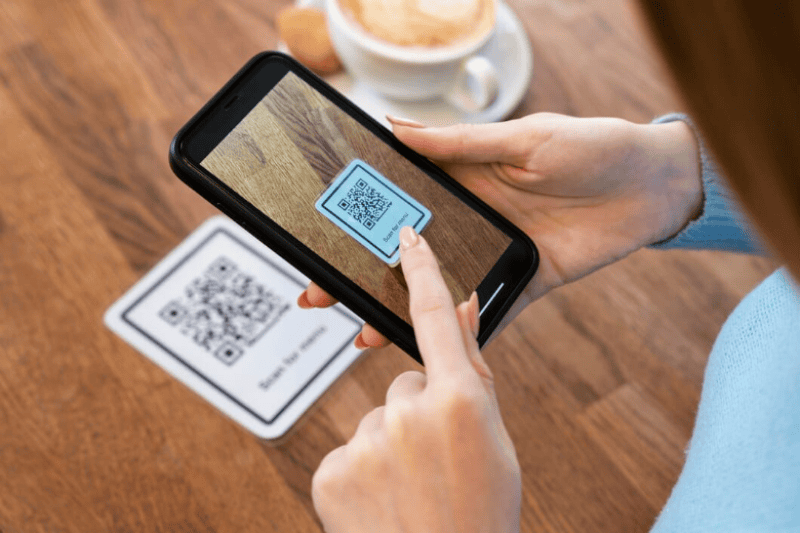
**“Brand Building”** is not as easy as it sounds! A Good brand includes the best service, products, warranty, after-sales support, and of course timely updates and new enhancements for retaining customers.
In today's competitive business landscape, the value of retaining old customers cannot be overstated. These customers are not just revenue sources; they are brand advocates, sources of valuable feedback, and a foundation for sustainable business growth. However, businesses often face challenges in keeping their customer base intact. From increasing competition to shifting consumer preferences, various factors contribute to customer churn.
### What does 2023 taught about customer re-engagement?
In a recent analysis, businesses that took QR code warranty management services experienced a significant uptick in customer retention. The transition to digital warranty management resulted in a 20% reduction in customer churn rates. Real-time data from 2023 showcases that businesses incorporating QR codes reported a 15% increase in customer engagement, emphasizing the positive impact of this technology on customer relationships.
Old customers are a treasure trove for businesses. They bring in consistent revenue, are more likely to try new products or services and act as brand ambassadors, attracting new customers through positive word-of-mouth. Retaining existing customers is more cost-effective than acquiring new ones, making them a crucial asset for long-term success.
Positive experiences with warranty management services contribute to a positive brand reputation. Customer is more likely to recommend and repurchase from brands that have a reputation for standing behind their products and resolving issues effectively.
**Challenges in Retaining Customers**
Challenges in customer retention include rising competition, evolving customer expectations, and a lack of personalized engagement. Customers often seek new experiences, and without proactive efforts, businesses risk losing them to competitors.
### **Solution for customer re-engagement with NeuroWaranty**
[NeuroWarranty](https://www.neurowarranty.com/) offers a strong warranty management solution and different warranty programs which is a differentiator in today's competitive market. While making a purchase decision many customers prefer a warranty program, choose the favorable one, and set your brand apart from competitors.
Enter QR code technology coupled with warranty management. This innovative approach provides a streamlined solution to re-engage customers. QR codes offer a convenient gateway for customers to access and manage warranty information. This instant accessibility enhances customer experience and strengthens the brand-customer relationship.
Re-engaging customers through QR codes and incorporating warranty management strategies can effectively enhance customer satisfaction and loyalty.
**Here are a few points on how to implement customer re-engagement strategies with better warranty management solutions-**
**1\. Link QR Codes to Warranty Information:**
Embed warranty details in the QR code so customers can easily access and manage their warranty information by scanning the code. Provide instructions on how to use the QR code for warranty-related activities. This is a simple warranty management solution provided through customized technology.
**2\. Offer Exclusive Discounts or Promotions:**
Encourage customers to scan the QR code by providing exclusive discounts or promotions tied to their warranty status. Businesses can also create time-sensitive offers to prompt immediate action.
**3\. Implement QR Code Campaigns:**
QR code campaigns via email, social media, or physical marketing materials to inform customers about the benefits of scanning the code. Highlight the convenience of accessing warranty information and exclusive offers.
**4\. Track and Analyze Performance:**
Monitor QR code scans and customer engagement metrics to assess the effectiveness of your re-engagement strategies. Use analytics to refine and optimize your approach over time.
**5\. Customer Support Integration:**
Provide a direct link to customer support services through the QR code, allowing customers to reach out with any questions or concerns easily.
**6\. Compliance and Data Security:**
Ensure that your QR code strategy complies with data protection regulations. Implement secure measures to protect customer information accessed through QR codes.
By combining QR codes with **[warranty management solutions](https://www.neurowarranty.com/warranty-management-solution)** and customer engagement strategies, businesses can create a seamless and rewarding experience for their customers, ultimately fostering brand loyalty and satisfaction.
**Warranty management solutions** can be integrated into customer loyalty programs. By offering extended warranties or additional benefits to loyal customers, you incentivize repeat business and create a sense of loyalty among the customers.
**Conclusion**
In conclusion, leveraging QR code technology for warranty management solutions is a game-changer in customer re-engagement. The statistics speak volumes, showcasing the tangible benefits that businesses have realized in retaining and re-engaging customers. As we move forward, it's clear that embracing innovation is key to staying ahead in the competitive market.
If you are looking forward to the **warranty management solution** for your business, implement the strategies for customer retention to enhance customer loyalty and watch your business thrive.
In Summary, a well-implemented warranty management solution (QR CODE TECHNOLOGY) is essential for customer retention as it not only addresses customer concerts effectively but also contributes to positive brand perception, customer satisfaction, and loyalty.
Existing customers who have already chosen to do business with your brand in the past are extremely valuable. Don’t let them fall to the wayside. Work on re-engagement plans to keep past customers coming back.
---
This blog is powered by Superblog. Visit https://superblog.ai to know more.
---
## Case Study Warranty registration for R for Rabbit
Author: Yogesh Miharia
Author URL: https://www.neurowarranty.com/blog/author/yogesh-miharia
Published: 2024-01-28
Meta Title: Warranty Registeration for R for Rabbit Brand by Neurowarranty
Tags: Warranty Management, warranty registration
Tag URLs: Warranty Management (https://www.neurowarranty.com/blog/tag/warranty-management), warranty registration (https://www.neurowarranty.com/blog/tag/warranty-registration)
URL: https://www.neurowarranty.com/blog/warranty-registeration-for-r-for-rabbit
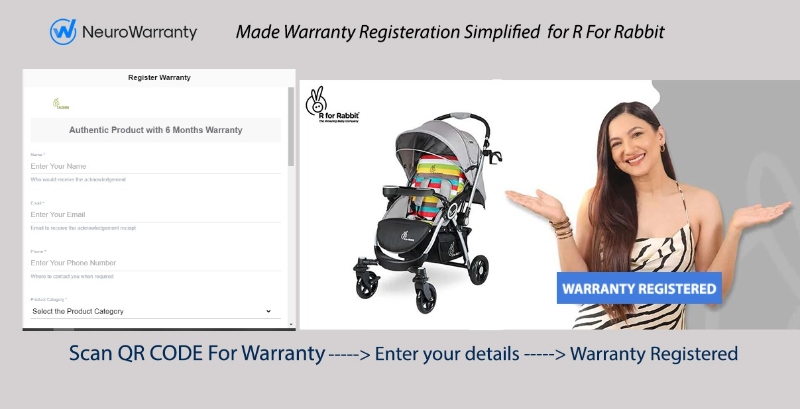
Warranty is important for almost every product that you buy specially when it is expensive. Effective warranty management reflects a manufacturer's commitment to quality, building customer loyalty and enhancing the brand's reputation. Ultimately, a perfect warranty system is integral to encourage user experience.
Providing the best possible solution aligned with the commitment to superior service, brands look for simple and smooth ways to implement the warranty scheme without any financial setback.
**How Warranty Management Software Helps brands in Effortless Registration - One-Step One Solution “QR Code”?**
1. **Effortless Registration:** Simplify the process with a one-step, one-click registration through QR code scanning, ensuring a hassle-free experience for consumers, allowing users to register their products swiftly with just a scan.
2. **User-Friendly Interface:** Design an intuitive and user-friendly interface that guides consumers through the registration process seamlessly, minimizing any confusion and automated updates.
3. Data Security: Implement security measures to protect consumer data, ensuring privacy and compliance with data protection regulation and provide instant confirmation upon successful registration, assuring consumers that their warranty details are securely recorded.
4. Integration Capabilities: Integrate the QR code registration system with existing databases and CRM tools for simplified data management and customer support. Ensure compatibility across various devices, making the registration process accessible to a wide range of consumers.
5. Analytics Dashboard: Provide brands with an analytics dashboard to track registration metrics, allowing them to analyze consumer behavior and optimize the warranty management process.
Neurowarranty has overcomed the traditional method of product registration through QR Codes, and provided end solution across industries. Enhancing brands consumers' connection and engagement, which makes them feel valuable and rely flowlessly.
### **Understanding the need of R for Rabbit**
Every business aims in maximizing the first party data so that it can help in marketing, advertisement and building a direct relation with the customer. The access to information helps to fulfill the tailored needs and reach out customers with transparency. This proves crucial in various situations, from sending thoughtful follow-ups to managing crises like product recalls.
Neurowarranty figured out the problems and implemented the one step one click warranty registeration solution which makes the users eligible to register and claim for warranty quickly and also prevent from the counterfieting. A comprehensive warranty not only safeguards against manufacturing defects but also provides peace of mind to buyer, fostering brand trust. Given the unique vulnerabilities associated with infant products, prompt resolution of issues is essential to prevent potential harm.
For this warranty program Neurowarranty provides a complete analytics where the R for Rabbit can check and identify every minute product related details and even buyers location. Warranty management through QR Code has helped delivering a rewarding experience and overcome challenges.
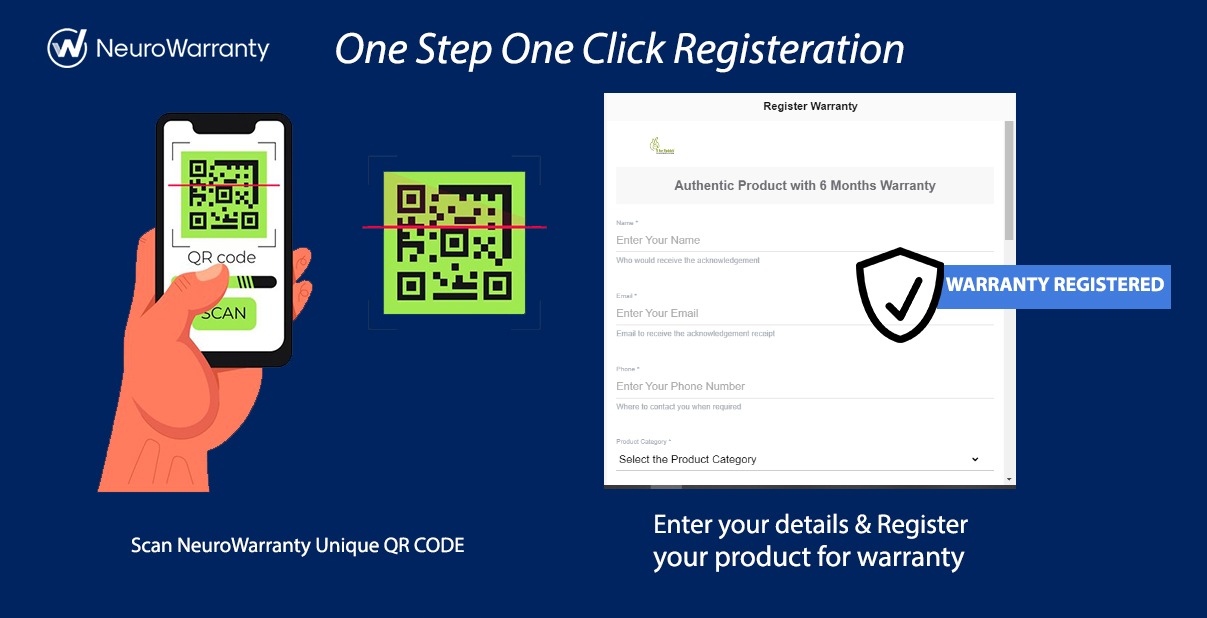
### **Neurowarranty - QR Code Solution**
The AI driven technology of Neurowarranty have transformed the look out of warranty management for brands like “R for Rabbit” in baby products. QR Code technology has boosted consumer engagement by simplifying the warranty process. Now, customers actively participate, leading to quicker issue resolutions.
**It results in -**
- Increased satisfaction and repeat sales, building strong brand loyalty.
- The user-friendly approach of integrating AI and QR codes not only streamlines operations but also enhances the overall customer experience.
**All About QR Code Warranty Management Analytics Dashboard**
NeuroWarranty - Warranty management, facilitated by QR code technology, now incorporates an analytics dashboard, streamlining access to crucial end customer data. This innovative approach allows brands to swiftly grasp consumer behavior, preferences, and product interactions in real time.
The analytics dashboard becomes a powerful tool for informed decision-making and personalized customer engagement. By collecting this data, businesses not only optimize their warranty processes but also establish robust connections with customers, fostering loyalty and satisfaction.
The comprehensive insights derived from warranty data offers a visual representation of key metrics, such as warranty claims, product performance, and customer feedback. This enables businesses to identify trends, assess the effectiveness of warranty programs, and make informed adjustments to enhance customer satisfaction and product quality.
The QR code-driven analytics dashboard proves instrumental in businesses striving to enhance and personalize their warranty management strategies.
The one-touch QR Code solution integrated into the warranty management system improves customer experience. By providing a quick and user-friendly method for warranty registration and claims, businesses can enhance customer satisfaction, build brand loyalty, and establish a seamless connection between customers and their products.
**If you are also looking for some warranty management program than Neurowarranty could be the best choice for you. Get a free demo and know how you can increase your customer loyalty. [Book a demo today!](https://calendly.com/aabhishekbindal/neurotags-demo)**
---
This blog is powered by Superblog. Visit https://superblog.ai to know more.
---
## How Warranty Management Software Provides a Better Service for Your Business?
Author: Yogesh Miharia
Author URL: https://www.neurowarranty.com/blog/author/yogesh-miharia
Published: 2024-01-10
Tags: warranty management solution, warranty mangement software
Tag URLs: warranty management solution (https://www.neurowarranty.com/blog/tag/warranty-management-solution), warranty mangement software (https://www.neurowarranty.com/blog/tag/warranty-mangement-software)
URL: https://www.neurowarranty.com/blog/how-warranty-management-software-provides-a-better-service-for-your-business
Warranty claim process might seem simple, but many organizations grapple with substantial financial losses. To mitigate these loss warranty management software is the best solution. This robust system not only streamlines operations but also enhances product quality, increases customer loyalty, customer satisfaction, and boosts supplier recovery.
Here are mentioned three chief services that benefits through warranty management software:
**1\. Making Warranty Claims Process Faster:**
The QR code enabled [digital warranty management system](https://www.neurowarranty.com/warranty-management-solution) simplifies the warranty tracking throughout a product’s lifecycle . This system also optimizes product value and accelerates the claims process. Now, it's the time to wave off and say goodbye to manual claims, drowning in a sea of documents. With the Neuro Warranty management software, claims processing becomes faster and more efficient.
**Track & Trace:**
- Implementing QR codes for track and trace functionality on a product item level.
- Providing real-time visibility into the movement and status of products within the supply chain.
- Improving inventory management and logistics efficiency.
**2\. Improved Customer Satisfaction**
Implementation of warranty management software transforms satisfaction of the customers manifold. Its integrated data framework ensures swift access to information for the customers. The system bolsters your company’s brand image by delivering timely services.
- Utilizing QR codes to connect offline products or materials with online content.
- Engaging users through innovative content, possibly accessible via QR code scans.
- Creating a seamless and interactive experience for consumers.
**3\. Authentication and Cost Saving**
Warranty processes and policies are vital for every business enterprise. The QR Code Authenticating warranty management system enhances transparency, reduces the risk of fraudulent claims. This improvement contributes to efficiency warranty management of the organization.
**Brand Protection:**
- Incorporating unique QR Code technologies to ensure the authenticity of products.
- Protecting against counterfeiting and unauthorized duplication.
- Enhancing brand trust and reputation through secure identification.
Furthermore, [warranty management software](https://www.neurowarranty.com/warranty-management-solution) increases the product quality, strengthens customers - manufacturer relationship, and enhances operational efficiency. These combined benefits reduce overall organizational cost.
**QR Code Solution with No-Code Applications:**
- Offering no-code applications for ease of use and quick implementation.
- Allowing businesses to create and manage QR campaigns without extensive coding knowledge.
[NeuroWarranty](https://www.neurowarranty.com/) provides an effective Warranty Management Software Solution through which one can track all warranties throughout a product life cycle. The process increases customer satisfaction through minimum service costs. We provide customized warranty management solutions through QR codes.
**Cloud-Based Data Analytics:**
- Leveraging cloud-based analytics to gather valuable insights from QR code scans.
- Tracking scan rates to understand user engagement and measure the effectiveness of campaigns.
- Supporting informed decision-making in marketing through the analysis of scan data.
**Enterprise Solutions:**
- Observing the QR code warranty solutions to meet the specific needs of enterprises.
- Providing a platform that grows in tandem with enterprise expansions and changing demands.

### **Why QR Code for Warranty Management?**
QR Code technology for warranty management is highly beneficial for businesses looking to bridge the gap between offline and online experiences. It enhances user engagement, and gathers valuable data insights. Additionally, provide clear information on how businesses can integrate and customize your solutions to suit their unique needs.
It may also be beneficial to showcase a user-friendly interface or demo of your no-code applications and emphasize the simplicity of implementing your QR code warranty solutions. Finally, make sure your marketing materials clearly articulate the value proposition and competitive advantages of your offerings compared to other solutions in the market.
### **How Warranty Management through QR Codes give an ease to your Customers?**
QR Code Scannable packaging for warranty management definitely enhances the overall customer experience and contributes to brand memorability throughout the entire buying journey.
**Here's an expansion on the benefits and key points:**
**1 Convenience in Warranty Registration** through a simplified warranty registration process. The Customers can easily scan the code to register their product which enhances the customer satisfaction and encourages timely warranty activation.
**2- Instant access to information** where users can quickly retrieve details about the warranty period, terms, and conditions by scanning the packaging. This instant access fosters transparency and builds trust in the brand.
**3- Enhanced customer engagement** by scanning the code, customers may access relevant content, such as product guides, tutorials, or exclusive promotions, enhancing their overall engagement with the brand.
**4- Scannable packaging** extends customer support beyond the post purchase experience. This continuous support reinforces positive perceptions of the brand. From the moment of purchase to warranty activation and beyond, scannable packaging contributes to a seamless and comprehensive customer journey. Each touchpoint reinforces the brand's commitment to customer satisfaction, leaving a lasting impression.
**Conclusion**
When the consumer scans the QR code, all the product information such as manufacturing and expiry date, warranty periods etc. is seamlessly recorded in the manufacturer database. This invaluable data simplifies the warranty claiming process for the users, retailers and manufacturers.
The customized warranty management solution by Neurowarranty helps in cost reduction, meeting customer expectations and increased business operations. Find out which QR Code Warranty solution best suits your needs to build a strong relation with your customers.
****
---
This blog is powered by Superblog. Visit https://superblog.ai to know more.
---
## The Power of QR Code Warranty Management Software: Customer Loyalty
Author: Yogesh Miharia
Author URL: https://www.neurowarranty.com/blog/author/yogesh-miharia
Published: 2023-12-18
Meta Title: The Power of QR Code Warranty management software
Tags: warranty mangement software, customer loyalty
Tag URLs: warranty mangement software (https://www.neurowarranty.com/blog/tag/warranty-mangement-software), customer loyalty (https://www.neurowarranty.com/blog/tag/customer-loyalty)
URL: https://www.neurowarranty.com/blog/the-power-of-qr-code-warranty-management-software-customer-loyalty
What does the world-class Business do? To be a top seller, it’s simple: offer relevant products, consistent service, and Yes, an excellent customer experience. Retaining a customer and making them loyal to your brand is chief important.
But the question is “HOW”? How to know if you have a satisfying customer or not? Let’s step into the world of electronics products. Whats most important thing in it? The latest features, design, and an effective warranty solution.
It's clear that staying relevant and unlocking customer loyalty in the rapidly evolving electronic market requires innovative approaches, and leveraging warranty management solution through QR codes is an excellent way to achieve this.
Here are some key points on how warranty management software do that:
**1\. Streamlined Warranty Claims**
Implementing QR code [warranty management](https://www.neurowarranty.com/digital-warranty-management-software) solution allows customers to easily initiate warranty claims with a simple scan. This streamlined process ensures that customers have a hassle-free experience when they encounter product issues, increasing their satisfaction.
**2\. Real-Time Updates**
Warranty management software technology can provide customers with real-time updates on the status of their warranty claims. This transparency builds trust and keeps direct link and we call it D2C, further enhancing their satisfaction with your service.
**3\. Personalized Support**
Use the data collected through QR code Warranty Management Solution applications to personalize customer support. Tailor your responses and solutions based on a customer's purchase history and preferences, showing them that you understand their needs.
**4\. Feedback and Improvement**
QR codes can also be used to gather customer feedback after a warranty claim is processed. This information is invaluable for making continuous improvements to your products and services, showing customers that you value their input.
**5\. Exclusive Offers and Promotions**
Include QR codes in your warranty applications to provide customers with access to exclusive offers, promotions, or loyalty rewards. This can incentivize repeat purchases and enhance the overall customer experience.
**6\. Educational Content**
QR codes can link customers to educational content such as how-to guides, maintenance tips, or troubleshooting videos of the products. This proactive approach can prevent issues and showcase your commitment to customer success.
**7\. Cross-Selling and Upselling**
Analyze customer data from warranty tracking software to identify opportunities for cross-selling or upselling related products or accessories. This not only increases revenue but also provides additional value to customers.
**8\. Ongoing Engagement**
Use warranty management software to engage with customers throughout their product lifecycle. Send updates, tips, and relevant content to keep them engaged and informed about your brand.
### **Warranty management software a boon for warranty management**
Warranty Management Software can indeed be a significant boon for electronics companies in several ways
**1- Data Analytics**
[Warranty management software](https://www.neurowarranty.com/digital-warranty-management-software) can analyze warranty claims data to identify common issues or defects in products. This data-driven approach helps companies make informed decisions to improve product quality, reduce defects, and minimize warranty claims.
**2- Reduced Fraud**
QR codes can be integrated with warranty management software to prevent warranty fraud. Authentic QR codes ensure that only legitimate products are eligible for warranty claims, saving the company money on fraudulent claims.
**3- Brand Loyalty and Trust**
QR codes can link customers to product authenticity checks, providing transparency about genuine products. This builds trust among consumers and helps protect the brand's reputation.
**4- Inventory Management / Product Registration**
QR codes can be used to encourage customers to register their products, providing valuable data for inventory management, demand forecasting, and after-sales support.
**5- Faster Troubleshooting**
Warranty management software can store detailed product information and history, enabling customer support teams to quickly diagnose issues and provide solutions, leading to higher customer satisfaction.
**6- Sustainability**
Electronic companies can use QR codes to provide digital user manuals and warranty information, reducing the need for printed materials and contributing to environmental sustainability.
**7- Regulatory Compliance**
Warranty management software can help electronics companies comply with various industry regulations and maintain accurate warranty documentation, reducing legal risks.
**Conclusion**
In the rapidly changing electronic market of 2024, staying relevant means embracing technology and continuously adapting to meet customer needs. Remember, it's essential to gather feedback, monitor customer satisfaction, and iterate on your warranty application process to ensure it remains effective and meets evolving expectations.
With the help of NeuroWarranty Management Software you are extended with proper scalability and customizable warranty solutions which are uniquely designed as per the need.
---
This blog is powered by Superblog. Visit https://superblog.ai to know more.
---
## Streamlining Warranty Processes for Marketplace Sellers: The Power of Warranty Management Software
Author: Abhishek Agrawal
Author URL: https://www.neurowarranty.com/blog/author/abhishek-agrawal
Published: 2023-05-16
URL: https://www.neurowarranty.com/blog/warranty-for-marketplace-sellers
In the age of online marketplaces like Amazon, Flipkart, and other e-commerce platforms, brands and sellers face unique challenges when it comes to managing warranties for their products.
With a large customer base, diverse product offerings, and the need for efficient and transparent warranty processes, brands are increasingly turning to warranty management software to simplify and streamline their warranty management operations.
In this blog post, we will explore how brands that sell on marketplaces can benefit from implementing warranty management software to enhance their warranty processes and ultimately improve customer satisfaction.
## The Complexities of Warranty Management for Marketplace Sellers:
Selling products on popular marketplaces brings tremendous opportunities for brands to reach a wider customer base and increase sales. However, it also presents complex warranty management challenges. Some common complexities include:
1. **Diverse Product Portfolios:** Marketplace sellers often offer a wide range of products across various categories, each with its unique warranty terms and conditions. Manually managing warranties for each product can be time-consuming and error-prone.
2. **Customer Data Management:** Sellers need an efficient way to manage customer data, including purchase information, warranty registrations, and claim history. This information is crucial for providing personalized customer support and tracking warranty claims effectively.
3. **Marketplace Compliance:** Different marketplaces have their own warranty policies and requirements. Ensuring compliance with these policies can be challenging for sellers, especially when managing warranties manually.
4. **Timely Claims Processing:** With a large customer base and potentially high order volumes, sellers must process warranty claims promptly to maintain customer satisfaction. Manual processes can lead to delays and errors, negatively impacting the customer experience.
## How Warranty Management Software Simplifies the Process:
Implementing warranty management software can revolutionize the way marketplace sellers handle warranty processes. Here are some key ways in which this software simplifies the warranty management process:
1. **Centralized Warranty Data**: Warranty management software provides a centralized database to store and manage warranty-related information. Sellers can easily access and update warranty terms, track customer data, and monitor warranty claims from a single platform.
2. **Automated Claims Processing**: By automating the claims process, warranty management software reduces the need for manual intervention. Sellers can set up rules and workflows to handle claims efficiently, ensuring faster processing and resolution for customers.
3. **Streamlined Communication**: Warranty management software enables seamless communication between sellers, customers, and marketplace platforms. Sellers can send automated claim status updates, request additional information, and provide prompt responses, enhancing customer satisfaction and transparency.
4. **Customization and Compliance**: With warranty management software, sellers can customize warranty terms and conditions based on the requirements of each marketplace. This ensures compliance with marketplace policies while maintaining brand identity and customer trust.
5. **Data Analytics and Reporting:** Warranty management software offers robust analytics and reporting capabilities. Sellers can gain valuable insights into warranty claim trends, product performance, and customer behavior, empowering them to make data-driven decisions for their business.
6. **Integration with Marketplace Platforms**: Many warranty management software solutions offer integrations with popular marketplace platforms like Amazon and Flipkart. This integration allows seamless data synchronization, automatic registration of warranties, and real-time updates on marketplace transactions.
For brands and sellers operating in the competitive landscape of online marketplaces, implementing warranty management software is no longer a luxury but a necessity.
By centralizing warranty data, automating claims processing, ensuring compliance, and providing insightful analytics, this software simplifies the complexities associated with warranty management.
As a result, marketplace sellers can enhance customer satisfaction, reduce operational inefficiencies, and build a strong reputation for their brand.
Invest in a reliable warranty management software solution today and unlock the potential for streamlined warranty processes and improved customer experiences.
## Ready to simplify your warranty processes for marketplace selling?
Explore NeuroWarranty, our advanced warranty management software designed specifically for brands and sellers like you.
Schedule a demo or get in touch with our team to learn more about how NeuroWarranty can revolutionize your warranty management operations and boost customer satisfaction.
QR code warranty solutions like NeuroWarranty provide a seamless and compliant way for marketplace sellers to gather data on their customers.
By integrating QR codes into the warranty management process, sellers can capture essential customer information without violating privacy regulations or causing inconvenience to customers.
When a customer purchases a product, a QR code can be included on the packaging or warranty card. When scanned, the QR code redirects the customer to a secure online form where they can register their warranty.
This process ensures that customer data is collected with their consent and in compliance with data protection regulations.
With QR code warranty solutions, sellers can efficiently gather customer information while maintaining transparency and meeting the requirements of marketplace platforms, creating a win-win situation for both sellers and customers.
---
This blog is powered by Superblog. Visit https://superblog.ai to know more.
---
## The Role of Warranty Management Software in Improving Customer Satisfaction
Author: Abhishek Agrawal
Author URL: https://www.neurowarranty.com/blog/author/abhishek-agrawal
Published: 2023-05-08
URL: https://www.neurowarranty.com/blog/warranty-management-to-improve-customer-satisfaction
As businesses strive to meet the ever-increasing customer demands, they are constantly looking for ways to improve the customer experience. One way to achieve this is through the use of warranty management software.
Warranty management software provides businesses with a centralized system to manage their warranty claims, track and process claims, manage warranties and agreements, and analyze claim data.
By utilizing this software, businesses can streamline the claims process and provide better customer service, which ultimately leads to improved customer satisfaction.
In this blog post, we'll explore the various benefits of warranty management software and how it can help improve customer satisfaction.
We'll also delve into the key features of a good warranty management software and what businesses should look for when selecting a system.
## Benefits of Warranty Management Software
1. **Efficient Claims Processing:** One of the main benefits of warranty management software is that it helps automate the claims process, reducing manual errors and improving the speed at which claims are processed. By reducing the time it takes to process a claim, businesses can provide a better customer experience.
2. **Real-time Tracking:** Warranty management software allows businesses to track the status of claims in real-time, providing customers with timely updates on their claims. This level of transparency improves customer satisfaction and reduces the need for customers to follow up on their claims.
3. **Improved Data Management:** By using warranty management software, businesses can collect and analyze claim data, providing valuable insights into customer behavior and product performance. This data can help businesses make informed decisions on product development, quality control, and customer service.
4. **Cost Savings:** Warranty management software can help reduce costs associated with manual claims processing and error correction. This results in a more efficient claims process and improved customer satisfaction.
## Improving Customer Satisfaction with Warranty Management Software
1. **Faster Claim Processing:** Warranty management software can help businesses process claims faster, resulting in a better customer experience. Customers want their claims resolved quickly and efficiently, and by using warranty management software, businesses can meet this expectation.
2. **Real-time Updates**: Warranty management software provides customers with real-time updates on their claims, which reduces the need for customers to contact the business for updates. This level of transparency and communication improves customer satisfaction.
3. **Improved Product Quality:** By analyzing claim data, businesses can identify patterns and trends in product defects or issues. This information can help businesses improve product quality, reducing the number of claims and improving customer satisfaction.
4. **Enhanced Customer Service:** Warranty management software helps businesses provide better customer service by improving the claims process and reducing errors. This leads to a more positive customer experience, which in turn improves customer loyalty and retention.
## Key Features of a Good Warranty Management Software
When selecting a warranty management software, businesses should look for the following key features:
1. **Automated Claims Processing:** The software should provide an automated claims processing system, reducing the need for manual intervention and minimizing the chances of errors.
2. **Real-time Tracking:** The software should allow businesses and customers to track the status of claims in real-time, providing timely updates on the progress of the claim.
3. **Data Analytics:** The software should offer data analytics capabilities, providing businesses with insights into product performance, customer behavior, and other critical metrics.
4. **Mobile Accessibility:** The software should be accessible from mobile devices, allowing businesses to process claims on the go and providing customers with access to claim information on their mobile devices.
5. **Customer Support:** The software should provide excellent customer support, including a comprehensive knowledge base, user guides, and technical support.
## Conclusion
Warranty management software is an essential tool for businesses looking to improve their customer experience and satisfaction.
By streamlining the claims process, providing real-time updates, and improving product quality, businesses can meet the needs of their customers and enhance.

When selecting a warranty management system, businesses should look for features such as automated claims processing, real-time analytics, a customizable dashboard, integration with CRM systems, and product registration and tracking.
With NeuroWarranty, businesses can enjoy all these features and more, resulting in improved efficiency, reduced costs, and increased customer satisfaction.
---
This blog is powered by Superblog. Visit https://superblog.ai to know more.
---
## Top Features to Look for in a Warranty Management System
Author: Abhishek Agrawal
Author URL: https://www.neurowarranty.com/blog/author/abhishek-agrawal
Published: 2023-04-24
URL: https://www.neurowarranty.com/blog/features-in-a-warranty-management-system
In today's competitive business landscape, it is crucial for companies to provide warranties to their customers to ensure they receive quality products or services.
However, managing warranties can be a challenging task, particularly for businesses with a large customer base. This is where a warranty management system comes in.
In this blog, we'll provide an overview of the top features to look for in a warranty management system, with a focus on NeuroWarranty, an innovative warranty management software.
Contents
- [Automated Claims Processing](#automated-claims-processing)
- [Real-Time Analytics](#real-time-analytics)
- [Customizable Dashboard](#customizable-dashboard)
- [Integration with CRM Systems](#integration-with-crm-systems)
- [Product Registration and Tracking](#product-registration-and-tracking)
## Automated Claims Processing
One of the top features to look for in a warranty management system is automated claims processing. This feature saves time and reduces errors by automating the entire claim process, from submission to approval.
With NeuroWarranty, businesses can reduce the time and resources spent on manual claim processing, resulting in faster claim resolutions and happier customers.
## Real-Time Analytics
Real-time analytics is another crucial feature to look for in a warranty management system.
With NeuroWarranty, businesses can access real-time analytics that provide insights into customer behavior, product performance, and warranty claims.
These insights enable businesses to make informed decisions, identify trends, and optimize their warranty programs for maximum efficiency.
## Customizable Dashboard
A customizable dashboard is an essential feature for any warranty management system. The dashboard should provide a comprehensive view of warranty claims, product performance, and other key metrics.
With NeuroWarranty, businesses can customize their dashboard to suit their specific needs, ensuring they have access to the information they need at a glance.
## Integration with CRM Systems
Integration with CRM systems is another vital feature to look for in a warranty management system. By integrating with a CRM system, businesses can manage customer information, warranty claims, and product data from a single platform.
This integration enables businesses to streamline their operations and improve customer satisfaction. NeuroWarranty integrates seamlessly with popular CRM systems, such as Salesforce, HubSpot, and Zoho.
[Read the list of the top 5 warranty management system in 2023](https://www.neurowarranty.com/blog/best-warranty-management-software).
## Product Registration and Tracking
Product registration and tracking are essential features for any warranty management system. With NeuroWarranty, businesses can track product registration and warranty claims, enabling them to monitor product performance and identify potential issues.
This feature also helps businesses to maintain accurate records, reduce warranty fraud, and improve customer service.
**Conclusion**
In conclusion, a warranty management system is an essential tool for businesses looking to manage their warranty programs effectively.
When selecting a warranty management system, businesses should look for features such as automated claims processing, real-time analytics, a customizable dashboard, integration with CRM systems, and product registration and tracking.
With NeuroWarranty, businesses can enjoy all these features and more, resulting in improved efficiency, reduced costs, and increased customer satisfaction.
---
This blog is powered by Superblog. Visit https://superblog.ai to know more.
---
## How to Enhance Your Customer Experience with Product Registration Software
Author: Abhishek Agrawal
Author URL: https://www.neurowarranty.com/blog/author/abhishek-agrawal
Published: 2023-03-31
Tags: product registration software, customer data
Tag URLs: product registration software (https://www.neurowarranty.com/blog/tag/product-registration-software), customer data (https://www.neurowarranty.com/blog/tag/customer-data)
URL: https://www.neurowarranty.com/blog/how-to-enhance-your-customer-experience-with-product-registration-software-clfwdfcjv168401jo257pn12w9
As competition in the business world becomes fiercer, companies are increasingly focusing on customer experience to gain a competitive edge. One way to improve customer experience is through product registration software.
This software automates the process of registering and tracking products, making it easier for customers and businesses alike.
In this article, we will discuss how product registration software can enhance your customer experience and provide a better user experience.
Contents
- [What is Product Registration Software?](#what-is-product-registration-software)
- [Benefits of Product Registration Software for Customer Experience](#benefits-of-product-registration-software-for-customer-experience)
- [Simplifies Registration Process](#simplifies-registration-process)
- [Improves Product Quality and Safety](#improves-product-quality-and-safety)
- [Offers Personalized Customer Support](#offers-personalized-customer-support)
- [Provides Access to Useful Product Information](#provides-access-to-useful-product-information)
- [Facilitates Product Recalls](#facilitates-product-recalls)
- [Implementing Product Registration Software](#implementing-product-registration-software)
- [Choose the Right Product Registration Software](#choose-the-right-product-registration-software)
- [Create an Effortless Registration Process](#create-an-effortless-registration-process)
- [Promote Product Registration](#promote-product-registration)
- [Utilize Customer Data](#utilize-customer-data)
- [Monitor Product Usage](#monitor-product-usage)
- [NeuroWarranty's QR Code-Based Product Registration Software](#neurowarrantys-qr-code-based-product-registration-software)
- [First-Party Data Collection](#first-party-data-collection)
## What is Product Registration Software?
Before diving into how product registration software can enhance customer experience, let's first define what it is. Product registration software automates the process of registering products, making it easier for customers to activate their warranties and for businesses to track product usage.
With product registration software, customers can simply scan a QR code or enter a serial number to register their product online. This eliminates the need for customers to fill out paper forms or call customer support, which can be time-consuming and frustrating.
## Benefits of Product Registration Software for Customer Experience
Now, let's explore how product registration software can enhance your customer experience:
### Simplifies Registration Process
Product registration software simplifies the registration process for customers by allowing them to register their products quickly and easily. By eliminating the need for customers to fill out lengthy paper forms or wait on hold with customer support, product registration software saves customers time and frustration. This positive experience leads to increased customer satisfaction and brand loyalty.
### Improves Product Quality and Safety
By tracking the usage and maintenance of products, product registration software helps businesses identify potential product defects or safety issues early on. This proactive approach to quality control not only helps improve product quality and safety but also enhances the overall customer experience. Customers who know that the products they purchase are thoroughly tested and monitored are more likely to trust the brand and become repeat customers.
### Offers Personalized Customer Support
Product registration software allows businesses to collect data on their customers and their products. This data can be used to provide personalized customer support and offer targeted marketing messages. For example, if a customer registers a product that requires maintenance or replacement parts, businesses can reach out to them proactively and offer assistance. This proactive approach to customer support enhances the customer experience and builds brand loyalty.
### Provides Access to Useful Product Information
Product registration software allows customers to access product information such as user manuals, warranty details, and safety information easily. This improves the customer experience by providing customers with the information they need to get the most out of their products. Additionally, businesses can use this feature to promote their brand and provide additional value to their customers.
### Facilitates Product Recalls
In the event of a product recall, product registration software can help businesses quickly and efficiently identify affected products and notify customers. This proactive approach to product recalls enhances customer safety and demonstrates that the brand takes its customers' safety seriously. This level of care and concern for customer safety enhances the overall customer experience and fosters brand loyalty.
Want to to create a winning product registration process? [Find out how you can do it here.](https://www.neurowarranty.com/blog/how-to-create-a-simplified-product-warranty-registration-process-using-qr-codes-ckx48j9x537831lqcl95chvxs)
## Implementing Product Registration Software
Now that we have established the benefits of product registration software for enhancing customer experience, let's discuss how to implement it. Here are a few steps to get started with product registration software:
### Choose the Right Product Registration Software
When selecting product registration software, it's important to choose one that meets the unique needs of your business. Look for software that is easy to use, integrates well with your existing systems, and provides the features you need to enhance your customer experience.
### Create an Effortless Registration Process
Once you have selected the right software, it's time to create a seamless registration process for your customers. Make sure the registration process is straightforward and easy to use. Consider offering incentives, such as discounts or extended warranties, to customers who register their products.
### Promote Product Registration
To encourage customers to register their products, it's essential to promote the benefits of product registration. Consider including information about product registration in marketing materials, on your website, and in packaging materials. Encourage customer service representatives to inform customers about the benefits of product registration and how to register their products.
### Utilize Customer Data
As customers register their products, you will begin to collect valuable data about their preferences, purchase history, and product usage. This data can be used to provide personalized customer support, targeted marketing messages, and to identify trends and opportunities for improvement.
### Monitor Product Usage
Product registration software allows you to track how customers use your products and identify potential issues early on. By monitoring product usage, you can proactively reach out to customers and offer assistance before they encounter a problem. This proactive approach to customer support can help enhance the customer experience and build brand loyalty.
[**Check out the list of the top 5 product registration software.**](https://www.neurowarranty.com/blog/the-top-5-best-product-registration-software-cl3889nwi22491kqbrck49rxi)
## NeuroWarranty's QR Code-Based Product Registration Software
NeuroWarranty's product registration software is designed to simplify the registration process and encourage more customers to register their products.
One of the unique features of our software is the use of QR codes, which can be easily scanned using a smartphone camera.
This results in a seamless registration process, where customers do not have to spend time filling out lengthy registration forms manually.
Studies have shown that using QR codes can result in 3X more registrations compared to traditional registration methods. This is because QR codes are easy to use and offer a fast and convenient way for customers to register their products.
By using NeuroWarranty's QR code-based registration process, you can increase customer engagement and improve the overall customer experience.
How are leading brands setting up their product registartion process?
## First-Party Data Collection
By using NeuroWarranty's [**product registration software**](https://www.neurowarranty.com/product-registration-software), you can collect valuable first-party data about your customers.
This data can be used to better understand your customers' preferences, purchase history, and product usage patterns.
By analyzing this data, you can gain insights that can be used to upsell and cross-sell to customers, boost customer lifetime value, and improve the overall customer experience.
For example, if you notice that a particular customer has purchased multiple products from your company, you can use this information to offer personalized promotions and discounts on related products. This can result in increased customer loyalty and higher revenue for your business.

If you're interested in learning more about how our software can help your business, contact us today to [**schedule a demo**](https://calendly.com/aabhishekbindal/neurotags-demo?month=2023-03).
---
This blog is powered by Superblog. Visit https://superblog.ai to know more.
---
## Why is warranty management software essential for modern brands?
Author: Abhishek Agrawal
Author URL: https://www.neurowarranty.com/blog/author/abhishek-agrawal
Published: 2023-03-29
Tags: Warranty Management, warranty management solution
Tag URLs: Warranty Management (https://www.neurowarranty.com/blog/tag/warranty-management), warranty management solution (https://www.neurowarranty.com/blog/tag/warranty-management-solution)
URL: https://www.neurowarranty.com/blog/why-is-warranty-management-software-essential-for-modern-brands-clftob07a1588021lnppm2y87a5
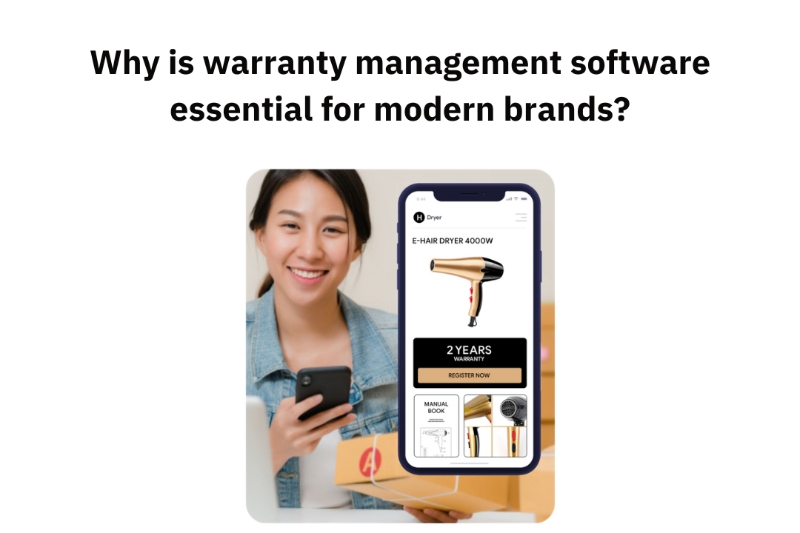
As modern brands continue to evolve and grow, they face new challenges when it comes to managing warranties. With the rise of e-commerce and the increasing expectations of consumers, brands must find ways to efficiently manage warranties to maintain customer satisfaction and loyalty. This is where warranty management software comes in as an essential tool for modern brands. In this blog post, we will explore the benefits of warranty management software and why it is a must-have for any modern brand.
## What is warranty management software?
Warranty management software is a tool designed to streamline and automate the warranty process. It enables brands to manage the entire warranty lifecycle, from registration to claim processing and resolution. This software typically includes features such as warranty registration, claims management, parts management, and analytics and reporting.
Why is warranty management software essential?
### Improved Customer Experience
One of the most significant benefits of warranty management software is that it improves the customer experience. With the ability to easily register warranties and make claims, customers have a more streamlined and efficient experience when dealing with warranty-related issues. This leads to increased customer satisfaction and loyalty, which can have a positive impact on a brand's reputation and bottom line.
Increased Efficiency and Cost Savings
Manual warranty management processes can be time-consuming and labor-intensive. Warranty management software automates many of these processes, reducing the time and resources required to manage warranties. This increased efficiency can lead to cost savings for brands, allowing them to allocate resources to other areas of the business.
### Data Analytics and Insights
Warranty management software also provides brands with valuable data analytics and insights. With access to data on warranty claims, brands can identify trends and patterns, allowing them to make data-driven decisions to improve their products and processes. This data can also be used to identify potential issues before they become major problems, minimizing the impact on customers and the brand.
### Compliance and Risk Management
Warranty management software can help brands ensure compliance with regulations and reduce risk. By automating processes and providing visibility into warranty claims and other data, brands can ensure they are meeting regulatory requirements and mitigating potential risks.
### Improved Communication and Collaboration
Warranty management software also improves communication and collaboration between different departments and teams within a brand. With a centralized system for managing warranties, different teams can easily access and share information, reducing the risk of miscommunication and ensuring everyone is on the same page.
### Building Customer Loyalty
One of the most significant benefits of using product registration software is building customer loyalty. When you offer an efficient and user-friendly registration process, customers are more likely to feel valued and appreciated.
By offering rewards or exclusive content for registered customers, you can foster a sense of loyalty and strengthen the relationship between your brand and customers.
### QR Code-Based Solutions for Warranty Registration
QR code-based solutions are an excellent way to streamline the warranty registration process. By incorporating QR codes into your product inserts or packaging, customers can quickly scan the code with their smartphone and be directed to a registration page.
This eliminates the need for customers to manually input product information, making the registration process quicker and more efficient.
In addition, QR code-based solutions can help businesses collect first-party customer data, such as email addresses and demographic information.
This data can be used to create targeted marketing campaigns and improve customer retention. By collecting customer data, businesses can also gain valuable insights into customer behaviour and preferences, which can inform product development and improve overall customer satisfaction.
**What do leading consumer brands say about using warranty management software like NeuroWarranty?**

If you're looking to improve your warranty management process and streamline your customer support efforts, get a free trial of NeuroWarranty's [**warranty management software**](https://www.neurowarranty.com/) now.
With NeuroWarranty, you can offer a seamless and user-friendly warranty registration experience that can help build customer loyalty and increase customer satisfaction.
Plus, with QR code-based solutions, you can collect valuable customer data and improve your marketing efforts. Try [NeuroWarranty](https://www.neurowarranty.com/) today and see how it can transform your business.
---
This blog is powered by Superblog. Visit https://superblog.ai to know more.
---
## Free Warranty Management Software: NeuroWarranty
Author: Abhishek Agrawal
Author URL: https://www.neurowarranty.com/blog/author/abhishek-agrawal
Published: 2023-03-27
Tags: warranty management solution, product registration software
Tag URLs: warranty management solution (https://www.neurowarranty.com/blog/tag/warranty-management-solution), product registration software (https://www.neurowarranty.com/blog/tag/product-registration-software)
URL: https://www.neurowarranty.com/blog/free-warranty-management-software-neurowarranty-clfqo344p98961lnplo4ullbi
Warranty management is an essential task for businesses, especially those that deal with a large number of products. A warranty management software can help businesses streamline this process, track warranties, and communicate with customers.
While there are several free warranty management software options available in the market, it's important to understand the limitations of free software and how they differ from paid solutions.
In this blog, we'll explore the differences between free and [paid warranty management software](https://www.dyrect.co/blog/best-warranty-management-software) and how NeuroWarranty, our paid warranty management software, can help businesses overcome these limitations.
Contents
- [What is free warranty management software?](#what-is-free-warranty-management-software)
- [Which are the best free warranty management software in 2026?](#which-are-the-best-free-warranty-management-software-in-2023)
- [NeuroWarranty](#neurowarranty)
- [Scalepad](#scalepad)
- [Pega](#pega)
- [FieldEZ](#fieldez)
- [Limitations of free warranty management software](#limitations-of-free-warranty-management-software)
- [Limited features](#limited-features)
- [Limited support](#limited-support)
- [Limited scalability](#limited-scalability)
- [How NeuroWarranty stands out](#how-neurowarranty-stands-out)
- [Comprehensive features](#comprehensive-features)
- [Dedicated support](#dedicated-support)
- [Better scalability](#better-scalability)
- [Using the free demo and trial](#using-the-free-demo-and-trial)
- [Conclusion](#conclusion)
## What is free warranty management software?
Free [warranty management software](https://www.dyrect.co/guide/warranty-management-software) is a software that allows businesses to manage warranties for their products without paying for it. These software programs may offer limited features or the entire suite of features for free. Free software can be a good option for businesses that are just starting out or have a limited budget.
According to the recent listing by [G2](https://www.g2.com/products/neurowarranty/reviews), NeuroWarranty has been ranked as one of the [top warranty management software in 2026](https://www.neurowarranty.com/blog/best-warranty-management-software).
## Which are the best free warranty management software in 2026?
### [NeuroWarranty](https://www.neurowarranty.com/)
### [Scalepad](https://www.scalepad.com/)
### [Pega](https://www.pega.com/?&utm_source=google&utm_medium=cpc&utm_campaign=G_India_Brand_Core_Exact_(CPN-111057)_EN&utm_term=pega&gloc=9062112&utm_content=pcrid%7c645971266319%7cpkw%7ckwd-13109652%7cpmt%7ce%7cpdv%7cc%7c&gclid=CjwKCAjw_YShBhAiEiwAMomsEMK3tKcoKwciXFImUYkmnR2Awcv9s0uuC8G32b9nBsCIqCw__RpSQRoCMZcQAvD_BwE&gclsrc=aw.ds)
### [FieldEZ](https://www.fieldez.com/)
While there are several free options available in the market, NeuroWarranty stands out for its comprehensive features and scalability.
Unlike other free solutions that offer limited functionality and may not be customizable, NeuroWarranty allows businesses to manage warranties effectively, track products, and automate processes without compromising on quality.
## Limitations of free warranty management software
While free warranty management software can be a good option for some businesses, there are some limitations to be aware of. These include:
### Limited features
Free warranty management software may offer a limited set of features compared to paid solutions. For instance, they may not offer automation features or advanced reporting capabilities.
### Limited support
Free software providers may not offer the same level of support as paid solutions. This can be a problem if businesses run into issues or need help with the software.
### Limited scalability
Some free warranty management software providers may limit the number of users or products that businesses can manage. This can be a problem for businesses that are growing and need to manage more products.
## How NeuroWarranty stands out
NeuroWarranty is a paid warranty management software that offers a range of features to help businesses manage warranties more efficiently. Our software stands out from free solutions in several ways:
### Comprehensive features
With NeuroWarranty, businesses get a comprehensive set of features that allow them to manage warranties for their products from start to finish. These features include:
- Tracking warranty claims
- Managing repairs
- Communicating with customers
- Creating custom reports
- Integrating with other software tools
- Customization
Our software is customizable to meet the unique needs of businesses. We understand that different businesses have different requirements when it comes to warranty management.
That's why we offer flexible workflows, custom reports, and integration options to ensure that our software fits your business perfectly.
### Dedicated support
With NeuroWarranty, businesses get dedicated support from our team of experts. We understand that businesses can run into issues or need help with the software. That's why we're always here to help you get the most out of our software and provide solutions to any issues you may encounter.
### Better scalability
Unlike free warranty management software, NeuroWarranty is designed to scale with your business. Whether you're managing a small number of products or a large portfolio, our software can handle it.
### Using the free demo and trial
While NeuroWarranty is not a free warranty management software, we do offer a free demo and trial. The demo allows businesses to see the software in action and get a feel for how it works.
The trial, on the other hand, allows businesses to use the software for a set period of time, during which they can manage warranties for their products and explore all the features of the software.

To get started with the demo or trial, [**sing up here.**](https://calendly.com/aabhishekbindal/neurotags-demo?month=2023-03)
## Conclusion
Free warranty management software can be a good option for businesses on a budget, but they often come with limitations that can hinder their ability to manage warranties effectively.
As one of the top 4 free warranty management software in 2026 according to G2, NeuroWarranty stands out by offering a comprehensive, customizable, and scalable solution to help businesses manage warranties efficiently and meet their unique needs.
---
This blog is powered by Superblog. Visit https://superblog.ai to know more.
---
## 5 Must-Have Features of Digital Warranty Management Systems
Author: Abhishek Agrawal
Author URL: https://www.neurowarranty.com/blog/author/abhishek-agrawal
Published: 2023-03-20
Tags: Digital Warranty Management, Warranty Management
Tag URLs: Digital Warranty Management (https://www.neurowarranty.com/blog/tag/digital-warranty-management), Warranty Management (https://www.neurowarranty.com/blog/tag/warranty-management)
URL: https://www.neurowarranty.com/blog/5-must-have-features-of-digital-warranty-management-systems-clfgr8lpq157681jl9drrtymte
Digital Warranty Management Systems have revolutionized the way businesses manage warranties for their products. With the advent of technology, brands no longer have to rely on manual processes to manage warranties.
Instead, they can use digital solutions like NeuroWarranty to automate and streamline their warranty management processes. But choosing the right digital warranty management system can be challenging, with so many options available in the market.
In this blog post, we'll explore the five must-have features of digital warranty management systems that can help businesses make informed decisions.
Contents
- [QR Code-based Warranty Registration](#qr-code-based-warranty-registration)
- [Automated Warranty Claims Processing](#automated-warranty-claims-processing)
- [First-Party Customer Data Collection](#first-party-customer-data-collection)
- [Inbuilt CRM](#inbuilt-crm)
- [Easy Implementation and Integration](#easy-implementation-and-integration)
## QR Code-based Warranty Registration
QR code-based registration is a must-have feature in digital warranty management systems. It allows businesses to provide a unique QR code for each product, simplifying the registration process for customers.
With QR codes, customers don't have to fill out lengthy registration forms, and there's less chance of errors. Moreover, the QR code should not just lead to a web page, but to a custom-built web app like NeuroWarranty. This allows businesses to collect relevant product information easily and efficiently.
NeuroWarranty's QR code-based registration system is a perfect example of how this feature works. When a customer purchases a product, they receive a unique QR code with their purchase.
The customer can scan the QR code using their mobile device, and it takes them to a custom-built web app where they can register their product by simply providing a few details.
This feature saves time for customers and businesses, reduces errors, and allows businesses to collect product information easily.
Automated Warranty Claims Processing
Automated claims processing is another must-have feature in digital warranty management systems. It allows businesses to process warranty claims quickly and efficiently, reducing cross-communications and phone calls.
With automated claims processing, customers can also track the status of their claims in real time. This feature can save businesses a lot of money and time.
NeuroWarranty's automated claims processing system is an excellent example of how this feature works. When a customer files a warranty claim, the system automatically verifies the claim, and if approved, directs your customer service teams to carry out the claim on simple dashboards.
The system also sends real-time updates to customers about the status of their claims. This feature helps businesses process claims quickly and efficiently, saves costs, and improves customer satisfaction.
## First-Party Customer Data Collection
Collecting first-party customer data is a must-have feature in digital warranty management systems. It allows businesses to gain insights into their customers' behavior, preferences, and needs.
This data can help businesses resell and upsell to existing customers, leading to increased LTV.
NeuroWarranty's first-party customer data collection system is an excellent example of how this feature works. The system collects data about customer behavior, preferences, and needs, which businesses can use to personalize their marketing efforts.
NeuroWarranty also empowers brands by bringing them data such as emails, phone numbers and names of their end customers allowing your marketing teams to personalize your remarketing efforts increasing repeat sales and maximum customer retention rates.
## Inbuilt CRM
Customers, when registered for a warranty claim, want constant updates on their claim status, but ensuring that customers are aware of their warranty claim's status is an expensive and time-consuming process for brands.
Absence of a direct communication channel between customers who claim a warranty and customer service teams forces brands to take up the process on-call resulting in additional service costs and reduced profits.
At the same time, collecting feedback and reviews from your end customers can prove to be a rather complicated task, notably for consumer product brands.
Using Customer Relationship Management (CRM) software, your end customers can connect directly with your client servicing teams to communicate and register their feedback.
NeuroWarranty's inbuilt CRM is an excellent example of how this feature works. The system provides businesses with a complete view of customer interactions, enabling them to resolve queries quickly and efficiently. The system also allows businesses to track customer complaints, follow-ups, and feedback, improving customer satisfaction.
## Easy Implementation and Integration
Easy implementation and integration are must-have features in digital warranty management systems. The system should be easy to implement, without making changes to the production line. Moreover, the system should be easy to integrate with existing software and systems, saving time and money.
NeuroWarranty's easy implementation and integration features make it a great example of how this feature works. The system can be easily integrated with existing software and systems, and businesses don't have to make any changes to their production line. This makes it easy for businesses to adopt the system, without disrupting their existing operations.
Overall, these five features are essential in any digital warranty management system. By choosing a system that has these features, businesses can streamline their warranty management processes, improve customer satisfaction, and save time and money.
**Trusted by 100s of leading brands including - Syska, JCB, ResQtech,** NeuroWarranty is a QR Code-based warranty management software that is easy to implement yet extremely powerful. Customers can register for a warranty by simply scanning a QR code placed on your product and entering the purchase details.
You can sign up for the [warranty management app](https://www.neurowarranty.com/) by scheduling a demo and getting a free 14-day trial here - [get a demo](https://calendly.com/aabhishekbindal/neurotags-demo?month=2022-02) when you schedule a demo, an account manager will contact you and organize a call to discuss your business requirements.
---
This blog is powered by Superblog. Visit https://superblog.ai to know more.
---
## How D2C brands can boost customer loyalty using a warranty management software
Author: Abhishek Agrawal
Author URL: https://www.neurowarranty.com/blog/author/abhishek-agrawal
Published: 2023-03-17
Tags: D2C, customer loyalty
Tag URLs: D2C (https://www.neurowarranty.com/blog/tag/d2c), customer loyalty (https://www.neurowarranty.com/blog/tag/customer-loyalty)
URL: https://www.neurowarranty.com/blog/how-d2c-brands-can-boost-customer-loyalty-using-a-warranty-management-software-clfcejxou1181261kqlazn65zyr
Warranty management is a crucial aspect of any business that sells products or services to customers. It involves creating a system to handle the process of warranty claims, tracking warranty information, and ensuring that customers receive timely responses and solutions to their warranty-related issues.
Effective warranty management is especially critical for D2C (Direct-to-Consumer) brands, as it can have a significant impact on customer loyalty.
In this blog, we'll explore the impact of effective warranty management on customer loyalty for D2C brands, the challenges that D2C brands face in managing warranties, and how NeuroWarranty can help streamline the warranty management process.
**The Impact of Effective Warranty Management on Customer Loyalty for D2C Brands**
Contents
- [Builds Trust](#builds-trust)
- [Increases Customer Satisfaction](#increases-customer-satisfaction)
- [Improves Brand Reputation](#improves-brand-reputation)
- [Reduces Customer Churn](#reduces-customer-churn)
- [The Challenges of Warranty Management for D2C Brands](#the-challenges-of-warranty-management-for-d2c-brands)
- [Lack of Resources](#lack-of-resources)
- [Limited Visibility](#limited-visibility)
- [Inconsistent Processes](#inconsistent-processes)
- [Lack of Integration](#lack-of-integration)
- [How NeuroWarranty Can Help D2C Brands Streamline the Warranty Management Process](#how-neurowarranty-can-help-d2c-brands-streamline-the-warranty-management-process)
- [Automation](#automation)
- [Integration](#integration)
- [Tracking](#tracking)
- [Customization](#customization)
- [Conclusion](#conclusion)
**** Effective warranty management can positively impact customer loyalty for D2C brands in several ways. Here are some of the key benefits:
## Builds Trust
Customers want to know that their purchases are backed by a reliable warranty. Effective warranty management builds trust with customers by ensuring that they can count on the company to stand behind its products.
When customers know that they can easily get help if they encounter issues with a product, they feel more confident in their decision to buy from a D2C brand.
By delivering on warranty promises and resolving issues quickly and efficiently, D2C brands can foster a sense of trust and confidence in their customers.
### Increases Customer Satisfaction
A well-managed warranty program can increase customer satisfaction. When customers encounter issues with a product, they want to know that the company will make things right.
By offering a seamless and hassle-free warranty process, D2C brands can create a positive customer experience, which can lead to repeat business and referrals.
Effective warranty management can also help prevent negative reviews and customer complaints, which can damage a brand's reputation.
## Improves Brand Reputation
Effective warranty management can improve a D2C brand's reputation. When customers have a positive experience with a warranty claim, they are more likely to share their experience with others, which can lead to positive word-of-mouth marketing.
This, in turn, can lead to increased brand awareness and trust. A good reputation is critical for D2C brands, as it can differentiate them from their competitors and help them stand out in a crowded marketplace.
## Reduces Customer Churn
Customers who encounter issues with a product but have a positive warranty experience are more likely to stay loyal to the D2C brand. In contrast, customers who have negative warranty experiences are more likely to switch to a competitor.
By reducing customer churn, D2C brands can increase their customer lifetime value and revenue. Effective warranty management can also help identify areas for improvement in product design or manufacturing, which can further enhance customer satisfaction and loyalty.
## The Challenges of Warranty Management for D2C Brands
While effective warranty management can have numerous benefits for D2C brands, it's not always easy to achieve. Here are some of the challenges that D2C brands face in managing warranties:
### Lack of Resources
Many D2C brands are startups or small businesses that may not have the resources to implement a comprehensive warranty management system. They may rely on manual processes or spreadsheets, which can be time-consuming and error-prone. This can result in delayed or incomplete warranty claims, which can frustrate customers and damage brand reputation.
### Limited Visibility
D2C brands may sell products through multiple channels, such as their website, social media, or third-party marketplaces. This can make it difficult to track warranty claims and customer interactions across all channels. Limited visibility can lead to missed or duplicated warranty claims, which can further erode customer trust and loyalty.
### Inconsistent Processes
D2C brands may have multiple teams or individuals involved in the warranty management process, which can lead to inconsistent processes and communication.
Inconsistencies can result in delays or incorrect responses to warranty claims, which can damage customer trust and loyalty. It's essential for D2C brands to have a clear and consistent warranty management process in place to ensure that all customers receive the same level of service and support.
## Lack of Integration
D2C brands may use multiple systems to manage different aspects of their business, such as inventory, customer service, and marketing. Without integration between these systems, warranty management can become fragmented, leading to errors and delays. Integration between systems can improve the warranty management process by streamlining workflows, reducing errors, and providing better visibility into customer interactions.
## How NeuroWarranty Can Help D2C Brands Streamline the Warranty Management Process
NeuroWarranty is a warranty management software designed to help businesses streamline their warranty management process. Here are some of the ways that NeuroWarranty can help D2C brands:
### Automation
NeuroWarranty automates many aspects of the warranty management process, reducing the need for manual processes and human intervention. This can help D2C brands save time and reduce the risk of errors or delays. For example, NeuroWarranty can automatically generate warranty claim forms, send emails to customers, and track warranty claims in real-time.
## Integration
NeuroWarranty integrates with other systems, such as customer service software, e-commerce platforms, and inventory management systems.
This allows D2C brands to manage all aspects of the warranty process in one place, reducing the risk of errors and delays. Integration also provides better visibility into customer interactions, enabling D2C brands to provide better service and support.
### Tracking
NeuroWarranty tracks warranty claims in real-time, providing D2C brands with up-to-date information on the status of each claim. This can help D2C brands identify areas for improvement and respond to customer inquiries quickly and efficiently.
### Customization
NeuroWarranty allows D2C brands to customize their warranty management process to meet their specific needs. This can include customizing warranty claim forms, creating custom workflows, and setting up automated responses to customer inquiries.
## Conclusion
Effective warranty management is critical for D2C brands looking to build customer loyalty and improve their reputation. By building trust, increasing customer satisfaction, improving brand reputation, and reducing customer churn, D2C brands can reap significant benefits from effective warranty management.
**Want to offer your customers a smarter warranty program?**
With NeuroWarranty's advanced features, such as QR codes and real-time notifications, you can provide a more [**personalized and efficient warranty experience.**](https://write.superblog.ai/sites/supername/neurowarranty/posts/untitled-draft-post-clf0ws7x308961kp7nvfgahgc/Want%20to%20offer%20your%20customers%20a%20smarter%20warranty%20program?%20With%20NeuroWarranty%27s%20advanced%20features,%20such%20as%20QR%20codes%20and%20real-time%20notifications,%20you%20can%20provide%20a%20more%20personalized%20and%20efficient%20warranty%20experience.)
Curious to know how industry-leading brands like Syska manage their product warranties?

**Read the complete case study on how Syska used product warranties to boost their repeat sales -** [**Read Now.**](https://www.neurowarranty.com/blog/warranty-management-solution-for-the-consumer-electronics-industry-case-study-cl027nbcy55861pm8ipb99ulw)
However, managing warranties can be challenging, especially for small businesses with limited resources and fragmented systems. That's where NeuroWarranty comes in.
With its automation, integration, tracking, and customization features, NeuroWarranty can help D2C brands streamline their warranty management process and enhance customer loyalty.
If you're interested in learning more about how NeuroWarranty can help your D2C brand, visit our website or reach out to our team for a demo.
---
This blog is powered by Superblog. Visit https://superblog.ai to know more.
---
## Trends in Warranty Management for 2023: How Brands Can Keep Up
Author: Abhishek Agrawal
Author URL: https://www.neurowarranty.com/blog/author/abhishek-agrawal
Published: 2023-03-09
Tags: Technology, warranty mangement software
Tag URLs: Technology (https://www.neurowarranty.com/blog/tag/technology), warranty mangement software (https://www.neurowarranty.com/blog/tag/warranty-mangement-software)
URL: https://www.neurowarranty.com/blog/top-trends-in-warranty-management-for-2023
As we head into 2023, the importance of warranty management for brands has never been clearer. Customers expect high-quality products and exceptional customer service, including warranties that are easy to understand, register, and claim.
To stay ahead of the competition and meet these customer expectations, brands need to adapt to the top trends in warranty management for 2023. In this blog post, we'll explore these trends and provide practical advice on how brands can keep up.
Contents
- [Trend 1: Increased Focus on Customer Experience](#trend-1-increased-focus-on-customer-experience)
- [Trend 2: Emphasis on Data and Analytics](#trend-2-emphasis-on-data-and-analytics)
- [Trend 3: Integration with Service Management Systems](#trend-3-integration-with-service-management-systems)
- [Trend 4: Rise of Smart Warranty Programs](#trend-4-rise-of-smart-warranty-programs)
- [Trend 5: Expansion of Warranty Coverage](#trend-5-expansion-of-warranty-coverage)
- [Conclusion](#conclusion)
Trend 1: Increased Focus on Customer Experience
In 2023, warranty management is all about the customer experience. Brands that prioritize customer experience in their warranty management strategies will have a distinct competitive advantage.
Customers want warranties that are easy to understand, register, and claim. They also expect prompt and helpful customer service when they need to make a claim. Brands that can provide this level of customer experience will earn the loyalty of their customers and stand out in the marketplace.
To improve customer experience, brands need to focus on transparency, simplicity, and speed. They should provide clear and concise warranty information, easy-to-use registration and claims processes, and quick and efficient resolution of claims.
Brands should also gather feedback from customers and use it to continuously improve their warranty programs.
One way to enhance customer experience is by providing self-service options. Customers want to be able to register their warranties and make claims online, without having to call customer service.
By providing a user-friendly self-service portal, brands can improve customer satisfaction and reduce customer service costs.
**Want to improve your customers' experience with warranty management?**
Try NeuroWarranty today and see how easy it is to provide clear and concise warranty information, as well as a simple and [**efficient registration and claims process**](https://www.neurowarranty.com/warranty-management-solution).
## Trend 2: Emphasis on Data and Analytics
Data and analytics are becoming more important in warranty management. Brands that can collect and analyze warranty data will gain valuable insights into their products, customers, and warranty programs.
They can use this data to improve product quality, identify warranty fraud, and optimize their warranty programs.
To leverage data and analytics, brands need to invest in the right tools and technologies. They should collect data on product defects, warranty claims, and customer feedback.
They should also use analytics to identify patterns and trends in the data. By doing so, they can make data-driven decisions that improve their warranty programs and drive customer satisfaction.
**Are you making the most of your warranty data?**
With NeuroWarranty, you can [**analyze patterns and trends in your product performance and warranty claims**](https://write.superblog.ai/sites/supername/neurowarranty/posts/untitled-draft-post-clf0ws7x308961kp7nvfgahgc/Are you making the most of your warranty data? With NeuroWarranty, you can analyze patterns and trends in your product performance and warranty claims, and use that information to make informed decisions about product development and warranty programs.), and use that information to make informed decisions about product development and warranty programs.
**Watch this video to understand how advanced warranty management solutions work.**
## **** Trend 3: Integration with Service Management Systems
Warranty management is becoming more integrated with overall service management systems. Brands that can seamlessly integrate their warranty management with their service management systems will have a significant advantage.
They can provide a unified customer experience that simplifies warranty registration and claims processes.
To achieve this integration, brands need to invest in the right technology platforms. They should use customer service software that includes warranty management functionality.
They should also ensure that their warranty management software can integrate with their other systems, such as inventory management and order processing.
By integrating warranty management with service management, brands can improve customer satisfaction, reduce service costs, and increase efficiency.
**Are you looking for an easier way to manage your warranty claims?**
With NeuroWarranty's seamless [**integration with service management systems**](https://write.superblog.ai/sites/supername/neurowarranty/posts/untitled-draft-post-clf0ws7x308961kp7nvfgahgc/re you looking for an easier way to manage your warranty claims? With NeuroWarranty's seamless integration with service management systems, you can streamline the process and reduce the time and resources needed to handle claims.), you can streamline the process and reduce the time and resources needed to handle claims.
## Trend 4: Rise of Smart Warranty Programs
Smart technology is transforming warranty management. Brands that can leverage smart technology in their warranty programs will have a competitive advantage.
Smart warranties use technology such as QR codes and IoT devices to improve the warranty experience for customers and brands.
One example of smart warranty technology is the use of QR codes. Brands can use QR codes to simplify warranty registration and claims processes.
Customers can scan the code with their smartphone and register their product or submit a claim instantly. This eliminates the need for paper forms and manual data entry, reducing errors and improving efficiency.
Another example of smart warranty technology is the use of IoT devices. Brands can use IoT devices to track product usage and detect defects in real-time.
This allows them to proactively identify and resolve issues before they become major problems, reducing the number of warranty claims and improving customer satisfaction.
Smart warranties also provide brands with valuable data on product usage and performance. They can use this data to identify patterns and trends and make informed decisions about product development and warranty programs.
**Want to offer your customers a smarter warranty program?**
With NeuroWarranty's advanced features, such as QR codes and real-time notifications, you can provide a more [**personalized and efficient warranty experience.**](https://write.superblog.ai/sites/supername/neurowarranty/posts/untitled-draft-post-clf0ws7x308961kp7nvfgahgc/Want to offer your customers a smarter warranty program? With NeuroWarranty's advanced features, such as QR codes and real-time notifications, you can provide a more personalized and efficient warranty experience.)
Curious to know how industry-leading brands like Syska manage their product warranties?

**Read the complete case study on how Syska used product warranties to boost their repeat sales -** [**Read Now.**](https://www.neurowarranty.com/blog/warranty-management-solution-for-the-consumer-electronics-industry-case-study-cl027nbcy55861pm8ipb99ulw)
## Trend 5: Expansion of Warranty Coverage
In 2023, warranty coverage is expanding beyond traditional product defects. Brands are now offering warranties that cover additional areas, such as accidental damage and loss.
This expansion of warranty coverage is driven by customer demand and the need for brands to differentiate themselves in a competitive market.
To offer expanded warranty coverage, brands need to assess the risks and costs involved. They should also develop clear and concise terms and conditions for the expanded coverage, and communicate these clearly to customers.
Expanded warranty coverage can provide significant benefits to brands, including increased customer satisfaction and loyalty, and higher revenue from warranty sales.
**Ready to expand your warranty coverage beyond traditional product defects?**
With NeuroWarranty's [**flexible and customizable warranty terms and conditions**](https://write.superblog.ai/sites/supername/neurowarranty/posts/untitled-draft-post-clf0ws7x308961kp7nvfgahgc/Ready to expand your warranty coverage beyond traditional product defects? With NeuroWarranty's flexible and customizable warranty terms and conditions, you can easily offer coverage for additional areas, such as accidental damage and loss.), you can easily offer coverage for additional areas, such as accidental damage and loss.
## Conclusion
As we head into 2023, the top trends in warranty management for brands are focused on customer experience, data and analytics, integration with service management systems, smart warranty programs, and the expansion of warranty coverage.
Brands that can adapt to these trends will have a competitive advantage and be better positioned to meet customer expectations.
By staying ahead of the curve in warranty management, brands can differentiate themselves in a crowded marketplace, drive customer satisfaction and loyalty, and increase revenue from warranty sales.
Ready to take your warranty management to the next level?
Book a demo of NeuroWarranty today and see how our innovative platform can help you improve customer experience, streamline your warranty management process, and drive revenue from warranty sales. Don't miss out on the opportunity to stay ahead of the curve in warranty management - [**schedule your demo now!**](https://calendly.com/aabhishekbindal/neurotags-demo?month=2023-03)
---
This blog is powered by Superblog. Visit https://superblog.ai to know more.
---
## Common Challenges Faced in Warranty Management and How a Service Can Help
Author: Abhishek Agrawal
Author URL: https://www.neurowarranty.com/blog/author/abhishek-agrawal
Published: 2023-03-02
Tags: Warranty Management Services, QR codes
Tag URLs: Warranty Management Services (https://www.neurowarranty.com/blog/tag/warranty-management-services), QR codes (https://www.neurowarranty.com/blog/tag/qr-codes)
URL: https://www.neurowarranty.com/blog/challenges-faced-in-warranty-management-and-how-a-service-can-help
Warranty management is a critical aspect of any business that offers products to customers. It helps to ensure that customers are satisfied with the quality of the products they receive and protects the business from any unforeseen liabilities.
However, managing warranties can be a complex process that comes with many challenges. In this blog post, we will explore some of the common challenges faced in warranty management and how a [**warranty management service**](https://www.neurowarranty.com/) can help businesses overcome them, including the issue of fraud claims and how QR code warranty service can help prevent them.
Contents
- [Inadequate Warranty Coverage](#inadequate-warranty-coverage)
- [Complex Claims Process](#complex-claims-process)
- [Data Management and Reporting](#data-management-and-reporting)
- [Cost Management](#cost-management)
- [Customer Service and Communication](#customer-service-and-communication)
- [Fraud Claims and QR Code Warranty Service](#fraud-claims-and-qr-code-warranty-service)
- [Real-time claim updates and tracking](#real-time-claim-updates-and-tracking)
- [Conclusion](#conclusion)
## **Inadequate Warranty Coverage**
One of the most significant challenges that businesses face in warranty management is providing adequate warranty coverage. Inadequate coverage can result in dissatisfied customers, negative reviews, and even legal issues.
When businesses don't have a clear understanding of what is covered and what is not, customers can become confused and frustrated.
A warranty management service can help businesses develop clear and concise warranty terms that meet legal requirements and customer expectations.
By providing customers with a comprehensive warranty plan, businesses can build trust and improve customer satisfaction.
## **Complex Claims Process**
Another common challenge in warranty management is a complex claims process. Customers expect quick and efficient claims processing, but when the process is too complex, it can lead to frustration and negative experiences.
Businesses that rely on manual processes or outdated technology may find it challenging to manage claims efficiently.
A warranty management service can help businesses streamline the claims process and make it more efficient. With automated systems and streamlined workflows, a warranty management service can reduce the time it takes to process claims and ensure that customers receive timely resolutions.
## **Data Management and Reporting**
Effective warranty management requires accurate data management and reporting. Businesses need to be able to track warranty claims, identify trends, and make data-driven decisions. However, manual data management can be time-consuming and prone to errors.
A warranty management service can help businesses automate data management and reporting.
With advanced analytics and reporting tools, businesses can quickly identify issues, track trends, and make informed decisions about their warranty programs.
## **Cost Management**
Warranty management can be costly for businesses, especially when claims volumes are high. Poorly managed warranties can result in unnecessary costs, such as over-replacement of products or processing of fraudulent claims.
A warranty management service can help businesses manage costs more effectively by providing accurate data on warranty claims, identifying areas for improvement, and implementing cost-saving measures.
By optimizing warranty management processes, businesses can reduce their warranty-related costs and improve their bottom line.
## **Customer Service and Communication**
Finally, effective warranty management requires excellent customer service and communication. Customers expect businesses to be responsive and transparent when it comes to warranty claims. Poor communication or lack of response can result in negative experiences and damaged reputations.
A warranty management service can help businesses provide excellent customer service and communication.
By offering multi-channel support and real-time updates on claims status, businesses can keep customers informed and engaged throughout the claims process.
**How does a warranty management service work?**
**Fraud Claims and QR Code Warranty Service**
Fraudulent warranty claims can be a significant challenge for businesses, with many companies struggling to identify and prevent them. Fraud claims can be costly and time-consuming to investigate, and they can damage a business's reputation.
A QR code warranty service can help businesses prevent fraud claims by providing a unique identifier that can be scanned and verified by authorized personnel.
QR codes can be applied to products and used to validate warranty claims, ensuring that only legitimate claims are processed. This can help businesses prevent fraudulent claims, reduce costs associated with investigations, and improve customer trust.
At Neurowarranty, we offer a QR code warranty service that helps businesses prevent fraudulent claims and improve their warranty management processes.
Our QR code solution allows customers to quickly and easily register their products and file warranty claims. When a claim is filed, the QR code can be scanned to validate the claim and ensure that it meets the terms and conditions of the warranty.
This streamlined process not only prevents fraud claims but also helps businesses manage their warranty claims more efficiently.
Facing challenges in managing warranties? [**Automate your process now.**](https://www.neurowarranty.com/warranty-management-solution)
## **Real-time claim updates and tracking**
Another challenge businesses face in warranty management is keeping their customers informed about the status of their claims. Customers want to know that their claim has been received, validated, and processed, and they want to be able to track its status throughout the process.
At Neurowarranty, we understand the importance of providing customers with real-time updates on their claims.
Our warranty management software allows customers to track the status of their claims through a dedicated portal, where they can view the progress of their claims, receive updates, and communicate with customer support.
This not only improves customer satisfaction but also reduces the workload on the customer support team, as customers can get the information they need without having to call or email.
[**Check out the list of the top 5 warranty management services in 2023.**](https://www.neurowarranty.com/blog/5-best-warranty-management-software-in-2022-ckzqvwn3k169851llanw48z6yo)
## **Conclusion**
Effective warranty management is essential for any business that wants to build trust and loyalty with its customers. However, warranty management can be complex and challenging, with many businesses struggling to manage their warranties effectively.

In this blog post, we've explored some of the common challenges faced in warranty management and how a warranty management service can help businesses overcome them.
By partnering with [**Neurowarranty**](https://www.neurowarranty.com/), you can improve their warranty management processes and drive better results. Contact us now to [**schedule a demo**](https://calendly.com/aabhishekbindal/neurotags-demo?month=2023-03) and see our software in action.
---
This blog is powered by Superblog. Visit https://superblog.ai to know more.
---
## Cut Your Warranty Costs by 50% with a Management App
Author: Abhishek Agrawal
Author URL: https://www.neurowarranty.com/blog/author/abhishek-agrawal
Published: 2023-02-23
Tags: NeuroWarranty, warranty management app
Tag URLs: NeuroWarranty (https://www.neurowarranty.com/blog/tag/neurowarranty), warranty management app (https://www.neurowarranty.com/blog/tag/warranty-management-app)
URL: https://www.neurowarranty.com/blog/reduce-cost-by-50percent-using-warranty-management-app
As a brand owner, managing warranties can be a daunting task, especially when you have a high volume of products to track, process, and manage.
In addition, warranties can be a costly expense that can hurt your bottom line. The good news is that a warranty management app can help you streamline your warranty management processes and save you money in the long run.
In this post, we'll explore some of the ways that a warranty management app can help you save money and reduce your warranty costs.
From identifying and addressing product issues to streamlining your claims process, there are many benefits to using a warranty management app.
Contents
- [Identifying and Addressing Product Issues](#identifying-and-addressing-product-issues)
- [Negotiating Better Supplier Agreements](#negotiating-better-supplier-agreements)
- [Improving the Efficiency of the Claims Process](#improving-the-efficiency-of-the-claims-process)
- [Reducing Customer Service Costs](#reducing-customer-service-costs)
- [Reducing Warranty Processing Costs](#reducing-warranty-processing-costs)
## Identifying and Addressing Product Issues
One of the most significant ways that a warranty management app can help you reduce your warranty costs is by identifying and addressing common product issues.
By tracking warranty claims and analyzing the data, you can identify trends and patterns in the types of issues customers are experiencing with your products.
From there, you can take steps to address these issues and prevent them from happening in the future, ultimately reducing the number of warranty claims you have to process.
For example, if you notice that a particular product line has a high rate of warranty claims due to a specific issue, you can work with your product development team to identify the root cause and develop a solution to prevent it from happening in the future. By improving your product quality, you can reduce the overall cost of your warranties and improve customer satisfaction.
Find the list of the best warranty management app in 2023. [Find the list of the best warranty management app in 2023.](https://www.neurowarranty.com/blog/5-best-warranty-management-software-in-2022-ckzqvwn3k169851llanw48z6yo)
## Negotiating Better Supplier Agreements
Another way that a warranty management app can help you reduce your warranty costs is by facilitating better supplier agreements. By having detailed data on warranty claims, you can negotiate with your suppliers for better pricing, extended warranties, or improved product quality.
By leveraging your warranty management app to identify common product issues, you can have data-driven conversations with your suppliers and ultimately reduce the overall cost of your warranties.
For example, if you notice that a specific supplier's products have a high rate of warranty claims, you can work with them to improve the product quality or negotiate better pricing based on the warranty claims data. By developing strong supplier relationships and using data to drive decisions, you can save money on warranties and improve your product offerings.
**Find out how brands our successfully saving money using NeuroWarranty's warranty management app.**
Improving the Efficiency of the Claims Process
A warranty management app can also help you save money by streamlining your claims process. By automating many of the tasks associated with processing warranty claims, you can save time and money on administrative tasks.
With a warranty management app, customers can easily submit warranty claims online, and your team can quickly review and approve them. By eliminating the need for manual data entry and paperwork, you can save money on administrative costs and ultimately reduce the cost of your warranties.
For example, a warranty management app can automatically capture and store warranty claims data, reducing the need for manual data entry and paperwork.
Additionally, it can automatically notify your team of new claims, so they can quickly review and approve them. By improving the efficiency of your claims process, you can reduce the time and cost associated with managing warranties.
## Reducing Customer Service Costs
A warranty management app can also help you save money on customer service costs. With an app, customers can easily submit warranty claims online, track the status of their claims, and receive notifications on the status of their claims.
By providing a self-service option for warranty claims, you can reduce the number of calls and emails to your customer service team. This not only reduces the cost of customer service but also improves the customer experience by providing a seamless and convenient way to manage their warranties.
For example, a warranty management app can provide customers with real-time updates on the status of their warranty claims, eliminating the need for them to contact your customer service team for updates. This can reduce the workload on your customer service team and free up their time to focus on more complex customer inquiries.
In addition, a warranty management app can also improve the overall customer experience by providing a seamless and convenient way for customers to manage their warranties.
By providing customers with a self-service option for warranty claims, you can reduce the frustration that comes with long wait times on the phone or delayed email responses. This can help to improve customer satisfaction and loyalty, ultimately benefiting your bottom line.
## Reducing Warranty Processing Costs
Finally, a warranty management app can help you save money by reducing your warranty processing costs. By automating many of the tasks associated with warranty management, you can save time and money on administrative tasks.
With a [warranty management app](https://www.neurowarranty.com/warranty-management-app), you can easily track and manage warranty claims, process refunds and replacements, and generate reports on warranty claims data. By automating these tasks, you can save money on administrative costs and ultimately reduce the cost of your warranties.
For example, a warranty management app can automate the refund and replacement process, reducing the need for manual data entry and paperwork.
It can also generate reports on warranty claims data, allowing you to quickly identify trends and patterns in warranty claims and make data-driven decisions to improve your products and processes.
By automating these tasks, you can save time and money on administrative tasks associated with warranty management.
In conclusion, a warranty management app can help you save money and reduce your warranty costs in many ways. If you're looking for ways to streamline your warranty management processes and save money on warranties, [**schedule a demo with NeuroWarranty today**](https://www.neurowarranty.com/warranty-management-app).
---
This blog is powered by Superblog. Visit https://superblog.ai to know more.
---
## How Consumer Product Brands can Combat Warranty Frauds
Author: Abhishek Agrawal
Author URL: https://www.neurowarranty.com/blog/author/abhishek-agrawal
Published: 2023-02-16
Tags: warranty management app, warranty frauds
Tag URLs: warranty management app (https://www.neurowarranty.com/blog/tag/warranty-management-app), warranty frauds (https://www.neurowarranty.com/blog/tag/warranty-frauds)
URL: https://www.neurowarranty.com/blog/how-consumer-brands-can-stop-warranty-fraud
Warranty fraud is a major concern for consumer product brands of all sizes, leading to significant financial losses and damaging the brand's reputation.
Fortunately, QR code-based warranty management software can help brands combat warranty fraud by providing an effective way to manage and authenticate warranty claims.
In this blog, we'll explore how QR code-based warranty management software works and how it can help consumer product brands reduce warranty fraud.
What is QR Code-Based Warranty Management Software?
QR code-based warranty management software is a solution that enables brands to create and manage unique QR codes for their products. These codes can be scanned by customers to register their products and make warranty claims quickly and easily.
One of the primary benefits of QR code-based warranty management software is its ability to provide unique identification for every product. The software generates a unique QR code for each product, which cannot be replicated.
This makes it challenging for fraudsters to create fake claims. The software tracks every QR code and verifies the authenticity of the code with each claim, ensuring that only genuine claims are processed.
## How Does QR Code-Based Warranty Management Software Help Brands Combat Warranty Frauds?
### Real-Time Verification:
The software verifies the warranty status of the product in real-time, making it easier to identify fraudulent claims and reject them. By checking the warranty status of a product in real-time, brands can stop fraudsters from claiming the warranty for products that are no longer eligible for a warranty. This also ensures that genuine customers receive quick and efficient service.
The real-time verification feature of QR code-based warranty management software is crucial in combating warranty fraud. It ensures that the warranty claim is legitimate and prevents fraudsters from making claims for products that are not eligible for warranty.
With real-time verification, brands can provide quick and efficient service to their customers while protecting their business from fraudsters.
### Data Analysis:
The software provides a detailed analysis of warranty claims, allowing brands to identify patterns and trends that may indicate fraudulent activities.
Brands can use this information to identify and eliminate fraudulent activities. For instance, if the software identifies a trend of fraudulent claims from a particular region or a particular product, brands can investigate the matter further to identify the source of the fraud.
The data analysis feature of QR code-based warranty management software provides brands with valuable insights into their warranty claims.
Brands can analyze data to identify patterns and trends that may indicate fraudulent activities. This information can then be used to prevent fraudulent activities in the future, leading to a significant reduction in warranty fraud.
## Why is QR Code-Based Warranty Management Software Important for Brands?
Warranty fraud can lead to significant financial losses and damage to a brand's reputation. By using QR code-based warranty management software, brands can reduce warranty fraud and protect their reputation. Additionally, this software can help brands to:
### Improve Customer Experience:
The software streamlines the warranty management process, making it easier for customers to register their products and make claims quickly and easily. This, in turn, enhances customer satisfaction and loyalty.
QR code-based warranty management software provides an efficient and convenient way for customers to register their products and make claims.
The software streamlines the entire process, making it easy for customers to navigate and complete. This results in improved customer satisfaction and loyalty, leading to repeat business and positive word-of-mouth.
### Enhance Brand Image:
By offering an efficient and reliable warranty management process, brands can enhance their brand image and reputation. This leads to increased customer trust and positive word-of-mouth.
The efficient and reliable warranty management process provided by QR code-based warranty management software enhances a brand's reputation and image.
Customers trust brands that offer an efficient and reliable warranty management process, leading to increased customer loyalty and positive word-of-mouth.
Want to choose the best warranty management software for your brand? [**Choose from the top 5 warranty management software of 2023.**](https://www.neurowarranty.com/blog/5-best-warranty-management-software-in-2022-ckzqvwn3k169851llanw48z6yo)
### Maintain Regulatory Compliance:
QR code-based warranty management software can help brands maintain regulatory compliance by providing detailed records of warranty claims. These records can be used to demonstrate compliance with regulations and to provide evidence in case of an audit.
By using QR code-based warranty management software, brands can maintain accurate and detailed records of warranty claims. This helps them to comply with regulatory requirements and to provide evidence in case of an audit.
This not only reduces the risk of non-compliance penalties but also provides a transparent and accountable process for customers.
[**NeuroWarranty**](https://www.neurowarranty.com/) offers QR code-based warranty management software that can help your brand combat warranty fraud and improve customer satisfaction. Contact us today to learn more about how we can help you protect your brand and provide an efficient warranty management process for your customers.
---
This blog is powered by Superblog. Visit https://superblog.ai to know more.
---
## Benefits of using QR codes in your warranty management process
Author: Abhishek Agrawal
Author URL: https://www.neurowarranty.com/blog/author/abhishek-agrawal
Published: 2023-02-09
Tags: QR codes, warranty mangement software
Tag URLs: QR codes (https://www.neurowarranty.com/blog/tag/qr-codes), warranty mangement software (https://www.neurowarranty.com/blog/tag/warranty-mangement-software)
URL: https://www.neurowarranty.com/blog/qr-code-warranty-management-benefits
Warranty management is an essential component of any product-selling business. It necessitates a system that is user-friendly, accurate, secure, and efficient.
QR codes are a great option for businesses looking to improve their warranty management procedures because they can offer all of these benefits and more. In this blog, we'll talk about the advantages of incorporating QR codes into your warranty management strategy and how doing so can help your company succeed.
## Improved efficiency:
QR codes have the potential to speed up the process of managing warranties and cut down on the amount of time required to handle claims. Customers don't have to wait for the business to manually access and update warranty information; instead, they can instantly access their warranty information by using QR codes. This not only helps the customer save time, but it also reduces the amount of work the warranty management team has to do, allowing them to focus on more pressing matters and increasing overall productivity. Because all data is stored electronically and no manual data entry is required, QR codes also reduce the likelihood of data entry errors.
## Enhanced customer experience:
Customers have a quick and easy way to access their warranty information when QR codes are used in warranty management. The use of QR codes has the potential to enhance the overall customer experience by providing instant access to warranty information. Customers will also be able to check on the status of their claim in real time and get updates on their warranty, keeping them up to date. Customer satisfaction and loyalty rises as a result of this increased openness and communication. Additionally, QR codes make it simple and quick for customers to access warranty information without having to search for it or go through complicated procedures.
## Improved data accuracy:
QR codes guarantee that information regarding warranties is current and accurate. Since all data is stored electronically, there is no chance of making mistakes during manual data entry, which can happen in paper-based processes. The QR code can also be linked to a secure database that is updated on a regular basis to guarantee that all information is correct and current. Because it helps to reduce the likelihood of incorrect data being entered or claims being mislaid, this can be especially important for businesses that deal with a large volume of warranty claims. Businesses can make well-informed decisions and effectively respond to customer needs with accurate data.
## Increased brand awareness:
Additionally, QR codes have the potential to enhance the overall customer experience and raise brand awareness. Businesses can make it easier for customers to identify and associate with the brand by using QR codes to create an experience that is one-of-a-kind and memorable for their customers. QR codes can be personalized with the company's logo and color scheme, giving the warranty management process a more personal touch and making the customer experience better all around. Customers may also be more likely to share the QR code with friends and family, expanding the brand's visibility and reach.
**Here's how Consumer Electronics giant Mobilla successfully implemented NeuroWarranty's QR Code based Warranty Management Software.**
Reduced cost:
Your company can save money by using QR codes in the warranty management process. Businesses can save time and money on labor costs by automating the warranty management process and eliminating the need for manual data entry. Additionally, using QR codes reduces the expense of printing, mailing, and storing paper documents by eliminating the need for paper-based procedures.
## Increased registration rates:
Additionally, QR codes have the potential to boost warranty registration rates. QR codes have the potential to boost the number of customers who take advantage of the warranties that are offered by making it simple and quick for customers to register their products and access warranty information. Both the overall customer experience and customer loyalty may benefit from this.
In conclusion, incorporating QR codes into your warranty management process can significantly improve the overall experience for both your business and your customers. From increased efficiency, accuracy and security to improved customer experience, reduced costs and higher registration rates, QR codes provide a versatile solution that can help your business thrive.
Looking for the best warranty management software for your brand? [**Find out the list of top 5 warranty management software in 2023.**](https://www.neurowarranty.com/blog/5-best-warranty-management-software-in-2022-ckzqvwn3k169851llanw48z6yo)
What does leading Indian Consumer Electronic brand Syska say about us?

So, take the next step and see the difference QR codes can make in your warranty management process with NeuroWarranty. Get started today and experience the benefits for yourself! [**Learn More**](https://www.neurowarranty.com/warranty-management-solution) or [**schedule a demo**](https://calendly.com/aabhishekbindal/neurotags-demo?month=2023-02) right away to find out more about how we can improve warranty management to help your brand succeed.
---
This blog is powered by Superblog. Visit https://superblog.ai to know more.
---
## Warranty Management Software: A Powerful Tool for Customer Data Collection
Author: Abhishek Agrawal
Author URL: https://www.neurowarranty.com/blog/author/abhishek-agrawal
Published: 2023-02-02
Tags: warranty mangement software, customer data
Tag URLs: warranty mangement software (https://www.neurowarranty.com/blog/tag/warranty-mangement-software), customer data (https://www.neurowarranty.com/blog/tag/customer-data)
URL: https://www.neurowarranty.com/blog/product-warranties-to-collect-customer-data
As a brand, having valuable customer data is crucial to measure your success and making informed decisions. This data can help you understand your target audience better, increase sales, and improve customer satisfaction. However, collecting customer data can be a challenge, especially looking at the strict data laws and increased dependency on marketplaces.
With the rise of warranty management software, brands now have the ability to capture valuable customer data and use it to their advantage.
Warranty management software is a digital tool designed to manage the warranty process from start to finish. It helps companies keep track of their products, warranty status, and customer data associated with each product.
The software automates the warranty process, reducing warranty costs and improving customer satisfaction. This not only saves time for the brands but also improves the customer experience.
## How Warranty Management Software Helps Brands Collect Customer Data
One of the key benefits of warranty management software is its ability to capture customer data at the point of purchase. When customers register for their warranties by scanning a QR code and filling in their details on a web app, the software captures this information and shares it with the brand. This data can include the customer's name, contact details, product details, and warranty status. This information is valuable to brands as it provides insights into their target audience, allowing them to remarket and resell to their existing customers.
Another advantage of warranty management software is that it provides a more efficient way to collect customer data. Traditional methods of collecting customer data can be time-consuming and lead to low acquisition rates. With warranty management software, the process is incentivised for customers boosting customer data collection rates. This not only helps the brand resell to customers, but also provides a better post-sales experience for the customer.
Warranty management software also helps brands keep track of customer interactions and feedback. This data can help companies identify areas where they need to improve, as well as understand what their customers are looking for in their products. Brands can also use this information to personalize their customer experience and provide better customer service.
In addition to collecting customer data, warranty management software also helps companies manage their warranties. Brands can use the software to keep track of warranty status, as well as manage warranty claims and returns. This not only improves the efficiency of the warranty process but also provides a better customer experience.
Want to boost your repeat sales using customer data? - [**Read our blog on - How brands can boost repeat sales using customer data.**](https://write.superblog.ai/sites/supername/neurowarranty/posts/untitled-draft-post-cldn231zl159761lniskokx0ci/Helping consumer electronics and appliances brands boost their repeat sales)
## How NeuroWarranty Can Help Your Brand
NeuroWarranty is a leading warranty management software that can help your brand collect valuable customer data. Our software automates the warranty process, reducing warranty costs and improving customer satisfaction. With NeuroWarranty, you can collect customer data with acquisition rates as high as 28%, giving you valuable insights into your target audience.
Our software is focused on making data acquisition easier and has features like single sign-on and 1 click registration. Whether you are a small business or a large corporation, NeuroWarranty can help you improve the efficiency of your warranty process and collect valuable customer data.
Having trouble choosing a warranty management software for your brand? - [**Check out the top 5 warranty management software of 2023.**](https://www.neurowarranty.com/blog/5-best-warranty-management-software-in-2022-ckzqvwn3k169851llanw48z6yo)
## Case Study: How NeuroWarranty Helped Syska, a Consumer Electronic Giant

Syska, a consumer electronics giant, was struggling to collect customer data using manual processes to manage their warranties. They decided to implement NeuroWarranty and saw an immediate improvement in their data collection process. With NeuroWarranty, Syska was able to capture customer data and use it to boost its customer retention rates.
Syska also saw a significant improvement in customer satisfaction, which led to increased sales and a better brand reputation. The implementation of NeuroWarranty was a game-changer for Syska, allowing them to make informed decisions and stay ahead of their competition.
The success of NeuroWarranty for Syska shows that warranty management software can help brands collect valuable customer data and improve their business operations. With NeuroWarranty, you can streamline your warranty process, reduce warranty costs, and gain valuable insights into your target audience. Our software provides a simple and efficient way to collect customer data and resell effectively.
Read the complete case study - [**here**](https://www.neurowarranty.com/blog/warranty-management-solution-for-the-consumer-electronics-industry-case-study-cl027nbcy55861pm8ipb99ulw).
In conclusion, warranty management software is an essential tool for brands looking to collect customer data. With NeuroWarranty, you can improve your warranty process and collect valuable customer data that can be used to improve your products and customer service. To learn more about how NeuroWarranty can help your brand, visit our website today and schedule a demo.
Take the first step towards [**collecting valuable customer data**](https://www.neurowarranty.com/collect-offline-consumer-data) and improving your business operations. Schedule a demo with NeuroWarranty today and see the difference for yourself!
---
This blog is powered by Superblog. Visit https://superblog.ai to know more.
---
## Warranty Management for D2C sellers: How to improve customer satisfaction and retention
Author: Abhishek Agrawal
Author URL: https://www.neurowarranty.com/blog/author/abhishek-agrawal
Published: 2023-01-27
URL: https://www.neurowarranty.com/blog/warranty-management-software-for-d2c-sellers
As a D2C seller, it's important to have a solid warranty management strategy in place to ensure customer satisfaction and retention. In today's competitive e-commerce market, customers have high expectations and any issues with their purchases can lead to dissatisfaction and lost business.
In this blog post, we will discuss how a comprehensive warranty management software solution can help improve customer satisfaction and retention, and how NeuroWarranty can help D2C sellers streamline their warranty processes.
Contents
- [Streamlining warranty claims for D2C sellers](#streamlining-warranty-claims-for-d2c-sellers)
- [Maximizing revenue with warranty management software](#maximizing-revenue-with-warranty-management-software)
- [Increase D2C sales](#increase-d2c-sales)
- [Ensuring compliance and reducing legal risks](#ensuring-compliance-and-reducing-legal-risks)
****
**The importance of warranty management for D2C sellers**
Warranty management is an essential aspect of any D2C business, as it directly impacts customer satisfaction and retention. A well-managed warranty process can lead to happier customers and increased customer loyalty, while poor warranty management can lead to dissatisfaction and lost business.
A comprehensive [**warranty management software**](https://www.neurowarranty.com/warranty-management-solution) can help D2C sellers streamline their warranty processes, improve customer satisfaction and retention, and ultimately increase revenue.
A warranty management software solution can help D2C sellers automate the process of managing warranty claims, making it more efficient and reducing resolution time for customers. This in turn leads to improved customer satisfaction and retention.
Additionally, a warranty management software can help D2C sellers track and manage warranty claims, and provide real-time reporting and analytics, giving sellers a better understanding of their warranty processes and how to improve them.
**Streamlining warranty claims for D2C sellers**
One of the biggest challenges D2C sellers face is managing warranty claims. The process can be time-consuming and complex and can lead to frustration for both sellers and customers. A warranty management software solution can help automate the process and make it more efficient.
This can lead to faster resolution times for customers and improved customer satisfaction. NeuroWarranty, for example, allows D2C sellers to easily track and manage warranty claims, and provides real-time reporting and analytics to help sellers stay on top of their warranty processes.
With NeuroWarranty, D2C sellers can also customize their warranty claims process to suit their specific needs. This includes setting up automatic email and SMS notifications to customers about their warranty claims, and providing a self-service portal for customers to track their warranty claims. This improves transparency and convenience for the customer, leading to improved customer satisfaction and retention.
**Maximizing revenue with warranty management software**
Warranty management software can also help D2C sellers maximize their revenue by providing detailed data and analytics on warranty claims and costs.
This information can help sellers make informed decisions about their warranty processes and identify areas where they can save money. Additionally, a warranty management solution can help D2C sellers identify and prevent warranty fraud, which can save them thousands of dollars.
Additionally, NeuroWarranty also provides sellers with detailed data and analytics on warranty claims, costs, and fraud, which can help sellers make informed decisions about their warranty processes and maximize revenue.
**Increase D2C sales**
Another key benefit of using a warranty management software solution like NeuroWarranty for D2C sellers is the ability to gather valuable first-party data on their marketplace customers.
This data can include information such as customer contact information, purchase history, warranty claim history, and more.
By having access to this data, D2C sellers can use it to create targeted marketing campaigns to convert marketplace customers into their own D2C customers.
For example, they can use customer purchase history to send personalized product recommendations or use warranty claim history to offer special promotions on related products.
Additionally, D2C sellers can use this data to identify and address any recurring issues or customer pain points, which can help to improve overall customer satisfaction.
Furthermore, first-party data also enables D2C sellers to segment their customer base and focus on the most profitable customer segments, which can lead to more effective marketing campaigns and increased revenue.
**How does NeuroWarranty's Warranty Management Software work to provide an unparalleled customer experience?**
**Compliance and reducing legal risks**
Warranty management is a legal and regulatory minefield, and D2C sellers need to be aware of the various laws and regulations that apply to their warranty processes.
A comprehensive warranty management software solution can help D2C sellers stay compliant with the law and reduce their legal risks. NeuroWarranty, for example, is designed to meet all legal and regulatory requirements and can help D2C sellers ensure compliance with local and international warranty laws and regulations.
In conclusion, a comprehensive warranty management software solution like NeuroWarranty can provide D2C sellers with the tools they need to streamline their warranty processes, improve customer satisfaction and retention, and maximize revenue.
By automating the process of managing warranty claims, providing real-time reporting and analytics, and ensuring compliance with legal and regulatory requirements, NeuroWarranty can help D2C sellers stay competitive in today's e-commerce market.
If you're a D2C seller looking to improve your warranty management processes and increase customer satisfaction and retention, consider trying out [**NeuroWarranty**](https://www.neurowarranty.com/warranty-management-solution) today.
With our powerful and easy-to-use software, you can streamline your warranty processes and take your business to the next level. Sign up for a free trial today and see the difference NeuroWarranty can make for your business!
---
This blog is powered by Superblog. Visit https://superblog.ai to know more.
---
## How QR code warranty solutions can enhance customer engagement.
Author: Abhishek Agrawal
Author URL: https://www.neurowarranty.com/blog/author/abhishek-agrawal
Published: 2023-01-20
Tags: Warranty Management, QR codes
Tag URLs: Warranty Management (https://www.neurowarranty.com/blog/tag/warranty-management), QR codes (https://www.neurowarranty.com/blog/tag/qr-codes)
URL: https://www.neurowarranty.com/blog/qr-code-warranty-for-customer-engagement
QR code warranty solutions have revolutionized the way businesses track and manage warranties. These solutions use QR codes to provide customers with easy access to the warranty information and make it more convenient for them to make warranty claims, ultimately enhancing customer engagement. In this blog post, we will explore the various ways in which QR code warranty solutions can enhance customer engagement and how businesses can use these solutions to improve customer satisfaction.
Contents
- [Easy Access to Warranty Information](#easy-access-to-warranty-information)
- [Convenient Way to Make Warranty Claims](#convenient-way-to-make-warranty-claims)
- [Real-time Updates on Warranty Claims](#real-time-updates-on-warranty-claims)
- [Cost Savings for Businesses](#cost-savings-for-businesses)
- [Valuable Data on Customers](#valuable-data-on-customers)
- [Conclusion](#conclusion)
Easy Access to Warranty Information
One of the most significant ways QR code warranty solutions can enhance customer engagement is by providing customers with easy access to warranty information. With a traditional warranty, customers may have to dig through paperwork or contact customer service to find information about the terms of the warranty, the duration of the warranty, and the process for making a claim. This can be a frustrating and time-consuming process for customers. However, with a QR code warranty solution, customers can simply scan the QR code on the product and access all the relevant warranty information instantly. This can be a major convenience for customers, as they don't have to waste time searching for the information they need. They can access the warranty information on their own time, and at their own convenience, whether it's at the time of purchase or months after.
## Convenient Way to Make Warranty Claims
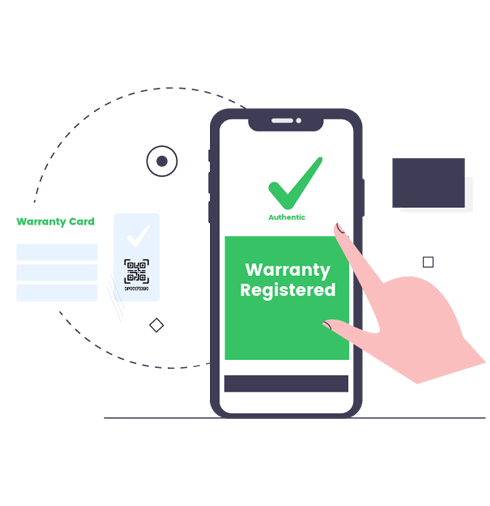
Another way QR code warranty solutions can enhance customer engagement is by providing customers with a more convenient way to make warranty claims. With traditional warranty systems, customers may have to mail in a claim form or contact customer service to initiate a claim. This can be a long and tedious process, often involving multiple phone calls and emails. Customers may also have to provide proof of purchase and other documentation, which can be lost or difficult to find. With a QR code warranty solution, customers can easily submit a claim through a mobile app or online portal by scanning the QR code on their product. This eliminates the need for paperwork and documentation, reducing the time it takes for a claim to be processed and providing customers with a more seamless experience.
## Real-time Updates on Warranty Claims
QR code warranty solutions also enhance customer engagement by providing customers with real-time updates on the status of their warranty claims. With traditional warranty systems, customers may have to wait for a response from customer service or check the status of their claims online. This can be a frustrating experience as customers may have to wait for days or even weeks to get an update on their claim. With a QR code warranty solution, however, customers can receive real-time notifications on their mobile app or email about the status of their claim, including when it has been received, when it is being reviewed, and when a resolution has been reached. This can help to keep customers informed and reduce the amount of time they spend waiting for a resolution.
## Cost Savings for Businesses
In addition to enhancing customer engagement, QR code warranty solutions can also help businesses to reduce costs associated with warranty management. By reducing the number of warranty claims that are processed and the amount of time and resources required to manage warranties, businesses can save a significant amount of money. Additionally, by using a QR code warranty solution, businesses can also reduce the number of claims that are denied due to a lack of documentation, further reducing the costs associated with warranty claims. This can help businesses to optimize their operations and cut costs.
**Having trouble choosing the perfect warranty management solution for your business?**- [**Check out the top 5 Warranty Management Software of 2023.**](https://www.neurowarranty.com/blog/5-best-warranty-management-software-in-2022-ckzqvwn3k169851llanw48z6yo)
## Valuable Data on Customers
Another way QR code warranty solutions can enhance customer engagement is by providing businesses with valuable data on their customers. With a QR code warranty solution, businesses can track customer behaviour, such as how often they make claims, which products are most likely to be covered under warranty, and which customers are most likely to make a claim. This data can be used to improve products, reduce warranty claims, and improve customer service. For instance, businesses can use the data to identify patterns and trends in customer behavior and use it to develop targeted marketing campaigns. This can help businesses to improve their products and services, and ultimately, retain their customers.
**What do leading brands say about NeuroWarranty?**

Conclusion
In conclusion, QR code warranty solutions can significantly enhance customer engagement by providing customers with easy access to warranty information, a more convenient way to make warranty claims, real-time updates on the status of their claims, and valuable data on their customer's businesses. These solutions can improve customer satisfaction and ultimately boost a business's bottom line.
If you're looking for a comprehensive and user-friendly QR code warranty management solution, [**NeuroWarrantry**](https://www.neurowarranty.com/) is a great option. Our solution is designed to streamline the warranty process, improve customer satisfaction, and boost your bottom line. Contact us today to learn more about how NeuroWarrantry can benefit your business.
---
This blog is powered by Superblog. Visit https://superblog.ai to know more.
---
## Here's how warranty management software can help manufacturers
Author: Abhishek Agrawal
Author URL: https://www.neurowarranty.com/blog/author/abhishek-agrawal
Published: 2023-01-13
Tags: warranty management solution, warranty management app
Tag URLs: warranty management solution (https://www.neurowarranty.com/blog/tag/warranty-management-solution), warranty management app (https://www.neurowarranty.com/blog/tag/warranty-management-app)
URL: https://www.neurowarranty.com/blog/warranty-software-benefits-manufacturers
Warranty management is a crucial aspect of any manufacturing business. It not only helps in ensuring customer satisfaction but also helps in reducing costs and improving overall business efficiency.
With the advancement of technology, manufacturers are now turning towards warranty management software to streamline their warranty processes and gain a competitive edge in the market.
Warranty management software, such as NeuroWarranty, helps manufacturers in several ways. Firstly, it helps in automating the warranty claim process.
This eliminates the need for manual paperwork and reduces the chances of errors. Manufacturers can easily track and manage warranty claims, ensuring that they are processed and resolved efficiently.
With NeuroWarranty, manufacturers can easily create and manage warranty claims, assign them to the relevant team members, track the progress of the claims, and even set up automated notifications for claim status updates.
This not only improves the speed and efficiency of the claim process but also ensures that all claims are handled in a timely and professional manner.
But how can you choose an effective warranty management software that suits your business needs? [_**Read this blog to find out the top 5 warranty management software going into 2023.**_](https://www.neurowarranty.com/blog/5-best-warranty-management-software-in-2022-ckzqvwn3k169851llanw48z6yo)
Secondly, the software also helps in tracking warranty expiration dates. This allows manufacturers to proactively inform customers of approaching expiration dates and offer them options for renewing or upgrading their warranties.
This helps in increasing customer retention and sales. With NeuroWarranty, manufacturers can easily set up automated notifications for upcoming warranty expiration dates, making it easy to stay on top of the warranty expiration dates of their products.
This not only helps in increasing customer retention but also helps in identifying new sales opportunities.
Thirdly, warranty management software also helps in improving customer service. With all warranty-related information easily accessible in one place, manufacturers can quickly and efficiently resolve customer complaints and queries.
This improves customer satisfaction and helps in building a positive reputation for the business. With NeuroWarranty, manufacturers can easily access all warranty-related information, such as customer details, product information, and claim history, in one centralized location. This makes it easy to resolve customer complaints and queries in a timely and professional manner.
Fourthly, the software also helps in reducing costs. With efficient warranty management, manufacturers can reduce the number of warranty claims and avoid paying out unnecessary costs.
This improves overall profitability and helps in maintaining a healthy bottom line. With NeuroWarranty, manufacturers can easily track and analyze warranty-related data, such as claim costs and warranty expiration dates, to identify patterns and trends. This can help in identifying common issues, improving product design, and reducing costs.
Finally, warranty management software also provides valuable insights and analytics. Manufacturers can easily track warranty-related data and use it to identify patterns and trends. This can help in identifying common issues, improving product design, and reducing costs.
With NeuroWarranty, manufacturers can easily access real-time data and analytics on their warranty management process, such as claim costs, warranty expiration dates, and customer satisfaction levels. This allows manufacturers to make data-driven decisions and improve their warranty management process.
In conclusion, warranty management software is a valuable tool for manufacturers. It not only helps in automating the warranty claim process but also helps in tracking warranty expiration dates, improving customer service, reducing costs and providing valuable insights and analytics.
[NeuroWarranty](https://www.neurowarranty.com/) is a leading warranty management software that can help manufacturers streamline their warranty processes and gain a competitive edge in the market.
With its robust features and user-friendly interface, NeuroWarranty can help manufacturers improve the speed and efficiency of their warranty claim process, increase customer retention, and make data-driven decisions to improve their warranty management process.
If you are a manufacturer looking to improve your warranty management process, we recommend you to give NeuroWarranty a try. [**Sign up**](https://calendly.com/aabhishekbindal/neurotags-demo?month=2023-01) for a free trial today and see how it can help take your business to the next level.
---
This blog is powered by Superblog. Visit https://superblog.ai to know more.
---
## QR Code Warranties: Streamlining the Process for Businesses and Customers
Author: Abhishek Agrawal
Author URL: https://www.neurowarranty.com/blog/author/abhishek-agrawal
Published: 2023-01-12
Tags: Digital Warranty Management, Warranty Management
Tag URLs: Digital Warranty Management (https://www.neurowarranty.com/blog/tag/digital-warranty-management), Warranty Management (https://www.neurowarranty.com/blog/tag/warranty-management)
URL: https://www.neurowarranty.com/blog/qr-code-warranty
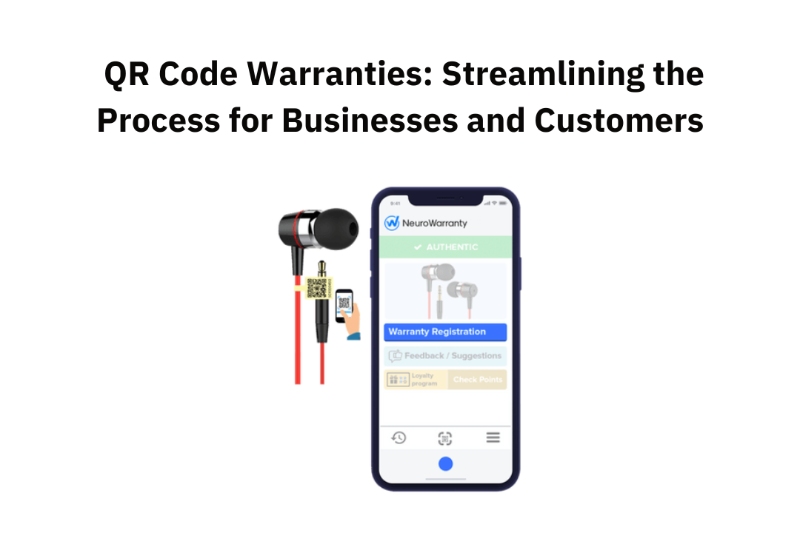
Warranty claims are an important aspect of any business. They provide customers with protection against faulty products and help to build trust in a brand.
However, the process of resolving a warranty claim can often be time-consuming and complicated for both businesses and customers.
QR codes have emerged as a solution to streamline this process, making it more efficient and convenient for everyone involved.
## The Benefits of Using QR Codes for Warranty Claims
QR codes offer several benefits when it comes to warranty claims. One of the key benefits is the prevention of warranty fraud. QR codes allow businesses to track and verify warranty claims, ensuring that only legitimate claims are processed. This helps to reduce the risk of fraud and ensures that businesses are not paying out on fraudulent claims.
Another benefit of using QR codes for warranty claims is the reduction of overall costs. By automating the process, businesses can reduce the time and resources needed to process claims. This can lead to lower costs for businesses, which can ultimately result in lower prices for consumers.
In addition, businesses can gain valuable customer data by using QR codes for warranty claims. The software tracks and records all warranty claims, providing businesses with insights into which products are most frequently claimed and which customers are the most active.
This data can be used to improve product design and customer service, helping to build stronger relationships with customers.
## How NeuroWarranty Utilizes QR Codes
NeuroWarranty is a QR Code based warranty management software that utilizes the power of QR codes to automate and digitize the warranty process.
The software uses QR codes to track and verify warranty claims, ensuring that only legitimate claims are processed. This helps to prevent warranty fraud and reduce overall costs.
In addition to its fraud prevention and cost-reduction capabilities, NeuroWarranty also makes it easy for customers to register and claim their warranties.
Customers can register their warranties in just one click, making it simple and convenient for them to claim their warranties. Furthermore, NeuroWarranty supports single sign-on, which allows customers to sign in using their Google and Truecaller accounts. This makes it even easier for customers to claim their warranties, as they don't have to create a new account.
But how can you choose an effective warranty management software that suits your business needs? [_**Read this blog to find out the top 5 warranty management software going into 2023.**_](https://www.neurowarranty.com/blog/5-best-warranty-management-software-in-2022-ckzqvwn3k169851llanw48z6yo)
## Preventing Warranty Fraud with QR Codes
Warranty fraud is a major concern for businesses, as it can result in significant financial losses. QR codes can help prevent fraud by allowing businesses to track and verify warranty claims.
This helps to ensure that only legitimate claims are processed, reducing the risk of fraud and protecting businesses from financial losses.
## Reducing Warranty Costs with QR Codes
Warranty claims can be a significant expense for businesses. By using QR codes to automate the process, businesses can reduce the time and resources needed to process claims. This can lead to lower costs for businesses, which can ultimately result in lower prices for consumers.
## Gaining Valuable Customer Data with QR Codes
QR codes can provide businesses with valuable customer data by tracking and recording all warranty claims. This data can be used to improve product design and customer service, helping to build stronger relationships with customers.
## Ease of Use with NeuroWarranty
NeuroWarranty is designed to make the warranty process easy for customers. Customers can register their warranty in just one click, and the software supports single-sign-on, allowing customers to sign in using their Google and Truecaller accounts. This makes it even easier for customers to claim their warranties.
QR codes offer a powerful solution for streamlining the warranty claim process for businesses and customers. By using NeuroWarranty, you can automate and digitize their warranty process, preventing fraud, reducing costs and gaining valuable customer data.
QR code-based warranty management processes offer several benefits including preventing warranty fraud, reducing overall costs and gaining valuable customer data.
By using software like NeuroWarranty, you can easily automate and digitize their warranty process, making it more efficient and convenient for everyone involved.
If you're a brand looking to improve your warranty process, consider trying out NeuroWarranty today. With its powerful features and easy-to-use interface, it's the perfect solution for streamlining your warranty claims and gaining valuable insights into your customers.
For more information, visit [**here**](https://www.neurowarranty.com/warranty-management-solution) and see for yourself how NeuroWarranty can help your brand.
---
This blog is powered by Superblog. Visit https://superblog.ai to know more.
---
## 5 reasons why your brand needs a warranty registration system
Author: Abhishek Agrawal
Author URL: https://www.neurowarranty.com/blog/author/abhishek-agrawal
Published: 2023-01-06
Tags: Warranty Management, customer experience
Tag URLs: Warranty Management (https://www.neurowarranty.com/blog/tag/warranty-management), customer experience (https://www.neurowarranty.com/blog/tag/customer-experience)
URL: https://www.neurowarranty.com/blog/why-your-brand-needs-a-warranty-registration-system
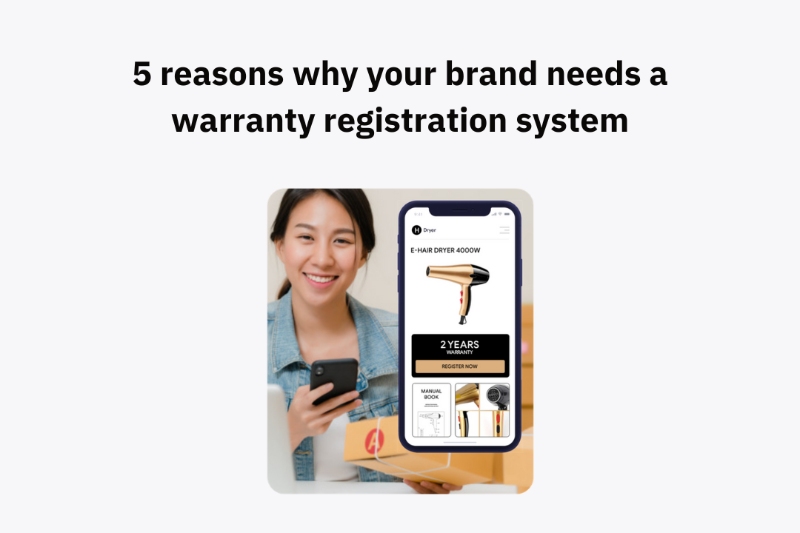
As a brand, offering a warranty for your products is a crucial step towards building customer trust and loyalty. It not only gives your customers peace of mind knowing that they can get their product repaired or replaced if something goes wrong, but it also helps to differentiate your brand from the competition.
However, managing warranties can be tedious and time-consuming, especially if you still rely on manual methods such as paper forms and snail mail. This is where a warranty registration system comes in.
A warranty registration system is software that automates and streamlines the process of registering and managing warranties. It makes it easier for customers to register their warranties online and for brands to track and manage them.
With a warranty registration system, you can say goodbye to the headache of manual warranty management and hello to improved efficiency and customer satisfaction.
If you are still on the fence about whether your brand needs a warranty registration system, here are 5 compelling reasons to consider:
1. **Improved customer experience:** One of the biggest benefits of a warranty registration system is that it makes it easier for customers to register their warranties online. Instead of filling out lengthy paper forms or sending them through snail mail, customers can simply visit your website and register their warranty with a few clicks. This convenience is sure to be appreciated by customers, leading to a better overall experience and increased customer satisfaction. Additionally, a warranty registration system can also help to improve the overall customer experience by providing easy access to the warranty information and allowing customers to track the status of their warranty claims.
2. **Increased efficiency:** Manual warranty management can be a time-consuming and resource-intensive process, especially if you have a large number of products and customers. A warranty registration system automates many of the tasks involved, such as tracking warranty expiration dates and sending out reminders. This not only frees up your time to focus on other important tasks, but it also helps to reduce the risk of errors and oversights. With a warranty registration system, you can easily track and manage all your warranties in one place, making it easier to see which ones are about to expire or have already expired. This can help you to provide better customer service and avoid any potential issues.
3. **Accurate tracking:** With a warranty registration system, you can keep track of all your warranties in one place, making it easier to see which ones are about to expire or have already expired. This helps you to provide better customer service and avoid any potential issues. For example, if a customer calls to inquire about their warranty, you can easily pull up their information and provide an accurate answer. Additionally, a warranty registration system can also help you to track the status of warranty claims, allowing you to stay on top of any issues and provide timely resolutions.
4. **Reduced costs:** Manually managing warranties can be expensive, especially if you have a large number of products. A warranty registration system helps to reduce costs by automating many of the tasks involved and eliminating the need for paper forms and snail mail. Additionally, by streamlining the warranty management process, you can reduce the risk of errors and oversights, which can save you time and money in the long run. With a warranty registration system, you can easily track and manage all your warranties in one place, making it easier to see which ones are about to expire or have already expired. This can help you to avoid any potential issues and provide better customer service, ultimately leading to increased customer satisfaction and loyalty.
5. **Increased customer loyalty:** By offering a seamless warranty registration process and providing excellent customer service, you can increase customer loyalty and improve your brand reputation. This can ultimately lead to increased sales and increased revenue.
Ultimately, a warranty registration system is an essential tool for any brand looking to improve the customer experience, increase efficiency, and reduce costs.
But how can you choose an effective warranty registration software that suits your business needs? [_**Read this blog to find out the top 5 warranty registration software going into 2023.**_](https://www.neurowarranty.com/blog/5-best-warranty-management-software-in-2022-ckzqvwn3k169851llanw48z6yo)
If you are ready to streamline your warranty management process and take your customer service to the next level, consider using a system like [NeuroWarranty](https://www.neurowarranty.com/).
Our software makes it easy for customers to register for warranties with just one click and helps you manage multiple products at once with its inbuilt CRM system.
In addition to the benefits mentioned above, a warranty registration system like NeuroWarranty also offers several other features that can help your brand to stand out from the competition.
For example, our software includes an inbuilt CRM system that allows you to manage multiple products on a single screen, making it easier to keep track of your warranties and customer information. This can help you to provide better customer service and build stronger relationships with your customers.

Another benefit of using a warranty registration system like NeuroWarranty is that it can help you to gather valuable customer data and insights.
By tracking customer interactions and warranty claims, you can learn more about your customers and their needs, allowing you to tailor your products and services to better meet their requirements.
This can ultimately lead to increased sales and long-term growth for your business. Don't wait any longer, try [NeuroWarranty](https://www.neurowarranty.com/) today and see the difference it can make for your brand!
---
This blog is powered by Superblog. Visit https://superblog.ai to know more.
---
## Points to consider when choosing a warranty registration software.
Author: Abhishek Agrawal
Author URL: https://www.neurowarranty.com/blog/author/abhishek-agrawal
Published: 2022-12-30
Tags: NeuroWarranty, warranty mangement software
Tag URLs: NeuroWarranty (https://www.neurowarranty.com/blog/tag/neurowarranty), warranty mangement software (https://www.neurowarranty.com/blog/tag/warranty-mangement-software)
URL: https://www.neurowarranty.com/blog/points-to-consider-when-choosing-a-warranty-registration-software-clca8wky1129461ro6kp0gqu9w
In this blog, we will discuss some of the key factors to consider when selecting a warranty registration software, and why NeuroWarranty's software is the best option on the market.
## **What to Consider When Choosing a Warranty Registration Software**
There are several key factors to consider when selecting a warranty registration software for your business. These include:
1. **User-friendliness and ease of navigation:** It is important to find a warranty registration software that is easy to use and navigate, especially if you have a large customer base. A user-friendly interface will make the registration process seamless and hassle-free for your customers and can help to reduce the number of support requests you receive.
2. **Data security:** Your customers' personal and financial information will be stored in the warranty registration software, so it is crucial to choose a platform that has robust security measures in place to protect this data from potential hackers or cyber threats. Look for software that uses encryption and other advanced security measures to ensure that your customers' data is safe and secure.
3. **Integration with existing systems and processes:** A warranty registration software that can integrate with your existing systems and processes can help to streamline your operations and improve efficiency by eliminating the need for manual data entry or duplicate processes. This can save you time and resources, and allow you to focus on running your business.
4. **Single sign-on (SSO) capability:** SSO allows your customers to use a single set of login credentials to access multiple applications and services, which can make the registration process much more convenient for them. Look for a warranty registration software that offers SSO capability to make the process as easy as possible for your customers.
5. **Customer data analysis:** A warranty registration software that can collect and analyze customer data can help you understand your customers' needs and preferences, and allow you to tailor your products and services accordingly. This can give you a competitive edge by helping you to better understand and serve your customers.
6. **Reliable customer support:** It is important to choose a warranty registration software that is backed by a strong customer support team. This will ensure that any issues or questions you have can be quickly and efficiently resolved, so you can focus on running your business.
7. **Collect first-party customer data:** Having a warranty registration software that brings you first-party customer data can provide numerous benefits for your business. First-party data refers to information that is collected directly from your customers through their interactions with your business, such as website visits, purchases, and customer service inquiries. This type of data can be extremely valuable, as it provides you with a more comprehensive understanding of your customer's behaviour and preferences.
One of the key benefits of first-party customer data is the ability to personalize your marketing and communication efforts. By analyzing customer data, you can better understand their needs and preferences, and tailor your messaging and products accordingly.
This can help to increase customer satisfaction and loyalty, and ultimately drive sales.
In addition, first-party customer data can help you to identify trends and patterns in customer behaviour. This can allow you to make informed decisions about your business strategy, such as which products to promote or which marketing channels to focus on.
**Why NeuroWarranty's Warranty Management Software is the Best Option:**
With all of these factors in mind, it is clear that NeuroWarranty's warranty registration software is the best option on the market. In addition to offering all of the features mentioned above, NeuroWarranty's software has several additional benefits that make it stand out from the competition.
But how can you choose an effective warranty management software that suits your business needs? [_**Read this blog to find out the top 5 warranty management software going into 2023.**_](https://www.neurowarranty.com/blog/5-best-warranty-management-software-in-2022-ckzqvwn3k169851llanw48z6yo)
One of the key advantages of NeuroWarranty's software is its single click sign-in feature. This allows customers to easily and quickly register their warranties with a single click, making the process as convenient as possible.
This can help to increase customer satisfaction and loyalty, and reduce the number of support requests you receive.
Another advantage of NeuroWarranty's software is its inbuilt customer relationship management (CRM) system. This allows you to effectively manage and track customer interactions and data, which can help you better understand and serve your customers.
The CRM system also includes features such as lead tracking, customer segmentation, and automated email marketing, all of which can help you to improve your customer relationships and drive sales.
Thank you for reading about the benefits of having warranty registration software that brings you first-party customer data. If you would like to learn more about this topic or explore the features of NeuroWarranty's software, please visit our website [here.](https://www.neurowarranty.com/) Our team would be happy to answer any questions you may have and help you find the best solution for your business needs.
---
This blog is powered by Superblog. Visit https://superblog.ai to know more.
---
## How to utilize warranty management to maximize customer retention?
Author: Abhishek Agrawal
Author URL: https://www.neurowarranty.com/blog/author/abhishek-agrawal
Published: 2022-12-23
Tags: warranty mangement software, customer retention
Tag URLs: warranty mangement software (https://www.neurowarranty.com/blog/tag/warranty-mangement-software), customer retention (https://www.neurowarranty.com/blog/tag/customer-retention)
URL: https://www.neurowarranty.com/blog/how-to-utilize-warranty-management-to-maximize-customer-retention-clc04bglr408981jmjxprdbpa6
Warranties are an essential part of any business, especially those that sell physical products. They provide customers with a sense of security and reassurance that if something goes wrong with their purchase, they will be taken care of. In turn, this helps to build trust and loyalty among customers, which is crucial for maintaining a strong customer base and increasing customer retention.
However, managing warranties can be a complex and time-consuming process, especially for businesses that sell a large volume of products. That's where warranty management software like NeuroWarranty comes in. With NeuroWarranty, businesses can easily track and manage their warranties, ensuring that customers receive timely and efficient service.
But how can businesses utilize warranties to their full potential and maximize customer retention and satisfaction? Here are some tips:
Contents
- [Offer a generous warranty period](#offer-a-generous-warranty-period)
- [Make it easy for customers to claim their warranty](#make-it-easy-for-customers-to-claim-their-warranty)
- [Provide prompt and efficient service](#provide-prompt-and-efficient-service)
- [Consider offering extended warranties](#consider-offering-extended-warranties)
- [Use customer data to retain customers](#use-customer-data-to-retain-customers)
- [Use warranty management software like NeuroWarranty](#use-warranty-management-software-like-neurowarranty)
## Offer a generous warranty period
One of the most effective ways to demonstrate to customers that you stand behind your products is by offering a generous warranty period. This shows that you have confidence in the quality of your products and are willing to take responsibility for any issues that may arise.
Of course, the length of the warranty period will depend on the type of product you sell and the industry you're in. For example, a company that sells appliances may offer a one-year warranty, while a company that sells electronics may offer a two-year warranty. Whatever the length, be sure to clearly communicate the details of your warranty to customers, including what is covered and what is not.
## Make it easy for customers to claim their warranty
When a customer experiences an issue with their product, the last thing they want is to jump through hoops to claim their warranty. Make it as easy as possible for customers to claim their warranty by providing clear instructions on your website or in the product packaging.
You should also provide multiple channels for customers to get in touch with you, whether it's through phone, email, or a contact form on your website. This will ensure that customers can get the help they need in a timely manner, which will go a long way in boosting customer satisfaction.
## Provide prompt and efficient service
Once a customer has claimed their warranty, it's important to provide prompt and efficient service to resolve the issue. This means responding to customer inquiries in a timely manner, sending out replacement parts or repaired products as quickly as possible, and keeping customers informed about the status of their warranty claim.
By providing excellent service, you'll not only show customers that you value their business, but you'll also increase the chances of them returning to your business in the future.
## Consider offering extended warranties
While offering a generous warranty period is a good start, some customers may still be hesitant to make a purchase if they're worried about the longevity of the product. One way to give customers extra peace of mind is by offering extended warranties.
Extended warranties provide additional coverage beyond the standard warranty period, giving customers even more protection and reassurance. While these warranties may come with an extra cost, they can be a great way to differentiate your business from the competition and encourage customers to choose your products over others.
But how can you choose an effective warranty management software that suits your business needs? [_**Read this blog to find out the top 5 warranty management software going into 2023.**_](https://www.neurowarranty.com/blog/5-best-warranty-management-software-in-2022-ckzqvwn3k169851llanw48z6yo)
## Use customer data to retain customers
In addition to helping businesses manage their warranties more efficiently, warranty management software like NeuroWarranty can also provide valuable insights into customer behavior and preferences.
By tracking customer interactions and warranty claims, businesses can gather valuable data on what products are most popular and which ones may be causing issues. This information can be used to inform future product development and marketing strategies, as well as to target specific customers with personalized promotions and incentives.
For example, if a customer has made multiple warranty claims for a particular product, it may be worth reaching out to them directly via email or phone with a special offer or discount on a newer, improved version of the product. Similarly, if a customer has a history of purchasing from your business, you may want to send them targeted promotions for related products or services via email or SMS.
By using customer data collected through the warranty process, such as email addresses and phone numbers, businesses can directly reach out to customers to resell products and retain their business. This can help to increase customer retention and satisfaction, as well as drive additional sales for the business.
Overall, using customer data collected through the warranty process can help businesses to better understand their customers, identify opportunities for upselling and cross-selling, and ultimately increase customer retention and satisfaction.
## Use warranty management software like NeuroWarranty
As mentioned earlier, managing warranties can be a complex and time-consuming process, especially for businesses that sell a large volume of products. That's where NeuroWarranty comes in.
NeuroWarranty is a powerful warranty management software that helps businesses track and manage their warranties, ensuring that customers receive timely and efficient service.
In conclusion, by offering a generous warranty period, making it easy for customers to claim their warranty, providing prompt and efficient service, and using warranty management software like NeuroWarranty, businesses can effectively utilize warranties to improve customer retention and satisfaction. If you're interested in streamlining your warranty process and maximizing customer satisfaction, learn more about us [**here**](https://www.neurowarranty.com/warranty-management-solution).
---
This blog is powered by Superblog. Visit https://superblog.ai to know more.
---
## Here's how warranty registration software benefit's you, and how to choose one
Author: Abhishek Agrawal
Author URL: https://www.neurowarranty.com/blog/author/abhishek-agrawal
Published: 2022-12-16
Tags: NeuroWarranty, warranty management solution
Tag URLs: NeuroWarranty (https://www.neurowarranty.com/blog/tag/neurowarranty), warranty management solution (https://www.neurowarranty.com/blog/tag/warranty-management-solution)
URL: https://www.neurowarranty.com/blog/heres-how-warranty-registration-software-benefits-you-and-how-to-choose-one-clbqc42fb558941imiwbkzd7t4
What can warranty registration software do for you?
Warranty registration software can greatly improve the efficiency and effectiveness of a company's warranty management process. By automating many of the tasks involved in tracking and managing warranties, warranty registration software can help businesses save time, reduce costs, and improve customer satisfaction.
One of the key benefits of warranty registration software is that it allows companies to quickly and easily track the status of warranties.
Rather than manually searching through paper records or spreadsheets, businesses can simply enter a customer's information into the software and instantly see the status of their warranty.
This can be especially helpful for businesses that handle a high volume of warranties, as it allows them to quickly and easily answer customer inquiries about the status of their warranty.
In addition to tracking the status of warranties, warranty registration software can also help businesses automate the process of registering warranties.
This can include tasks such as collecting customer information, verifying the purchase of a warranted product, and recording the terms of the warranty. By automating these tasks, businesses can save time and reduce the risk of errors that can occur when manually entering data.
Another way that warranty registration software can streamline the warranty process for businesses is by providing tools for analyzing and reporting on warranty data.
This can include features such as the ability to generate reports on warranty claims, warranty expiration dates, and customer satisfaction levels.
By having access to this data, businesses can better understand the performance of their products and make informed decisions about how to improve their warranty processes.
One of the major benefits of warranty registration software is that it can improve customer satisfaction by providing a more seamless and efficient warranty experience.
Customers can easily access information about their warranties through the software, and businesses can quickly and easily resolve any issues that may arise.
This can help to reduce the number of customer complaints and improve the overall satisfaction of customers with the company's products and services.
In summary, warranty registration software can greatly improve the efficiency and effectiveness of a company's warranty management process.
By automating tasks, providing tools for analyzing and reporting on warranty data, and improving the customer experience, warranty registration software can help businesses save time, reduce costs, and improve customer satisfaction.
## How to choose warranty registration software?
When it comes to choosing a warranty registration software, there are a few key factors that businesses should consider to find the best solution for their needs. Here are some steps to follow when evaluating different warranty registration software options:
1. **Determine your business needs**: The first step in choosing a warranty registration software is to determine what your business needs are. This includes understanding the size of your business, the number of warranties you need to manage, and any specific features or capabilities that you require.
2. **Research different software options**: Once you have a clear understanding of your business needs, start researching different available software options. Look for software that is specifically designed for warranty registration, as these will typically offer the features and capabilities that you need.
3. **Compare features and pricing:** As you research different software options, compare the features and pricing of each option. Make sure to consider both the upfront cost of the software as well as any ongoing fees, such as maintenance or support costs.
4. **Check for integrations:** Many businesses rely on other software systems to manage various aspects of their operations. It's important to choose a warranty registration software that can integrate with these systems to avoid any potential issues or inefficiencies.
5. **Test out the software**: Before making a final decision, it's a good idea to test out the software to ensure that it meets your needs. Many software providers offer free trials or demos that allow you to try out the software before committing.
6. **Consider customer support:** It's important to choose a warranty registration software that offers good customer support, as you may need help with the software at some point. Look for providers that offer phone, email, or chat support, and consider the availability of support hours.
7. **Read reviews:** Finally, be sure to read reviews of different software options from other users. This can help you get a sense of the pros and cons of each option and make a more informed decision.
By following these steps, you can choose a warranty registration software that meets your business needs and helps you streamline your warranty management process.
It's important to take the time to thoroughly evaluate different options and test out the software before making a final decision, as choosing the right warranty registration software can make a big difference in the efficiency and effectiveness of your business.
[NeuroWarranty's warranty registration software](https://www.neurowarranty.com/warranty-management-solution) automates your warranty process end-to-end and makes it extremely easy for your customers to register.
[**_Find out the top 5 warranty registration software going into 2023_**](https://www.neurowarranty.com/blog/5-best-warranty-management-software-in-2022-ckzqvwn3k169851llanw48z6yo)
We hope you found our blog helpful. **The NeuroWarranty warranty software is trusted by 100s of leading brands including, - Syska, JCB, and ResQtech.**
You can sign up for the [warranty management](https://www.neurowarranty.com/) software by scheduling a demo and getting a free 14-day trial here - [get a demo](https://calendly.com/aabhishekbindal/neurotags-demo?month=2022-09). An account manager will contact you and organize a call to discuss your business requirements.
---
This blog is powered by Superblog. Visit https://superblog.ai to know more.
---
## Here's how you can use warranty data to your advantage
Author: Abhishek Agrawal
Author URL: https://www.neurowarranty.com/blog/author/abhishek-agrawal
Published: 2022-12-09
Tags: Warranty Management, customer data
Tag URLs: Warranty Management (https://www.neurowarranty.com/blog/tag/warranty-management), customer data (https://www.neurowarranty.com/blog/tag/customer-data)
URL: https://www.neurowarranty.com/blog/heres-how-you-can-use-warranty-data-to-your-advantage-clbgfvkxh78711ko8ubqgf4xv
Warranty data is an important source of information for brands. It can provide valuable insights into customer satisfaction, product quality, and service issues.
By leveraging warranty data effectively, brands can improve their products and services to better meet customer needs.
**What Is Warranty Data?**
Warranty data is information collected from customers when they purchase a product or service with a warranty. This includes the date of purchase, the type of product purchased, any problems encountered during use, and how the problem was resolved (if applicable).
The purpose of collecting this data is to identify potential problems that may arise with a particular product or service to prevent them from occurring in the future.
**How Can Brands Use Warranty Data Effectively?**
1\. **Identify Product Quality Issues**: Warranty data can be used to identify areas where products are failing or not meeting customer expectations. This allows brands to pinpoint specific components or features that need improvement so they can make necessary changes before more customers experience similar issues.
2\. **Improve Customer Service**: By analyzing warranty data, brands can also identify common customer service issues such as long wait times or unhelpful staff members. With this knowledge, companies can take steps to address these issues and ensure customers have a positive experience when dealing with their brand’s support team.
3\. **Track Trends Over Time**: Analyzing warranty data over time allows brands to track trends in terms of which products are experiencing more failures than others and why certain types of problems occur more frequently than others do. This helps them understand how their products are performing relative to competitors’ offerings so they can make adjustments accordingly if needed.
4\. **Develop New Products & Services**: Finally, by looking at past warranty claims, brands can get ideas for new products and services that could potentially solve existing customer pain points.
For example, if many people complain about having difficulty using a particular feature on one device, then developing an easier-to-use version could be beneficial for both the company and its customers.
By leveraging warranty data effectively, companies have access to valuable insights into what works well for their customers –and what doesn’t–so they can continually refine their offerings based on real-world feedback. In addition, it gives them an opportunity to develop innovative solutions that address existing pain points while simultaneously creating new revenue streams.
Ultimately, effective use of warranty data enables companies to stay ahead of the competition by providing superior products and services that exceed customer expectations every time.
**How can you get warranty data?**
In many organizations, warranty services and claims procedures are typically handled internally and impact several departments, from the supply chain to customer service.
Advanced warranty tracking software like NeuroWarranty works by first replacing your paper-based warranty processing systems with a digital warranty management solution. Digitizing your warranty management process helps your brand by automating claims management.
A warranty tracking software allows you to handle all your post-sales support requirements from a single screen, thus saving efforts and costs.
[NeuroWarranty's warranty tracking software](https://www.neurowarranty.com/warranty-management-solution) gives you complete access to all your warranty data on easy-to-understand and customizable dashboards.
[**_Find out the top 5 warranty management software going into 2023_**](https://www.neurowarranty.com/blog/5-best-warranty-management-software-in-2022-ckzqvwn3k169851llanw48z6yo)
NeuroWarranty's smart Analytics dashboards can give you an idea of how your product performs across various geographies and demographics and where you need to improve. This data can help your brand make better decisions in various areas of your business.
---
This blog is powered by Superblog. Visit https://superblog.ai to know more.
---
## 5 must-haves for an unparalleled warranty experience for your customers.
Author: Abhishek Agrawal
Author URL: https://www.neurowarranty.com/blog/author/abhishek-agrawal
Published: 2022-12-02
Tags: Warranty Management, customer experience
Tag URLs: Warranty Management (https://www.neurowarranty.com/blog/tag/warranty-management), customer experience (https://www.neurowarranty.com/blog/tag/customer-experience)
URL: https://www.neurowarranty.com/blog/5-must-haves-for-an-unparalleled-warranty-experience-for-your-customers-clb6bkaeq134961ml50qbva1ru
Customer post-sales experience has far overtaken price and product and is now the most important criterion for customers in their buyer journey.
A study by [PwC](https://www.pwc.com/us/en/advisory-services/publications/consumer-intelligence-series/pwc-consumer-intelligence-series-customer-experience.pdf) points out that 86% of customers consider a positive post-sales experience as their top priority. And your competitors know this!
Leading e-commerce brands have made providing a positive post-sales experience with their top priority, so much so that according to a [Gartner research in 2022](https://www.gartner.com/en/marketing/insights/articles/key-findings-from-the-gartner-customer-experience-survey), 81% of the e-commerce brands compete mostly or completely on the post-sales experience.
Warranties are perhaps the most important post-sales touch point for a brand, and if you are not able to provide a satisfactory experience, you can lose the customer forever, even if they liked your product.
**So how can you win customers over?**
We strive to create an experience that is helpful, easy to understand and solves your issue quickly. Here are the top elements we look at (and any customer service team should be mindful of) to ensure you have a great experience:
## Have a transparent warranty plan -
A positive warranty experience starts by planning your warranty terms. You should have a clear warranty policy and communicate it with your customers.
Your customers should have advanced knowledge about the damages that will be covered, the costs, time duration and other variables.
When you're considering what to include in your warranty, be sure that the coverage is clear and that it's clearly stated on the packaging. If you're selling a product with multiple components, it's important to be clear about how the warranty applies to each.
## Have an easy registration process -
The biggest problem with the registration process is that it's complicated. The registration form is the first thing people see when they visit your website. It’s also where most people leave.
Your registration process should be short and clear but not so short that it feels like a forced choice. When someone has to think about what they want, they’re less likely to complete the process.
Ideally, you should be replacing forms with dynamic web apps where customers can not only register their warranty but also track, claim and use more of your post-sales services.
A clear process to handle claims -
You should set up a clear process with both your customer service teams and your customers for warranty claims.
If your customers want to file a claim, they should be able to do it easily, and your customer service teams should be able to resolve them easily.
Customers, when claiming a warranty, have to first find old purchase bills and warranty documents to get started with the process.
Not being able to find the correct documents eliminates around 50% of the user from even claiming a warranty. This is an extremely bad experience for any customer not only will he lose faith in your brand.
You can avoid this by automating and digitizing the warranty claims process for your end customers, find how you can do it here -
## Have easy customer communication -
This is a big one - a great customer experience starts with real communication. It should be very easy to get in touch with the customer service team, whether via phone, email or chat.
NeuroWarranty's warranty management software, with the help of its inbuilt CRM, sets up a direct communication channel between you and your customers.
The customer service teams can manage customer communication on a single interface with minimal effort.
[**_Find out the top 5 warranty registration software going into 2023_**](https://www.neurowarranty.com/blog/5-best-warranty-management-software-in-2022-ckzqvwn3k169851llanw48z6yo)
## Have a fast timeline for resolution -
A fast timeline means you get a decision on your claim quickly, and you're not left waiting weeks for an answer. A study found that [12% of people](https://www.statista.com/statistics/815599/causes-of-customer-service-frustration-us/) report a lack of speed as their biggest customer service frustration.
To resolve claims faster you need to have all your warranty-related processes set on a single easy-to-access dashboard and an easy communication channel between you and your customers.
NeuroWarranty's warranty management software, with the help of its inbuilt CRM, sets up a direct communication channel between you and your customers.
The customer service teams can manage customer communication on a single interface with minimal effort.
**What do leading brands say about NeuroWarranty?**

We hope you found our blog helpful. **The NeuroWarranty warranty software is trusted by 100s of leading brands including, - Syska, JCB, and ResQtech.**
You can sign up for the [warranty management](https://www.neurowarranty.com/) software by scheduling a demo and getting a free 14-day trial here - [get a demo](https://calendly.com/aabhishekbindal/neurotags-demo?month=2022-09). An account manager will contact you and organize a call to discuss your business requirements.
---
This blog is powered by Superblog. Visit https://superblog.ai to know more.
---
## Warranties can be a Twitter nightmare, here's how you can avoid it.
Author: Abhishek Agrawal
Author URL: https://www.neurowarranty.com/blog/author/abhishek-agrawal
Published: 2022-11-25
Tags: Warranty Management, customer experience
Tag URLs: Warranty Management (https://www.neurowarranty.com/blog/tag/warranty-management), customer experience (https://www.neurowarranty.com/blog/tag/customer-experience)
URL: https://www.neurowarranty.com/blog/warranties-can-be-a-twitter-nightmare-heres-how-you-can-avoid-it-clawb3mmt1078241kpsi0vsllx6
Twitter is in a weird phase now, with some people even doubting its future, but one thing no one can doubt is how important Twitter has played in allowing customers to complain directly to brands and getting their voices heard.
But what is a great tool for customers becomes an image problem for brands, as a large number of customers tag brands in their complaint tweets, and potential customers are driven away.
Customer post-sales experience has far overtaken price and product and is now the most important criterion for customers in their buyer journey.
But how big is the change? A study by [PwC](https://www.pwc.com/us/en/advisory-services/publications/consumer-intelligence-series/pwc-consumer-intelligence-series-customer-experience.pdf) points out that 86% of customers consider a positive post-sales experience as their top priority, and seeing negative tweets will only stop your potential customers from becoming your customers.
Leading e-commerce brands have made providing a positive post-sales experience with their top priority, so much so that according to a [Gartner research in 2022](https://www.gartner.com/en/marketing/insights/articles/key-findings-from-the-gartner-customer-experience-survey), 81% of the e-commerce brands compete mostly or completely on the post-sales experience.
In our study of complaints on Twitter, the most number of tweets were found to be regarding a brand's warranty process, which frustrated customers complying about their warranties not being processed in time.
## What are customers saying about the warranty process of leading brands?
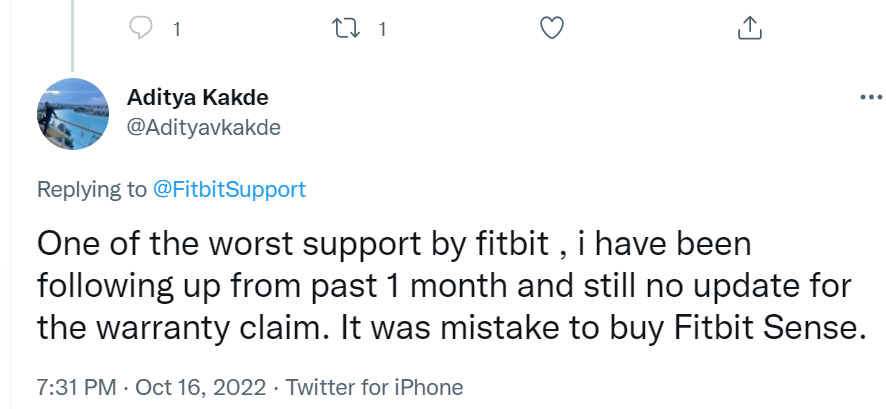
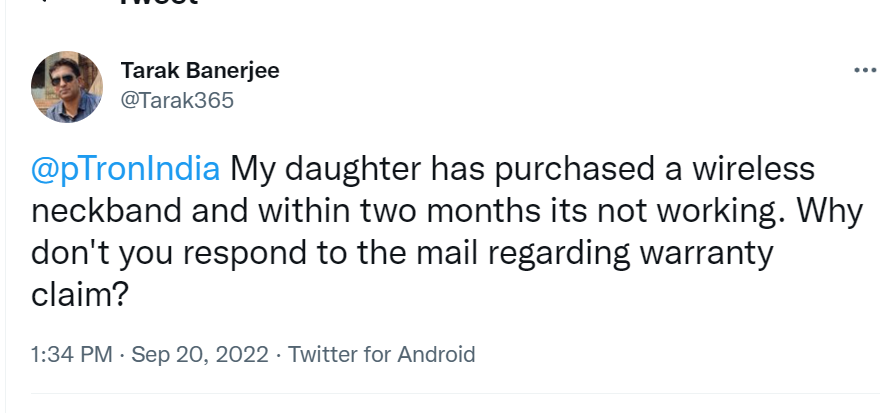
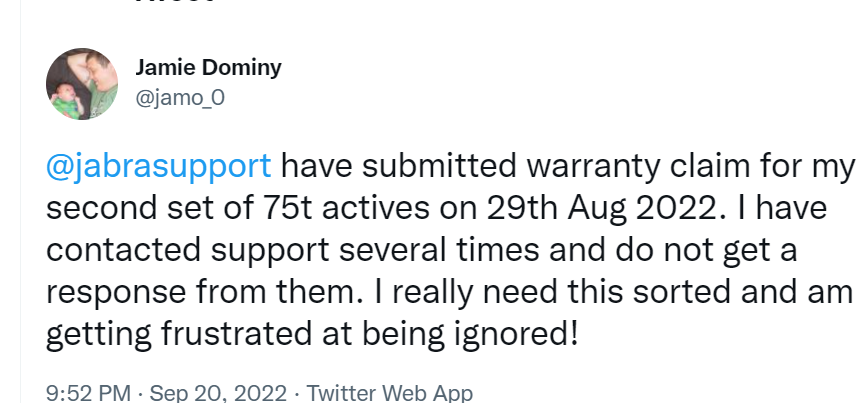
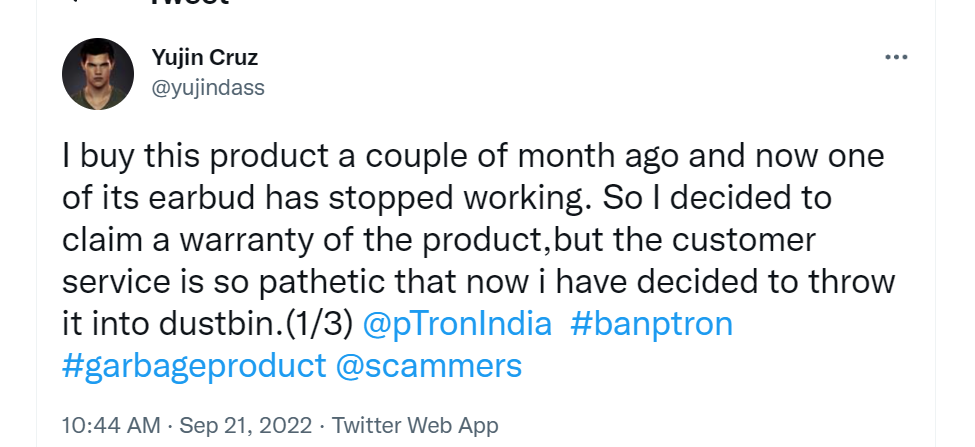
## What has forced customers to take to Twitter?
Customers often have to go through a lot of hassle while claiming warranties, be it finding the necessary documents or endless calls with your customer support team.
Customers, when claiming a warranty, have to first find old purchase bills and warranty documents to even get started with the process. Owing to the large volume of consumer products purchased by customers these days, it is nearly impossible to secure old documents of every purchase.
Not being able to find the correct documents eliminates around 50% of the user from even claiming a warranty. This is an extremely bad experience for any customer not only will he lose faith in your brand but will also advise their friends and family, to not buy from you.
Even if a customer can find their documents, brands require customers to go to the exact dealer they bought their product from to replace it. In a world where buying is a matter of clicks and people are constantly on the move a large number of customers move away from their buying location which makes them ineligible for their warranty claim.
But inefficient warranty communication takes the top spot when brands request a warranty claim, they expect to hear back. But small team sizes, high product sales, et, puts a lot of stress on the customer support teams resulting in efficient communication, pending claims and frustrated customers.
[**_Find out the top 5 warranty registration software going into 2023_**](https://www.neurowarranty.com/blog/5-best-warranty-management-software-in-2022-ckzqvwn3k169851llanw48z6yo)
## How can you avoid this?
Advanced warranty management software like [NeuroWarranty](https://www.neurowarranty.com/warranty-management-solution) are solutions that automate and digitize your warranty management processes end to end.
Warranty management software NeuroWarranty does that by replacing your paper-based warranty process with a QR code-based warranty process. QR code-based warranty cards are placed on the product or inside the product packaging.
As end customers scan the QR code to register their product, they get directed to a custom build page that gets brands' valuable data like Names, email ids, phone numbers and more.
After successfully registering their product, customers no longer have to secure purchase bills and warranty cards. Customers can now register, claim and manage all their product warranties on a single screen and with a single click.
We hope you found our blog helpful. **The NeuroWarranty warranty software is trusted by 100s of leading brands including - Syska, JCB, and ResQtech.** You can sign up for the [warranty management](https://www.neurowarranty.com/) software by scheduling a demo and getting a free 14-day trial here - [get a demo](https://calendly.com/aabhishekbindal/neurotags-demo?month=2022-09) when you schedule a demo, an account manager will contact you and organize a call to discuss your business requirements.
---
This blog is powered by Superblog. Visit https://superblog.ai to know more.
---
## Why you should always use Warranty Software in place of a Website Form
Author: Abhishek Agrawal
Author URL: https://www.neurowarranty.com/blog/author/abhishek-agrawal
Published: 2022-11-18
Tags: NeuroWarranty, warranty mangement software
Tag URLs: NeuroWarranty (https://www.neurowarranty.com/blog/tag/neurowarranty), warranty mangement software (https://www.neurowarranty.com/blog/tag/warranty-mangement-software)
URL: https://www.neurowarranty.com/blog/why-you-should-always-use-warranty-software-in-place-of-a-website-form-clam4i6xa4998451nntaei10om6
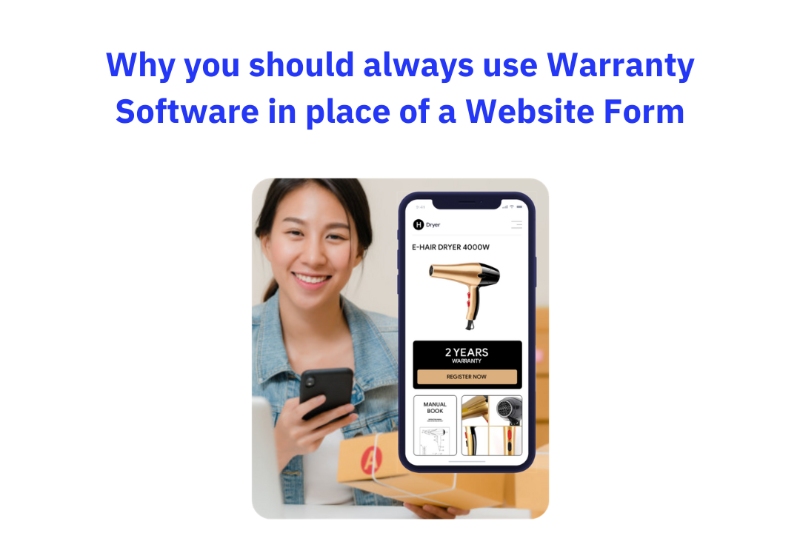
Whether you are a small D2C brand or a large corporation, the ability to make your customers register their products for warranty is critical for success.
Making customers register for a warranty not only makes the process a lot simpler for future claims but also gets you important first-party customer data. The customer data can then be used to build a personal connection with your marketplace and retail customers.
As brands slowly start to digitize their warranty processes, a large number of brands think a form on a website is all they need to get their customer to register their warranty.
Warranty solutions often end up being too complicated for users to register, resulting in low registration rates. The registration form is the first thing people see it’s also where most people leave.
The problem with website forms is it is one size serves all solution. No matter what product they buy, all customers will be directed to the same page. As a result, they have to enter details like product id, SKU, model etc resulting in a high drop-off rate.
**But talk to your customers, and you'll realize the shortcomings of a website form/ web page.**
**What is the difference between using a web form vs a warranty solution?**
Web Form
Warranty Software
1
They are not personalized.
Personalize the form for different languages based on the scan location.
2
Customers have to enter details like product id, SKU ID, model number etc, leading to a drop-off rate of more than 70%
Liberate customers from having to enter technical details like product id, SKU ID etc, as each QR code is unique for every product and SKU.
3
Website forms cannot be used for anything more than registering warranties, like providing product information or showing relevant demo videos.
Allow you to use the warranty touchpoint to educate the customers and showcase your product features using images and videos.
4
Website forms can't be used to upsell as there is no information available about the product purchased in the first place.
Upsell relevant products to customers based on their current purchases.
**** Warranty forms should be short and clear but not so short that it feels like a forced choice. When someone has to think about what they want, they’re less likely to complete the process. Take advantage of the fact that you have their attention by making sure there are no mistakes on the form itself or in its instructions.
So what can you do to make the warranty registration process more efficient?
**Using a QR-based warranty software like NeuroWarranty allows you to**
When using a QR code-based solution, each QR code is customized for different SKUs and products, cutting down the amount of information needed by customers.
Brands that shifted from website forms to QR code-based solutions saw their registration rates rise by as much as 200%.
A Warranty management software collects valuable information about each customer, such as their name, e-mail address and any other information they provide during registration.
Data is then used to increase repeat sales, manage warranty claims and improve customer satisfaction.
But a lot of brands, despite having a warranty management process in place, suffer from extremely low warranty registration rates. If you are one of them, how can you increase your warranty registration rates?
NeuroWarranty is amongst one of the most easy-to-use warranty registration software available in the market right now - [**Click here**](https://ndemo.neurotags.in/productDetails/62d64464e292381b6f7ec123/) to get the complete product experience.
---
This blog is powered by Superblog. Visit https://superblog.ai to know more.
---
## Here's how warranty management software can get you first-party customer data
Author: Abhishek Agrawal
Author URL: https://www.neurowarranty.com/blog/author/abhishek-agrawal
Published: 2022-11-11
Tags: warranty mangement software, customer data
Tag URLs: warranty mangement software (https://www.neurowarranty.com/blog/tag/warranty-mangement-software), customer data (https://www.neurowarranty.com/blog/tag/customer-data)
URL: https://www.neurowarranty.com/blog/heres-how-warranty-management-software-can-get-you-first-party-customer-data-clac63iiy2541611nnt52fkr30r
Customer data will drive business growth going into the future, but as third-party cookies continue to decline, brands are looking for ways to equip themselves with first-party data to re-market effectively. But is collecting first-party customer data that easy?
Nearly half of marketing leaders say they are not adequately leveraging first-party data sources in their marketing decision-making, according to a recent Forrester study commissioned by Eyeota.
Product Warranty Registrations - a process by which customers of a product can register their warranty with the brand to automate their claims process, is an amazing opportunity to collect first-party customer data.
Customers are often excited about new purchases and are extra cautious to set up all the necessary documentation. Having an easy digital warranty registration software to take advantage of this can skyrocket customer data acquisition.
## **What are the advantages of collecting first-party data with warranty management software?**
When customers register with your brand, they provide their contact information and other details that help you better understand them and their needs.
1\. First-party customer data is available from all your customers, in one place, including your marketplace and offline retail customers. This means you can view customer information like purchase history, contact details and more, all on a single dashboard.
2\. You can build custom reports for each customer that show their past behaviour and give you information on how to sell them the most successful products in future. This can help you to send targeted emails and remarket effectively to retain maximum customers.
3\. Digital warranty management software helps you maintain a record of all products which your customers buy, making warranty registrations and claims extremely simple.
## How can you collect first-party data during customer onboarding?
The users can scan the QR code with any app even their phone camera. The QR code directed users to a custom build web app, wherein users can register their warranty for any future claims in just a single click.
The users do this by entering in their personal and product details, with single-sign-on features enabled giving them the option to sign in through Google and Truecaller.
This meant that users did not have to remember their credentials for signing in and all the details submitted were verified.
Once registered, customers can be reached by email, SMS and WhatsApp (using the data provided on the web app) with confirmation messages and links for future claims.
This enabled brands to reach every customer personally, including Amazon and retail customers, opening up remarketing and reselling opportunities.
Whenever a customer wanted to claim a warranty, all they had to do was go on the web app, using links on their emails, SMS and WhatsApp, and click a button.
[**_Find out the top 5 warranty registration software going into 2023_**](https://www.neurowarranty.com/blog/5-best-warranty-management-software-in-2022-ckzqvwn3k169851llanw48z6yo)
## **Leading brands are using warranty registration to collect first-party data.**
Consumer electronics giant Wayona knew the importance of first-party data but was struggling to get it as they were heavily dependent on marketplaces and offline retail for their sales.
In partnership with NeuroWarranty, the brand focused on its customer onboarding process to get first-party customer data and engage customers. Equipped with first-party data of its customers Wayona was able to increase its repeat sales by a whopping 28% and bring down its customer support costs by 50%.
Customer onboarding is a vital opportunity to collect first-party data.
Using the onboarding experience to get first-party data allows you to engage your customers with other offerings while they are still in the buying phase, versus retargeting the current product owner in other, less effective mediums.
In addition to related products, customer onboarding is an excellent opportunity to sell product subscriptions, extended warranties and premium services.
We hope you found our blog helpful. **The NeuroWarranty warranty software is trusted by 100s of leading brands including - Syska, JCB, and ResQtech.**

You can sign up for the [warranty management](https://www.neurowarranty.com/) software by scheduling a demo and getting a free 14-day trial here - [get a demo](https://calendly.com/aabhishekbindal/neurotags-demo?month=2022-09) when you schedule a demo, an account manager will contact you and organize a call to discuss your business requirements.
---
This blog is powered by Superblog. Visit https://superblog.ai to know more.
---
## Here's how you can increase your warranty registration rates
Author: Abhishek Agrawal
Author URL: https://www.neurowarranty.com/blog/author/abhishek-agrawal
Published: 2022-11-01
Tags: Warranty Management, warranty mangement software
Tag URLs: Warranty Management (https://www.neurowarranty.com/blog/tag/warranty-management), warranty mangement software (https://www.neurowarranty.com/blog/tag/warranty-mangement-software)
URL: https://www.neurowarranty.com/blog/heres-how-you-can-increase-your-warranty-registration-rates-cl9y33zvi175371os6ypi2kipr
**Make the warranty registration process as simple as possible**
Warranty solutions often end up being too complicated for users to register, resulting in low registration rates. The registration form is the first thing people see, it’s also where most people leave.
Warranty forms should be short and clear but not so short that it feels like a forced choice. When someone has to think about what they want, they’re less likely to complete the process. Take advantage of the fact that you have their attention by making sure there are no mistakes on the form itself or in its instructions.
NeuroWarranty is amongst one of the most easy-to-use warranty registration software available in the market right now - [**Click here**](https://ndemo.neurotags.in/productDetails/62d64464e292381b6f7ec123/) to get the complete product experience.
## **Incentivise customers for registering their warranty**
The more you can provide for your customers, the more likely they are to become loyal and repeat customers. The best way to do this is by giving customers something in return for successfully registering their warranty with you.
A brand can offer extended warranties, discount coupons or loyalty points to customers if they register their warranty. Or it might send them an e-mail about new products and services. The key is to make sure that the customer has something of value to receive from registering with the company.
## **Have Help and Support always ready**
Simplify access to help, support, and assist. This means that there should be a single place where customers can go to ask questions, get answers, and find resources.
You may also want to consider using an automated system for handling customer inquiries. This will allow you to quickly respond to inquiries and focus on other aspects of your business without having to deal with low-priority issues or follow up with customers who haven't been able to resolve their issues.
When choosing a warranty management software for your brand always look for a solution like NeuroWarranty, which has an inbuilt CRM. An inbuilt CRM will make the life of your support executive a lot easier and also save you additional costs of buying different CRM tools.
[**Know the top 5 warranty management software of 2022**](https://www.neurowarranty.com/blog/5-best-warranty-management-software-in-2022-ckzqvwn3k169851llanw48z6yo)
## Make sure your customers trust you with their data
When it comes to data protection, customers are concerned about their privacy and the safety of their personal information. They also want to know that the company they do business with is committed to protecting their data.
Be clear about what information you collect and why. Explain how you use it, specifically how it's used for marketing purposes and how long you keep it. If there are any sensitive pieces of information, explain those as well.
Provide clear instructions on how to opt out of online tracking and third-party collection of data. You can even let customers know if they're already being tracked through other channels or if they can opt-out differently than just turning off cookies.
Let customers know what happens to their information if something goes wrong (for example, if someone hacks into your website). Then explain what steps you're taking now and in the future to prevent this from happening again.
## Remove extra fields from the form
The first step in increasing your warranty registrations is to eliminate as many fields as possible. By doing so, you will reduce the amount of data you need to enter for each order and make it easier for customers to complete their purchases.
You can do this by letting customers choose options from dropdown menus or by allowing them to enter certain information in boxes below the options. This approach makes it easy for customers to choose from a variety of options without having to search through lengthy textboxes or narrow fields.
## Offer single sign-on -
Most people have multiple passwords to remember, and a good number of people forget their passwords a lot. Allowing users to log in with phone numbers and e-mails will save your customers from a lot of hustle.
This process is called single sign-on, and it allows someone to register with one click. It can be a tricky design aspect to add to your website or app, but we think it is worth the extra effort. Keep in mind that most people would trust a single sign-on process more than one without it.
NeuroWarranty is amongst one of the most easy-to-use warranty management available in the market right now - [**Click here**](https://ndemo.neurotags.in/productDetails/62d64464e292381b6f7ec123/) to get the complete warranty experience.
---
This blog is powered by Superblog. Visit https://superblog.ai to know more.
---
## Here's how a Warranty Program can boost your Customer Retention
Author: Abhishek Agrawal
Author URL: https://www.neurowarranty.com/blog/author/abhishek-agrawal
Published: 2022-10-18
Tags: Warranty Management, customer retention
Tag URLs: Warranty Management (https://www.neurowarranty.com/blog/tag/warranty-management), customer retention (https://www.neurowarranty.com/blog/tag/customer-retention)
URL: https://www.neurowarranty.com/blog/heres-how-a-warranty-program-can-boost-your-customer-retention-cl9e3pifl245351mnst0pyh43m
With about half of a company’s revenue is from approximately **8% of its most loyal consumers**. Customer retention is the key to long time growth for consumer product businesses.
At a point when customers are overwhelmed by options, whether a customer retains or not broadly is decided by two important factors
1. **Their experience with your brand after their purchase**
2. **Your remarketing efforts.**
Product warranties are an excellent way to win your customer's trust and retain them, research finds that 81% of customers say a positive warranty claims experience makes them more likely to purchase from the company again.
To leverage warranties to grow your customer retention rates, it’s important to understand the basics of customer retention. Let’s take a look at what customer retention is, why it’s important, and how a warranty program can help you in your customer retention goals.
## What Is Customer Retention?
Customer retention is the measure of the number of returning customers who have multiple transactions over some time.
Customer retention strategies focus on ways to build a loyal base of repeat customers. Loyal customers maintain a long-term relationship with your brand that keeps them coming back.
You can calculate your customer retention rate by first determining a set period over which to measure your customers. Then look at the number of customers at the beginning and end of that period and count how many of them are new.
If you calculate your customer retention rate over a year, the equation would look like this:
_Total customers by end of the year − new customers within the year_
_\\_\\_\\_\_\_\_\_\_\_\_\_\_\_\_\_\_\_\_\_\_\_\_\_\_\_\_\_\_\_\_\_\_\_\_\_\_\_\_\_\_\_\_\_\_\_\_\_\_\_\_\_\_\__
_Total # of customers at the start of the year_
Retention rates will vary depending on the industry and product type. Try measuring the retention rate over several periods and see whether you have a general trend of an increase or decrease in repeat customers.
## How does NeuroWarranty's warranty management software help you increase customer retention?
Warranty management software helps brand increase customer retention by
### Digitizing warranty registrations to provide a positive post-sales experience.
Most customers think of warranty claims as a hassle-filled process as traditional paper-based warranty programs make them secure their old bills and warranty cards and present them at the time of warranty claims.
This becomes annoying for your customers as it is difficult to secure old paperwork, and customers are often buying new products almost every week, making it more difficult to manage multiple warranties.
Enabling digital warranty registrations at the time of purchase allows customers to digitally register their brand for a future warranty claim, saving them from the hassle of managing exhaustive paperwork. Educating your customers
Your warranty process is a crucial post-sales touchpoint with your customers and should be used to educate and engage them in activities more than just warranties.
NeuroWarranty's warranty registration solution creates for you a custom landing page that your customers get directed to while registering warranties you can use this digital real estate to educate and engage your customers by providing how-to guides, answering FAQs, collecting feedback and even cross-selling related products.
### Automating claims for an unparalleled post-sales experience
Warranty claims are the true test of a brand's post-sales experience. And depending on their warranty claims experience of their current purchase, the customer will decide if they want to engage with your brand again.
The best way to win customers over is to automate your claims process. NeuroWarranty automates your claims process by allowing your customers to claim a warranty in a single click, and at the same time, saving you money and labour spent in managing these claims.
### Enabling warranty tracking
Advanced warranty tracking software not only makes warranty tracking easier for the brands but also enables customers to track and manage multiple claims at once. NeuroWarranty's warranty tracking solution allows customers to claim, track and manage multiple claims on a single screen. Allowing users to track their claim status, and at the same time, saving costs spent on physical customer communication and support tickets.
### Easing communication with your customers
Customers, when registered for a warranty claim, want constant updates on their claim status, but ensuring that their customers are aware of their warranty claim's status is an expensive and time-consuming process.
NeuroWarranty's warranty management software, with the help of its inbuilt CRM, sets up a direct communication channel between you and your customers. The customer service teams can manage customer communication on a single interface with minimal effort.
### Helping you remarket effectively
Customer data is a gold mine for any business and is the biggest advantage that they could have. Businesses use it to help them retain their existing customers by utilizing a loyalty program and acquiring new customers for their other products through a cross-selling strategy.
[**_Find out the top 5 warranty registration software going into 2023_**](https://www.neurowarranty.com/blog/5-best-warranty-management-software-in-2022-ckzqvwn3k169851llanw48z6yo)
They can also use customer data to tailor every online marketing campaign to their existing customers to increase their return rates. Customer data can be used to promote businesses in a way that's more personal because it's like having a relationship with every customer.
[Get data of your Amazon and other marketplace customers now](https://www.neurowarranty.com/collect-offline-consumer-data).
NeuroWarranty's [warranty management software](https://www.neurowarranty.com/warranty-management-solution) specializes in delivering end-customer data to brands, and at the same time, helps brands build a profitable interaction with their customers.
To know how NeuroWarranty helped market leader Syska increase profits by harnessing customer data read the complete case study [here](https://www.neurowarranty.com/blog/warranty-management-solution-for-the-consumer-electronics-industry-case-study-cl027nbcy55861pm8ipb99ulw).
It is impossible to remarket to existing customers without having their data. Most consumer brands struggle with remarketing as their sales channels, Amazon and retail, do not allow them to access or collect end-customer data.
NeuroWarranty's warranty management software boosts your repeat sales by bringing you data from all your end customers (Amazon and retail).
Allowing your marketing teams to reach your customers and boost repeat sales by personalizing and segmenting their marketing message using data provided by the warranty management software.
Investing in advanced warranty management software like NeuroWarranty not only helps you provide your existing customers with an unparalleled post-sales experience but also helps you gather end-customer first-party data and resell effectively.
What do leading brands say about NeuroWarranty?

The Key to Customer Retention
Companies that retain more customers are those that are dedicated to providing a top-notch customer experience that delights consumers.
Customer-centric retailers should make sure that a positive customer experience applies to every aspect of their business. A positive warranty customer experience from beginning to end is key to leveraging warranties to increase your customer retention.
Want to boost your customer retention rates? Schedule a call with our solution experts now - [**Schedule A Call.**](https://calendly.com/aabhishekbindal/neurotags-demo?month=2022-10)
---
This blog is powered by Superblog. Visit https://superblog.ai to know more.
---
## Keys to delivering an unparalleled warranty experience.
Author: Abhishek Agrawal
Author URL: https://www.neurowarranty.com/blog/author/abhishek-agrawal
Published: 2022-09-27
Tags: Warranty Management, customer experience
Tag URLs: Warranty Management (https://www.neurowarranty.com/blog/tag/warranty-management), customer experience (https://www.neurowarranty.com/blog/tag/customer-experience)
URL: https://www.neurowarranty.com/blog/keys-to-delivering-an-unparalleled-warranty-experience-cl8k5v1r2448291kph6fiih73b
Warranty is evolving. It’s no longer about replacing broken products. Instead, leading consumer brands are using warranty as another touchpoint in the customer journey to build brand loyalty and drive sales. Other organizations are using warranty data to gain insights into equipment performance and develop future-looking service contracts.
A negative customer experience with a warranty process is an unfortunately common situation. A frustrating experience with customer service is the first thing that will make your customers look elsewhere for a new brand or service provider.
## Keys to a Positive Customer Experience
## **Have an easy warranty registration process**
A smooth and pleasant first warranty experience is the basis on which you build your post-sales connection with your customers, hence you must ace it.
The biggest problem with the registration process is that it's complicated. The registration form is the first thing people see when they visit your website. It’s also where most people leave.
Your registration process should be short and clear but not so short that it feels like a forced choice. When someone has to think about what they want, they’re less likely to complete the process. Ideally, you should be replacing forms with dynamic web apps where customers can not only register their warranty but also track, claim and use more of your post-sales services.
NeuroWarranty is one of the most easy-to-use warranty registration software available in the market right now. Using single sign-on, customers can register their product with a single click - [**Click here**](https://ndemo.neurotags.in/productDetails/62d64464e292381b6f7ec123/) to get the complete product experience.
## **Easy customer communication**
Customers, when registered for a warranty claim, want constant updates on their claim status, but ensuring that their customers are aware of their warranty claim's status is an expensive and time-consuming process.
This is a big one - a great customer experience starts with real communication. It should be very easy to get in touch with the customer service team, whether via phone, email or chat. They should be accessible and respond quickly. Being able to get an answer from a knowledgeable person, rather than getting passed off from representative to representative (or worse, an automated system), makes all the difference in the world.
NeuroWarranty's warranty management software, with the help of its inbuilt CRM, sets up a direct communication channel between you and your customers. The customer service teams can manage customer communication on a single interface with minimal effort.
## **Resolving claims faster**
Customers request a claim when they encounter a problem with your product and are in a stressful state, often even doubting whether their claim will be resolved or not. This is an excellent time to win customers over by solving their claims at the earliest.
Time is really of the essence in the warranty process as longer processing times often get customers sceptical and you end up with an angry tweet by an unsatisfied customer.
A warranty management software can help you easily track the progress of each claim and process each stage faster. By allowing the system to automate menial jobs, your employees will have more time to focus on bigger tasks and improve their skills.
## **Using real-time data**
Warranty management software should provide access to reliable real-time data and advanced analytics. With this, you can monitor product quality and notice patterns in customer behaviour, gaining valuable insights into cost-saving opportunities. Put instant claims analysis against entitlement.
Data can help you streamline your warranty claims service. Using reports from the analytics dashboards, brands can review the process at scale and figure out new easier processes. Analyzing the data will allow you to look into your post-sales customer service and find out which step the customer finds the most exhaustive and time-consuming.
## **Automating the process**
Traditional warranty management processes are manual and labour intensive, thus driving up costs. Automating the warranty process with the NeuroWarranty software allows you to reduce your dependency on customer support executives and reduce customer support costs. Automating the process allows brands to manage a large number of warranty claims at once on a single screen, thus cutting down the operational cost significantly.
Automating time-consuming and repetitive administrative tasks frees up your personnel talent to do what you’re paying them for strategic warranty management that drives your business forward. Administrative tasks are also more susceptible to human error, so eliminate the costly do-overs by letting warranty management software do what it does best.
**What do leading brands say about NeuroWarranty?**

We hope you found our blog helpful. ts. **The NeuroWarranty warranty software is trusted by 100s of leading brands including - Syska, JCB, and ResQtech.** You can sign up for the [warranty management](https://www.neurowarranty.com/) software by scheduling a demo and getting a free 14-day trial here - [get a demo](https://calendly.com/aabhishekbindal/neurotags-demo?month=2022-09) when you schedule a demo, an account manager will contact you and organize a call to discuss your business requirements.
---
This blog is powered by Superblog. Visit https://superblog.ai to know more.
---
## What consumer electronics brands can learn from Mobilla | Mastering the warranty claims process
Author: Abhishek Agrawal
Author URL: https://www.neurowarranty.com/blog/author/abhishek-agrawal
Published: 2022-09-20
Tags: Warranty Management, consumer electronics
Tag URLs: Warranty Management (https://www.neurowarranty.com/blog/tag/warranty-management), consumer electronics (https://www.neurowarranty.com/blog/tag/consumer-electronics)
URL: https://www.neurowarranty.com/blog/what-consumer-electronics-brands-can-learn-from-mobilla-or-mastering-the-warranty-claims-process-cl8a62my5221041mmnor6do0fo

Having an amazing product is only a job half done in a competitive market like consumer electronics. If brands want to survive and grow in the long run, they need to provide better customer experiences than their competitors.
But is the customer experience that important?
According to [Gartner research in 2022](https://www.gartner.com/en/marketing/insights/articles/key-findings-from-the-gartner-customer-experience-survey), 81% of the e-commerce brands compete mostly or completely on the post-sales experience.
Warranty claims are perhaps the most important part of the post-sales experience as it helps customers build trust with your brand, if you are unable to provide a satisfactory warranty claims experience, your customers will most likely avoid any further interaction with your brand (or even worse discourage their friends and family too).
Contents
- [How is Mobilla mastering the art of consumer warranties -](#how-is-mobilla-mastering-the-art-of-consumer-warranties)
- [What issues was Mobilla facing?](#what-issues-was-mobilla-facing)
- [How does the Mobilla warranty process work?](#how-does-the-mobilla-warranty-process-work)
- [How can your brand do the same?](#how-can-your-brand-do-the-same)
- [NeuroWarranty guarantees -](#neurowarranty-guarantees)
About Mobilla -
Mobilla has been a consumer electronics leader in India for more than 20 years and has two major categories - Lifestyle accessories and consumer accessories covering among them 50 + product lines.
With an increasing D2C presence and well-established marketplace sales, Mobilla has emerged as a consumer electronics leader in India.
Unparalleled warranty claims and replacement processes are a major USP of Mobilla, which is reflected, in its high customer retention rates.
How is Mobilla mastering the art of consumer warranties -
Mobilla realized soon enough the importance of a hassle-free, customer-centric warranty process.
### What issues was Mobilla facing?
1. High Warranty management costs.
2. Low customer participation
3. Low customer satisfaction as claims could not be verified, as warranty cards and purchase bills were often lost.
4. Struggling to manage product warranties across different SKUs and increasing sales
5. Ineffective customer communication during warranty claims
Mobilla was using a traditional paper-based warranty process, which made it very difficult for Mobilla and its customers to manage warranty claims.
Mobilla soon realized that it may be impossible to use the same in light of increasing SKUs and sales.
Mobilla's search for a suitable solution led them to NeuroWarranty. Mobilla realized that this was the most cost-effective, robust solution that could cater to their massive distribution network without additional effort in the minimum time frame.
How does the Mobilla warranty process work?
Partnering with NeuroWarranty, mobilla was successful in implementing an automated warranty process. Mobilla's customers have to first scan the QR code of a warranty card included in every product box.
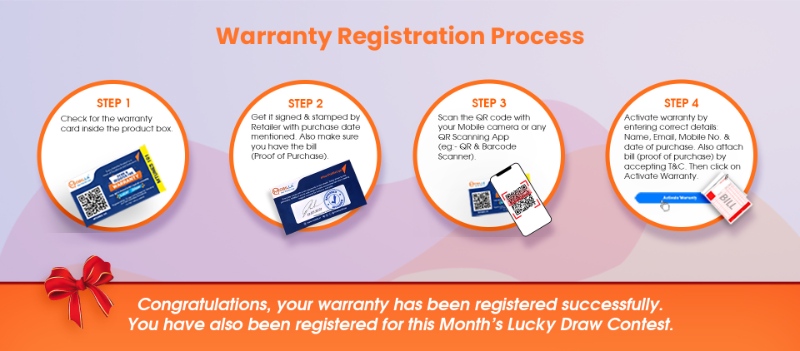
The warranty registration process for Mobilla.
The users can scan the QR code with any app, and even their phone camera, the QR code directed users to a custom build a web app, wherein users can register their warranty for any future claims in just a single click.
The users do this by entering in their personal and product details, with single-sign-on features enabled giving them the option to sign in through Google and Truecaller. This meant that users did not have to remember their credentials for signing in and all the details submitted were verified.
Once registered Mobilla reached out to customers by email, SMS and WhatsApp (using the data provided on the web app) with confirmation messages and links for future claims.
This enabled Mobilla to reach every customer personally including Amazon and retail customers, opening up remarketing and reselling opportunities.
Whenever a customer wanted to claim a warranty all they had to do was go on the web app, using links on their emails, SMS and WhatsApp, and click a button.
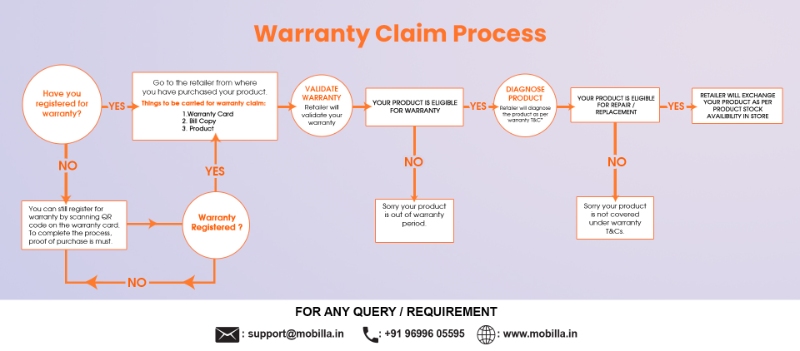
The warranty claims process for Mobilla.
The automated warranty management process transformed Mobilla's post-sales service as it allowed it to-
1. Automate the warranty process.
2. Increase customer participation.
3. Enable customers to claim a warranty with a single click.
4. Enable customers to track the status of their claims.
5. Solve customer queries and collect feedback in real-time using NeuroWarranty's inbuilt CRM.
6. Resell effectively to amazon and retail customers using customer data.
Mobilla could soon feel the difference and observed that customer support requests fell drastically, as customers could now manage warranties on their own this allowed Mobilla to focus more on other parts of the business.
**About NeuroWarranty**
Mobilla achieved this and much more using the NeuroWarranty warranty management software.NeuroWarranty not only helped Mobilla provide a superior customer experience but also helped Mobilla increase its repeat sales by bringing it data from its amazon and retail customers.
How can your brand do the same?
NeuroWarranty's [warranty management software](https://www.neurowarranty.com/) is helping Mobilla, Syska, Smartshout and 100+ leading brands increase their repeat sales by transforming their postsales services.
**What are you waiting for?**
Make Warranty Management Software your Strategic Advantage!
[**_Check out the list of the best warranty management software for the year 2022._**](https://neurowarranty.com/blog/5-best-warranty-management-software-in-2022-ckzqvwn3k169851llanw48z6yo)
### NeuroWarranty guarantees -
1. Increase in revenue and profit
2. Up to 90% decrease in warranty-related costs.
3. Up to 28% increase in repeat sales.
4. 100% Reduction in fraudulent warranty claims
5. Data of your Amazon, Flipkart and retail end customers
6. 5X customer engagement compared to your competitors.
7. Increase your D2C sales.
If you wish to convert your warranty expenses into a profit-making asset, schedule a call with our solution experts and get a solution that has delivered results for market leaders in the consumer electronics segment. [Schedule a call now.](https://calendly.com/aabhishekbindal/neurotags-demo?month=2022-02)
---
This blog is powered by Superblog. Visit https://superblog.ai to know more.
---
## How can you deliver an unparalleled post-sales experience using a warranty solution?
Author: Abhishek Agrawal
Author URL: https://www.neurowarranty.com/blog/author/abhishek-agrawal
Published: 2022-09-13
Tags: Warranty Management, customer experience
Tag URLs: Warranty Management (https://www.neurowarranty.com/blog/tag/warranty-management), customer experience (https://www.neurowarranty.com/blog/tag/customer-experience)
URL: https://www.neurowarranty.com/blog/how-can-you-deliver-an-unparalleled-post-sales-experience-using-a-warranty-solution-cl8066nx5153041kpglh49jlme
Your competitors are no longer competing with your product or your pricing... So what exactly is their game plan?
Research by [Gartner](https://www.linkedin.com/company/gartner/) shows that in 2022, 81% of the brands mostly or completely compete only on customer experience.
A positive post-sales experience is now the most important criterion for customers in making their buying decisions. A study by [PwC](https://www.pwc.com/us/en/advisory-services/publications/consumer-intelligence-series/pwc-consumer-intelligence-series-customer-experience.pdf) points out that 86% of customers consider a positive post-sales experience as their top priority.
A hassle-free warranty process is one of the most important aspects of the post-sales experience, as it show's your customers that you care about them even after the purchase and helps build trust between you and your customers for future transactions.
**So how can you exactly provide an unparalleled post-sales experience to your customers using your warranty process?**
## 1\. Digitize warranty registrations to provide a positive post-sales experience.
Most customers think of warranty claims as a hassle-filled process as traditional paper-based warranty programs make them secure their old bills and warranty cards and present them at the time of warranty claims.
This becomes annoying for your customers as it is difficult to secure old paperwork, and customers are often buying new products almost every week, making it more difficult to manage multiple warranties.
Enabling digital warranty registrations at the time of purchase allows customers to digitally register their brand for a future warranty claim, saving them from the hassle of managing exhaustive paperwork.
## 2\. Educate your customers
Your warranty process is a crucial post-sales touchpoint with your customers and should be used to educate and engage them in activities more than just warranties.
NeuroWarranty's warranty registration solution creates for you a custom landing page that your customers get directed to while registering warranties you can use this digital real estate to educate and engage your customers by providing how-to guides, answering FAQs, collecting feedback and even cross-selling related products.
## 3\. Automate claims for an unparalleled post-sales experience
Warranty claims are the true test of a brand's post-sales experience. And depending on their warranty claims experience of their current purchase, the customer will decide if they want to engage with your brand again.
The best way to win customers over is to automate your claims process. NeuroWarranty automates your claims process by allowing your customers to claim a warranty in a single click, and at the same time, saving you money and labour spent in managing these claims.
How does NeuroWarranty's warranty management solution automate warranty claims?
## 4\. Enable warranty tracking
Advanced warranty tracking software not only makes warranty tracking easier for the brands but also enables customers to track and manage multiple claims at once. NeuroWarranty's warranty tracking solution allows customers to claim, track and manage multiple claims on a single screen. Allowing users to track their claim status, and at the same time, saving costs spent on physical customer communication and support tickets.
[**_Check out the list of the best warranty management software_**](https://neurowarranty.com/blog/5-best-warranty-management-software-in-2022-ckzqvwn3k169851llanw48z6yo) **_._**
## 5\. Communicate with your customers
Customers, when registered for a warranty claim, want constant updates on their claim status, but ensuring that their customers are aware of their warranty claim's status is an expensive and time-consuming process.
NeuroWarranty's warranty management software, with the help of its inbuilt CRM, sets up a direct communication channel between you and your customers. The customer service teams can manage customer communication on a single interface with minimal effort.
## 6\. Resell, cross-sell and upsell
Repeat sales are driving business growth, and customer retention has far overtaken customer acquisition and is the top priority of all e-commerce brands.
But it is impossible to remarket to existing customers without having their data. Most consumer brands struggle with remarketing as their sales channels, Amazon and retail, do not allow them to access or collect end-customer data.
NeuroWarranty's warranty management software boosts your repeat sales by bringing you data from all your end customers (Amazon and retail).
**How does the warranty solution work?**
Allowing your marketing teams to reach your customers and boost repeat sales by personalizing and segmenting their marketing message using data provided by the warranty management software.
Investing in advanced warranty management software like NeuroWarranty not only helps you provide your existing customers with an unparalleled post-sales experience but also helps you gather end-customer first-party data and resell effectively.
**What do leading brands say about NeuroWarranty?**

We hope you found our blog helpful. ts. **The NeuroWarranty warranty software is trusted by 100s of leading brands including - Syska, JCB, and ResQtech.** You can sign up for the [warranty management](https://www.neurowarranty.com/) software by scheduling a demo and getting a free 14-day trial here - [get a demo](https://calendly.com/aabhishekbindal/neurotags-demo?month=2022-09) when you schedule a demo, an account manager will contact you and organize a call to discuss your business requirements.
---
This blog is powered by Superblog. Visit https://superblog.ai to know more.
---
## What does warranty management software exactly do for you?
Author: Abhishek Agrawal
Author URL: https://www.neurowarranty.com/blog/author/abhishek-agrawal
Published: 2022-09-06
Tags: Warranty Management, warranty mangement software
Tag URLs: Warranty Management (https://www.neurowarranty.com/blog/tag/warranty-management), warranty mangement software (https://www.neurowarranty.com/blog/tag/warranty-mangement-software)
URL: https://www.neurowarranty.com/blog/what-does-warranty-management-software-exactly-do-for-you-cl7q47r3a1539631llizqdh4u5d
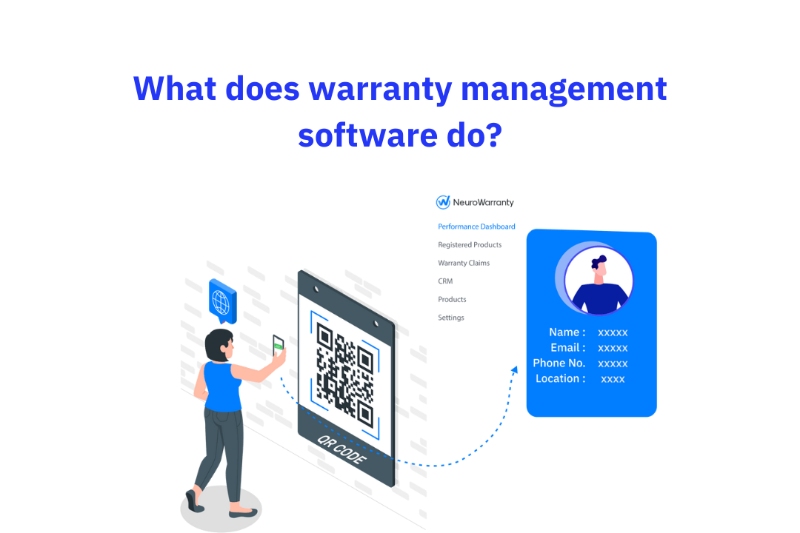
The markets have never been more customer centricity, and providing an unparalleled post-sales experience is the top priority of all brands. The most crucial of which is a hassle-free warranty claims experience for your end customers.
With ever-increasing CAC, you want to retain as many customers as possible, in which their warranty experience with you plays a vital role. But innovations in the warranty management market have made warranties much more than product replacements.
Leading consumer brands are now using their warranty program to get customer data, communicate with customers and most importantly, retain customers.
**Let's see what exactly warranty management software does and how leading brands use it to boost their repeat sales.**
## What is warranty claims management?
A warranty is a trust-building assurance given by you to your customers before they purchase your product. Safeguarding their purchase against damages or manufacturing faults not only builds trust but also helps you develop a long-term relationship with your end customers.
But just having a warranty process in place won't get you going in a market where brands mostly compete on customer experience. Customers will judge you based on the efficiency of your warranty processes.
You should have a warranty process that is easy to use, informs customers at all stages and saves you time and costs in managing them.
## What does warranty management software do?
In many organizations, warranty services and claims procedures are typically handled internally and impact several departments, from the supply chain to customer service.
Traditional warranty processes are dependent on paper-based warranty cards, that the customers get during their purchase and are to be secured and presented when they claim for a warranty. Traditional warranty claims often leave customers unsatisfied and drive up your management costs as -
1. Customers are unable to claim as they often lose their warranty card/ purchase bills
2. Customers have to go through multiple touchpoints
3. The manual process tends to drive up your costs
4. Brands face serious issues when scaling up
Advanced warranty management software like [NeuroWarranty](https://www.neurowarranty.com/warranty-management-solution) are solutions that automate and digitize your warranty management processes end to end.
Warranty management software NeuroWarranty does that by replacing your paper-based warranty process with a QR code-based warranty process. QR code-based warranty cards are placed on the product or inside the product packaging.
As end customers scan the QR code to register their product, they get directed to a custom build page that gets brands' valuable data like Names, email ids, phone numbers and more.
After successfully registering their product, customers no longer have to secure purchase bills and warranty cards. Customers can now register, claim and manage all their product warranties on a single screen and with a single click.
[**_Check out the list of the best warranty management software for the year 2022._**](https://neurowarranty.com/blog/5-best-warranty-management-software-in-2022-ckzqvwn3k169851llanw48z6yo)
## What are the benefits of warranty management software -
- **Faster processes:** A warranty management software can help you easily track the progress of each claim and process each stage faster. By allowing the system to automate menial jobs, your employees will have more time to focus on bigger tasks and improve their skills.
- **Reduce fraudulent risk:** Customers who are worried about their data can be easily reassured as the risk of fraud is reduced with a warranty management system. As all the processes and policies are already in place, and with the latest technology, any issues or errors such as fraudulent activity are much easier to detect and stop.
- **Cost-effective:** With management software, you can easily save on administrative costs as the system will automate claims and settlement processes.
- **Improved customer service:** With real-time data available, you can easily track the progress of each claim to keep customers updated and improve overall customer satisfaction.
- **Clearer insights:** Clearer insights and analysis data are available with the help of a warranty management system. This makes it much simpler to monitor any quality issues and gives you a clear understanding of customer requirements.
## How can Warranty Management software increase your repeat sales?
1. [Providing an unparalleled post-sales experience.](https://www.neurowarranty.com/digital-warranty-management-software)
NeuroWarranty's digital warranty solution allows your customers to claim a warranty with just a few clicks, avoiding the hassle of finding old purchase bills and going through endless calls with your customer service teams. Creating an unparalleled customer experience and resulting in customer satisfaction.
2. [Bring you data like Email Ids, Phone Numbers of your end-customers.](https://www.neurowarranty.com/collect-offline-consumer-data)
NeuroWarranty also empowers brands by bringing them data such as emails, phone numbers and names of their end customers allowing your marketing teams to personalize your remarketing efforts increasing repeat sales and maximum customer retention rates.
We hope you found our blog helpful. **The NeuroWarranty warranty software is trusted by 100s of leading brands including - Syska, JCB, and ResQtech.** You can sign up for the [warranty management](https://www.neurowarranty.com/) software by scheduling a demo and getting a free 14-day trial here - [get a demo](https://calendly.com/aabhishekbindal/neurotags-demo?month=2022-09) when you schedule a demo, an account manager will contact you and organize a call to discuss your business requirements.
---
This blog is powered by Superblog. Visit https://superblog.ai to know more.
---
## Here's how consumer brands can sell extended warranties effectively to their customers.
Author: Abhishek Agrawal
Author URL: https://www.neurowarranty.com/blog/author/abhishek-agrawal
Published: 2022-08-29
Tags: Warranty Management, Warranty Management Services
Tag URLs: Warranty Management (https://www.neurowarranty.com/blog/tag/warranty-management), Warranty Management Services (https://www.neurowarranty.com/blog/tag/warranty-management-services)
URL: https://www.neurowarranty.com/blog/heres-how-consumer-brands-can-sell-extended-warranties-effectively-to-their-customers-cl7eqha9t99691lli8hwdg63e
Apple is right now the biggest consumer brand, but can you guess what is Apple's most profitable and highest margin product? (Hint - It's not the latest iPhone) [AppleCare](https://www.forbes.com/sites/greatspeculations/2020/02/25/apples-services-to-top-50-billion-profits-by-2025--beating-iphone/?sh=2ff54ee253db) extended warranty offering is the company’s highest margin (at 63%) and second-largest segment.
While Apple is acing the selling extended warranties process to its loyal customer base, new consumer brands are constantly struggling, or even worse, are unaware of about just how highly profitable can selling extended warranties be.
While learning about high-profit margins in selling extended warranties is not a difficult process, learning how to sell them effectively is. And this blog show's you how you can do it effectively.
**Here's how consumer brands can sell extended warranties to their customers -**
Contents
- [Provide a seamless warranty registration experience -](#provide-a-seamless-warranty-registration-experience)
- [Give customers several price/ feature options -](#give-customers-several-price-feature-options)
- [1\. Pricing](#1-pricing)
- [2\. Features](#2-features)
- [Digitize warranty management -](#digitize-warranty-management)
- [Use Email to your benefit -](#use-email-to-your-benefit)
## Provide a seamless warranty registration experience -
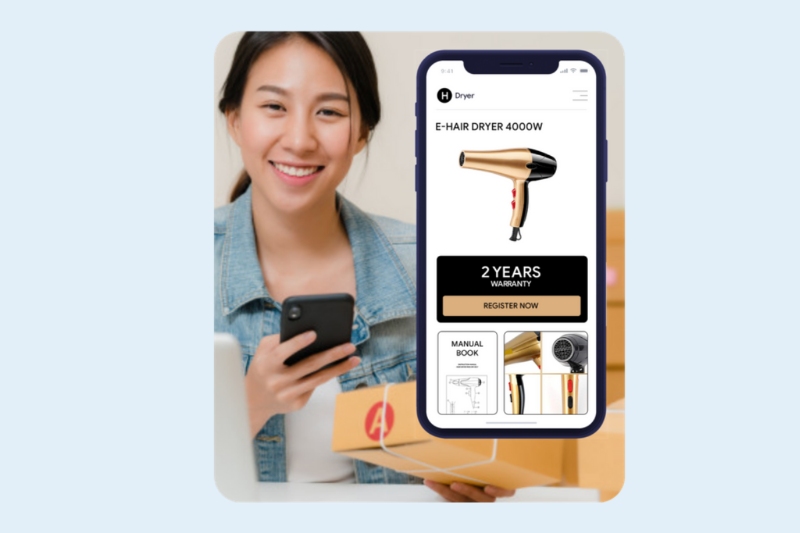
A smooth and pleasant first warranty experience is the basis on which you built your post-sales connection with your customers, hence you must ace it.
It is necessary to have a warranty registration process in place that can help you build a two-way communication channel with your customers. You can do this by choosing a warranty management software that can work in unison with your current CRM and also brings you contact details like Names, phone numbers and emails of your end customers.
You would also like to maximize your warranty registrations so that you have maximum potential buyers for your extended warranties. You can do this by offering your customers something in return for the registration like loyalty points or limited extended warranty coverage.
## Give customers several price/ feature options -
One size does not fit all and that holds for warranties as well, all customers are different and are looking for different features from their extended warranties based on their risk analysis of the product. It is in your best interest of you to create several prices and features combos by including (or excluding) several features.
### 1\. Pricing
First, decide how much you want to charge for the warranty. You might offer a free trial period or a discount for the first year of coverage. If you want to create a long-term relationship with customers, consider offering discounts for multiple years' worth of coverage.
### 2\. Features
Extended warranties come with several features that might not be standard in other types of warranties — like free shipping, free returns, and even free replacements if something goes wrong with the product (such as if it's damaged by water). These features can attract customers who are looking for more than just replacement coverage — they might also want to get their money back or have an item replaced at no cost after a certain period.
Highlight the need for an extended warranty -
Educating is the first part of selling. For your customer registering a warranty is the last step of their product purchase journey. To sell extended warranties successfully you would have to educate your customers on the benefits of having one and on the risks of not having one. You can do this by researching and coming up with numbers to back your claim, for example, the percentage of extended warranty users who claimed a warranty, the amount of money usually required to get a product repaired etc.
## Digitize warranty management -
Traditional warranty processes put a lot of burden on customers by making them secure and manage their purchase bills, warranty cards and other related documents, as a result, to quit the hassle most customers do not opt-in for extended warranties.
You can solve this by having digital warranty software like NeuroWarranty take care of your warranty process. As NeuroWarranty digitizes your warranty process, your customers no longer have to secure old purchase bills and warranty cards. Instead, customers can register and claim a warranty in just a single click, easing up the process of first registration and opening doors for extended warranties.
## Use Email to your benefit -
Selling extended warranties typically has a longer sales cycle compared to other post-sales services. You will have to keep engaging with and educating your customers for them to take a purchase action. You can do this by periodically sending your customers emails about the same. But at a time when most consumer brands depend on marketplaces like Amazon for their sales, how can you get the email ids of your customers? To do this you will need a solution that can overcome the complex challenges of your sales channels and bring you data of all your end customers.
NeuroWarranty's [warranty management software](https://www.neurowarranty.com/warranty-management-solution) specializes in delivering end-customer data to brands, and at the same time, helps brands build a profitable interaction with their customers. To know how NeuroWarranty helped market leader Syska increase profits by harnessing customer data read the complete case study [here](https://www.neurowarranty.com/blog/warranty-management-solution-for-the-consumer-electronics-industry-case-study-cl027nbcy55861pm8ipb99ulw).
---
This blog is powered by Superblog. Visit https://superblog.ai to know more.
---
## How can a warranty program benefit your brand?
Author: Abhishek Agrawal
Author URL: https://www.neurowarranty.com/blog/author/abhishek-agrawal
Published: 2022-08-24
Tags: Warranty Management, warranty mangement software
Tag URLs: Warranty Management (https://www.neurowarranty.com/blog/tag/warranty-management), warranty mangement software (https://www.neurowarranty.com/blog/tag/warranty-mangement-software)
URL: https://www.neurowarranty.com/blog/how-can-a-warranty-program-benefit-your-brand-cl7789gvi166721po1r273yllf

Many companies think of warranty management as just another part of their customer service and a burden on their sales revenues. However, with the help of a sound warranty management solution, you can turn your warranty expenditure into a profit-making asset.
This blog will look into how brands can leverage warranty management to increase sales and profits.
Warranty is an important ingredient in building customer satisfaction and paving the road to retaining them. A well-executed Warranty process reinforces customers’ faith in your brand because they feel taken care of even after the purchase. It helps your brand retain customers and eventually increase sales.
**If you are looking for a [Warranty Management system](https://www.neurowarranty.com/warranty-management-solution) that can help you automate the process and provide an unparalleled experience to your end customers check out NeuroWarranty's warranty management software.**
**Here is how a warranty program can benefit your brand -**
With increased digitization, more manufacturers are turning to technology solutions to optimize the warranty management process.
While manufacturers have traditionally viewed warranty management as a necessary evil, studies now prove that the right technology can help manage warranty information and claims processes more effectively, which can positively impact revenue.
## **What is a Warranty Management Software?**
In many organizations, warranty services and claims procedures are typically handled internally and impact several departments, from the supply chain to customer service.
If you are not all using the same system and viewing the same data, this can cause many problems. By investing in a warranty management app, brands can ensure that the warranty management process not only goes smoothly but also brings added benefits to them.
Today’s warranty software products are also AI-enabled, allowing manufacturers to use machine learning capabilities to automate time-consuming functions. This helps improve the warranty process and ensures a superior level of customer service while delivering profitability.
## **Benefits of a Warranty Management Software-**
### **Improved Warranty Process.**
In general, [warranty management software](https://www.neurowarranty.com/warranty-management-solution) helps ensure uniform standards in warranty processes while providing increased transparency and communication between manufacturers, and suppliers.
Let’s look at some of the additional specific benefits:
- **Faster processes:** A warranty management app can help to easily track the progress of each claim and process each stage faster. By allowing the system to automate menial jobs, your employees will have more time to focus on bigger tasks and improve their skills.
- **Reduce fraudulent risk:** Customers who are worried about their data can be easily reassured as the risk of fraud is reduced with a warranty management system. As all of the processes and policies are already in place and with the latest technology any issues or errors such as fraudulent activity are much easier to detect and stop.
- **Cost-effective:** With a management system you can easily save on administrative costs as the system will automate claims and settlement processes.
- **Improved customer service:** With real-time data available you can easily track the progress of each claim to keep customers updated and improve overall customer satisfaction.
- **Clearer insights:** Clearer insights and analysis data are available with the help of a warranty management system. This makes it much simpler to monitor any quality issues and gives you a clear understanding of customer requirements.
## **Get you warranty data and analytics -**
A warranty tracking software allows you to handle all your post-sales support requirements from a single screen, thus saving efforts and costs. But there are other benefits an advanced warranty tracking software can deliver for your brand like -
### Improving your customer service -
Data can help you streamline your warranty claims service. Using reports from the analytics dashboards, brands can review the process at scale and figure out new easier processes. Analyzing the data will allow you to look into your post-sales customer service and find out which step the customer finds the most exhaustive and time-consuming.
### Improving your product -
Track warranty data to find out what aspect of the product is triggering the most warranty claims. Warranty data not only allows you to save R&D costs but also allows you to use user-generated data to create an improved customer experience. Warranty data provides direct information about how and when your products fail. With this information, you can identify parts and systems that need improvement. Warranty data will also give you insight into what needs to be improved to reduce failure rates and improve customer satisfaction.
## **Get your end customer data -**
Customer data is the biggest advantage for businesses, whether it be for online or offline marketing campaigns. It facilitates the retention of existing customers when utilized for loyalty programs and acquires new customers for other products through effective marketing strategies like promotion and cross-selling.
Customer data is a gold mine for any business and is the biggest advantage that they could have. Businesses use it to help them retain their existing customers by utilizing a loyalty program and acquiring new customers for their other products through a cross-selling strategy.
They can also use customer data to tailor every online marketing campaign to their existing customers to increase their return rates. Customer data can be used to promote businesses in a way that's more personal because it's like having a relationship with every customer.
[Get data of your Amazon and other marketplace customers now](https://www.neurowarranty.com/collect-offline-consumer-data).
NeuroWarranty's [warranty management software](https://www.neurowarranty.com/warranty-management-solution) specializes in delivering end-customer data to brands, and at the same time, helps brands build a profitable interaction with their customers. To know how NeuroWarranty helped market leader Syska increase profits by harnessing customer data read the complete case study [here](https://www.neurowarranty.com/blog/warranty-management-solution-for-the-consumer-electronics-industry-case-study-cl027nbcy55861pm8ipb99ulw).
---
This blog is powered by Superblog. Visit https://superblog.ai to know more.
---
## 5 questions to ask before choosing a warranty management solution.
Author: Abhishek Agrawal
Author URL: https://www.neurowarranty.com/blog/author/abhishek-agrawal
Published: 2022-08-18
Tags: Warranty Management, warranty management solution
Tag URLs: Warranty Management (https://www.neurowarranty.com/blog/tag/warranty-management), warranty management solution (https://www.neurowarranty.com/blog/tag/warranty-management-solution)
URL: https://www.neurowarranty.com/blog/5-questions-to-ask-before-choosing-a-warranty-management-solution-cl6z1242i451591lmesy9zf785
### **Is the warranty solution easy to use for customers?**
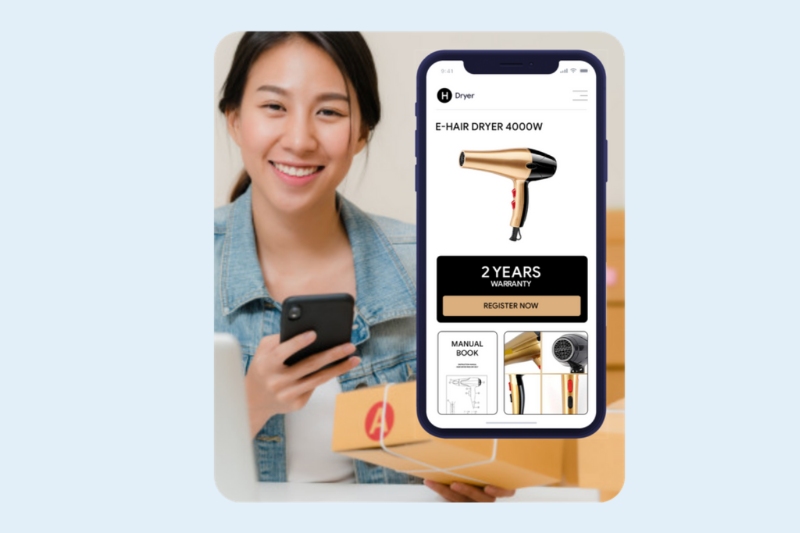
Customer experience has overtaken price and product has the top deciding factor if customers retain or not, so while choosing a warranty management solution, make sure to have customer experience as the top deciding factor.
The current warranty process most brands use is having a physical warranty card inside the product packaging, and whenever a customer wants to claim a warranty, they have to bring the warranty card to a retail outlet and verify their claim.
This makes claiming a warranty a hassle-filled process for your customers, leading to a large dropout rate.
What you would want is instead to have a digital solution where customers can register and claim a warranty in just a single click.
With the help of NeuroWarranty, [registering for a warranty claim](https://www.neurowarranty.com/blog/warranty-management-app-reduce-costs-and-automate-your-product-warranties-cl1g7op6l65941jlfkyb2vlqj) becomes much simpler. Customers can register for a warranty by simply scanning a QR code placed on your product and entering the purchase details. Once registered, customers no longer need to secure purchase bills and invoices.
### **Can the solution automate your warranty process?**
Traditional warranty management processes are manual and labour intensive, thus driving up costs. The software should be designed to automate the tedious aspects of a warranty process.
Whether it is collecting warranty data or sending out notifications, the solution should be able to handle it effortlessly. This can save a lot of time and money that would otherwise be spent on building the process manually.
[Automating the warranty process](https://www.neurowarranty.com/blog/warranty-management-app-reduce-costs-and-automate-your-product-warranties-cl1g7op6l65941jlfkyb2vlqj) allows you to reduce your dependency on customer support executives and reduce customer support costs. Automating the process allows brands to manage a large number of warranty claims at once on a single screen, thus cutting down the operational cost significantly.
### **Does it allow you to communicate with your customers?**
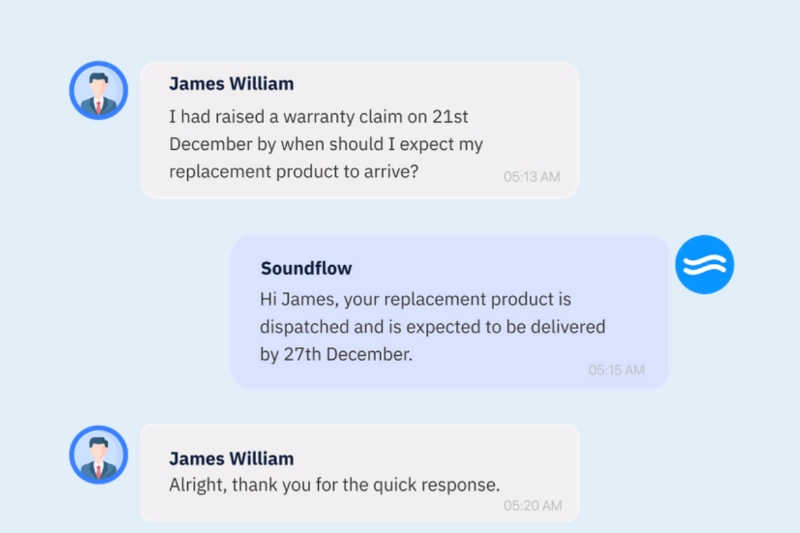
Customer feedback is the most important part of any business. It helps determine what products and services you should offer, how to communicate with your customers, and even what your brand needs to look like.
With advanced warranty solutions, collecting customer feedback is easy. Most of these tools allow you to send an email or text message directly to your customers after they have purchased your product.
Digital warranty management solutions like [NeuroWarranty](https://www.neurowarranty.com/blog/warranty-management-app-reduce-costs-and-automate-your-product-warranties-cl1g7op6l65941jlfkyb2vlqj) come with inbuilt CRMs and allow your customer support executives to manage the entire post-sales experience from a single screen.
### **Does the solution allow you to access warranty data and analytics?**
[Warranty solutions](https://www.neurowarranty.com/) equipped with intelligent dashboards offer relevant insights for better decision-making. There are many reasons why you would want to equip your business with a digital warranty solution. One of them is because they give you unique insights into the performance of your product in the field.
Analytics dashboards can give you an idea of how your product performs across various geographies and demographics and where you need to improve. This data can help your brand make better decisions in various areas of your business.
With the right warranty analytics in place, businesses can save time, money and resources, and make better decisions. When shopping for a warranty solution, it's important to find a solution that can offer you the [right warranty analytics](https://www.neurowarranty.com/warranty-management-solution). The solution should be able to provide the right services that fit your needs and is optimized for your business.
### **Can the solution bring you valuable customer data?**

[Customer data](https://www.neurowarranty.com/collect-offline-consumer-data) is the biggest advantage for businesses, whether it be for online or offline marketing campaigns. It facilitates the retention of existing customers when utilized for re-marketing and acquires new customers for other products through effective marketing strategies like promotion and cross-selling.
Customer data can be used to promote businesses in a way that's more personal because it's like having a relationship with every customer.
Customer data is a gold mine for your business and is the biggest advantage that you could have.
With NeuroWarranty leading consumer brands like Wayona can have a customer data collection rate as high as 16%. The data collected includes name, address, email address, phone number and even some demographic information such as age and gender. This data was then used by Wayona as part of their re-marketing efforts and were able to achieve a 20% increase in their repeat sales. [Get complete case study.](https://www.neurowarranty.com/blog/helping-consumer-electronics-and-appliances-brands-boost-their-repeat-sales-case-study-cl524alru26771kqqk0i7d0l4)
Want to know more about how NeuroWarranty can help you improve your warranty process and get customer data? [Schedule a demo now.](https://calendly.com/aabhishekbindal/neurotags-demo?month=2022-08)
---
This blog is powered by Superblog. Visit https://superblog.ai to know more.
---
## Top 5 issues brands face while managing warranties (and how to solve them)
Author: Abhishek Agrawal
Author URL: https://www.neurowarranty.com/blog/author/abhishek-agrawal
Published: 2022-08-12
Tags: Warranty Management, warranty mangement software
Tag URLs: Warranty Management (https://www.neurowarranty.com/blog/tag/warranty-management), warranty mangement software (https://www.neurowarranty.com/blog/tag/warranty-mangement-software)
URL: https://www.neurowarranty.com/blog/top-5-issues-brands-face-while-managing-warranties-and-how-to-solve-them-cl6qgfhal715421jo4wsfjzz2n
Fraudulent Warranty Claims -
A large chunk of fraudulent claims come from fraudsters who mix up with real customers who end up losing their warranty cards and bills. Also, customers at times intentionally provide an out-of-the-warranty product under claims. By eliminating fraudulent claims early in the process, you not only save money but also precious time and resources.
Warranty fraud can be difficult to detect, especially without skilled resources, processes and controls in place -- e.g. internal audit departments, anti-fraud policies, and formal fraud risk assessment. As brands look forward to providing the best customer experience, a lot of such repetitive and fraudulent claims are left in the suspicion stage.
Using the NeuroWarranty app, when any product comes for warranty claims, you can track details like when the product was manufactured and who was the supplier/ OEM. This will help in tracking which supplier is using the wrong product.
[Stop warranty claim frauds faced by your brand now](https://www.neurowarranty.com/blog/here-is-how-you-can-stop-warranty-frauds-faced-by-your-brand-cl202i0jv16301ll8aet2xuhl).
### Tedious Warranty Claim Processes -
Most customers see claiming a warranty replacement for their product as a hassle rather than a privilege. This is due to the tedious time and effort-consuming warranty process brands use.
Before claiming a warranty customers have to go through the tedious process of finding old purchase bills and warranty letters which more often than not are misplaced due to the high volume of purchases customers make nowadays.
Although the process does not end at finding the purchase bills, customers then have to often go through endless calls with customer support teams to verify their purchase and then claim a warranty.
This process has been known to have a high dropout rate and customers often link the bad experience of the claim to the brand, creating a negative brand image and restricting them to buy from you again.
NeuroWarranty's warranty management software completely automates and digitizes your process end to end. Customers no longer have to look for old bills and go through endless calls, instead, they can register and claim for a warranty in a single click, heres how-
**Scan the QR code or** [**click here**](https://ndemo.neurotags.in/productDetails/62d64464e292381b6f7ec123/) **to get the complete 1 click warranty registration experience :**
### High Warranty Management Costs -
Traditional warranty management processes are manual and labour intensive, thus driving up costs. [Automating the warranty process](https://www.neurowarranty.com/warranty-management-solution) allows you to reduce your dependency on customer support executives and reduce customer support costs. Automating the process allows brands to manage a large number of warranty claims at once on a single screen, thus cutting down the operational cost significantly.
### Customer Warranty Communication -

Customers, when registered for a warranty claim, want constant updates on their claim status, but ensuring that customers are aware of their warranty claim's status is an expensive and time-consuming process for brands.
Absence of a direct communication channel between customers who claim a warranty and customer service teams forces brands to take up the process on-call resulting in additional service costs and reduced profits.
At the same time, collecting feedback and reviews from your end customers can prove to be a rather complicated task, notably for consumer product brands. Using Customer Relationship Management (CRM) software, your end customers can connect directly with your client servicing teams to communicate and register their feedback.
While buying separate CRM tools can be expensive and difficult to manage, you can save tons of money spent on buying additional CRM tools. Digital [warranty management solutions](https://www.neurowarranty.com/) like NeuroWarranty come with inbuilt CRMs and allow your customer support executives to manage the entire post-sales experience from a single screen.
### Lack of Warranty Data and Analytics -
Warranty Applications equipped with intelligent dashboards offer relevant insights for better decision-making. There are many reasons why you would want to equip your business with a warranty management app. One of them is because they give you unique insights into the performance of your product in the field.
Analytics dashboards can give you an idea of how your product performs across various geographies and demographics and where you need to improve. This data can help your brand make better decisions in various areas of your business.
With the right warranty analytics in place, businesses can save time, money, and resources and make better decisions. When selecting a warranty management app, it's important to find an app that can offer you the right warranty analytics. The application should be able to provide the right services that fit your needs and is optimized your business.
The NeuroWarranty warranty tracking software allows you to access in-depth analytics of all your product warranties and the personal data of your end customers. If you have any questions about how to use our software or how it can help your business, book a demo according to your convenience [here](https://calendly.com/aabhishekbindal/neurotags-demo?month=2021-09).
---
This blog is powered by Superblog. Visit https://superblog.ai to know more.
---
## Key Warranty metrics and terms you need to know
Author: Abhishek Agrawal
Author URL: https://www.neurowarranty.com/blog/author/abhishek-agrawal
Published: 2022-08-10
Tags: Digital Warranty Management, warranty mangement software
Tag URLs: Digital Warranty Management (https://www.neurowarranty.com/blog/tag/digital-warranty-management), warranty mangement software (https://www.neurowarranty.com/blog/tag/warranty-mangement-software)
URL: https://www.neurowarranty.com/blog/key-warranty-metrics-and-terms-you-need-to-know-cl6nk55fy381481jo4985lm57b
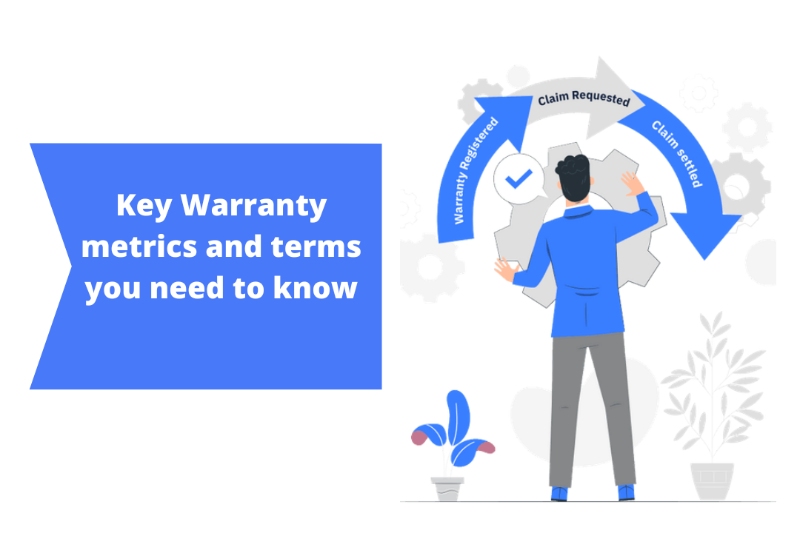
The first step to improving your warranty claims process is to have an in-depth understanding of metrics that can tell you what needs to be worked upon. In addition to the total number of claims and warranty costs, these five key warranty metrics help you drive performance and product quality.
**What are some important warranty metrics and terms to track?**
### **Product return rate**
How many of your customers are returning products? If you're not tracking this metric, you're missing out on a lot of important information about your business.
The product return rate is the percentage of your customers who are returning products. You can calculate it by dividing the number of returns by the total number of units sold. For example, if you sell 100 units, and 15% of those units are returned, then your product return rate would be 15/100 = 14%.
This metric tells you how many customers believe that their item is defective or not what they expected. If 1% of your sales are returned, it means that each customer has experienced a problem in some way, and most likely no one else will buy from you again if they have had an issue with any part of their purchase experience.
### **Labour cost per repair**
The labour cost per repair is the cost of labour required to perform a repair or maintenance. If a technician has to replace a part or add a new component, it will be counted as a repair. If someone needs to do some diagnostics on the equipment, that will also be counted as labour.
Labour cost per repair is important because it tells you how efficient your technicians are at fixing problems. If they're not very efficient in their work, then they won't be able to fix many problems in one visit and you'll have to keep hiring them more often than necessary.
### **Warranty reserves and accruals**
Warranty Reserve is a fund maintained by the manufacturer to meet warranty expenses. The warranty reserve balance is the balance left after deductions of claim expenses for the year.
The accrual rate is usually a fixed percentage of sales and is managed by the finance department of the company. The finance department can adjust the accrual rate to manage company earnings.
Hence, the management of warranty reserve and its accrual rates becomes crucial for a company.
### Percentage Supplier recovery
**Supplier recovery/total warranty cost**
As companies source, most of the components from suppliers, percentages of the warranty recovered from suppliers is a very important part of managing warranty costs and supplier quality. Supplier warranty and recovery amounts can help measure the supplier performance and help with discussions on parts pricing and warranty terms & conditions with suppliers.
### Warranty Cost as % of sales
**Annual warranty cost / Annual sales**
Warranty as a percentage of sales may vary from 0.5% to 5% of sales for different industries. This metric will help companies easily define the impact of a warranty on the company’s bottom line.
This measure calculates warranty costs (repair and replacement) as a percentage of sales. Warranty costs include materials, labour, and problem diagnosis for products returned for repair or refurbishment. This measure is part of a set of Process Efficiency measures that help companies optimize the performance of their "produce/manufacture/deliver product" process by minimizing waste and refining resource consumption.
Understanding these warranty metrics is the first step in improving your warranty management process. Try doing a self-audit using the above formulas, what are the results?
Do you think you are not performing to your best abilities? Do you think you have very high warranty costs?
[NeuroWarranty](https://www.neurowarranty.com/warranty-management-solution) is warranty management software that can reduce your warranty costs by as much as 50% while automating the entire process end to end.
**How does NeuroWarranty automate your warranty process?**
Scan the QR code or [click here](https://ndemo.neurotags.in/productDetails/62d64464e292381b6f7ec123/) to get the complete 1 click warranty registration experience :
---
This blog is powered by Superblog. Visit https://superblog.ai to know more.
---
## How to increase product registration rates? The complete guide -
Author: Abhishek Agrawal
Author URL: https://www.neurowarranty.com/blog/author/abhishek-agrawal
Published: 2022-08-05
Tags: product registration software, customer data
Tag URLs: product registration software (https://www.neurowarranty.com/blog/tag/product-registration-software), customer data (https://www.neurowarranty.com/blog/tag/customer-data)
URL: https://www.neurowarranty.com/blog/how-to-increase-product-registration-rates-the-complete-guide--cl6gd9kbi02081kpa0zny9zw1
Whether you are a small D2C brand or a large corporation, the ability to make your customers register their products is critical for success. A Product registration software collects valuable information about each customer, such as their name, e-mail address and any other information they provide during registration. Data is then used to increase repeat sales, manage warranty claims and improve customer satisfaction.
But a lot of brands despite having a product registration process in place, suffer from extremely low product registration rates, if you are one of them, how can you increase your product registration rates?
### Your complete guide to increasing your product registration rates -
Contents
- [Simplify the product registration process -](#simplify-the-product-registration-process)
- [Offer customers something in return for their data -](#offer-customers-something-in-return-for-their-data)
- [Simplify Access to Help, Support -](#simplify-access-to-help-support)
- [Make sure your customers trust you with their data -](#make-sure-your-customers-trust-you-with-their-data)
- [Make the form as simple as possible -](#make-the-form-as-simple-as-possible)
- [Allow users to sign in with phone numbers and e-mails -](#allow-users-to-sign-in-with-phone-numbers-and-e-mails)
### **Simplify the product registration process -**
The biggest problem with the registration process is that it's complicated. The registration form is the first thing people see when they visit your website. It’s also where most people leave.
Your registration form should be short and clear but not so short that it feels like a forced choice. When someone has to think about what they want, they’re less likely to complete the process. Take advantage of the fact that you have their attention by making sure there are no mistakes on the form itself or in its instructions.
NeuroWarranty is amongst one of the most easy-to-use product registration software available in the market right now - [**Click here**](https://ndemo.neurotags.in/productDetails/62d64464e292381b6f7ec123/) to get the complete product experience.
### **Offer customers something in return for their data -**
The more you can provide for your customers, the more likely they are to become loyal and repeat customers. The best way to do this is by giving them something more than what they expected — a little something extra that serves as a reward for their loyalty and participation in your business model.
The first step to increasing product registrations is to deliver value in return for customer data. A good example of this is building a loyalty program that tracks how customers are using your products and services, and then gives them discounts and other rewards when they use them more.
A company might offer customers a discount on their next purchase if they register for the service. Or it might send them an e-mail about new products and services.
The key is to make sure that the customer has something of value to receive from registering with the company. But how can you make use of data that you onboard, **[Click here](https://ndemo.neurotags.in/productDetails/62d64464e292381b6f7ec123/)** to know how you can increase repeat sales by as much as 180% using customer data.
### **Simplify Access to Help, Support -**
One of the best ways to improve product registration is to simplify access to help, support, and assist. This means that there should be a single place where customers can go to ask questions, get answers, and find resources.
You may also want to consider using an automated system for handling customer inquiries. This will allow you to quickly respond to inquiries and focus on other aspects of your business without having to deal with low-priority issues or follow up with customers who haven't been able to resolve their issues.
While looking for product registration solutions for your brand always look for a solution like NeuroWarranty, which has an inbuilt CRM. An inbuilt CRM will make the life of your support executive a lot easier and also save you additional costs of buying different CRM tools.
**_[Know the top 5 product registration software of 2022](https://www.neurowarranty.com/blog/the-top-5-best-product-registration-software-cl3889nwi22491kqbrck49rxi)_**
### Make sure your customers trust you with their data -
When it comes to data protection, customers are concerned about their privacy and the safety of their personal information. They also want to know that the company they do business with is committed to protecting their data.
**So how can you reassure your customers about data protection? Here are some tips:**
Be clear about what information you collect and why. Explain how you use it, specifically how it's used for marketing purposes and how long you keep it. If there are any sensitive pieces of information, explain those as well.
Provide clear instructions on how to opt-out of online tracking and third-party collection of data. You can even let customers know if they're already being tracked through other channels or if they can opt-out in a different way than just turning off cookies.
Let customers know what happens to their information if something goes wrong (for example, if someone hacks into your website). Then explain what steps you're taking now and in the future to prevent this from happening again.
### Make the form as simple as possible **-**
The first step in increasing your product registrations is to eliminate as many fields as possible. By doing so, you will reduce the amount of data you need to enter for each order and make it easier for customers to complete their purchases.
You can do this by letting customers choose options from dropdown menus or by allowing them to enter certain information in boxes below the options. This approach makes it easy for customers to choose from a variety of options without having to search through lengthy textboxes or narrow fields.
For example, if you sell multiple products—such as earphones and speakers —you could create a menu of choices that allows customers to select the type of earphone they want to register (for example, "wireless earphones"), then enter the model (for example, "wl - 07").
### Allow users to sign in with phone numbers and e-mails -
Most people have multiple passwords to remember, and a good number of people forget their passwords a lot. Allowing users to log in with phone numbers and e-mails will save your customers from a lot of hustle.
This process is called single sign-on, and it allows someone to register with one click. It can be a tricky design aspect to add to your website or app, but we think it is worth the extra effort. Keep in mind that most people would trust a single sign-on process more than one without it.
NeuroWarranty is amongst one of the most easy-to-use product registration software available in the market right now - [**Click here**](https://ndemo.neurotags.in/productDetails/62d64464e292381b6f7ec123/) to get the complete product experience.
Product registration software is a great way to help your brand increase repeat sales. It's also a great way to build customer loyalty and keep customers coming back for more. And making sure you are great at it can become one of your biggest strategic advantages.
---
This blog is powered by Superblog. Visit https://superblog.ai to know more.
---
## Advantages of Product Registration Software | NeuroWarranty
Author: Abhishek Agrawal
Author URL: https://www.neurowarranty.com/blog/author/abhishek-agrawal
Published: 2022-07-28
Tags: product registration software, repeat sales, customer data
Tag URLs: product registration software (https://www.neurowarranty.com/blog/tag/product-registration-software), repeat sales (https://www.neurowarranty.com/blog/tag/repeat-sales), customer data (https://www.neurowarranty.com/blog/tag/customer-data)
URL: https://www.neurowarranty.com/blog/advantages-of-product-registration-software-or-neurowarranty-cl651zne4205311kp71z2umej9
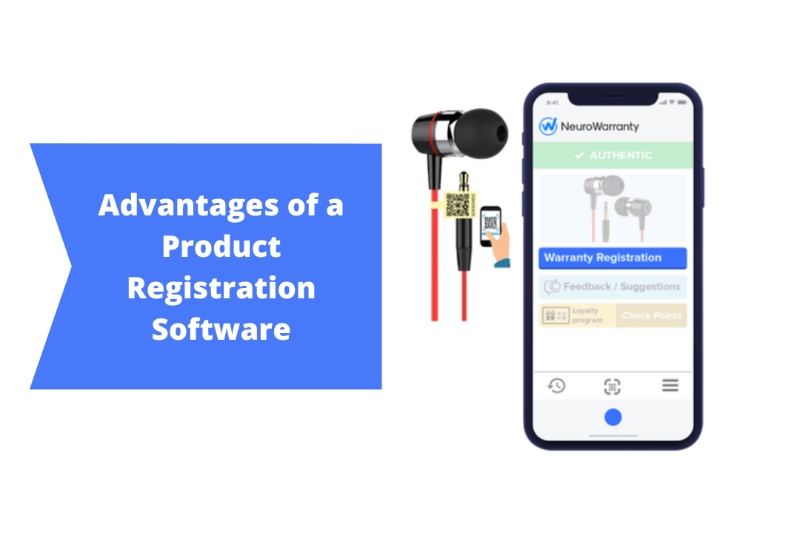
Collect customer data
Our product registration software is designed to collect data from your customers as they register for products. This allows you to create a complete profile of your customers based on their purchase history, allowing you to tailor marketing efforts to keep them coming back.
If you have ever run a loyalty card scheme or any other loyalty reward system then you will know how valuable this information can be when trying to market your products.
The data collected includes name, address, email address, phone number and even some demographic information such as age and gender. This data is then used by the company that has registered it as part of their marketing efforts and can be used by other companies as well.
With our product registration software, you can create an online database which stores all of your customer data so that you do not have to manually enter it each time someone registers for a product.
Automate marketing with a product registration software -
When you use an automated marketing solution, you can automatically send messages out to your customers when they log into their accounts or make purchases through the website. This saves you time and helps keep them informed about new content or promotions that are available at no additional cost or effort on their part.
Increase Customer Loyalty
A product registration software allows you to track your customers’ behaviour and thus, you can stay ahead of the competition. If you have a loyal customer base, chances are that they will return for more.
For example, if you know that customers who buy your product tend to be repeat buyers, then it makes sense for you to offer them special discounts or other incentives. You can also use this information to target new customers by sending them targeted emails.
In addition, product registration software can help you keep an eye on how much each customer spends on your products. If a particular customer spends more than usual, then you may want to send him/her a message explaining why they should get the next version of your product at the same price as the previous one. This way, they will become loyal customers and will continue buying from you in the future.
Registration software can help businesses improve their customer service. It allows them to do more with less by automating processes and streamlining processes that were previously done manually.
**Improve Customer Service**
The best way to improve customer service is to automate it. A product registration software can be used to manage your customer relationship management (CRM) system, which means you can use a single platform to handle all of your customer interactions. As a result, you’ll be able to streamline the entire process of managing customers and their purchases, including:
Contacting them when they have questions or need help with their order
Sending them an email after they place their order in case it needs any additional information or instructions
Receiving payment from customers and processing refunds
The manufacturer's database stores customer and product information directly. They have everything they need to manage claims, repairs, and replacements with ease.
With real-time data at your fingertips, you can simply track the status of each claim, keeping consumers informed and significantly improving satisfaction.
**_[Know the top 5 product registration software of 2022](https://www.neurowarranty.com/blog/the-top-5-best-product-registration-software-cl3889nwi22491kqbrck49rxi)_**
**Protection from online fraud**
**** In the age of cybercrime, it is wise to consider protecting your brand. If a product registration software can ensure that all products are registered with the right serial number and name, then you are less likely to suffer from online fraud. This means that if someone tries to register a fake product with your company's name, they will be blocked by the software before they even get started.
**More than just protection -** A product registration software can also help in other ways. It can be used to track down missing shipments and ensure that every single product is accounted for. This not only helps you avoid bad publicity but also makes it easier for you to track down any issues with your suppliers or customers down the line.
**Collect Customer Feedback**
Customer feedback is the most important part of any business. It helps determine what products and services you should offer, how to communicate with your customers, and even what your brand needs to look like.
With product registration software, collecting customer feedback is easy. Most of these tools allow you to send an email or text message directly to your customers after they have purchased your product.
This allows you to collect feedback from them before they return the product so that you can improve its quality in future batches.
A product registration software will help you increase customer retention by providing them with a wide range of tools that can be used to register their products.
By allowing your customers to register their products, you are ensuring that they stay on board and continue to interact with your business. This is because they will be able to keep track of their orders and know where their products are in the process.
**Increase Repeat Sales with the NeuroWaarranty product registration software -**
Product registration software can help increase customer retention, and improve customer satisfaction and loyalty.
As customers tend to become familiar with your brand, product registration software can be a great way to keep them coming back for more.
Product registration software also allows you to provide customers with a seamless experience by storing customer data in one place — no need for multiple forms or complicated processes.
This reduces the amount of time it takes for customers to complete their orders and makes it easier for you to manage orders going forward.
Product registration software can also make it easier for you to engage with customers by allowing them to track their orders without having to log in each time they visit your website or app. This helps increase customer retention because it keeps them on track and encourages repeat purchases (which increases revenue).
We hope the information provided here has been helpful. We encourage you to further research this topic on your own and use it as a guide when deciding whether a product registration software is right for your business. [Click here](https://www.neurowarranty.com/product-registration-software) **to know the NeuroWarranty product registration software can help you boost your repeat sales by 28%.**
It's easy to see how product registration software will continue to gain popularity in the coming years, especially with emerging consumer brands and the growing popularity of the D2C model.
---
This blog is powered by Superblog. Visit https://superblog.ai to know more.
---
## Here is how you can increase repeat sales by 180% using customer data.
Author: Abhishek Agrawal
Author URL: https://www.neurowarranty.com/blog/author/abhishek-agrawal
Published: 2022-07-22
Tags: repeat sales, customer data
Tag URLs: repeat sales (https://www.neurowarranty.com/blog/tag/repeat-sales), customer data (https://www.neurowarranty.com/blog/tag/customer-data)
URL: https://www.neurowarranty.com/blog/here-is-how-you-can-increase-repeat-sales-by-180percent-using-customer-data-cl5wewo191015391mqugm7srwvo
A recent study from Hubspot shows that 92% of companies use customer data to grow revenue. The same study also showed that 69% of companies use customer data to improve customer experience.
Customer data is a powerful tool for resellers. It allows you to build up a better picture of your customers so that you can better understand who they are and how you can increase your repeat sales.
When it comes to reselling, it’s important to have a clear idea of who your customer is, so that you can offer them the right solutions for their needs.
Contents
- [Send targeted emails based on customer behaviours](#send-targeted-emails-based-on-customer-behaviours)
- [Increase repeat sales by increasing engagement on social media](#increase-repeat-sales-by-increasing-engagement-on-social-media)
- [Identify the right time to reach out to your customers](#identify-the-right-time-to-reach-out-to-your-customers)
- [Use mobile push notifications to increase repeat sales](#use-mobile-push-notifications-to-increase-repeat-sales)
- [Use customer data to sell D2C](#use-customer-data-to-sell-d2c)
- [Increase repeat sales by creating product subscriptions](#increase-repeat-sales-by-creating-product-subscriptions)
Understand your loyal customers
Customer loyalty is an important factor in building effective reselling. If you know what makes your loyal customers tick, then you can provide them with products and services that meet their needs and increase your repeat sales.
Knowing who your most loyal customers are will help you keep them happy and engaged. These are the people who spend the most money with your company over time, so it makes sense to invest in them heavily.
Customers with high lifetime value (LTV) are worth more than those with low LTV because they're likely to spend more over time as well as refer others to do business with you.
Customer data helps you understand your loyal customers better, their history with your company, and even buying patterns. This information helps you provide them with relevant products and services at the right time and place.
This way, you can identify:
- What products do they like most?
- When they bought from you and how often they buy from you
- Where they are located and what websites they visit
- How much money do they spend with you (and on what)
**Target the right customers with** **personalized** **emails to increase repeat sales**
Target the right customers with personalized emails. Email marketing is one of the most cost-effective ways to reach customers directly and increase repeat sales. But it takes a lot of time and effort to write hundreds of individualized messages.
With customer data, you can tailor your marketing campaigns based on specific interests or purchase histories, making it easier to send relevant emails while spending less time on each message.
For example, if a customer buys only one product from you but never returns for more, send them a message offering another product similar to the one they purchased before — along with an incentive such as a discount or free shipping. This strategy works well because it's personalized and relevant to that customer's needs — which means they'll be more likely to respond positively than if you simply sent them an email with no context whatsoever.
Personalized email marketing is one of the best ways to increase repeat sales. You can increase repeat sales using personalized emails in a number of ways, including:
## Send targeted emails based on customer behaviours
- Create dynamic product recommendations
- Personalize your email subject lines
- Use behavioural triggers like abandoned carts, abandoned forms and more
You should use all of these techniques to improve your email marketing campaigns. But how do you get started? Struggling to access data of your Amazon and retail customers? [**Click here to access data of your end - customers.**](https://calendly.com/aabhishekbindal/neurotags-demo?month=2022-05)
## Increase repeat sales by increasing engagement on social media
Personalized social media marketing is one of the most effective ways to increase repeat sales. Most social media platforms allow you to target ads based on demographics (age, gender), interests (likes) and other information that's already been collected about a user.
You can also target people based on their location or other behaviours — for example, if a user checks out multiple products on your website but doesn't make a purchase, you could send them an ad for one of those products once they've left your site.
You can advertise on social media channels such as Facebook and Twitter to reach these potential buyers with targeted ads that promote products based on their previous purchases or browsing history on your site.
## Identify the right time to reach out to your customers
Identify the right time to reach out to your customers. If you're selling a product or service that's related to an existing one, you may want to wait until the customer has been using it for a while before contacting them with a new offer. This will help ensure that they're familiar with your brand, which makes it more likely that they'll buy from you again.
Identify the right time to resell to your customers. Knowing when customers are most likely to buy is important for any business — but especially if you're reselling products that have a short lifecycle or limited stock.
It's hard enough for customers to make purchasing decisions in the first place, so if you're sending out emails about new products at the wrong time, likely, they won't be interested in what you're offering.
[_**Click here to know how consumer electronics brand Syska increased it's repeat sales by 180%**_](https://www.neurowarranty.com/case-study)
## Use mobile push notifications to increase repeat sales
Mobile push notifications are one way to reach customers on their mobile devices. Using the right messaging, you can encourage them to make another purchase or take advantage of an offer that's only valid for a limited time. These messages can be tailored based on the customer's preferences and past purchases so that they know exactly what they need to do next.
Personalized mobile push notifications are an excellent way to keep in touch with your customers and make sure they never miss out on an opportunity. If you have an e-commerce site, sending personalized notifications about new products or sales can build loyalty among your customers by keeping them informed about new opportunities and discounts.
Struggling to reach your customers on mobile? here is how you can reach your amazon and retail customers directly on their mobile - [Know more](https://calendly.com/aabhishekbindal/neurotags-demo?month=2022-05).
## Use customer data to sell D2C
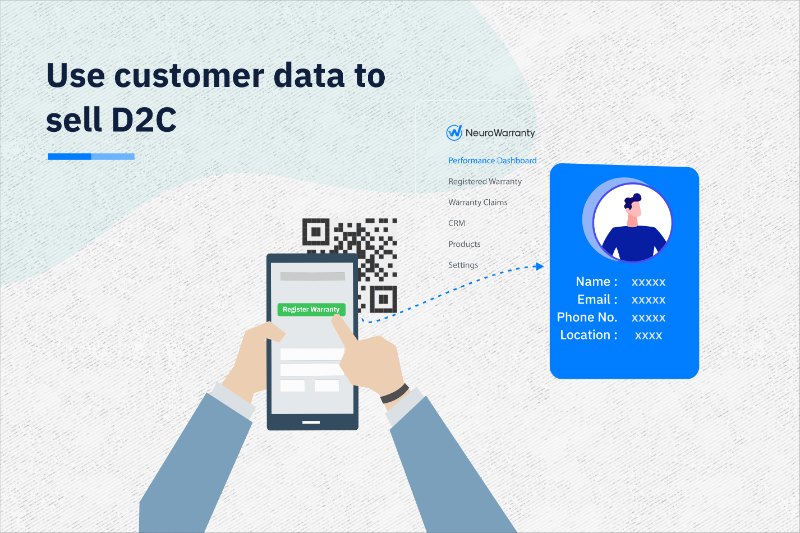
The rise of direct-to-consumer (D2C) brands has been well documented. The ability for companies to connect directly with their customers and offer them experiences they can’t get anywhere else has been a game-changer.
Directly selling from your website is a great way to increase repeat sales, because you don't have to rely on any third-party websites or companies like Google or Facebook for traffic or leads. You also don't have to pay any commissions or fees for providing this service to customers. Want to FastTrack your brands D2C journey? [FastTrack your journey now!](https://calendly.com/aabhishekbindal/neurotags-demo?month=2022-05)
## Increase repeat sales by creating product subscriptions

The most common way to increase repeat sales products is via subscriptions. Subscriptions are a great way to increase your margin and reduce the risk of inventory management.
Subscription models are popular in eCommerce, but they can be tricky to implement. If you don't offer enough value upfront or have unclear policies, customers are likely to churn and cancel their subscriptions.
Customer data can help you avoid these problems and make sure that your subscription program is successful. Here's how you can increase repeat sales using product subscriptions:
Target your customers with personalization. Use customer data to create product bundles and offers that cater to specific needs or interests. You can also use this information to personalize the subscription experience (for example, sending welcome emails with customized tips).
Data of your customers is gold for you, but the majority of consumer brands are unable to leverage data in their remarketing efforts as brands don't simply have access to it.
The biggest roadblock between consumer brands and the data of their end customers is the seller's policy of Amazon and other marketplaces that restrict brand access to the data of their buyers.
However, Brands like Syska, Portronics, Flo and many more have cracked this blockade and can get data of every end customer using NeuroWarranty.
[NeuroWarranty](https://www.neurowarranty.com/) has helped 100s of leading brands to access data of their end customers and increase repeat sales by as much as 180%. To know how your brand can get data of its end customers and boost its repeat sales, book a demo with NeuroWarranty’s solution expert using this link - [**Book a demo now.**](https://calendly.com/aabhishekbindal/neurotags-demo)
---
This blog is powered by Superblog. Visit https://superblog.ai to know more.
---
## Using mobile push notifications to increase repeat sales | Your complete guide
Author: Abhishek Agrawal
Author URL: https://www.neurowarranty.com/blog/author/abhishek-agrawal
Published: 2022-07-07
Tags: Consumer Data Collection, repeat sales, customer retention
Tag URLs: Consumer Data Collection (https://www.neurowarranty.com/blog/tag/consumer-data-collection), repeat sales (https://www.neurowarranty.com/blog/tag/repeat-sales), customer retention (https://www.neurowarranty.com/blog/tag/customer-retention)
URL: https://www.neurowarranty.com/blog/using-mobile-push-notifications-to-increase-repeat-sales-or-your-complete-guide-cl5aug1e6102161po7nu8b82by
Mobile push notifications have become a popular way for businesses to engage with customers. And with good reason: research shows that 82% of consumers prefer to receive mobile messages, and 65% are more likely to purchase after receiving a notification.
But if you’re not using the right strategy for your business, it can be difficult to generate results with push notifications. Mobile push notifications are an effective way to reach your customers, but you need to make sure that you're doing it right. Here are some tips for using mobile push notifications to increase repeat sales.
## How to use mobile push notifications to increase repeat sales -
## Contents - [Get your prospects to opt-in to receive push notifications](\#get-your-prospects-to-opt-in-to-receive-push-notifications) - [Create a well-crafted message basic structure that you use for all your push notifications](\#create-a-well-crafted-message-basic-structure-that-you-use-for-all-your-push-notifications) - [Use simple, clear, and short language when crafting messages to send as a push notification](\#use-simple-clear-and-short-language-when-crafting-messages-to-send-as-a-push-notification) - [Here are some tips for creating effective mobile push notifications:](\#here-are-some-tips-for-creating-effective-mobile-push-notifications) - [Segment and target based on their location - e.g., notifying users of nearby offers and events](\#segment-and-target-based-on-their-location-eg-notifying-users-of-nearby-offers-and-events) - [Location-based targeting:](\#location-based-targeting) - [Interest-based targeting:](\#interest-based-targeting) - [Segment message delivery based on the time of day](\#segment-message-delivery-based-on-the-time-of-day)
## **Get your prospects to opt-in to receive push notifications**
The first step in using mobile push notifications is getting your prospects to opt in to receive them. The best way to do this is by offering them something of value in return for their contact information. This could be anything from a discount on their next purchase or trial period for new products, to exclusive content on your blog or social media pages.
Once you have their contact information, you can begin sending them personalized messages based on their buying patterns and interests. An example would be if someone buys one of your products, they might receive an offer for another product that complements it — like a new accessory or replacement parts for broken ones. Once they've permitted you, you can send them specific messages at different points in the buying cycle to help increase conversion rates and get more repeat sales.
## **Create a well-crafted message basic structure that you use for all your push notifications**
Mobile push notifications are an extremely effective way to get your customers to re-engage with your business.
The key is to create a well-crafted message basic structure that you use for all your push notifications. This way, your customers know what to expect from each type of message and can easily recognize the difference between them.
**Here are some tips to help you do just that:**
1. Define the purpose of your mobile push notifications
2. Use different colours for different types of messages
3. Use icons or images in addition to text
4. Keep messages short and concise
## **Use simple, clear, and short language when crafting messages to send as a push notification**
Mobile push notifications are a great way to keep your customers engaged. They're also a great way to get them back into your store.
But what if you're not sure how to craft the right message?
### **Here are some tips for creating effective mobile push notifications:**
Use simple, straightforward, and short language when crafting messages to send as a push notification. The goal is to get people excited about something without overwhelming them with information.
Consider using an image of the product that you're promoting alongside the text of your message. For example, if you're promoting a sale on women's swimsuits, include an image of one or two suits in your message. This will help convey the value of what you're offering and make it easier for people to understand what they'll be getting if they click through.
Be sure that your message includes a call to action — one that lets users know exactly what they'll get if they click through to your website or app. For example, instead of saying "Get 20% off all swimsuits," say "20% off all swimsuits."
Use simple, clear, and short language when crafting messages to send as a push notification. It’s tempting to use long sentences and complex language in an attempt to sound professional, but this is more likely to confuse your customer than inform them. Think about how you would speak to someone in person if you needed them to do something. If you wouldn’t say it that way, don’t write it that way either!
Don’t send too many messages at once. You want your customers to read each message carefully and act on it when they have time — not get overwhelmed with information they don’t need right now. Send no more than two or three messages per day and make sure they are relevant before sending them out again.
## **Segment and target based on their location - e.g., notifying users of nearby offers and events**
By segmenting by demographics like gender and age or by past purchases or actions taken within the app (such as commenting on an item), you can send more relevant messages that drive engagement among those most likely to respond positively.
Knowing who you’re targeting with your mobile push notifications is important. There are several ways to do this, including:
### **Location-based targeting:**
Send messages based on where customers are located. If they’re near a competitor, send them a message about how much better your business is than theirs. Use location-based triggers so you only push messages when people are near your store or business location (or other places where you want).
### **Interest-based targeting:**
Send messages based on what customers like or don’t like — such as products they browse online or videos they watch on social media platforms like Instagram and Facebook. This lets you target specific groups with relevant messages that will drive them back into stores or online shopping carts.
## **Segment message delivery based on the time of day**
Mobile push notifications can be used as an incentive for customers who are on the fence about making a purchase. If someone has been thinking about buying from you but hasn't made a decision yet, consider sending them a message with an offer that expires soon or another reason why they should buy now before it's too late. This will help build urgency around the purchase and encourage them to act now instead of waiting until later before deciding whether or not to make the purchase.
Segment message delivery based on the time of day. If you know your customer is most likely to open their phone during work hours, send them an offer there. If they're more likely to open their phone after work and on weekends, send them an offer at those times. This will help you increase the number of people who respond to your offers by making them more relevant.
Send offers that align with what people have been looking at or buying recently. If someone was browsing a pair of shoes last week but hasn’t purchased them yet, send them an offer for those shoes again — maybe with a discount or special deal that makes it more tempting to buy now instead of later when they have time to shop around again.
If you're not using push notifications to market your business, you're missing out on a huge opportunity. Push notifications are a powerful tool for customer retention and repeat sales.
Getting data of your customers is the first step to using mobile push notifications, but at a time when a large number of brands are dependent on marketplaces like Amazon to sell their products, how can your brand get data of your end customers?
NeuroWarranty is your one stop solution that can get you data of both your marketplace(Amazon) and reatil customers. Having worked with the leading consumer brands, NeuroWarranty has helped brands like Syska increase their repeat sales by up to 180%, to know how NeuroWarranty can bring you data of your Amazon and retail customers, [**Book a demo now**](https://calendly.com/aabhishekbindal/neurotags-demo?month=2022-06).
To know more about how your brand can use email marketing and increase repeat sales by up to 180%, read this blog on the [**comprehensive guide to increasing repeat sales.**](https://www.neurowarranty.com/blog/here-is-how-you-can-increase-repeat-sales-by-180percent-using-customer-data-cl3efvrme11991krmpc4ggf7r)
---
This blog is powered by Superblog. Visit https://superblog.ai to know more.
---
## Helping consumer electronics and appliances brands boost their repeat sales [Case Study]
Author: Abhishek Agrawal
Author URL: https://www.neurowarranty.com/blog/author/abhishek-agrawal
Published: 2022-07-01
Tags: Warranty Management, Consumer Data Collection, consumer electronics
Tag URLs: Warranty Management (https://www.neurowarranty.com/blog/tag/warranty-management), Consumer Data Collection (https://www.neurowarranty.com/blog/tag/consumer-data-collection), consumer electronics (https://www.neurowarranty.com/blog/tag/consumer-electronics)
URL: https://www.neurowarranty.com/blog/helping-consumer-electronics-and-appliances-brands-boost-their-repeat-sales-case-study-cl524alru26771kqqk0i7d0l4
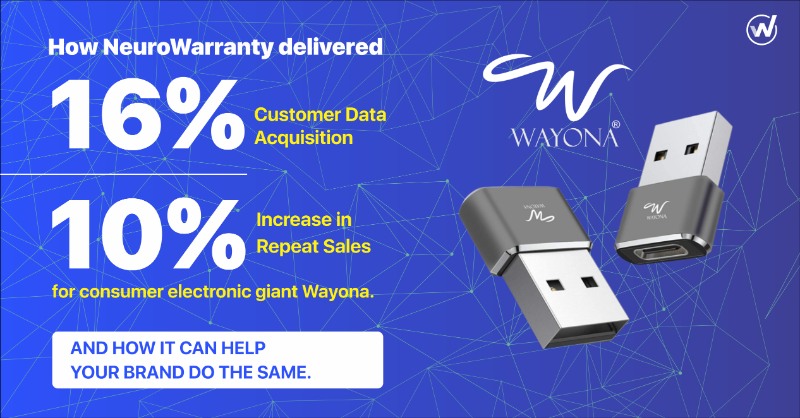
Data of your customers is gold for you, but the majority of consumer brands are unable to leverage data in their remarketing efforts as brands don't simply have access to it.
Contents
- [Introduction - Helping Wayona access data of their end customers.](#introduction-helping-wayona-access-data-of-their-end-customers)
- [What were the issues Wayona was facing?](#what-were-the-issues-wayona-was-facing)
- [What did NeuroWarranty notice?](#what-did-neurowarranty-notice)
- [Challenges faced by Wayona -](#challenges-faced-by-wayona)
- [How did NeuroWarranty help Wayona?](#how-did-neurowarranty-help-wayona)
- [How NeuroWarranty helped Wayona increase their repeat sales?](#how-neurowarranty-helped-wayona-increase-their-repeat-sales)
- [Bringing Wayona data of their end customers -](#bringing-wayona-data-of-their-end-customers)
- [Transforming Wayona's post-sales service -](#transforming-wayonas-post-sales-service)
- [Simplifying customer communications -](#simplifying-customer-communications)
- [Digitizing and automating warranty claims -](#digitizing-and-automating-warranty-claims)
- [The Results?](#the-results)
- [How can your consumer electronics and appliances brand benefit from this solution?](#how-can-your-consumer-electronics-and-appliances-brand-benefit-from-this-solution)
- [NeuroWarranty guarantees -](#neurowarranty-guarantees)
**Are you looking for these features for your consumer electronics brand?**
1. Access to data of your Amazon/ retail end customers
2. Increasing customer engagement
3. Increase repeat sales
4. Automated post-sales service for end customers
5. Elimination of fraud/ expired claims
If yes, NeuroWarranty is a [Warranty Management Software](https://www.neurowarranty.com/) that has helped leading consumer electronics brands like Wayona, Syska, Resqtech, Smartshout, and 100+ leading brands achieve these results in no time.
At a time when repeat sales drive businesses and customer retention has become more important than ever, NeuroWarranty is a solution that can help you boost your repeat sales and increase revenues.
## How did NeuroWarranty enable Wayona to get data of its Amazon and offline customers and boost their repeat sales?
Introduction - Helping Wayona access data of their end customers.
Wayona are market leaders in the Indian consumer electronics and appliances sector,with a diversified product range. Wayona relies majorly on offline retail and Amazon, that are its two major sales channels.
### What were the issues Wayona was facing?
1. Not having access to data of their retail and Amazon customers.
2. Not being able to connect with their customers at scale.
3. Not being able to re-market to existing customers and thus losing valuable repeat business.
4. Hassle in delivering smooth post-sales services for multiple SKUs.
### What did NeuroWarranty notice?
Consumer electronics and appliances brands like Wayona have a high Customer lifetime value, but the inability to remarket to their existing customers results in low retention rates and diminishing profits over time.
## Challenges faced by Wayona -
### **Not being able to remarket to existing customers -**
Consumer electronics brands have a very high customer lifetime value, but not having effective channels for remarketing restricts consumer electronics brands from unlocking the true value of a customer.
Data from Oberlo shows that 80% of businesses consider email marketing as the most effective strategy for retaining customers. The lack of access to customer data like emails and phone numbers made Wayona struggle with their remarketing efforts.
Not being able to target the right segment of customers at the right time resulted in Wayona losing invaluable repeat business.
### **Not being able to connect with their customers at scale -**
Customers, when registered for a warranty claim, wanted constant updates on their claim status, but ensuring that their customers were aware of their warranty claim's status was an expensive and time-consuming process for Wayona.
Absence of a direct communication channel between customers who claim a warranty and customer service teams had forced Wayona to take up the process on-call resulting in additional service costs and reduced profits.
### **Low customer satisfaction rate (post-sales service related) -**
With retail sales becoming increasingly online, the commission rates by marketplaces like Amazon were costing Wayona a large chunk of their profit margins. With commission rates as high as 20%, Wayona was increasingly looking for ways to reduce their dependency on marketplaces like Amazon for their sales.
And even if Wayona was to ignore the high commission rates, Amazon policies like not allowing brands to re-market, not allowing brands to access customer data and [misusing your data to copy your products](https://www.linkedin.com/pulse/amazon-using-your-data-copy-products-connect-customers-before-/?trackingId=ui4bBi%2BUcUXpcq8mGd4UCg%3D%3D) were guaranteed to harm Wayona and affect your sales in the long run.
### **Hassle in managing product warranties for multiple SKUs -**
Wayona was using a **Traditional Warranty Management System**. In the absence of AI and IoT-based tools, it was facing an increase in cost and time elements.
### **Result?**
1. Huge time investment in the claim settlement process.
2. Increased warranty frauds due to reliance upon paperwork. And we know how manual data recording is prone to errors.
## How does NeuroWarranty help brands?
## **How did NeuroWarranty help Wayona?**
Wayona's search for a suitable solution led them to NeuroWarranty. Wayona realized soon enough that this was the most cost-effective, robust solution that could even cater to their massive distribution network without additional effort in the minimum time frame.
With NeuroWarranty, customers of Wayona can simply scan the tag placed inside the package to register for a warranty and track and manage it digitally.
The scan gathers relevant consumer data for Wayona, which is being leveraged in several innovative ways to resell, cross-sell and upsell to existing customers. The digitization even consolidated all data in one place, connecting thousands of Wayona service centers across the country.
> NeuroWarranty is your one stop solution that can get you data of both your marketplace(Amazon) and reatil customers. Having worked with the leading consumer brands, NeuroWarranty has helped brands like Syska increase their repeat sales by up to 180%, to know how NeuroWarranty can bring you data of your Amazon and retail customers, [**Book a demo now**](https://calendly.com/aabhishekbindal/neurotags-demo?month=2022-06).
## **How NeuroWarranty helped Wayona increase their repeat sales?**
### **Bringing Wayona data of their end customers -**
Wayona knew that the consumer electronics and appliances market is filled with competitors trying to attract customers, and consumers of this segment are always open to trying out new brands. Hence their ability to retain customers will determine their profitability in the long run.
[Did You Know: A 5% Increase in Retention Increases Profits by Up to 95%Bain and Company](https://www.bain.com/insights/retaining-customers-is-the-real-challenge/)
Consumer electronics brands like Wayona struggled to remarket effectively, as their sales channels (retail and marketplaces like Amazon) did not give them the end-customer data needed to reach the customers.
NeuroWarranty helped Wayona by giving them complete access to the personal data of every registered customer including Names, Email Ids and Phone Numbers.
**NeuroWarranty was able to deliver a 16% customer data acquisition for Wayona and as end-customers get used to the solution, customer data acquisition for Wayona is expected to be as much as 20%.**
Access to data of its Amazon and retail customers allowed Wayona to reengineer its remarketing strategy and achieve a 10% increase in repeat sales.
_[Get data of your Amazon and other marketplace customers now!](https://calendly.com/aabhishekbindal/neurotags-demo?month=2022-07)_
### **Transforming Wayona's post-sales service -**
NeuroWarranty replaced Wayona's traditional paper-based warranty with a [QR code-based digital warranty.](https://www.neurowarranty.com/blog/warranty-management-app-reduce-costs-and-automate-your-product-warranties-cl1g7op6l65941jlfkyb2vlqj) The new warranty software allowed Wayona to deliver an unparalleled customer experience across all touchpoints.
**How was the consumer electronic brand's post-sales service improved?**
1. Customers no longer had to go through the hassle of finding old bills and warranty cards to claim a warranty.
2. Customers could track the status of their warranty claim in real-time.
3. Using the Inbuilt CRM customers can communicate directly with customer support executives to solve their queries.
4. In case of improvements are needed, customers can have the reviews and feedback acknowledged leading to an increase in customer engagement.
### **Simplifying customer communications -**
Wayona had identified the need to be customer-centric, they needed to connect with their end customers at scale to provide an unparalleled customer experience.
NeuroWarrnty's Inbuilt CRM helped Wayona manage all their post-sales customer communications on a single dashboard. The simplified customer interaction helped Wayona reduce customer complaints calls and help tickets while reducing their customer service costs by 30%.
NeuroWarranty also helped Wayona increase their customer engagement by enabling them to respond to individual customer queries and acknowledge customer feedback and reviews.
### **Digitizing and automating warranty claims -**
NeuroWarranty replaced Wayona's traditional warranty with a QR code-based Digital Warranty Solution. With the process of 'NeuroTagging', NeuroWarranty not only helped Wayona automate its warranty but also made product serialization more effective for an improved supply chain management.
Customers of the Consumer Electronics and appliances brand no longer had to secure old purchase bills and warranty cards to claim a warranty, which was one of the main reasons for rejecting warranty claims as warranty cards get easily misplaced. The [automated warranty claims process](https://www.neurowarranty.com/blog/warranty-management-app-reduce-costs-and-automate-your-product-warranties-cl1g7op6l65941jlfkyb2vlqj) resulted in a 70% decrease in warranty processing costs for Wayona.
## The Results?
1. 8% customer data acquisition in the first quarter. 16% customer data acquisition in this quarter. As end customers get used to the solution, customer data acquisition for wayona is expected to touch 20% by the next quarter.
2. 5X customer engagement compared to other consumer electronics brands allows Wayona to connect with their customers at scale and build a long-term relationships.
3. 10% increase in repeat sales due to the combing effect of transformed customer service and personalized data-driven remarketing strategy.
4. 300% increase in customer participation in the warranty program as products across SKUs were digitized.
5. 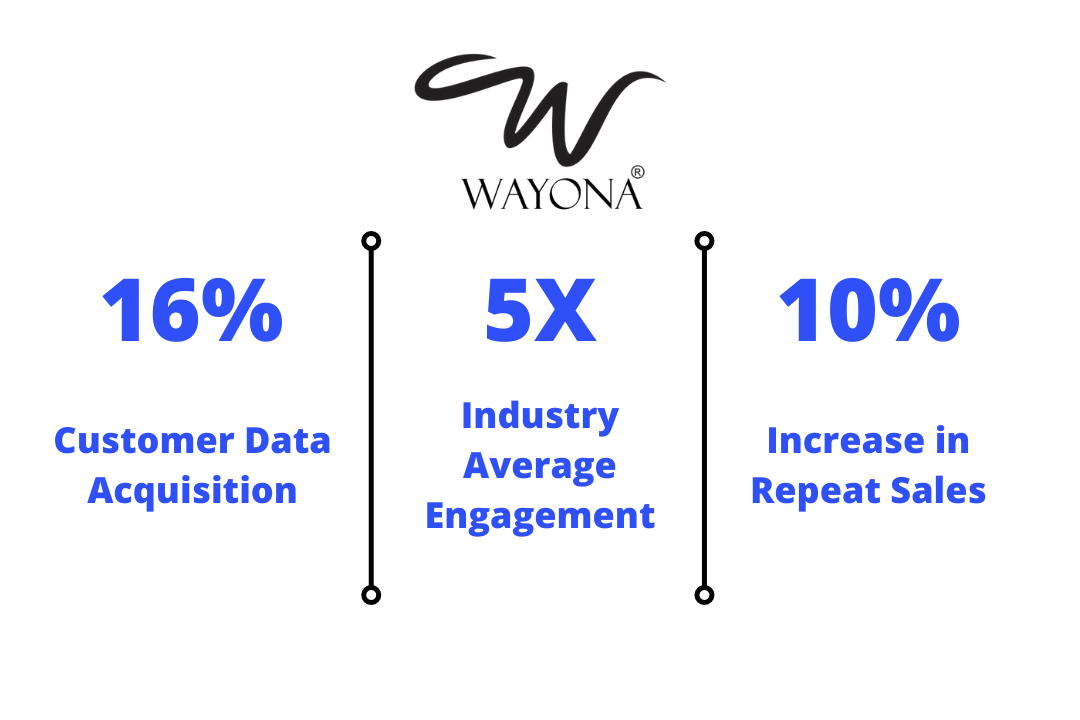
## **How can your consumer electronics and appliances brand benefit from this solution?**
NeuroWarranty's [warranty management software](https://www.neurowarranty.com/) is helping Wayona, Syska, Resqtech, Smartshout and 100+ leading brands increase their repeat sales by transforming their post-sales services.
**What are you waiting for?**
Make Digital Warranty Management System your Strategic Advantage!
**_[Check out the list of the best warranty management solutions for the year 2022.](https://www.neurowarranty.com/blog/5-best-warranty-management-software-in-2022-ckzqvwn3k169851llanw48z6yo)_**
### NeuroWarranty guarantees -
1. Increase in revenue and profit
2. Up to 25% increase in repeat sales.
3. Up to 90% decrease in warranty-related costs.
4. 100% Reduction in fraudulent warranty claims
5. Data of your Amazon, Flipkart and retail end customers
6. 5X customer engagement compared to your competitors.
7. Kickstarting your D2C journey.
A 10% increase in repeat sales is an astonishing number in the electronics and appliances industry and can increase your profits by as much as 180%, want to achieve the same for your brand?
Get a free product demo to know how NeuroWarranty can help you do it. [**Book A Demo Now.**](https://calendly.com/aabhishekbindal/neurotags-demo?month=2022-07)
---
This blog is powered by Superblog. Visit https://superblog.ai to know more.
---
## Your complete guide to using social media to increase repeat sales
Author: Abhishek Agrawal
Author URL: https://www.neurowarranty.com/blog/author/abhishek-agrawal
Published: 2022-06-27
Tags: repeat sales, customer retention
Tag URLs: repeat sales (https://www.neurowarranty.com/blog/tag/repeat-sales), customer retention (https://www.neurowarranty.com/blog/tag/customer-retention)
URL: https://www.neurowarranty.com/blog/your-complete-guide-to-using-social-media-to-increase-repeat-sales-cl4w4udpd22211jmrtmpy3pkb

If you want to increase your business' repeat sales, then social media can be a great place to do so.
A study of 6,500 retailers found that customers who used social media paid 65% more than those who didn't. Social media is a great way to increase brand awareness and customer loyalty. It's also easy to drive traffic to your store online and build a following of people who love the products you sell.
A good social media presence also helps create a sense of trust with consumers, which is essential for repeat sales.
**This is how you can use social media to increase repeat sales -**
## **Identify your target audience.**
The first step in social media optimization is to identify the target audience you want to reach. You can do this by using tools like Nielsen's Digital IQ, Google Analytics and Facebook Insights to get a better understanding of who they are and what they like.
Once you know your customers, you can create custom content that will resonate with them. If you're selling products, it may make sense for you to share content about how-to videos or how-to guides for your customers' favorite products. If you sell services, it might be wise to share tips on how to get hired by a particular company or industry-specific resources.
If none of these ideas appeals to your business, there are still plenty of ways that social media can help increase sales! Just remember: if it doesn't resonate with your customer base, it probably won't work for your business either!
## **Showcase your brand personality and humanize your brand.**
It's not just about creating content that is relevant to your audience. It's also about creating content that is relevant to you.
If you are a small business owner, it's important that you know your brand and how to communicate it effectively. This can be a challenge when you have limited resources and time. But it's also an opportunity to stand out among the crowd by promoting your company in a way that makes people want to buy from you again and again.
The best way to do this is by showcasing who you are as a brand, what your values are, and how your products or services fit into the lives of your customers. This will help you humanize your brand and make it more relatable for those who may not know much about it yet.
Part of the reason people buy products and services is that they trust the company behind them. The people running a company have to be a part of the conversation, and they need to be able to express themselves in a way that resonates with their customers.
### **Engage your audience.**
Brand engagement is one of the most important things to keep in mind when you’re thinking about social media marketing. You don’t have to have a large following or even a large following at all, but if you do have an audience, you want to make sure you’re engaging with them.
To get started, think about some of the questions that you hear from customers and prospects regularly. Do they have questions about your product or service? Are they asking for recommendations? What are they saying in their reviews? If you can answer those questions, then it should be easy for you to find content that will help engage your audience and provide value to them.
## **Use social media as a customer service tool.**
Social media is not just for brands to be seen, it's also for the customers to leave reviews, ask questions and provide feedback. By using social media for customer service, you can help lower your company's churn rate by providing outstanding service to your customers.
**Some examples of ways you can use social media to improve customer service:**
Connect with past customers and build relationships. If they have a problem with their order or if they want more information about something that you're selling, make sure that they know how to contact you directly on social media so that they don't end up calling or emailing in frustration.
Answer questions quickly and efficiently. If someone asks a question on social media (or elsewhere), be ready with an answer right away. This will give them confidence in your business and make them feel valued as a customer. It also shows that you are willing to stand behind what you sell — something that will resonate with many potential buyers who may otherwise be turned off by poor customer service.
## **Use paid advertising**
The best way to increase repeat sales is to use paid advertising. You can advertise on social media sites, but not all social networks are created equal. You want to look for the ones with the highest engagement rates, the most active communities, and a good reputation from other businesses in your industry. Use paid advertising.
Pay-per-click (PPC) advertising is one of the most potent ways to increase your sales, and it's relatively cheap to set up. All you need is a good keyword research tool and a budget for ads that run on Google and Facebook.
Facebook ads are the most effective way to drive traffic to your store, but they do require some work on your part. You'll want to create unique content for each ad campaign, which may take you some time.
If you're just getting started with PPC, here are some tips:
1) **Choose keywords appropriately** — this is where keyword research comes in handy. If you're not familiar with how search engines work or how people search for products online, then don't worry about it too much at first — just choose keywords that seem relevant to your product and its target audience, and keep an eye out for them when researching your competitors' products or topics in general.
2) **Write compelling copy for each ad**— this is what will get people clicking on your ads! The copy should be short and sweet but still, convey the message. Don't use too many words; aim for three sentences max per ad.
By creating campaigns with a consistent and unique voice, brands can establish trust through social media. This voice is what keeps customers coming back again and again, eager to see what the brand will share next. By cultivating a strong social presence that consumers want to be a part of, brands can ensure ongoing participation and engagement, which will help drive repeat sales.
Social media is all about interaction, engagement and building relationships. Therefore, to cope up with the current trend due to social media, that is Make-Brands-Interactive-Now and Make-Brands-Engaging by using social media.
Build your audience on social networks, focus on cultivating genuine interactions to gain loyalty & positive brand image in the minds of users and do not forget that word of mouth still remains the best source for your business or products. So brands now can easily connect with the buyers or clients by fast growing Social Media Marketing through Facebook, Twitter, YouTube etc.
To know more about how your brand can use social media and increase repeat sales by up to 180%, read this blog on the [comprehensive guide to increasing repeat sales.](https://www.neurowarranty.com/blog/here-is-how-you-can-increase-repeat-sales-by-180percent-using-customer-data-cl5wewo191015391mqugm7srwvo)
---
This blog is powered by Superblog. Visit https://superblog.ai to know more.
---
## Your complete guide to using personalized email campaigns to increase repeat sales
Author: Abhishek Agrawal
Author URL: https://www.neurowarranty.com/blog/author/abhishek-agrawal
Published: 2022-06-03
Tags: repeat sales, customer retention
Tag URLs: repeat sales (https://www.neurowarranty.com/blog/tag/repeat-sales), customer retention (https://www.neurowarranty.com/blog/tag/customer-retention)
URL: https://www.neurowarranty.com/blog/your-complete-guide-to-using-personalized-email-campaigns-to-increase-repeat-sales-cl3ygjgkd34211oobpfg68kj6

A personalized email campaign is a specific type of segmented email marketing that can help you increase repeat sales.
The idea behind personalized email campaigns is to send automated emails to customers who have already purchased from your company. This is done by creating an automated email sequence that will be sent to each customer after they have made their first purchase to increase repeat purchases.
Personalized email campaigns allow you to connect with the customer on a one-on-one basis, which can help drive repeat sales and increase customer retention.
Contents
- [Segment email campaigns to boost repeat sales](#segment-email-campaigns-to-boost-repeat-sales)
- [How can you segment your audience? Here are three ways:](#how-can-you-segment-your-audience-here-are-three-ways)
- [Segment customers based on purchase history:](#segment-customers-based-on-purchase-history)
- [Segment customers based on online behaviour:](#segment-customers-based-on-online-behaviour)
- [Segment customers by demographics:](#segment-customers-by-demographics)
- [Create an automated personalized email sequence to increase repeat sales](#create-an-automated-personalized-email-sequence-to-increase-repeat-sales)
- [Use abandoned cart emails to encourage immediate sales](#use-abandoned-cart-emails-to-encourage-immediate-sales)
- [Include personalized product recommendations in all emails](#include-personalized-product-recommendations-in-all-emails)
- [A/B Test and optimize your emails based on effectiveness](#ab-test-and-optimize-your-emails-based-on-effectiveness)
## **Segment email campaigns to boost repeat sales**

Segmented marketing is one of the most cost-effective ways to acquire new customers and increase repeat sales. Segment customers into groups based on their behaviour and preferences. You can then send targeted offers based on what they have bought in the past or what they have shown interest in. For example, if someone has purchased a mobile phone from you in the past, they may be interested in other items that would go well with this purchase.
Personalized email campaigns are an effective way to get customers to buy again from you.
To get started with personalization, you first need to segment your audience into groups based on their behaviour and preferences. You can then tailor your message to each group's needs, increasing engagement and conversion rates.
### How can you segment your audience? Here are three ways:
### Segment customers based on purchase history:
When it comes to email campaigns, don't underestimate the power of recommending products based on past purchases or browsing patterns. If a customer buys a pair of shoes from you once, they may come back for another colour or style if they see it in their inbox.
### Segment customers based on online behaviour:
Personalized emails aren't just about what people buy; they're also about how they behave online — what websites they visit and how frequently they use them, how often they open emails from you and how many links they click through. All this data can help tailor messages that resonate with specific groups of people.
### Segment customers by demographics:
Perhaps your company wants to target men vs women or millennials vs baby boomers (or any other demographic).
Getting data of your customers is the first step to building any segmented campaign, but at a time when a large number of brands are dependent on marketplaces like Amazon to sell their products, how can your brand get data of your end customers?
## **Create an automated personalized email sequence to increase repeat sales**
With the right email automation in place, you can create a personalized email sequence that will automatically send out new products and deals to your existing customers to increase repeat sales.
**Here's how you can set an automated personalized email sequence to increase repeat sales -**
First, you set up an automated email campaign based on a trigger. Triggers are criteria — like when a customer purchases an item or reaches a certain point in their purchase history — that tell your email automation software when to send out an email. For example, if you have a customer who has purchased several times before and hasn't made a purchase in over 30 days, you can have your software send them an email offering 20% off their next purchase.
Next, you set up what's called an "autoresponder." When someone receives an autoresponder message in their inbox, they'll see different messages based on what triggered them (their purchase history or another criterion). Each time they receive another message in that sequence, they'll see different content based on the same trigger (for example, if they respond to one of those emails).
## **Use abandoned cart emails to encourage immediate sales**
According to a study by the Baymard Institute, 68% of shopping carts are abandoned before they’re completed, which means you could be losing out on potential sales.
This is where an abandoned cart email comes in: it’s a last-ditch attempt to get customers who have decided against completing their purchase to reconsider.
Here are some tips for how to use abandoned cart emails more effectively:
1. Target your audience
2. Include something unique about the product or service that was abandoned
3. Include a discount or free shipping offer that’s specific to the item(s) left in the cart and only available through this email campaign
4. Offer free shipping with no minimum order commitment
## **Include personalized product recommendations in all emails**
Personalized product recommendations are a great way to encourage repeat purchases by showing off the products that customers have previously purchased or looked at on your website. This is a great way to get people to buy more from you, as they will already have an idea of what they like from their previous purchase history.
You can generate customer profiles based on past purchases and other data points. This can include demographic information (age, location, gender), behavioural data (purchase history, browsing habits), or even psychographic information (personality traits).
Using these profiles to send personalized product recommendations with every email campaign can provide a significant boost to your repeat sales.
## **A/B Test and optimize your emails based on effectiveness**

Once you've designed your email template, it's time to test it. Test your segmentation and subject lines, and make sure there are no issues with content delivery or image sizes. Once you know that everything is working properly, A/B test the different variations of your email to see what works best.
Make sure you're tracking metrics like open rate and click-through rate (CTR) so that you can determine which version is generating more responses from your audience. If a certain version has a lower open rate but higher CTR, then it's worth continuing to send that version versus the other one.
If you take the time to personalize your emails, you will be rewarded with repeat sales from beloved customers. You can use personalized emails to increase repeat sales and retain customers. Personalized emails have been proven to bring as much as a 75%increase in repeat sales.
Getting data of your customers is the first step to building any segmented campaign, but at a time when a large number of brands are dependent on marketplaces like Amazon to sell their products, how can your brand get data of your end customers?
NeuroWarranty is your one stop solution that can get you data of both your marketplace(Amazon) and reatil customers. Having worked with the leading consumer brands, NeuroWarranty has helped brands like Syska increase their repeat sales by up to 180%, to know how NeuroWarranty can bring you data of your Amazon and retail customers, [**Book a demo now**](https://calendly.com/aabhishekbindal/neurotags-demo?month=2022-06).
To know more about how your brand can use email marketing and increase repeat sales by up to 180%, read this blog on the [comprehensive guide to increasing repeat sales.](https://www.neurowarranty.com/blog/here-is-how-you-can-increase-repeat-sales-by-180percent-using-customer-data-cl5wewo191015391mqugm7srwvo)
---
This blog is powered by Superblog. Visit https://superblog.ai to know more.
---
## Here is how building customer loyalty can help you resell effectively
Author: Abhishek Agrawal
Author URL: https://www.neurowarranty.com/blog/author/abhishek-agrawal
Published: 2022-05-30
Tags: repeat sales, customer retention, customer loyalty
Tag URLs: repeat sales (https://www.neurowarranty.com/blog/tag/repeat-sales), customer retention (https://www.neurowarranty.com/blog/tag/customer-retention), customer loyalty (https://www.neurowarranty.com/blog/tag/customer-loyalty)
URL: https://www.neurowarranty.com/blog/here-is-how-building-customer-loyalty-can-help-you-resell-effectively-cl3so1t22831011kpb8yan6fpf

The average retail customer spends about 67% of their money with brands and retailers with which they are already loyal. Customer loyalty is important for any business because it represents a long-term commitment from your customers, increasing the chance that they will stick with you for a longer period.
In addition to helping build trust between your business and customers, loyalty can also help increase repeat sales. Loyal customers are more likely to buy from you again because they have already established a relationship with your brand, which makes buying from you easier than going through the process of selecting another brand.
Contents
- [Customer Loyalty decrease customer acquisition costs](#customer-loyalty-decrease-customer-acquisition-costs)
- [Loyalty means more word-of-mouth marketing and referrals](#loyalty-means-more-word-of-mouth-marketing-and-referrals)
- [Loyal customers spend more](#loyal-customers-spend-more)
- [They help you build a better product](#they-help-you-build-a-better-product)
**It is easier to upsell and cross-sell to loyal customers**
It makes it easier to upsell and cross-sell. When customers trust a brand enough to buy from it again, they are much more likely to purchase other products/services from that brand too. Brands often offer discounts for both first-time buyers and repeat customers on their websites or through in-store promotions. It is easier for them to upsell and cross-sell to loyal customers because they know exactly who will be interested in those products/services based on their previous purchases. To know how your brand can increasing effeciency of your re-marketing campaigns, read this blog on the
## **Customer Loyalty decrease customer acquisition costs**
Customer loyalty decreases customer acquisition costs because it reduces the need for advertising and marketing campaigns that would normally be required to bring in new customers. This means more money in your pocket!
When you are starting and trying to grow your business, one of the most difficult things is - getting new customers. Your marketing costs will be high, and you will need to invest in advertising to reach new customers.
If you have loyal customers who buy regularly from your store, then this reduces the cost of new customer acquisition because they already know about your products and services.
Not only do loyal customers help with cost reduction, but they also increase customer lifetime value (CLV). This means that each customer will spend more money with you over time than a new one would have done if they were not acquired by word-of-mouth or other marketing methods.
## **Loyalty means more word-of-mouth marketing and referrals**
Word-of-mouth marketing is one of the most effective ways to promote your business. According to research conducted by Nielsen, 92% of consumers trust recommendations from friends and family above any other type of advertising. Loyal customers are more likely than non-loyal ones to refer their friends and family members to your business, so it pays off to keep them happy.
Loyal customers will be your biggest advocates if you deliver on your promises and give them the experience they expect and deserve. Loyalty means more word-of-mouth marketing and referrals. Customers who feel like they have a good experience with a business are more likely to tell their friends and family about it, which leads to increased sales.
## **Loyal customers spend more**
Loyal customers are more likely to buy from you again, and they spend more when they do. A study by the Harvard Business Review found that loyal consumers spend significantly more than other consumers — an average of 77 percent more.
They buy more often, and they buy more expensive items. This is because they trust you, so they are willing to spend more money with you. They also have an incentive to buy from you, since they do not have to worry about getting their money's worth. In fact, according to a survey by American Express, 69% of consumers are willing to pay more for brands they trust, and 62% of consumers said they would pay more for products from companies that provide exceptional customer service.
## **They help you build a better product**
The best way to know what your customers want is to listen to them. And loyal customers are the ones who will tell you the truth about your product or service. Loyal customers help you build a better product because they will spend more time using it and provide feedback about what you are doing right and wrong. They are also the ones who will stick with you during hard times.
The more often a customer visits, the more likely they are to give you feedback about what's working (or not working) with your business. And if someone comes back regularly, chances are good that they'll be honest with their feedback — which means that it'll probably be accurate as well! If something isn't up to par, your regular customers will let you know about it — so make sure you listen.
It's no secret that repeat purchases are the goal of any retail business. The most loyal customers are those who buy from you again and again. This is because they have built trust in your brand, which makes them more likely to shop with you than with other companies. And at a time when it is estimated that more than 50% of any brand's total revenue comes from repeat customers, building customer loyalty should be any brand's first focus.
To know more about how your brand can build customer loyalty and increase repeat sales by up to 180%, read this blog on the **[comprehensive guide to increasing repeat sales.](https://www.neurowarranty.com/blog/here-is-how-you-can-increase-repeat-sales-by-180percent-using-customer-data-cl5wewo191015391mqugm7srwvo)**
---
This blog is powered by Superblog. Visit https://superblog.ai to know more.
---
## How can a product registration software benefit your brand
Author: Abhishek Agrawal
Author URL: https://www.neurowarranty.com/blog/author/abhishek-agrawal
Published: 2022-05-06
Tags: Consumer Data Collection, product registration software
Tag URLs: Consumer Data Collection (https://www.neurowarranty.com/blog/tag/consumer-data-collection), product registration software (https://www.neurowarranty.com/blog/tag/product-registration-software)
URL: https://www.neurowarranty.com/blog/how-can-a-product-registration-software-benefit-your-brand-cl2ubkpoy149921kltibabx5kl
Whether you're a small business or large corporation, the ability to track your inventory and manage customer information is critical for success. A Product registration software collects valuable information about each customer, such as their name, email address and any other information they provide during registration. Data, which can then be used to increase repeat sales, manage warranty claims and improve customer satisfaction.
Contents
- [Increase brand loyalty](#increase-brand-loyalty)
- [Improve field services efficiency](#improve-field-services-efficiency)
- [Empower customers](#empower-customers)
- [Automate warranty claims](#automate-warranty-claims)
**Get customer data**

You know you need customer data, but where do you get it from? There are plenty of ways to collect this information, but a product registration software is one of the best options for getting what you need.
Product registration software is a great way to get customer data. You can ask customers to submit their information as they register their product or service with you. You can collect data such as their name, email address and phone number.
When customers register with your brand, they provide their contact information and other details that can help you better understand them and their needs. This information can be used to improve your marketing efforts, build loyalty programs and target content to specific groups of customers.
### **Increase customer lifetime value**

Customer lifetime value (CLV) is the total amount of revenue a company can expect from a single customer over their entire relationship with the company. The CLV metric helps you determine how much you should spend on advertising, acquisition or retention activities in order to maximize profits from each customer.
A Product registration software is an easy way to boost repeat sales. The registration process can collect information about your customers, this data can be used later to send out special offers or newsletters that are personalized and relevant to each customer.
For instance, you could use the details collected during registration to create a mailing list of people who purchased a specific product. When it comes time for a new product launch, you can send out an email blast to all the customers who bought your previous product offering. This way you can target your marketing efforts and ensure that those who want your latest offering receive it first.
### **Increase brand loyalty**

When your customers register with you, they're creating an account. This means they have direct access to their order history and any other information that may be useful to them. If they have any problems or questions, they can always get in touch with you through the same channel as well. This creates an opportunity for further engagement with your customers and helps build relationships between them and your brand.
A good product registration software can help you understand your customers more and create better experiences for them. You can use this data to create better product recommendations based on what people buy together. You can also use it to send out emails that are more relevant to people's needs and interests. This will increase customer satisfaction, which will lead to increased brand loyalty.
### **Improve field services efficiency**

The more information about your customers that you have, the better informed you'll be when dealing with any problems or queries they have. You can use this information to find out which products they like most and provide better customer service based on this knowledge.
Field service management is one of the most important aspects of any business. It is essential to ensure that your customers receive quality service whenever possible. If a customer needs assistance with a product, it is vital for them to be able to contact someone immediately. A product registration software can help you to manage this process more effectively.
**Product Registration Software helps you deliver better customer service -**
Customers expect high-quality goods and services when they purchase goods from your company. Poor customer service can lead to unhappy customers who will spread negative word-of-mouth about your company and its products. This could result in lost sales and lost revenue for your business.
Product registration software helps you deliver better customer service by allowing you to track incidents and complaints in real time, so that they can be dealt with quickly by the right person within your organization (or outsourced). This ensures that you are able to resolve issues before they have time to escalate into something larger.
### **Empower customers**

The product registration software allows you to empower customers by giving them a voice — a place where they can share their opinion about your product or service. This gives consumers an opportunity to interact with the brand, which can be very valuable for companies that want to understand what their customers really think about them and their products.
The product registration software also allows companies to collect feedback from customers. This data can be used as part of an overall marketing strategy, which will help companies understand what their customers want and need, as well as how they prefer to interact with the brand.
### **Automate warranty claims**
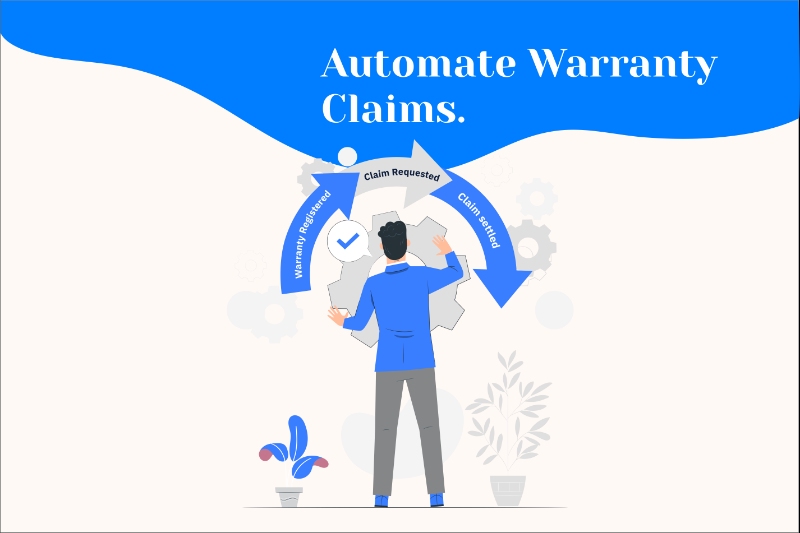
Product registration software helps with warranty claims management by enabling you to gather more accurate data about your products and the customers who purchased them so you can better identify trends and patterns related to product failures or malfunctions that might affect future sales and returns related to those particular products.
Product registration software allows you to track these issues so that when someone calls for assistance, you'll already have all the information about their particular product ready for them when they call for help — no searching required! This can save both time and money for both parties involved in the transaction because it eliminates any unnecessary delays between when someone needs assistance with their product.
Product registration software is a great way to help your brand increase repeat sales. It's also a great way to build customer loyalty and keep customers coming back for more.
---
This blog is powered by Superblog. Visit https://superblog.ai to know more.
---
## How to create a product warranty policy | The complete guide.
Author: Abhishek Agrawal
Author URL: https://www.neurowarranty.com/blog/author/abhishek-agrawal
Published: 2022-04-29
Tags: Warranty Management Services, warranty policy
Tag URLs: Warranty Management Services (https://www.neurowarranty.com/blog/tag/warranty-management-services), warranty policy (https://www.neurowarranty.com/blog/tag/warranty-policy)
URL: https://www.neurowarranty.com/blog/how-to-create-a-product-warranty-policy-or-the-complete-guide-cl2kaiv5l305491kqoi7waoqk9

If you are interested in making your products look trustworthy to consumers, then product warranties may be something you should consider.
Most successful brands have a warranty policy that they offer goods or services. Offering your customers a [product warranty policy](https://www.dyrect.co/warranty-policy-generator) helps build customer confidence and loyalty, increase brand recognition, and it sets you apart from your competitors.
It's important to provide warranties for your products if you want consumers to feel confident about buying them. In this article, we'll walk you through the complete and the only guide you need to create a product warranty policy for your brand.
Contents
- [Consider your competition before creating your warranty policy](#consider-your-competition-before-creating-your-warranty-policy)
- [Set a duration for your product warranty](#set-a-duration-for-your-product-warranty)
- [Explain what is covered under the warranty](#explain-what-is-covered-under-the-warranty)
- [Clearly define what isn't considered a defect and won't be fixed for free](#clearly-define-what-isnt-considered-a-defect-and-wont-be-fixed-for-free)
- [Create a customer support policy](#create-a-customer-support-policy)
- [Invest in a warranty management software](#invest-in-a-warranty-management-software)
- [What should be your next step?](#what-should-be-your-next-step)
### **Identify your legal requirements before creating your warranty policy**

Before you begin writing, check your state's legal requirements for warranty policies. In some cases, your warranty policy may need to be approved by a lawyer. In other cases, you may only need to ensure that it complies with federal and state warranty laws. If you are unsure of your state's requirements, consult a lawyer or a government agency for guidance. Also be sure to look into any industry-specific rules.
Once you have identified all the regulations that apply to your business, examine each one closely. Read them carefully and highlight any important details that come up repeatedly in different documents. You’ll use this information when writing your policy, so make sure it's accurate and up-to-date.
### **Consider your competition before creating your warranty policy**

Let's be honest: the competitors in your market are doing basically the same thing you are. They're selling to a similar audience and offering similar products, so it's natural for you to want to do things a little differently. In fact, it's important that you do things a little differently! If you don't, you'll likely end up losing business to someone with a more appealing product warranty policy.
One of the best ways to differentiate yourself from your competition is to offer a longer warranty period than they do. If everyone else offers warranties of only one year on their products, consider offering two years instead—or even three or five! This will allow potential customers to see that they can get more value from your products than they can from anyone else's.
If you're worried about not being able to afford this type of product warranty policy, remember that it doesn't necessarily have to cover every single product you sell. You could opt instead to offer different types of warranties based on the type of product it is and its retail price.
### **Set a duration for your product warranty**
This is pretty straight forward - you need to think about how long your product should be covered by the warranty. If you're not sure, it's always best to give too much coverage than not enough. Consider what kind of material your products are made from, how long they are expected to last, and what kind of durability tests were performed during manufacturing and development stages. The better the quality of your product, the less need there will be for repairs or replacements due to defects. However, when in doubt, give yourself some leeway so that if any problems arise after the intended lifespan has expired, you can still provide coverage without losing money on the deal
### **Explain what is covered under the warranty**
When you're considering what to include in your warranty, be sure that the coverage is clear, and that it's clearly stated on the packaging. If you're selling a product with multiple components, it's important to be clear about how the warranty applies to each.
The more complicated the technology of your product is, the more complicated its warranty will likely be. It's important for consumers to understand exactly what's covered in case of malfunction. If there are any stipulations—for instance, if a warranty applies only when the product has been used in conjunction with a specific component—be sure to make that explicit.
The consumer needs to know exactly what the warranty covers. For example, you may offer a one-year warranty that covers all parts and labor, but only if the product was used in accordance with its intended purpose. If you sell a product that is meant to be used indoors, but the consumer left it out in the rain, and it broke, then you would not be responsible for fixing it.
### **Clearly define what isn't considered a defect and won't be fixed for free**
As you're creating your warranty policy, be sure to set some boundaries for what is and isn't covered. If you sell something that's prone to damage from lots of use—like a car, washing machine, or kitchen appliance—you'll want to establish up front what kind of damages aren't considered defects by your company.
For example, if the motor in a blender breaks after a year because it was used daily for four hours a day, that probably isn't a defect—but if the motor breaks after only three months of intermittent use because the blades weren't properly aligned and the blender was shook when it was turned on (read: user error), that's probably a defect.
Knowing which damages are definitely not defects can help you avoid being taken advantage of by customers who want something for nothing, but also helps you avoid looking unreasonable when a customer has to pay for repairs that they feel should be covered under warranty. Make it clear what won't be fixed without charge so you can build trust with your customers.
### **Create a customer support policy**
When you create your policy, include a clear explanation of how your customers can get support for their issue. Providing phone numbers and email addresses will help them feel as though they can reach you directly if they need to. It's also a good idea to explain how long it will take to receive a response. You should provide realistic estimates rather than promising a rapid turnaround time that you can't deliver.
If you want to set up a good customer service experience for your customers and make good on the promise of a product warranty, make sure you:
1\. Provide multiple ways for them to get support
2\. Give customers an estimate of how long it will take for them to receive a response
3\. Use available feedback mechanisms so that you can improve your customer service
### **Invest in a warranty management software**
Warranty management can be a daunting task for any company. All too often, managing warranty information is an ad hoc process that relies on the memory of a select few employees. This typically leads to inconsistent customer service, longer repair cycles, and expensive warranty costs. The good news is that by [investing in a warranty management software](https://www.dyrect.co/blog/best-warranty-management-software) like [NeuroWarranty](https://www.neurowarranty.com/), your company can avoid these pitfalls and improve overall customer satisfaction.
[Warranty management software](https://www.dyrect.co/guide/warranty-management-software) will enable you to:
- Track every warranty claim from start to finish
- Keep a history of past claims and repairs
- Identify potential problems with products and services before they become widespread issues
- Determine which warranties are worth pursuing and which ones are not
- Provide better customer service to your clients
- It's not hard to create a warranty policy that will work for your business.
Creating a strong warranty policy not only increases your repeat sales but customers will also be less hesitant to try your product in the first place.
### What should be your next step?
Now that you have formulated a strong warranty policy for your products, you would need an easy to use process to help your customers claim, and help you manage warranty claims. To know how NeuroWarranty can help you automate your warranty claims management [click here](https://www.neurowarranty.com/warranty-management-solution).
---
This blog is powered by Superblog. Visit https://superblog.ai to know more.
---
## Warranty Tracking software: Best ways to track warranty claims.
Author: Abhishek Agrawal
Author URL: https://www.neurowarranty.com/blog/author/abhishek-agrawal
Published: 2022-04-22
URL: https://www.neurowarranty.com/blog/warranty-tracking-software-best-ways-to-track-warranty-claims-cl2af2dl2110381klrrcvz8eci
##
## What is warranty tracking software?
If you are in the consumer goods business, you know that keeping a tab on warranty claims can be a real tough job. The reason is that it is not easy to keep track of all the products that you sell and their warranty details. This could be a painful task and the only way to make it easy is to invest in a warranty tracking software. But this also means that you need to hire a professional developer to make your application.
Today, however, several software companies offer a warranty tracking application that can be bought online. These applications work like a charm and they can help you track warranty claims with ease. Not just that, but they can also help you manage all your customer data in a simple and organized manner. So, the next time when you need to track warranty claims, you can simply check out the warranty tracking application that we have put together for you.
## How does warranty tracking software work?
In many organizations, warranty services and claims procedures are typically handled internally and impact several departments, from the supply chain to customer service.
An advanced warranty tracking software like NeuroWarranty works by first replacing your paper-based warranty processing systems with a digital warranty management solution. Digitizing your warranty management process helps your brand by automating claims management.
A warranty tracking software allows you to handle all your post-sales support requirements from a single screen, thus saving efforts and costs.
NeuroWarranty's warranty tracking software gives you complete access to all your warranty data on easy to understand and customizable dashboards.
NeuroWarranty's smart Analytics dashboards can give you an idea of how your product performs across various geographies and demographics and where you need to improve. This data can help your brand make better decisions in various areas of your business.
## What are the benefits of a warranty tracking software?

A warranty tracking software allows you to handle all your post-sales support requirements from a single screen, thus saving efforts and costs. But there are other benefits an advanced warranty tracking software can deliver for your brand like -
### Improving your customer service -
Data can help you streamline your warranty claims service. Using reports from the analytics dashboards, brands can review the process at scale and figure out new easier processes. Analyzing the data will allow you to look into your post-sales customer service and find out which step the customer finds the most exhaustive and time-consuming.
### Improving your product -
Track warranty data to find out what aspect of the product is triggering the most warranty claims. Warranty data not only allows you to save R&D costs but also allows you to use user-generated data to create an improved customer experience. Warranty data provides direct information about how and when your products fail. With this information, you can identify parts and systems that need improvement. Warranty data will also give you insight into what needs to be improved to reduce failure rates and improve customer satisfaction.
### Streamline customer communication -
Customers, when registered for a warranty claim, want constant updates on their claim status, but ensuring that their customers are aware of their warranty claim's status is an expensive and time-consuming process.
NeuroWarranty's [warranty management app](https://www.neurowarranty.com/), with the help of its inbuilt CRM, sets up a direct communication channel between you and your customers. The customer service teams can manage customer communication on a single interface with minimal effort.
### Help customers track their claim status -
Advanced warranty tracking software not only makes warranty tracking easier for the brands but also enables customers to track and manage multiple claims at once. NeuroWarranty's warranty tracking solution allows customers to claim, track and manage multiple claims on a single screen. Allowing users to track their claim status, helps brands deliver an excellent customer experience and, at the same time, saves costs spent on physical customer communication and support tickets.
We hope you found our blog helpful today regarding the benefits of using warranty tracking software. The NeuroWarranty warranty tracking software allows you to access in-depth analytics of all your product warranties and the personal data of your end customers. If you have any questions about how to use our software or how it can help your business, book a demo according to your convenience [here](https://calendly.com/aabhishekbindal/neurotags-demo?month=2021-09).
---
This blog is powered by Superblog. Visit https://superblog.ai to know more.
---
## Here is how you can stop warranty frauds faced by your brand.
Author: Abhishek Agrawal
Author URL: https://www.neurowarranty.com/blog/author/abhishek-agrawal
Published: 2022-04-15
Tags: Warranty Management, warranty frauds
Tag URLs: Warranty Management (https://www.neurowarranty.com/blog/tag/warranty-management), warranty frauds (https://www.neurowarranty.com/blog/tag/warranty-frauds)
URL: https://www.neurowarranty.com/blog/here-is-how-you-can-stop-warranty-frauds-faced-by-your-brand-cl202i0jv16301ll8aet2xuhl
Worldwide warranty frauds are costing brands roughly 2 - 4 % of their profit shares, and although the number may seem small, as brands increase their sales, a loss of 4% of profit shares can result in huge revenue losses.
Contents
- [What is a Warranty Fraud?](#what-is-a-warranty-fraud)
- [Types of Warranty Frauds -](#types-of-warranty-frauds)
- [Duplicate products:](#duplicate-products)
- [Customer Frauds:](#customer-frauds)
- [Which brands suffer the most from warranty fraud?](#which-brands-suffer-the-most-from-warranty-fraud)
- [How can brands stop warranty fraud?](#how-can-brands-stop-warranty-fraud)
- [Serializing your Products -](#serializing-your-products)
- [Replacing Paper base warranty cards -](#replacing-paper-base-warranty-cards)
- [Save your business from warranty fraud now -](#save-your-business-from-warranty-fraud-now)
## What is a Warranty Fraud?
To understand warranty fraud, a brief background of warranty claims is needed. Warranties are terms of contracts that accompany the sale of most products. Under a warranty, a manufacturer agrees to repair or replace a defective product, subject to certain limitations. Often limitations are directed to time or usage – a 90-day warranty or 50,000-mile warranty, for example.
Warranties can also be subjective to specific conditions laid down by the manufacturer and cover only specific parts of the products rather than the whole product. Brands try to make their warranty policies as vast and as long as possible so as to give their end customers an unparalleled post-sales experience and retain them for future sales.
## Types of Warranty Frauds -
Warranty fraud can be difficult to detect, especially without skilled resources, processes and controls in place -- e.g. internal audit departments, anti-fraud policies, and formal fraud risk assessment. As brands look forward to providing the best customer experience, a lot of such repetitive and fraudulent claims are left in the suspicion stage.
A manual warranty process can lead to several warranty frauds, and as these frauds are mixed with real customers who have lost their warranty cards and need assistance with their claims, it is impossible for brands to differentiate between fraudulent claims and genuine customers.
### Duplicate products:
If customers love your products, there is a high possibility that counterfeit/ look-alike products of yours are floated in the market with your brand name. Your brand name is used by the counterfeit & sell substandard products in your name. This, not only increases your warranty claims, but customers also lose trust in your brand.
### Customer Frauds:
A large chunk of fraudulent claims come from fraudsters who mix up with real customers who end up losing their warranty cards and bills. Also, customers at times intentionally provide an out of the warranty product under claims.
About 10-15 per cent of warranty claims are classified as intentionally fraudulent (as against typos or accidental errors, which are easily detected during verification).
By eliminating fraudulent claims early in the process, you not only save money but also precious time and resources.
## Which brands suffer the most from warranty fraud?
Statistically, consumer electronics and consumer products brands suffer the most from warranty fraud, but it is not a common cause for brands across segments.
Brands that have a digital warranty solution have managed to reduce their fraudulent warranty claims to less than 0.1% and brands that continue to use a manual warranty process face a disproportionate amount of fraudulent claims.
The reason is, that brands that use a manual warranty have no process of differentiating between fraudulent and genuine claims. And in order to not dissatisfy real customers, they end up giving a warranty to a large number of counterfeit products.
## How can brands stop warranty fraud?
Warranty fraud detection is undertaken by brands to ensure that they are only covering legitimate warranty claims. Brands can detect fraudulent claims by replacing their manual paper-based warranty process with a [QR code-based warranty management solution](https://www.neurowarranty.com/).
**A digital warranty solution works by**
### Serializing your Products -
You should serialize your products so that every product can be uniquely identified and tracked at any point in the supply chain.
The benefits of serializing are when any product comes for warranty claims, you can track details like when was the product manufactured and who was the supplier/ OEM. This will help in tracking which supplier is using the wrong product.
### Replacing Paper base warranty cards -
An advanced [digital warranty solution](https://www.neurowarranty.com/) like NeuroWarranty replaces your paper-based warranty cards with unique QR codes which are placed inside the product packaging. Scanning the QR code takes the users to a web app that allows them to upload their purchase claims, authenticate their purchase and register a warranty for future claims.
This process, makes it impossible for warranty fraudsters or for people with counterfeit products to register for a warranty claim as the web app is only accessible by scanning the QR code (The QR codes are managed by the brands from the back end)
## Save your business from warranty fraud now -
Warranty fraud does not just save your business money in fraudulent repairs and replacement parts. Eliminating warranty fraud makes your warranty processing more efficient. Further, without fraudulent claims distorting your statistics, you will be able to focus on failures that truly are occurring, thereby improving product quality. NeuroWarranty has helped 100s of leading brands like Syska, JCB, and Escorts, among many others, stop warranty frauds and safeguard their brand image.
**_To know how NeuroWarranty can stop warranty frauds faced by your brand, book a demo now. [Book a demo now.](https://calendly.com/aabhishekbindal/neurotags-demo?month=2022-04)_**
---
This blog is powered by Superblog. Visit https://superblog.ai to know more.
---
## What can a warranty management app deliver for your business?
Author: Abhishek Agrawal
Author URL: https://www.neurowarranty.com/blog/author/abhishek-agrawal
Published: 2022-04-08
Tags: Warranty Management, warranty management app
Tag URLs: Warranty Management (https://www.neurowarranty.com/blog/tag/warranty-management), warranty management app (https://www.neurowarranty.com/blog/tag/warranty-management-app)
URL: https://www.neurowarranty.com/blog/what-can-a-warranty-management-app-deliver-for-your-business-cl1q5hu2t156851inzcsyf9727
When companies first started offering guarantees on their products, it was a terrific way to boost revenues and gain customer loyalty.
However, as the number of claims has progressively increased over time, managing the warranties to improve customer satisfaction has proven to be problematic.
Contents
- [Stop warranty frauds -](#stop-warranty-frauds)
- [Streamline customer communication -](#streamline-customer-communication)
- [Get customer data -](#get-customer-data)
- [Automate warranty claims management -](#automate-warranty-claims-management)
- [Get market/ product insights -](#get-market-product-insights)
## **Stop warranty frauds -**
If customers love your products, there is a high possibility that counterfeit/ look-alike products of yours are floated in the market with your brand name. Your brand name is used by the counterfeit & sell substandard products in your name. This not only increases your warranty claims, but customers also lose trust in your brand.
Using the NeuroWarranty app, when any product comes for warranty claims, you can track details like when the product was manufactured and who was the supplier/ OEM. This will help in tracking which supplier is using the wrong product.
[Stop warranty claim frauds faced by your brand now](https://www.neurowarranty.com/blog/here-is-how-you-can-stop-warranty-frauds-faced-by-your-brand-cl202i0jv16301ll8aet2xuhl).
## **Streamline customer communication -**

Customers, when registered for a warranty claim, want constant updates on their claim status, but ensuring that customers are aware of their warranty claim's status is an expensive and time-consuming process for brands.
Absence of a direct communication channel between customers who claim a warranty and customer service teams forces brands to take up the process on-call resulting in additional service costs and reduced profits.
At the same time, collecting feedback and reviews from your end customers can prove to be a rather complicated task, notably for consumer product brands. Using Customer Relationship Management (CRM) software, your end customers can connect directly with your client servicing teams to communicate and register their feedback.
While buying separate CRM tools can be expensive and difficult to manage, you can save tons of money spent on buying additional CRM tools. Digital [warranty management solutions](https://www.neurowarranty.com/) like NeuroWarranty come with inbuilt CRMs and allow your customer support executives to manage the entire post-sales experience from a single screen.
## **Get customer data -**
Customer data is the biggest advantage for businesses, whether it be for online or offline marketing campaigns. It facilitates the retention of existing customers when utilized for loyalty programs and acquires new customers for other products through effective marketing strategies like promotion and cross-selling.
Customer data is a gold mine for any business and is the biggest advantage that they could have. Businesses use it to help them retain their existing customers by utilizing a loyalty program and acquiring new customers for their other products through a cross-selling strategy. They can also use customer data to tailor every online marketing campaign to their existing customers to increase their return rates. Customer data can be used to promote businesses in a way that's more personal because it's like having a relationship with every customer.
[Get data of your Amazon and other marketplace customers now](https://www.neurowarranty.com/collect-offline-consumer-data).
NeuroWarranty's [warranty management app](https://www.neurowarranty.com/blog/warranty-management-app-reduce-costs-and-automate-your-product-warranties-cl1g7op6l65941jlfkyb2vlqj) specializes in delivering end-customer data to brands, and at the same time, helps brands build a profitable interaction with their customers. To know how NeuroWarranty helped market leader Syska increase profits by harnessing customer data read the complete case study [here](https://www.neurowarranty.com/blog/warranty-management-solution-for-the-consumer-electronics-industry-case-study-cl027nbcy55861pm8ipb99ulw).
## **Automate warranty claims management -**
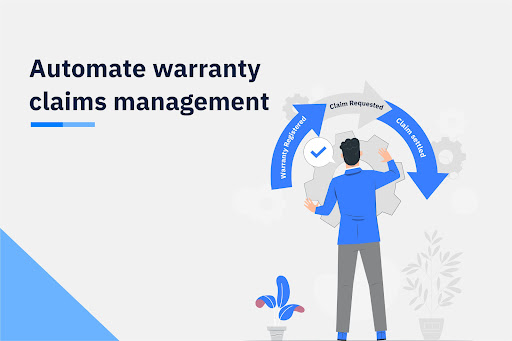
Traditional warranty management processes are manual and labour intensive, thus driving up costs. Automating the warranty process with the NeuroWarranty App allows you to reduce your dependency on customer support executives and reduce customer support costs. Automating the process allows brands to manage a large number of warranty claims at once on a single screen, thus cutting down the operational cost significantly.
## **Get market/ product insights -**

Warranty Applications equipped with intelligent dashboards offer relevant insights for better decision-making. There are many reasons why you would want to equip your business with a warranty management app. One of them is because they give you unique insights into the performance of your product in the field.
Analytics dashboards can give you an idea of how your product performs across various geographies and demographics and where you need to improve. This data can help your brand make better decisions in various areas of your business.
With the right warranty analytics in place, businesses can save time, money, and resources and make better decisions. When selecting a warranty management app, it's important to find an app that can offer you the right warranty analytics. The application should be able to provide the right services that fit your needs and is optimized your business.
[**_Check out the list of the best warranty management apps for the year 2022._**](https://neurowarranty.com/blog/5-best-warranty-management-software-in-2022-ckzqvwn3k169851llanw48z6yo)
**Trusted by 100s of leading brands including - Syska, JCB, ResQtech,** NeuroWarranty is a QR Code-based warranty management software that is easy to implement yet extremely powerful. Customers can register for a warranty by simply scanning a QR code placed on your product and entering the purchase details.
You can sign up for the [warranty management app](https://www.neurowarranty.com/) by scheduling a demo and getting a free 14-day trial here - [get a demo](https://calendly.com/aabhishekbindal/neurotags-demo?month=2022-02) when you schedule a demo, an account manager will contact you and organize a call to discuss your business requirements.
---
This blog is powered by Superblog. Visit https://superblog.ai to know more.
---
## Warranty Management App - Reduce costs and automate your product warranties.
Author: Abhishek Agrawal
Author URL: https://www.neurowarranty.com/blog/author/abhishek-agrawal
Published: 2022-04-01
Tags: Warranty Management, warranty management app
Tag URLs: Warranty Management (https://www.neurowarranty.com/blog/tag/warranty-management), warranty management app (https://www.neurowarranty.com/blog/tag/warranty-management-app)
URL: https://www.neurowarranty.com/blog/warranty-management-app-reduce-costs-and-automate-your-product-warranties-cl1g7op6l65941jlfkyb2vlqj
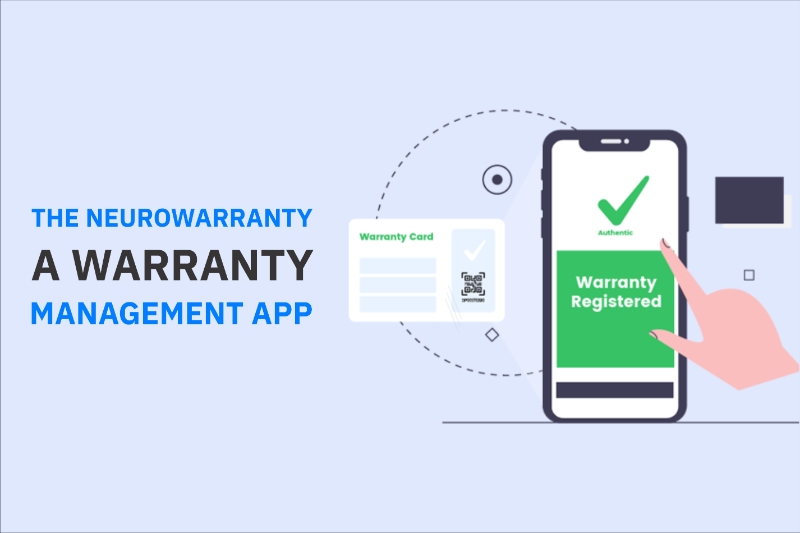
When you are a business owner, you understand the importance of a quality product, you put in the time and effort to ensure that your product is the best it can be, and you want to make sure that your customers get the best experience with it.
Contents
- [Why do brands need a warranty management app -](#why-do-brands-need-a-warranty-management-app)
- [What should you look for before choosing a warranty management app for your brand?](#what-should-you-look-for-before-choosing-a-warranty-management-app-for-your-brand)
- [Can the app automate and simplify warranty processes?](#can-the-app-automate-and-simplify-warranty-processes)
- [Can the app get you valuable customer data?](#can-the-app-get-you-valuable-customer-data)
- [Can the warranty management app help you manage customer communications?](#can-the-warranty-management-app-help-you-manage-customer-communications)
- [Is the warranty management app cloud-based?](#is-the-warranty-management-app-cloud-based)
- [The NeuroWarranty warranty management app](#the-neurowarranty-warranty-management-app)
- [Automate claims management -](#automate-claims-management)
- [Identify fraudulent claims -](#identify-fraudulent-claims)
- [Communicate with customers -](#communicate-with-customers)
- [Get customer data -](#get-customer-data)
- [Warranty Analytics -](#warranty-analytics)
## **Why do brands need a warranty management app -**
In many organizations, warranty services and claims procedures are typically handled internally and impact several departments, from the supply chain to customer service. If you are not all using the same system and viewing the same data, this can cause many problems.
By investing in a warranty management app, brands can ensure that the warranty management process not only goes smoothly but also brings added benefits to them.
- **Faster processes:** A warranty management app can help to easily track the progress of each claim and process each stage faster. By allowing the system to automate menial jobs, your employees will have more time to focus on bigger tasks and improve their skills.
- **Reduce fraudulent risk:** Customers who are worried about their data can be easily reassured as the risk of fraud is reduced with a warranty management system. As all of the processes and policies are already in place and with the latest technology any issues or errors such as fraudulent activity are much easier to detect and stop.
- **Cost-effective:** With a management system you can easily save on administrative costs as the system will automate claims and settlement processes.
- **Improved customer service:** With real-time data available you can easily track the progress of each claim to keep customers updated and improve overall customer satisfaction.
- **Clearer insights:** Clearer insights and analysis data are available with the help of a warranty management system. This makes it much simpler to monitor any quality issues and gives you a clear understanding of customer requirements.
## **What should you look for before choosing a warranty management app for your brand?**
Whether it is collecting warranty data or sending out notifications, the app should be able to handle it effortlessly. This can save a lot of time and money that would otherwise be spent on building the process manually.
### Can the app automate and simplify warranty processes?
Traditional warranty management processes are manual and labour intensive, thus driving up costs. Automating the warranty process allows you to reduce your dependency on customer support executives and reduce customer support costs. A [warranty management app](https://www.neurowarranty.com/) should be able to manage a large number of warranty claims at once on a single screen, thus cutting down the operational cost significantly.
[**_Check out the list of the best warranty management apps for the year 2022._**](https://neurowarranty.com/blog/5-best-warranty-management-software-in-2022-ckzqvwn3k169851llanw48z6yo)
Is the warranty management app easy to implement?
You should be able to use the app without any help from the vendor, and you should be able to get your data in and out of the system.
If you have to spend a lot of time setting up the app and moving data around, that will probably be reflected in a longer implementation time and a bigger budget. You can and should ask to see an app demo before making a final decision.
### Can the app get you valuable customer data?
Customer data is the biggest advantage for businesses, whether it be for online or offline marketing campaigns. It facilitates the retention of existing customers when utilized for loyalty programs and acquires new customers for other products through effective marketing strategies like promotion and cross-selling. The warranty management app should be able to collect, process, and present this data to you in real-time and on an easy to manage interface.
[Get data of your Amazon and other marketplace customers now.](https://www.neurowarranty.com/collect-offline-consumer-data)
When it comes to choosing a warranty management app for your business, there are a lot of different options available. The best way to decide which one is right for you is to consider how easy the solution is for your end customers. Some of the best warranties that experience high redemption rates are the ones that offer simple onboarding and registrations.
### Can the warranty management app help you manage customer communications?
Inbuilt CRM offered by [advanced warranty management apps](https://www.neurowarranty.com/) unifies the data used by service teams for effective warranty management. Businesses can organize customer queries from one source.
In addition to using the in-built CRM, customers can also send product feedback via email or SMS. Businesses can follow up on the input and have personalized communications with the customers to solve the problem and enhance customer satisfaction.
### Is the warranty management app cloud-based?
[Cloud-based warranty management app](https://www.neurowarranty.com/) is a good choice if you want to move your business to the cloud while keeping all the important data in one place and not worrying about the version of your software. Cloud-based apps are a good choice for businesses that are going global and are not sure about the future.
## **The NeuroWarranty warranty management app**
**Trusted by 100s of leading brands including Syska, JCB, ResQtech,** NeuroWarranty is a QR Code-based [warranty management software](https://www.neurowarranty.com/) that is easy to implement yet extremely powerful. Customers can register for a warranty by simply scanning a QR code placed on your product and entering the purchase details. Once registered, customers no longer need to secure purchase bills and invoices. You will be surprised to know the functions NeuroWarranty's Warranty management App can perform for your business.
**_Download the complete case study to know more on how NeuroWarranty helped the consumer product leader Syska digitize its warranty process and increase repeat sales._** [**_Download Complete Case Study_**](https://neurowarranty.com/case-study) **_._**
**[The NeuroWarranty app allows brands to](https://www.neurowarranty.com/digital-warranty-management-software) -**
### **Automate claims management -**
Traditional warranty management processes are manual and labour intensive, thus driving up costs. Automating the warranty process with the NeuroWarranty App allows you to reduce your dependency on customer support executives and reduce customer support costs. Automating the process allows brands to manage a large number of warranty claims at once on a single screen, thus cutting down the operational cost significantly.
### **Identify fraudulent claims -**
If customers love your products, there is a high possibility that counterfeit/ look-alike products of yours are floated in the market with your brand name. Your brand name is used by the counterfeit & sell substandard products in your name. This not only increases your warranty claims, but customers also lose trust in your brand.
Using the NeuroWarranty app, when any product comes for warranty claims, you can track details like when the product was manufactured, who was the supplier/ OEM. This will help in tracking which supplier is using the wrong product.
[Stop warranty claim frauds faced by your brand now.](https://www.neurowarranty.com/blog/here-is-how-you-can-stop-warranty-frauds-faced-by-your-brand-cl202i0jv16301ll8aet2xuhl)
### **Communicate with customers -**
Customers, when registered for a warranty claim, want constant updates on their claim status, but ensuring that their customers are aware of their warranty claim's status is an expensive and time-consuming process.
NeuroWarranty's [warranty management app](https://www.neurowarranty.com/warranty-management-app), with the help of its inbuilt CRM, sets up a direct communication channel between you and your customers. The customer service teams can manage customer communication on a single interface with minimal effort.
### **Get customer data -**
Customer data is a gold mine for any business and is the biggest advantage that they could have. NeuroWarranty has empowered 100s of brands by giving them access to the data of their customers. Brands use it to help them retain their existing customers by utilizing a loyalty program and acquiring new customers for their other products through a cross-selling strategy. Brands also use customer data to tailor every online marketing campaign to their existing customers to increase their return rates.
### **Warranty Analytics** -
NeuroWarranty's smart Analytics dashboards can give you an idea of how your product performs across various geographies and demographics and where you need to improve. This data can help your brand make better decisions in various areas of your business.
With NeuroWarranty, brands get the power to access customer data that can be leveraged by their marketing teams in endless ways. The fully automated and fault-proof warranty process works efficiently to deliver an unparalleled post-sales customer experience with minimum effort. The No App required digital warranty Software facilitates offline to the online transition of customers and enables businesses to increase customer LTV and repeat sales.
> "NeuroWarranty is an awesome solution for all sellers and manufacturers to give the best support to their customers." It is very useful in getting the customer to register and avail warranty, and also it's very easy for us as sellers to monitor the warranty registrations and claims.
>
> **Mr Ranjit B, Head of business development. ResqTech.**
You can sign up for the warranty management software by scheduling a demo and getting a free 14-day trial here - [get a demo](https://calendly.com/aabhishekbindal/neurotags-demo?month=2022-02), when you schedule a demo, an account manager will contact you, and you can organize a call to discuss your business requirements.
---
This blog is powered by Superblog. Visit https://superblog.ai to know more.
---
## Warranty Management Solution for the Automotive Industry [Case Study]
Author: Abhishek Agrawal
Author URL: https://www.neurowarranty.com/blog/author/abhishek-agrawal
Published: 2022-03-25
Meta Title: Warranty Management Solution for the Automotive Industry [Case Study]
Tags: Warranty Management Services, warranty management solution, Automotive Industry
Tag URLs: Warranty Management Services (https://www.neurowarranty.com/blog/tag/warranty-management-services), warranty management solution (https://www.neurowarranty.com/blog/tag/warranty-management-solution), Automotive Industry (https://www.neurowarranty.com/blog/tag/automotive-industry)
URL: https://www.neurowarranty.com/blog/warranty-management-solution-for-the-automotive-industry-case-study-cl168595p236001nnvgqg1i2ov
The automotive parts industry has one of the highest warranty processing costs across industry segments. In an industry where counterfeit products are extremely prevalent brands need a warranty solution that can
1. Help brands identify fraudulent warranty claims
2. Help customers identify genuine automotive parts from counterfeit automotive parts
3. Reduce warranty process costs
Protecting the investment of their customers and maintaining high levels of trust to encourage repeat business is critical for automotive brands. Many brands overlook this notion and often discount the importance of warranty and after-sales support services and end up losing invaluable repeat sales.
**Are you looking for these features in a Warranty Management Software for your automotive brand?**
1. Automates your warranty process
2. Increasing customer engagement
3. Warranty claims tracking
4. Elimination of fraud/ expired claims
If yes, NeuroWarranty is a [Digital Warranty Management Software](https://www.neurowarranty.com/) that has helped leading home appliances brands like JCB, Escorts, Syska, and a 100+ leading brands achieve these results in no time.
Contents
- [Introduction - A warranty management software that helps brands automate their process and reduce costs.](#introduction-a-warranty-management-software-that-helps-brands-automate-their-process-and-reduce-costs)
- [What issues do automotive parts brands face?](#what-issues-do-automotive-parts-brands-face)
- [What did NeuroWarranty notice?](#what-did-neurowarranty-notice)
- [Challenges -](#challenges)
- [High operational costs -](#high-operational-costs)
- [Low customer satisfaction rate (post-sales service related) -](#low-customer-satisfaction-rate-post-sales-service-related)
- [Increased Fraudulent Claims -](#increased-fraudulent-claims)
- [Hassle in managing product warranties for multiple SKUs -](#hassle-in-managing-product-warranties-for-multiple-skus)
- [Result?](#result)
- [How can NeuroWarranty help automotive brands?](#how-can-neurowarranty-help-automotive-brands)
- [How was the home appliances brand's post-sales service improved?](#how-was-the-home-appliances-brands-post-sales-service-improved)
- [Simplifying customer communications and building a connect with end-customers -](#simplifying-customer-communications-and-building-a-connect-with-end-customers)
- [Digitizing and automating warranty claims -](#digitizing-and-automating-warranty-claims)
- [What results does NeuroWarranty deliver?](#what-results-does-neurowarranty-deliver)
- [How can your home appliance brand benefit from this solution?](#how-can-your-home-appliance-brand-benefit-from-this-solution)
- [NeuroWarranty guarantees -](#neurowarranty-guarantees)
## **Introduction - A warranty management software that helps brands automate their process and reduce costs.**
## What issues do automotive parts brands face?
1. High Operational Costs.
2. Low customer satisfaction rates related to post-sales services.
3. Increased Fraudulent Claims.
4. Hassle in managing product warranties for multiple SKUs.
### What did NeuroWarranty notice?
Automotive parts brands have a high Customer lifetime value, but customers' experiences of dealing with time-consuming warranty processes and counterfeit parts create a negative brand image and affect future sales.
## **Challenges**-
### **High operational costs -**
Automotive brands have extremely high warranty processing costs. Their operations are extremely dependent on paper-based systems, and these high overheads accounted for a huge percentage of the total spending in this department. As a result, their warranty services cost increased multi-fold due to four main factors:
1. Labor-intensive manual claims process.
2. No direct communication between customers who claim a warranty. and the client servicing teams.
3. Fraudulent/ Expired warranty claims.
4. Lack of access to warranty data.
### **Low customer satisfaction rate (post-sales service related) -**
Customers often had to go through the hassle of finding old purchase bills and visiting service centers in person to validate their claim to access some essential post-sales services like warranty claims and product replacement.
### **Increased Fraudulent Claims -**
The automotive parts industry is amongst the industries that suffer the most from fake and counterfeit products, and brands have to put in a lot of time and money into differentiating between genuine and fraudulent claims **.**
A traditional warranty solution used by Automotive brands cannot differentiate between fraudulent, expired and genuine claims. This affected its revenue and caused a poor brand image, thus, increasing warranty costs and cutting margins.
### **Hassle in managing product warranties for multiple SKUs -**
A large number of automotive brands use a **Traditional Warranty Management System**. In the absence of AI and IoT based tools, they face an increase in cost and time elements.
### **Result?**
1. Huge time investment in the claim settlement process.
2. Increased warranty frauds due to reliance upon paperwork. And we know how manual data recording is prone to errors.
## **How can NeuroWarranty help automotive brands?**
**NeuroWarranty enables brands to:**
- Automate claim processing and reduced data entry by automatically recovering customer, product and warranty information based on business rules.
- Manage different types of automotive claims.
- Integrate with EPC and other enterprise systems using standard web services to enable Seamless End-to-End Warranty Processes
- Increase in business performance, reduce warranty and service contract costs, and improve product quality through warranty analytics, fraud detection and prediction analytics
### **How was the home appliances brand's post-sales service improved?**
1. Customers no longer have to go through the hassle of finding old bills and warranty cards to claim a warranty.
2. Customers can track the status of their warranty claim in real-time.
3. Using the Inbuilt CRM customers can communicate directly with customer support executives to solve their queries.
4. In case of improvements needed, customers can have the reviews and feedback acknowledged leading to an increase in customer engagement.
### **Simplifying customer communications and building a connect with end-customers -**
NeuroWarrnty's Inbuilt CRM helps brands manage all their post-sales customer communications on a single dashboard.
NeuroWarranty helps automotive brands increase their customer engagement by enabling them to respond to individual customer queries and acknowledge customer feedback and reviews.
### **Digitizing and automating warranty claims -**
In an industry where it is crucial to building trust among your customers for a long term relationship, the easy and hassle-free warranty claims process can soon become a key differentiator between you and your competitors.
NeuroWarranty replaces your traditional warranty with a QR code-based [Digital Warranty Solution](https://www.neurowarranty.com/). With the process of 'NeuroTagging', NeuroWarranty not only helps automotive brands automate their warranty but also make product serialization more effective for improved supply chain management.
**_Download the complete case study to know more on how NeuroWarranty helped the consumer product leader Syska digitize its warranty process and increase repeat sales._** [**_Download Complete Case Study_**](https://neurowarranty.com/case-study) **_._**
## What results does NeuroWarranty deliver?
1. Automotive brands can differentiate between fraudulent claims and genuine claims that results in the stoppage of warranty frauds.
2. Automotive brands can reduce claims processing costs by automating the process and managing it on a single dashboard.
A simplified warranty claims process ensuring that only genuine parts are supplied builds trust among your customers, and can become your brand's biggest USPs.
## **How can your home appliance brand benefit from this solution?**
NeuroWarranty's [warranty management software](https://www.neurowarranty.com/) is helping JCB, Escorts, Syska and 100+ leading brands increase their repeat sales by transforming their post-sales services.
**What are you waiting for?**
Make Digital Warranty Management System your Strategic Advantage!
[Check out the list of the best warranty management software for the year 2022.](https://neurowarranty.com/blog/5-best-warranty-management-software-in-2022-ckzqvwn3k169851llanw48z6yo)
### NeuroWarranty guarantees -
1. Increase in revenue and profit
2. Up to 90% decrease in warranty-related costs.
3. Up to 180% increase in repeat sales.
4. 100% Reduction in fraudulent warranty claims
5. Data of your Amazon, Flipkart and retail end customers
6. 5X customer engagement compared to your competitors.
7. Kickstarting your D2C journey.
If you wish to convert your warranty expenses into a profit-making asset, schedule a call with our solution experts and get a solution that has delivered results for market leaders in the home appliances segment. [Schedule a call now.](https://calendly.com/aabhishekbindal/neurotags-demo?month=2022-02)
---
This blog is powered by Superblog. Visit https://superblog.ai to know more.
---
## Warranty Management Solution for the Mattress Industry [Case Study]
Author: Abhishek Agrawal
Author URL: https://www.neurowarranty.com/blog/author/abhishek-agrawal
Published: 2022-03-11
Tags: Digital Warranty Management, Warranty Management, Mattress Industry
Tag URLs: Digital Warranty Management (https://www.neurowarranty.com/blog/tag/digital-warranty-management), Warranty Management (https://www.neurowarranty.com/blog/tag/warranty-management), Mattress Industry (https://www.neurowarranty.com/blog/tag/mattress-industry)
URL: https://www.neurowarranty.com/blog/warranty-management-solution-for-the-mattress-industry-case-study-cl0mekld199121jqy5814zxjr
Today’s mattress market is big business with the global mattress market currently valued at around $81 billion. For decades, shifts in the mattress industry occurred gradually. Early on, the modern market was ruled by only a handful of companies that dominated all the depot stores and offline retail. These big brands all followed pretty much the same business model: Distribute mattresses to department and furniture stores, where they’d be sold by middlemen who’d collect some of the profits.
But in 2014, the industry underwent a major change. Thanks largely to the emergence of the Casper brand, which helped pioneer the model of mattresses being sold online directly to consumers, the bed-in-a-box trend took off. In less than seven years, the number of new players in the mattress space has ballooned.
_[Research by the BSC research group showed that more than 40% of customers considered reputation and warranty as to their biggest factors while making a product choice.](https://bedtimesmagazine.com/2021/05/bsc-research-consumer-mattress-buying-behavior-part-3-all-about-the-bed/)_
A hassle-free warranty process is the most important service a warranty brand can offer to their customers to build trust and stay ahead of their competitors. And as the mattress industry is moving to an increasingly D2C model, it becomes imperative for mattress brands to develop a solution that will help them bring customers to their website and remarket and retain them.
**Are you looking for these features in a Warranty Management Software for your mattress brand?**
1. Access to data of your Amazon/ retail end customers
2. The ability to bring retail customers to your website.
3. Unparraled warranty claims experience for your end customers.
4. Warranty claims tracking
5. Elimination of fraud/ expired claims
Contents
- [Introduction - Helping Flo develop a hassle-free warranty experience for their end-users.](#introduction-helping-flo-develop-a-hassle-free-warranty-experience-for-their-end-users)
- [What were the issues Flo was facing?](#what-were-the-issues-flo-was-facing)
- [What did NeuroWarranty notice?](#what-did-neurowarranty-notice)
- [Challenges -](#challenges)
- [A difficult warranty claims process for end customers -](#a-difficult-warranty-claims-process-for-end-customers)
- [High operational costs -](#high-operational-costs)
- [Know how you can reduce your warranty costs.](#know-how-you-can-reduce-your-warranty-costs)
- [Not being able to cross-sell, upsell to existing customers.](#not-being-able-to-cross-sell-upsell-to-existing-customers)
- [Increased Fraudulent Claims -](#increased-fraudulent-claims)
- [Result?](#result)
- [How did NeuroWarranty help Flo Mattress?](#how-did-neurowarranty-help-flo-mattress)
- [Transforming Flo's post-sales service -](#transforming-flos-post-sales-service)
- [Simplifying customer communications and building a connect with end-customers -](#simplifying-customer-communications-and-building-a-connect-with-end-customers)
- [Getting access to data of end customers -](#getting-access-to-data-of-end-customers)
- [The Results?](#the-results)
- [How can your Mattress brand benefit from this solution?](#how-can-your-mattress-brand-benefit-from-this-solution)
- [NeuroWarranty guarantees -](#neurowarranty-guarantees)
**How has NeuroWarranty helped Mattress brands with its Digital Warranty Management Solution?**

## Introduction - Helping Flo develop a hassle-free warranty experience for their end-users.
Flo focuses on providing best in class mattresses to its consumers since its inception. Flo aims to become the biggest mattress brand in India and change the industry by making it customer-centric and taking it truly D2C **.**
## **What were the issues Flo was facing?**
1. A difficult warranty claims process for end customers
2. Not being able to cross-sell, upsell to existing customers.
3. High warranty-related costs.
4. Increased Fraudulent Claims.
5. Hassle in managing product warranties for multiple SKUs.
### **What did NeuroWarranty notice?**
While many Mattress brands focussed heavily on acquiring customers and giving discounts, the importance of a delightful post-sales customer experience was ignored by many brands. Research showed that close to 40% of customers chose a brand based on the above factors, hence for unparalleled growth, Flo needed to revamp its post-sales service.
**How does NeuroWarranty digitize your warranty process?**
## **Challenges**-
### A difficult warranty claims process for end customers -
Flo was using a traditional paper-based warranty process to serve its customers, but due to the long life cycle of products in the mattress industry, the paper-based warranty cards were often misplaced by customers. Once the warranty card was lost, customers could no longer claim a warranty for their products.
In an industry where customer trust is crucial ifcustomers had to face difficulties in claiming a warranty, they would simply switch to competitor brands.
### **High operational costs -**
Flo had a major problem with their warranty costs. Their operations were extremely dependent on paper-based systems, and these high overheads accounted for a huge percentage of the total spending in this department. As a result, their warranty services cost increased multi-fold due to four main factors:
1. Labour-intensive manual claims process.
2. No direct communication between customers who claim a warranty and client servicing teams.
3. Fraudulent/ Expired warranty claims.
4. Lack of access to warranty data.
### [Know how you can reduce your warranty costs.](https://www.neurowarranty.com/blog/reduce-the-cost-of-your-product-warranty-claims-here-is-how-ckxiopr0204981ks7c5ibicfx)
### **Not being able to cross-sell, upsell to existing customers.**
Mattress brands have a very high customer lifetime value, but not having effective channels for cross-selling and upselling restricts mattress brands from unlocking the true value of their customers.
Data from Oberlo shows that 80% of businesses consider email marketing as the most effective strategy for retaining customers. The lack of access to customer data like emails and phone numbers made Flo struggle with their cross-selling efforts.
Not being able to target the right segment of customers at the right time resulted in Flo losing invaluable repeat business.
### **Increased Fraudulent Claims -**
Our client was receiving numerous monthly fraudulent claims. A traditional warranty solution used by Flo could not differentiate between fraudulent, expired and genuine claims. This affected its revenue and caused a poor brand image, thus, increasing warranty costs and cutting margins.
[_**Stop warranty claim frauds faced by your brand now.**_](https://www.neurowarranty.com/blog/reduce-the-cost-of-your-product-warranty-claims-here-is-how-ckxiopr0204981ks7c5ibicfx)
Flo was using a **Traditional Warranty Management System**. In the absence of AI and IoT based tools, it was facing an increase in cost and time elements.
### **Result?**
1. Huge time investment in the claim settlement process.
2. Increased warranty frauds due to reliance upon paperwork. And we know how manual data recording is prone to errors.
## **How did NeuroWarranty help Flo Mattress?**
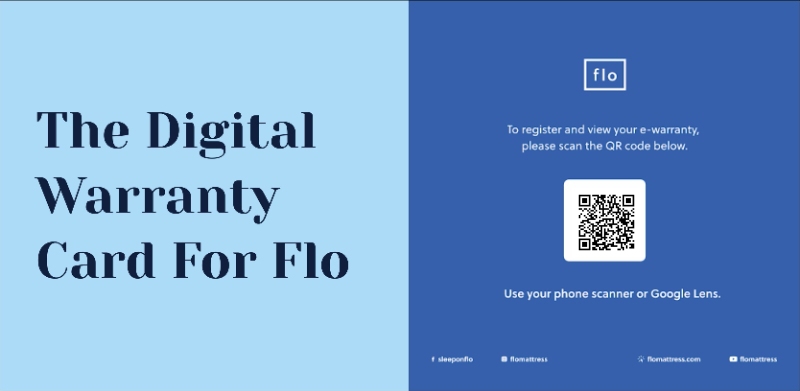
Flo realized that to built brand trust and become a D2C leader it had to -
1. Simplify the warranty process for its end customers.
2. Access customer data of retail and amazon customers to Cross-sell and up-sell to existing customers effectively.
Flo trusted NeuroWarranty with its [best warranty management solution](https://www.neurowarranty.com/). With NeuroWarranty, customers of Flo can simply scan the tag placed inside the package to register for a warranty and track and manage it digitally.
The scan gathers relevant consumer data for Flo, which is being leveraged in several innovative ways to resell, cross-sell and upsell to existing customers. The digitization even consolidated all data in one place, allowing Flo to track its sales across geographies and demographics and take informed business decisions.
### **Transforming Flo's post-sales service -**
NeuroWarranty replaced Flo's traditional paper-based warranty with a QR code-based digital warranty. The [new warranty software](https://www.neurowarranty.com/blog/warranty-management-app-reduce-costs-and-automate-your-product-warranties-cl1g7op6l65941jlfkyb2vlqj) allowed Flo to deliver an unparalleled customer experience across all touchpoints.
**How was the mattress brand's post-sales service improved?**
1. Customers no longer had to go through the hassle of finding old bills and warranty cards to claim a warranty.
2. Customers could track the status of their warranty claim in real-time.
3. Using the Inbuilt CRM customers can communicate directly with customer support executives to solve their queries.
### **Simplifying customer communications and building a connect with end-customers -**
NeuroWarrnty's Inbuilt CRM helped Flo manage all their post-sales customer communications on a single dashboard. The simplified customer interaction helped Flo reduce customer complaints calls and help tickets while reducing their customer service costs by 30%.
Flo had identified the need to be customer-centric. They needed to connect with their end customers at scale to provide an unparalleled customer experience.
NeuroWarranty helped Flo increase their customer engagement by enabling them to respond to individual customer queries and acknowledge customer feedback and reviews.
### **Getting access to data of end customers -**
Mattress brands like Flo struggled to remarket effectively, as their sales channels (retail and marketplaces like Amazon) did not give them the end-customer data needed to reach the customers.
NeuroWarranty helped Flo by giving them complete access to the personal data of every registered customer including - Names, Email Ids and Phone Numbers. Access to end customer data allowed Flo to reengineer its remarketing strategy and achieve the highest percentage of repeat sales in the industry segment.
[Get data of your Amazon and other marketplace customers now](https://www.neurowarranty.com/blog/6-effective-ways-you-can-bring-your-amazon-customers-to-your-website-ckzfhj6rq12471jt7s9rboxh3)!
**Digitizing and automating warranty claims -**
In an industry where it is crucial to building trust among your customers for a long term relationship, the easy and hassle-free warranty claims process soon became a key differentiator between Flo and its competitors.
NeuroWarranty replaced Flo's traditional warranty with a QR code-based Digital Warranty Solution. With the process of 'NeuroTagging', NeuroWarranty not only helped Flo automate its warranty but also made product serialization more effective for the improved supply chain management.
Customers of the mattress brand no longer had to secure old purchase bills and warranty cards to claim a warranty, which was one of the main reasons for rejecting warranty claims as warranty cards get easily misplaced. The automated warranty claims process resulted in an 80% decrease in warranty processing costs for Flo.
**_Download the complete case study to know more on how NeuroWarranty helped the consumer product leader Syska digitize its warranty process and increase repeat sales._** [**_Download Complete Case Study_**](https://neurowarranty.com/case-study) **_._**
## The Results?
1. With its simplified warranty claims process, Flo was able to position itself as the most trusted, customer-centric mattress brand and the hassle-free warranty process continues to be among its USPs.
2. As the scan gathered personal data of its customers, Flo was able to use this data to cross-sell and resell effectively and bring customers directly to its website.
3. As the warranty process was automated Flo reduced its warranty processing costs by more than half.
## **How can your Mattress brand benefit from this solution?**
[NeuroWarranty's warranty management software](https://www.neurowarranty.com/) is helping Flo, Sleep Ayurveda, Syska and 100+ leading brands increase their repeat sales by transforming their postsales services.
**What are you waiting for?**
Make Digital Warranty Management System your Strategic Advantage!
[Check out the list of the best warranty management solftware for the year 2022.](https://neurowarranty.com/blog/5-best-warranty-management-software-in-2022-ckzqvwn3k169851llanw48z6yo)
### **NeuroWarranty guarantees -**
1. Increase in revenue and profit
2. Up to 90% decrease in warranty-related costs.
3. Up to 180% increase in repeat sales.
4. 100% Reduction in fraudulent warranty claims
5. Data of your Amazon, Flipkart and retail end customers
6. 5X customer engagement compared to your competitors.
7. Kickstarting your D2C journey.
If you wish to convert your warranty expenses into a profit-making asset, schedule a call with our solution experts and get a solution that has delivered results for market leaders in the mattress segment. [Schedule a call now.](https://calendly.com/aabhishekbindal/neurotags-demo?month=2022-02)
---
This blog is powered by Superblog. Visit https://superblog.ai to know more.
---
## Warranty Management Solution for the Home Appliances Industry [Case Study]
Author: Abhishek Agrawal
Author URL: https://www.neurowarranty.com/blog/author/abhishek-agrawal
Published: 2022-03-04
Tags: Warranty Management Services, warranty management solution, Home Appliances
Tag URLs: Warranty Management Services (https://www.neurowarranty.com/blog/tag/warranty-management-services), warranty management solution (https://www.neurowarranty.com/blog/tag/warranty-management-solution), Home Appliances (https://www.neurowarranty.com/blog/tag/home-appliances)
URL: https://www.neurowarranty.com/blog/warranty-management-solution-for-the-home-appliances-industry-case-study-cl0cd82bq26011ko3jlzvpoyo
The home appliances industry has one of the highest customer lifetime values across industry segments. In an industry where brands have a large number of SKUs, the profitability of a home appliances brand depends on its ability to successfully upsell and cross-sell to its existing customers.
Protecting the investment of their customers and maintaining high levels of trust to encourage repeat business is critical for a home appliances brand. Many brands overlook this notion and often discount the importance of warranty and after-sales support services and end up losing invaluable repeat sales.
To keep up with an ever-changing marketplace and a growing customer base, companies have to get more creative in terms of the top-notch services they offer. To provide the best possible customer experience, brands need a new age warranty solution that can deliver much more than just managing product warranties and help them increase sales and save costs.
**Are you looking for these features in a Warranty Management Software for your home appliances brand?**
1. Access to data of your Amazon/ retail end customers
2. Increasing customer engagement
3. Optimizing Warranty claims & tracking
4. Elimination of fraud/ expired claims
Contents
- [Introduction - A warranty management software that refined Greenchef's post-sales customer experience.](#introduction-a-warranty-management-software-that-refined-greenchefs-post-sales-customer-experience)
- [What were the issues Greenchef was facing?](#what-were-the-issues-greenchef-was-facing)
- [What did NeuroWarranty notice?](#what-did-neurowarranty-notice)
- [Challenges -](#challenges)
- [High operational costs -](#high-operational-costs)
- [Low customer satisfaction rate (post-sales service related) -](#low-customer-satisfaction-rate-post-sales-service-related)
- [Not being able to cross-sell, upsell to existing customers -](#not-being-able-to-cross-sell-upsell-to-existing-customers)
- [Increased Fraudulent Claims -](#increased-fraudulent-claims)
- [Hassle in managing product warranties for multiple SKUs -](#hassle-in-managing-product-warranties-for-multiple-skus)
- [Result?](#result)
- [How did NeuroWarranty help Greenchef ?](#how-did-neurowarranty-help-greenchef)
- [Transforming GreenChef's post-sales service -](#transforming-greenchefs-post-sales-service)
- [Simplifying customer communications and building a connect with end-customers -](#simplifying-customer-communications-and-building-a-connect-with-end-customers)
- [Getting access to data of end customers -](#getting-access-to-data-of-end-customers)
- [The Results?](#the-results)
- [How can your home appliance brand benefit from this solution?](#how-can-your-home-appliance-brand-benefit-from-this-solution)
- [NeuroWarranty guarantees -](#neurowarranty-guarantees)
**How has NeuroWarranty helped Home Appliances brands with its Digital Warranty Management Software?**
## **Introduction - A warranty management software that refined Greenchef's post-sales customer experience.**
Greenchef focuses on providing best in class home appliances to its consumers since its inception. Greenchef always aimed to build a long-term connection with its end customers and deliver an unparalleled post-sales experience to its end customers to strengthen this relationship.
### What were the issues Greenchef was facing?
1. High Operational Costs.
2. Low customer satisfaction rates related to post-sales services.
3. Not being able to cross-sell, upsell to existing customers.
4. Increased Fraudulent Claims.
5. Hassle in managing product warranties for multiple SKUs.
### What did NeuroWarranty notice?
Home Appliances brands like Greenchef have a high Customer lifetime value, but customers not having a satisfactory post-sales experience, the inability to remarket and a hassle-filled warranty experience results in low retention rates and diminishing profits over time.
## **Challenges**-
### **High operational costs -**
Greenchef had a major problem with their warranty costs. Their operations were extremely dependent on paper-based systems, and these high overheads accounted for a huge percentage of the total spending in this department. As a result, their warranty services cost increased multi-fold due to four main factors:
1. Labour-intensive manual claims process.
2. No direct communication between customers who claim a warranty. and the client servicing teams.
3. Fraudulent/ Expired warranty claims.
4. Lack of access to warranty data.
### **Low customer satisfaction rate (post-sales service related) -**
Customers often had to go through the hassle of finding old purchase bills and going through endless calls with Greenchef's client servicing teams to access some essential post-sales services like warranty claims and product replacement.
In an industry where replacing the product is often cheaper/ easier than repairing the product, customers who had to face difficulties in claiming a warranty switched to competitor brands.
### **Not being able to cross-sell, upsell to existing customers -**
Home appliances brands have a very high customer lifetime value, but not having effective channels for cross-selling and upselling restricts home appliances brands from unlocking the true value of a customer.
Data from Oberlo shows that 80% of businesses consider email marketing as the most effective strategy for retaining customers. The lack of access to customer data like emails and phone numbers made Greenchef struggle with its cross-selling efforts.
Not being able to target the right segment of customers at the right time resulted in Greenchef losing invaluable repeat business.
### **Increased Fraudulent Claims -**
Our client was receiving numerous monthly fraudulent claims. A traditional warranty solution used by Greenchef could not differentiate between fraudulent, expired, and genuine claims. This affected its revenue and caused a poor brand image, thus, increasing warranty costs and cutting margins.
### **Hassle in managing product warranties for multiple SKUs -**
Greenchef was using a **Traditional Warranty Management System**. In the absence of AI and IoT-based tools, it was facing an increase in cost and time elements.
### **Result?**
1. Huge time investment in the claim settlement process.
2. Increased warranty frauds due to reliance upon paperwork. And we know how manual data recording is prone to errors.
## **How did NeuroWarranty help Greenchef ?**
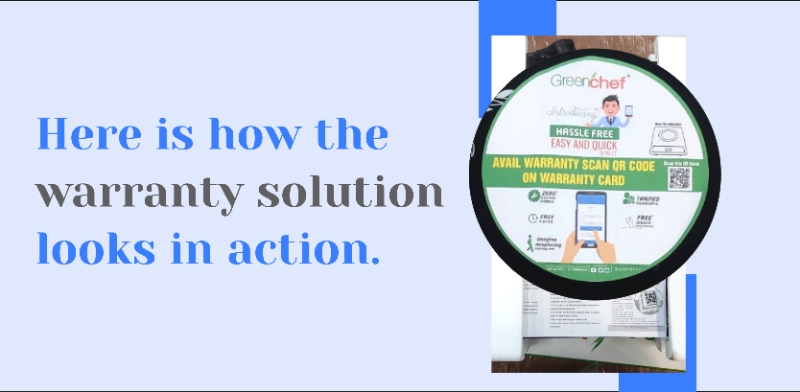
Greenchef realized that in order to maintain long term growth, profitability and profit margins it had to work on two important touchpoints -
1. Reduce fraudulent warranty claims.
2. Cross-sell and up-sell to existing customers effectively.
Greenchef's search for a suitable solution led them to NeuroWarranty. Greenchef realized soon enough that this was the most cost-effective, robust solution that could even cater to their massive distribution network without additional effort in the minimum time frame.
With NeuroWarranty, customers of Greenchef can simply scan the tag placed inside the package to register for a warranty and track and manage it digitally.
The scan gathers relevant [consumer data](https://www.neurowarranty.com/collect-offline-consumer-data) for Greenchef, which is being leveraged in several innovative ways to resell, cross-sell and upsell to existing customers. The digitization even consolidated all data in one place, allowing Greenchef to track its sales across geographies and demographics and take informed business decisions.
### **Transforming GreenChef's post-sales service -**
NeuroWarranty replaced Greenchef's traditional paper-based warranty with a QR code-based digital warranty. The new [warranty software](https://www.neurowarranty.com/) allowed Greenchef to deliver an unparalleled customer experience across all touchpoints.
**How was the home appliances brand's post-sales service improved?**
1. Customers no longer had to go through the hassle of finding old bills and warranty cards to claim a warranty.
2. Customers could track the status of their warranty claim in real-time.
3. Using the Inbuilt CRM customers can communicate directly with customer support executives to solve their queries.
4. In case of improvements needed, customers can have the reviews and feedback acknowledged leading to an increase in customer engagement.
### **Simplifying customer communications and building a connect with end-customers -**
NeuroWarrnty's Inbuilt CRM helped Greenchef manage all their post-sales customer communications on a single dashboard. The simplified customer interaction helped Greenchef reduce customer complaints calls and help tickets while reducing their customer service costs by 30%.
Greenchef had identified the need to be customer-centric. They needed to connect with their end customers at scale to provide an unparalleled customer experience.
NeuroWarranty helped Greenchef increase its customer engagement by enabling them to respond to individual customer queries and acknowledge customer feedback and reviews.
### **Getting access to data of end customers -**
Greenchef knew that the home appliances market is filled with competitors trying to attract customers, and consumers of this segment are always open to trying out new brands. Hence their ability to retain customers will determine their profitability in the long run.
Home Appliance brands like Greenchef struggled to remarket effectively, as their sales channels (retail and marketplaces like Amazon) did not give them the end-customer data needed to reach the customers.
[Get data of your Amazon and other marketplace customers now!](https://www.neurowarranty.com/blog/6-effective-ways-you-can-bring-your-amazon-customers-to-your-website-ckzfhj6rq12471jt7s9rboxh3)
**How does NeuroWarranty digitize your warranty process?**
**Digitizing and automating warranty claims -**
In an industry where it is crucial to build trust among your customers for a long-term relationship, the easy and hassle-free warranty claims process soon became a key differentiator between Greenchef and its competitors.
NeuroWarranty replaced Greenchef's traditional warranty with a QR code-based Digital Warranty Solution. With the process of 'NeuroTagging', NeuroWarranty not only helped Greenchef automate its warranty but also made product serialization more effective for the improved supply chain management.
Customers of the Home Appliances brand no longer had to secure old purchase bills and warranty cards to claim a warranty, which was one of the main reasons for rejecting warranty claims as warranty cards get easily misplaced. The [**automated warranty claims process**](https://www.neurowarranty.com/blog/warranty-management-app-reduce-costs-and-automate-your-product-warranties-cl1g7op6l65941jlfkyb2vlqj) resulted in an 80% decrease in warranty processing costs for Greenchef.
**_Download the complete case study to know more on how NeuroWarranty helped the consumer product leader Syska digitize its warranty process and increase repeat sales._** [**_Download Complete Case Study_**](https://neurowarranty.com/case-study) **_._**
## The Results?
1. Green chef was able to differentiate between fraudulent claims and genuine claims that lead to the stoppage of warranty frauds.
2. Using personal data of their end customers from retail as well as market places like Amazon and Flipkart, Greenchef reengineered its cross-selling strategy and achieved among the highest repeat sales percentage in the industry.
3. A [simplified warranty claims process](https://www.neurowarranty.com/) built trust among Greenchef customers, and the hassle-free warranty process continues to be among its USPs.
## **How can your home appliance brand benefit from this solution?**
NeuroWarranty's [warranty management software](https://www.neurowarranty.com/) is helping Greenchef, Resqtech, Syska, and 100+ leading brands increase their repeat sales by transforming their postsales services.
**What are you waiting for?**
Make Digital Warranty Management System your Strategic Advantage!
[_**Check out the list of the best warranty management software for the year 2022.**_](https://neurowarranty.com/blog/5-best-warranty-management-software-in-2022-ckzqvwn3k169851llanw48z6yo)
### NeuroWarranty guarantees -
1. Increase in revenue and profit
2. Up to 90% decrease in warranty-related costs.
3. Up to 180% increase in repeat sales.
4. 100% Reduction in fraudulent warranty claims
5. Data of your Amazon, Flipkart, and retail end customers
6. 5X customer engagement compared to your competitors.
7. Kickstarting your D2C journey.
If you wish to convert your warranty expenses into a profit-making asset, schedule a call with our solution experts and get a solution that has delivered results for market leaders in the home appliances segment. [Schedule a call now.](https://calendly.com/aabhishekbindal/neurotags-demo?month=2022-02)
---
This blog is powered by Superblog. Visit https://superblog.ai to know more.
---
## Warranty Management Solution for the Consumer Electronics Industry [Case Study]
Author: Abhishek Agrawal
Author URL: https://www.neurowarranty.com/blog/author/abhishek-agrawal
Published: 2022-02-25
Tags: warranty mangement software, consumer electronics
Tag URLs: warranty mangement software (https://www.neurowarranty.com/blog/tag/warranty-mangement-software), consumer electronics (https://www.neurowarranty.com/blog/tag/consumer-electronics)
URL: https://www.neurowarranty.com/blog/warranty-management-solution-for-the-consumer-electronics-industry-case-study-cl027nbcy55861pm8ipb99ulw
Contents
- [Introduction - Helping Syska automate their warranty process.](#introduction-helping-syska-automate-their-warranty-process)
- [What were the issues Syska was facing?](#what-were-the-issues-syska-was-facing)
- [What did NeuroWarranty notice?](#what-did-neurowarranty-notice)
- [Challenges -](#challenges)
- [Low customer satisfaction rate (post-sales service related) -](#low-customer-satisfaction-rate-post-sales-service-related)
- [Not being able to connect with their customers at scale -](#not-being-able-to-connect-with-their-customers-at-scale)
- [Not being able to remarket to existing customers -](#not-being-able-to-remarket-to-existing-customers)
- [Hassle in managing product warranties for multiple SKUs -](#hassle-in-managing-product-warranties-for-multiple-skus)
- [Result?](#result)
- [How did NeuroWarranty help Syska?](#how-did-neurowarranty-help-syska)
- [Transforming Syska's post-sales service -](#transforming-syskas-post-sales-service)
- [Simplifying customer communications -](#simplifying-customer-communications)
- [Getting access to data of end customers -](#getting-access-to-data-of-end-customers)
- [Digitizing and automating warranty claims -](#digitizing-and-automating-warranty-claims)
- [The Results?](#the-results)
- [How can your consumer electronic brand benefit from this solution?](#how-can-your-consumer-electronic-brand-benefit-from-this-solution)
- [NeuroWarranty guarantees -](#neurowarranty-guarantees)
A safe and secure warranty system plays a huge role in increasing customer confidence. Warranty management is a complex process that needs to change as companies and their product lines grow.
As more products are released, the need for additional warranty and after-sales service processes becomes increasingly important. Yet many consumer electronics brands aren't aware of this until they realize they must find some solution quickly or risk losing customers.
Contents
- [Introduction - Helping Syska automate their warranty process.](#introduction-helping-syska-automate-their-warranty-process)
- [What were the issues Syska was facing?](#what-were-the-issues-syska-was-facing)
- [What did NeuroWarranty notice?](#what-did-neurowarranty-notice)
- [Challenges -](#challenges)
- [Low customer satisfaction rate (post-sales service related) -](#low-customer-satisfaction-rate-post-sales-service-related)
- [Not being able to connect with their customers at scale -](#not-being-able-to-connect-with-their-customers-at-scale)
- [Not being able to remarket to existing customers -](#not-being-able-to-remarket-to-existing-customers)
- [Hassle in managing product warranties for multiple SKUs -](#hassle-in-managing-product-warranties-for-multiple-skus)
- [Result?](#result)
- [How did NeuroWarranty help Syska?](#how-did-neurowarranty-help-syska)
- [Transforming Syska's post-sales service -](#transforming-syskas-post-sales-service)
- [Simplifying customer communications -](#simplifying-customer-communications)
- [Getting access to data of end customers -](#getting-access-to-data-of-end-customers)
- [Digitizing and automating warranty claims -](#digitizing-and-automating-warranty-claims)
- [The Results?](#the-results)
- [How can your consumer electronic brand benefit from this solution?](#how-can-your-consumer-electronic-brand-benefit-from-this-solution)
- [NeuroWarranty guarantees -](#neurowarranty-guarantees)
**Are you looking for these features in a Warranty Management Software for your consumer electronics brand?**
1. Access to data of your Amazon/ retail end customers
2. Increasing customer engagement
3. Warranty claims tracking
4. Elimination of fraud/ expired claims
If yes, NeuroWarranty is a Digital [Warranty Management Software](https://www.dyrect.co/guide/warranty-management-software) that has helped leading consumer electronics brands like Syska, Resqtech, Smartshout, and a 100+ leading brands achieve these results in no time.
At a time when repeat sales drive businesses and customer retention has become more important than ever, traditional warranty solutions are just not the right fit for you.
**How has NeuroWarranty helped Consumer Electronics brands with its Digital Warranty Management Software?**

## **Introduction - Helping Syska automate their warranty process.**
Syska are market leaders in the Indian consumer electronics and electronics sector,with a diversified product range in segments like Syska LED, Syska Personal Care, Syska Accessories, Syska Home Appliances and Syska Wires & Cables.
### What were the issues Syska was facing?
1. Low customer satisfaction rates related to post-sales services.
2. Not being able to connect with their customers at scale.
3. Not being able to remarket to existing customers.
4. Hassle in managing product warranties for multiple SKUs.
### What did NeuroWarranty notice?
Consumer electronics brands like Syska have a high Customer lifetime value, but customers not having a satisfactory post-sales experience, the inability to remarket and a hassle filled warranty experience results in low retention rates and diminishing profits over time.
## Challenges -
### **Low customer satisfaction rate (post-sales service related) -**
Customers often had to go through the hassle of finding old purchase bills and going through endless calls with Syska's client servicing teams to access some essential post-sales services like warranty claims and product replacement.
This lead to an overall bad customer experience and left the customer dissatisfied with the post-sales service.
### **Not being able to connect with their customers at scale -**
Customers, when registered for a warranty claim, wanted constant updates on their claim status, but ensuring that their customers were aware of their warranty claim's status was an expensive and time-consuming process for Syska.
Absence of a direct communication channel between customers who claim a warranty and customer service teams had forced Syska to take up the process on-call resulting in additional service costs and reduced profits.
### **Not being able to remarket to existing customers -**
Consumer electronics brands have a very high customer lifetime value, but not having effective channels for remarketing restricts consumer electronics brands from unlocking the true value of a customer.
Data from Oberlo shows that 80% of businesses consider email marketing as the most effective strategy for retaining customers. The lack of access to customer data like emails and phone numbers made Syska struggle with their remarketing efforts.
Not being able to target the right segment of customers at the right time resulted in Syska losing invaluable repeat business.
### **Hassle in managing product warranties for multiple SKUs -**
Syska was using a **Traditional Warranty Management System**. In the absence of AI and IoT based tools, it was facing an increase in cost and time elements.
### **Result?**
1. Huge time investment in the claim settlement process.
2. Increased warranty frauds due to reliance upon paperwork. And we know how manual data recording is prone to errors.
## **How did NeuroWarranty help Syska?**
Syska's search for a suitable solution led them to NeuroWarranty. Syska realized soon enough that this was the most cost-effective, robust solution that could even cater to their massive distribution network without additional effort in the minimum time frame.
With NeuroWarranty, customers of Syska can simply scan the tag placed inside the package to register for a warranty and track and manage it digitally.
The scan gathers relevant consumer data for Syska, which is being leveraged in several innovative ways to resell, cross-sell and upsell to existing customers. The digitization even consolidated all data in one place, connecting thousands of Syska service centres across the country.
**How does NeuroWarranty digitize your warranty process?**
### **Transforming Syska's post-sales service -**
NeuroWarranty replaced Syska's traditional paper-based warranty with a [QR code-based digital warranty.](https://www.neurowarranty.com/blog/warranty-management-app-reduce-costs-and-automate-your-product-warranties-cl1g7op6l65941jlfkyb2vlqj) The new warranty software allowed Syska to deliver an unparalleled customer experience across all touchpoints.
**How was the consumer electronic brand's post-sales service improved?**
1. Customers no longer had to go through the hassle of finding old bills and warranty cards to claim a warranty.
2. Customers could track the status of their warranty claim in real-time.
3. Using the Inbuilt CRM customers can communicate directly with customer support executives to solve their queries.
4. In case of improvements needed, customers can have the reviews and feedback acknowledged leading to an increase in customer engagement.
### **Simplifying customer communications -**
NeuroWarrnty's Inbuilt CRM helped Syska manage all their post-sales customer communications on a single dashboard. The simplified customer interaction helped Syska reduce customer complaints calls and help tickets while reducing their customer service costs by 30%.
Syska had identified the need to be customer-centric. They needed to connect with their end customers at scale to provide an unparalleled customer experience.
NeuroWarranty, helped Syska increase their customer engagement by enabling them to respond to individual customer queries and acknowledge customer feedback and reviews.
### **Getting access to data of end customers -**
Syska knew that the consumer electronics market is filled with competitors trying to attract customers, and consumers of this segment are always open to trying out new brands. Hence their ability to retain customers will determine their profitability in the long run.
> ## [Did You Know: A 5% Increase in Retention Increases Profits by Up to 95%Bain and Company](https://www.bain.com/insights/retaining-customers-is-the-real-challenge/)
Consumer electronics brands like Syska struggled to remarket effectively, as their sales channels (retail and marketplaces like Amazon) did not give them the end-customer data needed to reach the customers.
NeuroWarranty helped Syska by giving them complete access to the personal data of every registered customer including Names, Email Ids and Phone Numbers. Access to end customer data allowed Syska to reengineer its remarketing strategy and achieve a 180% increase in repeat sales.
[**_Get data of your Amazon and other marketplace customers now_**](https://www.neurowarranty.com/collect-offline-consumer-data) **!**
### **Digitizing and automating warranty claims -**
NeuroWarranty replaced Syska's traditional warranty with a QR code-based Digital Warranty Solution. With the process of 'NeuroTagging', NeuroWarranty not only helped Syska automate its warranty but also made product serialization more effective for an improved supply chain management.
Customers of the Consumer Electronics brand no longer had to secure old purchase bills and warranty cards to claim a warranty, which was one of the main reasons for rejecting warranty claims as warranty cards get easily misplaced. The [automated warranty claims process](https://www.neurowarranty.com/blog/warranty-management-app-reduce-costs-and-automate-your-product-warranties-cl1g7op6l65941jlfkyb2vlqj) resulted in a 70% decrease in warranty processing costs for Syska.
**_Download the complete case study to know more on how NeuroWarranty helped Syska digitize its warranty process and increase repeat sales._** [**_Download Complete Case Study_**](https://neurowarranty.com/case-study) **_._**
## **The Results?**
1. 300% increase of customer participation in the warranty program as products across SKUs were digitized.
2. 5X customer engagement compared to other consumer electronics brands allows Syska to connect with their customers at scale and build a long term relationship.
3. 180% increase in repeat sales due to the combing effect of transformed customer service and personalized data-driven remarketing strategy.
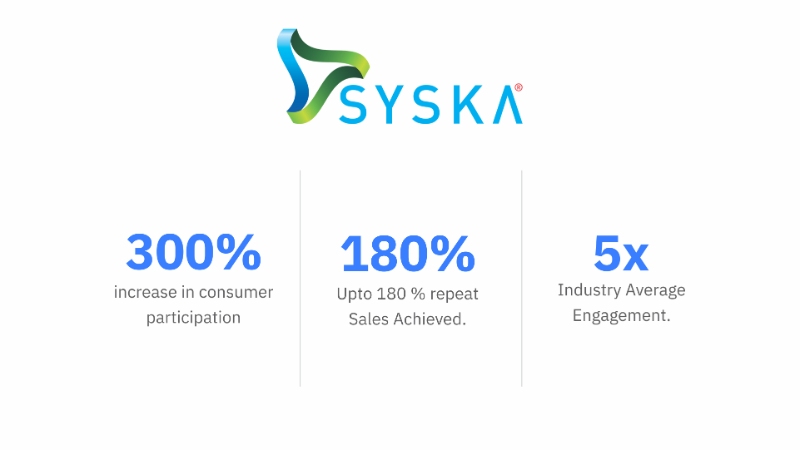
## **How can your consumer electronic brand benefit from this solution?**
NeuroWarranty's [warranty management software](https://www.neurowarranty.com/) is helping Syska, Resqtech, Smartshout and 100+ leading brands increase their repeat sales by transforming their postsales services.
**What are you waiting for?**
Make Digital Warranty Management System your Strategic Advantage!
[**_Check out the list of the best warranty management solutions for the year 2022._**](https://neurowarranty.com/blog/5-best-warranty-management-software-in-2022-ckzqvwn3k169851llanw48z6yo)
### NeuroWarranty guarantees -
1. Increase in revenue and profit
2. Up to 90% decrease in warranty-related costs.
3. Up to 180% increase in repeat sales.
4. 100% Reduction in fraudulent warranty claims
5. Data of your Amazon, Flipkart and retail end customers
6. 5X customer engagement compared to your competitors.
7. Kickstarting your D2C journey.
If you wish to convert your warranty expenses into a profit-making asset, schedule a call with our solution experts and get a solution that has delivered results for market leaders in the consumer electronics segment. [Schedule a call now.](https://calendly.com/aabhishekbindal/neurotags-demo?month=2022-02)
---
This blog is powered by Superblog. Visit https://superblog.ai to know more.
---
## 5 Best Warranty Management Software in 2022
Author: Abhishek Agrawal
Author URL: https://www.neurowarranty.com/blog/author/abhishek-agrawal
Published: 2022-02-17
Tags: Warranty Management, warranty mangement software
Tag URLs: Warranty Management (https://www.neurowarranty.com/blog/tag/warranty-management), warranty mangement software (https://www.neurowarranty.com/blog/tag/warranty-mangement-software)
URL: https://www.neurowarranty.com/blog/5-best-warranty-management-software-in-2022-ckzqvwn3k169851llanw48z6yo
There is a lot of hassle associated with warranty management. The process for doing it manually is long, repetitive, and prone to error. You can eliminate a lot of the hassle by using global warranty management software. This blog will look at the top 5 best global warranty management software in order of their advantages so you can choose one that's right for you.
When it comes to managing product warranties, you need software that understands the nuances of warranty management and has the right tools to make your life easier. Some of the most popular warranty management software are NeuroWarranty, Tavant Warranty, Pega Warranty Management, A1 Trackker's Warranty Management and Intelli Systems.
[**Read this blog to find the best warranty management software of the year 2023.**](https://www.neurowarranty.com/blog/best-warranty-management-software)
Contents
- [NeuroWarranty](#neurowarranty)
- [How does it work?](#how-does-it-work)
- [Features -](#features)
- [Dyrect](#dyrect)
- [Features -](#features)
- [Pega Warranty](#pega-warranty)
- [Features -](#features)
- [A1 Tracker](#a1-tracker)
- [Features -](#features)
- [Intelli Warranty](#intelli-warranty)
- [Features -](#features)
- [5 Best Warranty Management Solutions 2022 - Which is the best warranty management software?](#5-best-warranty-management-solutions-2022-which-is-the-best-warranty-management-software)
## NeuroWarranty
Number one in our list of the best warranty management software (2022) is NeuroWarranty. [NeuroWarranty](https://neurowarranty.com/) is a unique and currently the leading warranty management software that redefines the way warranties work and helps brands convert their warranty expenses into an opportunity to connect with their customers and retain them for more repeat business and higher revenues.
### How does it work?
NeuroWarranty is a QR Code-based warranty management software that is easy to implement yet extremely powerful. Customers can register for a warranty by simply scanning a QR code placed on your product and entering the purchase details. Once registered, customers no longer need to secure purchase bills and invoices.
When a warranty claim request is placed by a customer, the Inbuilt CRM kicks in and automates the process to make warranty management easier for your client servicing teams.
With NeuroWarranty, brands get the power to access customer data that can be leveraged by their marketing teams in endless ways. The fully automated and fault-proof warranty process works efficiently to deliver an unparalleled post-sales customer experience with minimum effort. The No App required [digital warranty Software](https://www.neurowarranty.com/) facilitates offline to the online transition of customers and enables businesses to increase customer LTV and repeat sales.
### Features -
- Inbuilt CRM
- Access to Customer Data
- Analytics Dashboards
- Remarketing Solutions
- Paperless Solution
- Multiple Claims management
- Warranty Status Tracking
- Identifying Fraud/ Expired Claims.
> "NeuroWarranty is an awesome solution for all sellers and manufacturers to give the best support to their customers." It is very useful in getting the customer to register and avail warranty, and also it's very easy for us as sellers to monitor the warranty registrations and claims.
>
> Mr. Ranjit B, Head of business development. ResqTech.
You can sign up for the warranty management software by scheduling a demo and getting a free 14-day trial here [get a demo](https://calendly.com/aabhishekbindal/neurotags-demo?month=2022-02), when you schedule a demo an account manager will contact you and you can organize a call to discuss your business requirements.
**Cons -** It might be a bit tough for a customer who doesn't have a smartphone to scan the code to activate the online warranty .
_[Know 6 essential factors you need to consider before choosing a warranty management software.](https://neurowarranty.com/blog/how-to-choose-a-warranty-management-solution-6-things-things-to-consider-cky01k675305691ks20jihwv4w)_
## [Dyrect](https://www.dyrect.co/)
Number 2 on the list of our best warranty management software for the year 2022 is Dyrect. [Dyrect's warranty solution](https://www.dyrect.co/) is an end-to-end warranty product registration system that helps brands reduce warranty costs, get first-party customer data, and improve the post-sales warranty experience. Dyrect is a combination of warranty expertise, industry best practices, and technology innovation. The solution is aimed at allowing brands to increase their repeat sales by providing an unparalleled warranty experience to customers.
### Features -
1. No App Download
2. Inbuilt CRM
3. Single Sign-on
4. Automate Warranty Claims
5. Complete Data Ownership for Brands.
## **Pega Warranty**
Pega is ranked third in the best warranty management software list. [Pega Warranty Management](https://www.pega.com/industries/manufacturing/warranty-management) provides fast, efficient claims management and reduces warranty costs. this cloud-based platform offers performance-oriented and customer-focused warranty services. This solution is capable of handling changing business requirements and the frequent technical updates demanded by connected smart devices. Pega Warranty streamlines and improves the end-to-end warranty process.
### Features -
1. Advanced claim analytics
2. Product/warranty registration
3. Repair order and diagnosis decisions
4. Multi-channel claims submissions
5. Claim processing and exception handling.
6. Claims analysis
**Cons**\- Not having complete access to data of registered customers as compared to other solutions like NeuroWarranty.
## A1 Tracker
[A1 Tracker’s](https://www.a1tracker.com/warranty-management-software/) Warranty Management software gives warranty administrators full control over the warranty lifecycle and your guarantee programs. The ability to manage agreements & related claims is key for a successful [warranty management operation](https://www.neurowarranty.com/).
The web-based warranty portal gives customers, sales reps, and retailers a simple tool to submit a warranty request online and follow the process from start to finish. Warranty purchases, renewals, and claims are reportable in a single warranty database which centralizes data between customers, retailers, and products under warranty.
### Features -
- Warranty Claims
- Parts & Products
- Customer Management
- Vendor Management
- Approval Workflow
**Cons**\- A below average customer experience for the end users when compared to other warranty software in the 5 best warranty software list.

_**Know more about who one of the biggest consumer electronics brands Syska choose to manage their product warranties.**_ [_**Download Free Syska Case Study**_](https://neurowarranty.com/case-study) _**.**_
_****_
## Intelli Warranty
[Intelli Warranty](https://www.intellinetsystem.com/warranty-management-software.htm) by Intellinet is a warranty management and claims software. Use this solution to reduce your warranty cost to the minimum, automate warranty claims, streamline your [warranty management system](https://www.neurowarranty.com/) and increase your service revenue to the maximum with Warranty software.
The software offers cross-browser compatibility as well as has a responsive design. It integrates the entire warranty process and offers a complete solution for all warranty-related issues.
### Features -
- Multiple claims
- Easy integration with EPC, SAP, SI, and other modules
- Restricted access to user
- Work queue management
**Cons**\- The software is mainly focused on B2B businesses and does not cater to the needs of consumer product brands.
### 5 Best Warranty Management Solutions 2022 - Which is the best warranty management software?
All the warranty management software on the 2022 list of the best warranty management software bring something unique to the table to resolve different management issues and help you drive your business.
This does mean you’ll need to trial a few to see what works best for you. To see schedule a demo and get a free 14 day trial of NeuroWarranty's warranty management software [click here.](https://calendly.com/aabhishekbindal/neurotags-demo?month=2022-02)
---
This blog is powered by Superblog. Visit https://superblog.ai to know more.
---
## 6 effective ways you can bring your Amazon customers to your website.
Author: Abhishek Agrawal
Author URL: https://www.neurowarranty.com/blog/author/abhishek-agrawal
Published: 2022-02-09
Meta Title: 6 effective ways you can bring your Amazon customers to your website.
Tags: warranty management solution, D2C
Tag URLs: warranty management solution (https://www.neurowarranty.com/blog/tag/warranty-management-solution), D2C (https://www.neurowarranty.com/blog/tag/d2c)
URL: https://www.neurowarranty.com/blog/6-effective-ways-you-can-bring-your-amazon-customers-to-your-website-ckzfhj6rq12471jt7s9rboxh3

With retail sales becoming increasingly online, the commission rates by marketplaces like Amazon and Flipkart are costing brands a large chunk of their profit margins. With commission rates as high as 20%, brands are increasingly looking for ways to reduce their dependency on marketplaces like Amazon for their sales.
And even if brands are to ignore the high commission rates, Amazon policies like not allowing brands to re-market, not allowing brands to access customer data and [misusing your data to copy your products](https://www.linkedin.com/pulse/amazon-using-your-data-copy-products-connect-customers-before-/?trackingId=ui4bBi%2BUcUXpcq8mGd4UCg%3D%3D) is guaranteed to harm your brand and affect your sales in the long run.
Amazon has a lot of policies in place that prevent directing customers off of the marketplace and to your website. However, it is possible to get direct purchases from your Amazon customers without breaking the rules.
Contents
- [1\. Bundle your products to encourage repeat sales -](#1-bundle-your-products-to-encourage-repeat-sales)
- [How to bring these customers to your website?](#how-to-bring-these-customers-to-your-website)
- [2\. Use product packaging to encourage website visits -](#2-use-product-packaging-to-encourage-website-visits)
- [4\. Use warranty management to bring your Amazon customers to your website -](#4-use-warranty-management-to-bring-your-amazon-customers-to-your-website)
- [5\. Increase social media presence -](#5-increase-social-media-presence)
- [6\. Use Facebook ads -](#6-use-facebook-ads)
- [How to get customer data from amazon -](#how-to-get-customer-data-from-amazon)
- [How to target your Amazon customers on Facebook - Create a Custom Audience](#how-to-target-your-amazon-customers-on-facebook-create-a-custom-audience)
- [Need help with bringing your Amazon customers to your website?](#need-help-with-bringing-your-amazon-customers-to-your-website)
## 1\. Bundle your products to encourage repeat sales -
When thinking about creating a product bundle to sell on Amazon, the first thing to keep in mind is that bundles and multipacks are not the same! A bundle usually consists of complimentary items sold together as part of a set that typically cost less than purchasing the individual items separately.
For example, if you sell a hair shampoo that comes in six different fragrances, then you should not consider bundling six bottles of each kind together into its package. Instead, bundle 3 Bottles of a specific shampoo and one bottle of conditioner that goes along with the type of shampoo.
When your customer runs out of conditioner, they would want to buy this specific conditioner.
Limit to offering individual conditioners on your website instead of on Amazon. That way, the customer will have to purchase directly from your site when their conditioner runs out because the ones included in the bundle will not last forever.
### **How to bring these customers to your website?**
1. Include a card with your web address so that the customer knows where to visit for purchase.
2. Although you cannot direct your customers to your website directly, What if your customer reaches out to you through the Amazon listing asking for a conditioner? You can let them know that you do not sell these individual items on the marketplace, which will offer a hint to check out your website instead.
## 2\. Use product packaging to encourage website visits -

One of the oldest market tricks that drive customers to your website is placing an insert or a card in the packaging delivered to the customer. Insert cards are the first thing your customers see when they open your product package so, it is essential to design your insert card effectively to deliver the most value.
Your Insert cards may be ignored if they are no more than a marketing message. To drive more customers make sure your insert cards deliver value like Discount Coupons, Style Guides, product and user manuals.
**Know how Syska brought its marketplace customer to its website using product packaging- [Download case study.](https://neurowarranty.com/case-study)**
3\. Provide an incentive for website sales -
Buyers nowadays go through an intensive research process before purchasing through any platform. The research includes reading customer reviews, checking through the brands' websites, and even taking a look at the brands' social media presence.
With so many touchpoints available, if you are looking to drive amazon traffic to your website, make sure to include special incentives for website sales in your marketing message across platforms.
## 4\. Use warranty management to bring your Amazon customers to your website -
A lot of the time, Insert cards and discount coupons will be deemed unnecessary and get ignored by your customers. To drive the most number of consumers to your website, you need to build a bridge that cannot be ignored.
A QR code-based digital warranty solution is the newest and the most result driving method used by new-age brands these days.
How does a digital warranty solution help you bring your amazon customers to your website?
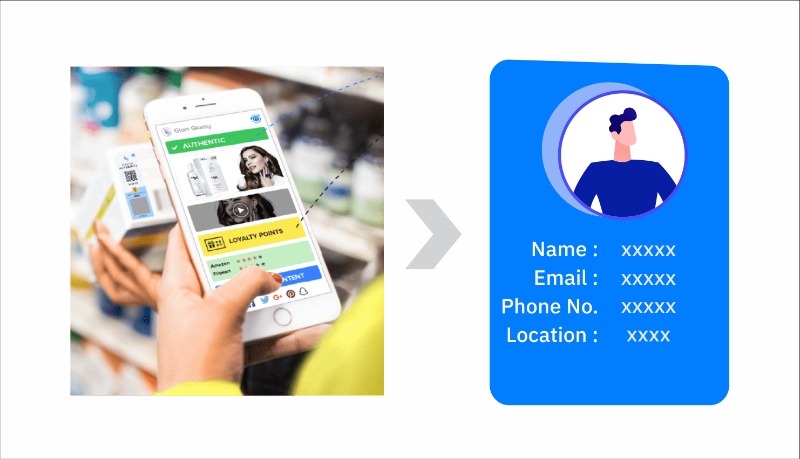
Digital warranty solutions work by having a QR code placed on your product or product packaging. Whenever a customer wants to register for or claim a warranty, the customer can scan the QR code and get directed to a custom-built page.
This custom-built page asks the customers for their purchase details along with their personal data like Names, phone numbers and email ids. This personal data is then used by brands for direct targeting, remarketing and bringing their customers to their websites.
A benefit of using QR code-based warranty solutions is getting direct access to the data of your customers which, can then be used to re-market and retain them.
Digital warranty solutions like NeuroWarranty have helped Syska, Portronics, FLO, and a 100+ leading brand increase go D2C and bring their marketplace customers to their website. To know more about how a digital warranty solution can help your brand bring your marketplace customers to your website - [Click here.](https://calendly.com/aabhishekbindal/neurotags-demo)
## 5\. Increase social media presence -
You can also use social credibility to enhance your site’s value. Similar to any review or testimonial, social proof brings the human voice into your brand experience.
In attracting consumers of today, social media plays a very important role. Use social media not to sell your products but to engage your audience. Whenever someone is about to make a purchase or is shopping for something they want, they look for reviews, recommendations, referrals, and input from others who have used the product or service.
Include exciting discounts, offers and clear CTA's to increase the number of website visits from your social media.
## 6\. Use Facebook ads -
Facebook ads is another effective method to get amazon customers to your website. Facebook ads allow you to target specific audiences that you build based on your customers’ key demographics.
Amazon does not provide you with the phone numbers and email id of your buyers however, it does give you their names and postal codes, which is all it is needed. To create an audience with your Amazon customers, download a Seller Central report with your customers' names and address information.
### **How to get customer data from amazon -**
1. Go to Reports in Seller Central
2. Click on Fulfillment
3. Go to the Sales tab in Fulfillment Reports.
4. Click on Amazon Fulfilled Shipments
5. Input the date range and request download
To build your audience, the only information you need is the buyer name, city, state postal code. When you export your fulfilled shipments report, you can remove all but these columns.
The “buyer-name” column will have both the first and last name so make sure to separate the last name into its own column as seen below.
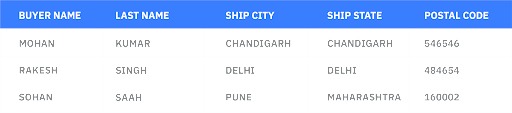
### **How to target your Amazon customers on Facebook -** **Create a Custom Audience**
1. Click Create Audience
2. Select Custom Audience
3. Choose the Customer File option
4. Choose 'Add customers from your own file or copy and paste data.'
5. Upload your prepared customer file
Once the information is uploaded, Facebook will begin to target as many profiles as possible that match the information you uploaded.
One thing you might notice is that your audience is a little small. Even more so if you segment it, however, Facebook can help you broaden your reach by allowing you to create a Lookalike Audience that is similar to your Amazon customers, this can help you reach audiences who are similar to your customers but are not yet aware of your product.
### **Need help with bringing your Amazon customers to your website?**
NeuroWarranty has helped leading brands kickstart their D2C journey and increase their profit margins by bringing their existing customers to their website. [Book a quick demo](https://calendly.com/aabhishekbindal/neurotags-demo) to know how you can bring your customers to your website and increase your profit margins.
---
This blog is powered by Superblog. Visit https://superblog.ai to know more.
---
## How to choose a warranty management solution? | Neurowarranty
Author: Abhishek Agrawal
Author URL: https://www.neurowarranty.com/blog/author/abhishek-agrawal
Published: 2022-01-04
Meta Title: How to choose a warranty management solution? 6 things things to consider.
Tags: Digital Warranty Management, Warranty Management Services
Tag URLs: Digital Warranty Management (https://www.neurowarranty.com/blog/tag/digital-warranty-management), Warranty Management Services (https://www.neurowarranty.com/blog/tag/warranty-management-services)
URL: https://www.neurowarranty.com/blog/how-to-choose-a-warranty-management-solution-or-neurowarranty-cky01k675305691ks20jihwv4w
When it comes to keeping customers happy and turning them into long-term customers, a strong post-sales customer experience is what a brand needs to ace. Warranties and service contracts are essential for earning customer loyalty, making it essential to choose a warranty management system sensibly.
Customer satisfaction is a crucial success metric for many companies, and the work of Service Providers, especially Warranty Managers, is to maintain that level of satisfaction for your customers.
Contents
- [Can the solution automate and simplify warranty processes?](#can-the-solution-automate-and-simplify-warranty-processes)
- [Is the warranty management solution easy to implement?](#is-the-warranty-management-solution-easy-to-implement)
- [Can the solution get you valuable customer data?](#can-the-solution-get-you-valuable-customer-data)
- [Is the solution easy to use for your end customers?](#is-the-solution-easy-to-use-for-your-end-customers)
- [Can the warranty management solution help you manage customer communications?](#can-the-warranty-management-solution-help-you-manage-customer-communications)
- [Is the warranty management solution cloud-based?](#is-the-warranty-management-solution-cloud-based)
## Can the solution automate and simplify warranty processes?

For most solutions, the answer is no. Here is where the real value of a warranty management solution comes into play. The software should be designed to automate the tedious aspects of a warranty process.
Whether it is collecting warranty data or sending out notifications, the solution should be able to handle it effortlessly. This can save a lot of time and money that would otherwise be spent on building the process manually.
Traditional warranty management processes are manual and labour intensive, thus driving up costs. [Automating the warranty process](https://www.neurowarranty.com/blog/warranty-management-app-reduce-costs-and-automate-your-product-warranties-cl1g7op6l65941jlfkyb2vlqj) allows you to reduce your dependency on customer support executives and reduce customer support costs. Automating the process allows brands to manage a large number of warranty claims at once on a single screen, thus cutting down the operational cost significantly.
## Is the warranty management solution easy to implement?
Warranty management solutions are designed to make your life easier, so why should you find it hard to get them up and running? You should be able to install the solution without any help from the vendor, and you should be able to get your data in and out of the system.
If you have to spend a lot of time setting up the solution and moving data around that will probably be reflected in a longer implementation time and a bigger budget. You can and should ask to see an implementation demo before making a final decision.
## Can the solution get you valuable customer data?

This is a great question and one that you should ask all of your providers. Many solutions out there can get you some warranty data, and a few can get you a lot of it (like [NeuroWarranty](https://www.neurowarranty.com)!). But getting detailed data on how you are doing with your warranties is key to making decisions about a warranty program for your business.
If the provider won’t tell you how many warranties you have, what the average length of the warranty is, or how many people call in, then it is likely the data they are getting isn’t that great. Getting this information, then looking at it and seeing how it compares to industry standards can give you insight into how your business is doing and what you should be focusing on.
[Get data of your Amazon and other marketplace customers now!](https://www.neurowarranty.com/)
## Is the solution easy to use for your end customers?
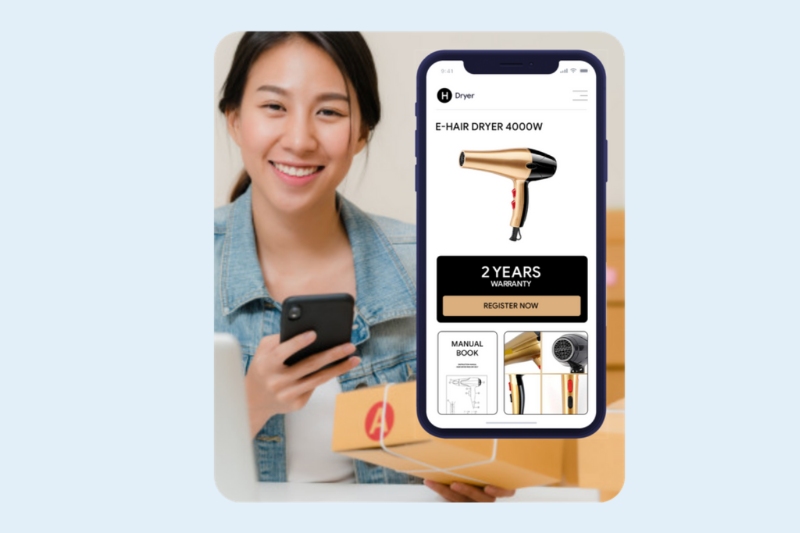
When it comes to choosing a [warranty management solution](https://www.neurowarranty.com/) for your business, there are a lot of different options available. The best way to decide which one is right for you is to consider how easy the solution is for your end customers. Some of the best warranties that experience high redemption rates are the ones that offer simple onboarding and registrations.
With the help of NeuroWarranty, [registering for a warranty claim](https://www.neurowarranty.com/blog/warranty-management-app-reduce-costs-and-automate-your-product-warranties-cl1g7op6l65941jlfkyb2vlqj) becomes much simpler. Customers can register for a warranty by simply scanning a QR code placed on your product and entering the purchase details. Once registered, customers no longer need to secure purchase bills and invoices.
When a warranty claim request is placed by a customer the Inbuilt CRM kicks in and automates the process to make warranty management easier for your client servicing teams.
## Can the warranty management solution help you manage customer communications?
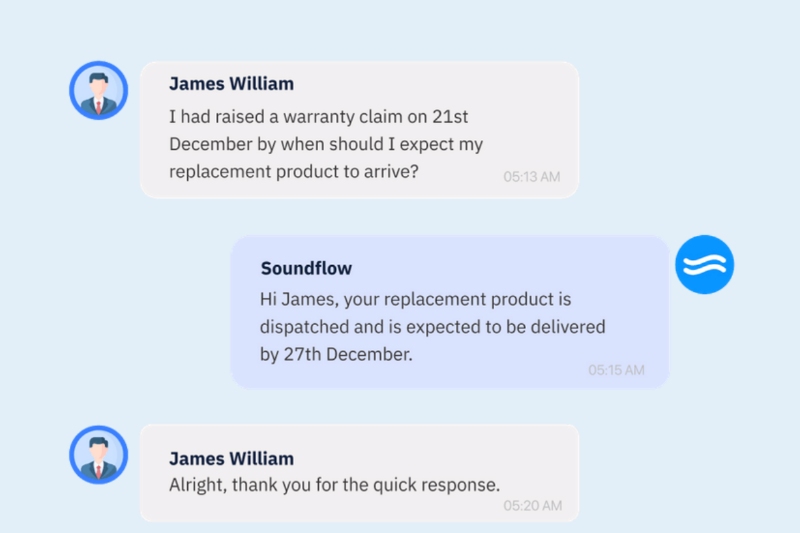
Inbuilt CRM offered by advanced warranty management systems unifies the data used by service teams for effective warranty management. Businesses can organize customer queries from one source.
In addition to using the in-built CRM, customers can also send product feedback via email or SMS. Businesses can follow up on the input and have personalized communications with the customers to solve the problem and enhance customer satisfaction.
Managing feedback and reviews on a CRM, you can analyze the feedback to improve your product, service and leverage good reviews to build trust and image for your brand and increase sales.
While buying separate CRM tools can be expensive and difficult to manage, you can save tons of money spent on buying additional CRM tools. Digital warranty management solutions like [NeuroWarranty](https://www.neurowarranty.com/blog/warranty-management-app-reduce-costs-and-automate-your-product-warranties-cl1g7op6l65941jlfkyb2vlqj) come with inbuilt CRMs and allow your customer support executives to manage the entire post-sales experience from a single screen.
## Is the warranty management solution cloud-based?

A cloud-based warranty management solution is a good choice if you want to move your business to the cloud while keeping all the important data in one place and not worrying about the version of your software. Cloud-based systems are a good choice for businesses that are going global and are not sure about the future.
Making sure that your business is as prepared as possible when it comes to a warranty management solution is not a decision to be taken lightly. That is why here at NeuroWarranty, we work with you every step of the way to ensure that your business needs are being met.
_**[Check the list of the top 5 best warranty solutions.](https://www.neurowarranty.com/blog/5-best-warranty-management-software-in-2022-ckzqvwn3k169851llanw48z6yo)**_
If you have been considering getting a warranty management solution, we hope you found today’s blog post helpful. If you have any questions or would like to get a demo of NeuroWarranty's digital warranty solution, please book a consultation session according to your convenience [here](https://calendly.com/aabhishekbindal/neurotags-demo). Thank you for reading!
---
This blog is powered by Superblog. Visit https://superblog.ai to know more.
---
## How to increase your revenue using warranty services?
Author: Abhishek Agrawal
Author URL: https://www.neurowarranty.com/blog/author/abhishek-agrawal
Published: 2021-12-29
Meta Title: How to increase your revenue using warranty services?
Tags: Digital Warranty Management, Warranty Management Services
Tag URLs: Digital Warranty Management (https://www.neurowarranty.com/blog/tag/digital-warranty-management), Warranty Management Services (https://www.neurowarranty.com/blog/tag/warranty-management-services)
URL: https://www.neurowarranty.com/blog/how-to-increase-your-revenue-using-warranty-services-ckxrcdsrl163021kn8g75qclw7

Warranty is an important ingredient in building customer satisfaction and paving the road to retaining them. A well-executed Warranty process reinforces customers’ faith in your brand because they feel taken care of even after the purchase. It helps your brand retain customers and eventually increase sales.
Many companies think of warranty management as just another part of their customer service and a burden on their sales revenues. However, with the help of a sound warranty management solution, you can turn your warranty expenditure into a profit-making asset.
This blog will look into how brands can leverage warranty management to increase sales and profits.
## 1\. Use warranty analytics to get market insights.

[Warranty solutions](https://www.neurowarranty.com/) equipped with intelligent dashboards offer relevant insights for better decision-making. There are many reasons why you would want to equip your business with a digital warranty solution. One of them is because they give you unique insights into the performance of your product in the field.
Analytics dashboards can give you an idea of how your product performs across various geographies and demographics and where you need to improve. This data can help your brand make better decisions in various areas of your business.
With the right warranty analytics in place, businesses can save time, money and resources, and make better decisions. When shopping for a warranty solution, it's important to find a solution that can offer you the [right warranty analytics](https://www.neurowarranty.com/warranty-management-solution). The solution should be able to provide the right services that fit your needs and is optimized your business.
## 2\. Using customer data to resell and retain customers.

[Customer data](https://www.neurowarranty.com/collect-offline-consumer-data) is the biggest advantage for businesses, whether it be for online or offline marketing campaigns. It facilitates the retention of existing customers when utilized for loyalty programs and acquires new customers for other products through effective marketing strategies like promotion and cross-selling.
Customer data is a gold mine for any business and is the biggest advantage that they could have. Businesses use it to help them retain their existing customers by utilizing a loyalty program and acquiring new customers for their other products through a cross-selling strategy. They can also use customer data to tailor every online marketing campaign to their existing customers to increase their return rates. Customer data can be used to promote businesses in a way that's more personal because it's like having a relationship with every customer.
## 3\. Bring your customers online and go D2C

D2C has immerged to become one of the most profitable business models post-covid, and brands are going all out to kickstart their D2C journey. As the online shift is evident and the future of retail sales is online, if your brand fails to bring your offline customers online, customers will move to your competitors who can facilitate this transition.
_**[Know how you can bring your Amazon customers directly to your website](https://www.neurowarranty.com/blog/6-effective-ways-you-can-bring-your-amazon-customers-to-your-website-ckzfhj6rq12471jt7s9rboxh3)**_.
Bringing your customers online also gives you access to valuable customer data. This data can then be used by your marketing teams to personalize and segment your remarketing campaigns to achieve maximum customer retention rates. A [warranty solution](https://www.neurowarranty.com/) like NeuroWarranty brings your offline customers online by aiding a smooth transition through a digital warranty registration process.
## 4\. Leverage feedback and reviews to attract new customers

Collecting feedback and reviews from your end customers can prove to be a rather complicated task, notably for consumer product brands. Using Customer Relationship Management (CRM) software, your end customers can connect directly with your client servicing teams and give reviews, feedback.
Managing feedback and reviews on a CRM, you can analyze the feedback to improve your product, service and leverage good reviews to build trust and image for your brand and increase sales.
While buying separate CRM tools can be expensive and difficult to manage, you can save tons of money spent on buying additional CRM tools. Digital warranty management solutions like [NeuroWarranty](https://www.neurowarranty.com/blog/warranty-management-app-reduce-costs-and-automate-your-product-warranties-cl1g7op6l65941jlfkyb2vlqj) come with inbuilt CRMs and allow your customer support executives to manage the entire post-sales experience from a single screen.
## 5\. Retain existing customers and increase clv

The majority of consumer brands struggle with retaining customers, as they fail to provide a good post-sales experience and not remarket effectively.
Customers often have to go through the hassle of finding old purchase bills and going through endless calls with your client servicing teams to access some essential post-sales services like warranty claims and product replacement. This leads to an overall bad customer experience and leaves the customer dissatisfied with your brand.
Data from Oberlo shows that 80% of businesses consider email marketing as the most effective strategy for retaining customers. The lack of access to customer data like emails and phone numbers makes the majority of retail and consumer brands struggle with their remarketing efforts. Not being able to target the right segment of customers at the right time costs brands invaluable repeat business.
[Get data of your Amazon and other marketplace customers now!](https://www.neurowarranty.com/)
## How can a warranty management solution help you retain customers and increase repeat sales?
### [1\. Providing an unparalleled post-sales experience.](https://www.neurowarranty.com/digital-warranty-management-software)
NeuroWarranty's digital warranty solution allows your customers to claim a warranty with just a few clicks, avoiding the hassle of finding old purchase bills and going through endless calls with your customer service teams. This creates an unparalleled customer experience and results in customer satisfaction.
### [2\. Bringing you data like Email Ids, Phone Numbers of your end-customers.](https://www.neurowarranty.com/collect-offline-consumer-data)
NeuroWarranty also empowers brands by bringing them data such as emails, phone numbers and names of their end customers allowing your marketing teams to personalize your remarketing efforts increasing repeat sales and maximum customer retention rates.
This blog post has covered how you can expand your revenue streams by offering warranty services to your clients. We hope you have been inspired by this blog post and can use this information to expand your own revenue sources and help your business grow as a result. To know how a digital [warranty solution](https://www.neurowarranty.com/blog/warranty-management-app-reduce-costs-and-automate-your-product-warranties-cl1g7op6l65941jlfkyb2vlqj) like NeuroWarranty can help you convert your warranty expenses into a profit-making asset - [click here](https://calendly.com/aabhishekbindal/neurotags-demo?month=2021-12)
---
This blog is powered by Superblog. Visit https://superblog.ai to know more.
---
## Reduce the cost of your product warranty claims - Here is How
Author: Abhishek Agrawal
Author URL: https://www.neurowarranty.com/blog/author/abhishek-agrawal
Published: 2021-12-23
Meta Title: Reduce the cost of your product warranty claims - Here is How
Meta Description: Are you worried about the cost of a product Warranty claim? Here is how you can reduce the costs of your product warranty claims - 1. Use data and analytics 2. Identify fraud claims 3. Automate the process...
Tags: Digital Warranty Management, Warranty Management Services
Tag URLs: Digital Warranty Management (https://www.neurowarranty.com/blog/tag/digital-warranty-management), Warranty Management Services (https://www.neurowarranty.com/blog/tag/warranty-management-services)
URL: https://www.neurowarranty.com/blog/reduce-the-cost-of-your-product-warranty-claims-here-is-how-ckxiopr0204981ks7c5ibicfx
At a time when customer retention drives sales and customer experience is the name of the game, brands look forward to providing an unparalleled warranty claims experience for their customers. However, [warranty management](https://www.neurowarranty.com/blog/warranty-management-app-reduce-costs-and-automate-your-product-warranties-cl1g7op6l65941jlfkyb2vlqj) is a complex field and can prove to become a burden on companies profit. Read this blog to know how you can reduce your warranty claims cost.
Warranty claims can cost brands between 1.5 - 4 percent of sales revenues, depending on the industry and product segment. And when handled improperly, warranties make companies lose business and revenue almost irretrievably.
Contents
- [Use data and analytics to reduce warranty claims cost -](#use-data-and-analytics-to-reduce-warranty-claims-cost)
- [Improving your customer service -](#improving-your-customer-service)
- [Improving your product -](#improving-your-product)
- [Automate your warranty process to reduce costs -](#automate-your-warranty-process-to-reduce-costs)
- [Identify fraud, repetitive claims to reduce warranty claims costs -](#identify-fraud-repetitive-claims-to-reduce-warranty-claims-costs)
- [Frauds can be classified into 2 categories:](#frauds-can-be-classified-into-2-categories)
- [Duplicate products:](#duplicate-products)
- [Customer Frauds:](#customer-frauds)
- [The Solution?](#the-solution)
- [Serialize your Products -](#serialize-your-products)
- [Digitize the Warranty Process -](#digitize-the-warranty-process)
## Use data and analytics to reduce warranty claims cost -

Harnessing and utilizing warranty data is any manufacturer's best bet for reducing warranty costs. Warranty data can be utilized for two major objectives -
### Improving your customer service -
Data can help you streamline your warranty claims service. Using reports from the analytics dashboards, brands can review the process at scale and figure out new easier processes. Analyzing the data will allow you to look into your post-sales customer service and find out which step the customer finds the most exhaustive and time-consuming.
### Improving your product -
Track warranty data to find out what aspect of the product is triggering the most warranty claims. Warranty data not only allows you to save R&D costs but also allows you to use user-generated data to create an improved customer experience. Warranty data provides direct information about how and when your products fail. With this information, you can identify parts and systems that need improvement. [Warranty data](https://www.neurowarranty.com/collect-offline-consumer-data) will even give you insight into what needs to be improved to reduce failure rates and improve customer satisfaction.
## Automate your warranty process to reduce costs -

Traditional warranty management processes are manual and labour intensive, thus driving up costs. [Automating the warranty process](https://www.neurowarranty.com/warranty-management-solution) allows you to reduce your dependency on customer support executives and reduce customer support costs. Automating the process allows brands to manage a large number of warranty claims at once on a single screen, thus cutting down operational cost significantly.
**Know how Syska reduced its warranty costs by automating its claims process -** [Download case study.](https://www.neurowarranty.com/case-study)
## **Identify fraud, repetitive claims to reduce warranty claims costs -**

[Warranty fraud](https://www.neurowarranty.com/blog/here-is-how-you-can-stop-warranty-frauds-faced-by-your-brand-cl202i0jv16301ll8aet2xuhl) can be difficult to detect, especially without skilled resources, processes and controls in place -- e.g. internal audit departments, anti-fraud policies, and formal fraud risk assessment. As brands look forward to providing the best customer experience, a lot of such repetitive and fraudulent claims are left on the suspicion stage.
## Frauds can be classified into 2 categories:
### Duplicate products:
If customers love your products, there is a high possibility that counterfeit/ look alike products of yours are floated in the market with your brand name. Your brand name is used by the counterfeit & sell substandard products in your name. This not only increases your warranty claims, but customers also lose trust towards your brand.
### Customer Frauds:
A large chunk of fraudulent claims come from fraudsters who mix up with real customers who end up losing their warranty cards and bills. Also, customers at times intentionally provide an out of the warranty product under claims.
About 10-15 percent of warranty claims are classified as intentionally fraudulent (as against typos or accidental errors, which are easily detected during verification). Know more about how you can stop fraud warranty claims - [Stop warranty frauds](https://www.neurowarranty.com/blog/here-is-how-you-can-stop-warranty-frauds-faced-by-your-brand-cl202i0jv16301ll8aet2xuhl).
By eliminating fraudulent claims early in processing, you save not only money but precious time and resources as well.
## The Solution?
## Serialize your Products -
You should serialize your products so that every product can be uniquely identified and tracked at any point in the supply chain.
Benefits: When any product comes for warranty claims, you can track details like when the product was manufactured, who was the supplier/ OEM. This will help in tracking which supplier is using the wrong product.
## Digitize the Warranty Process -

Digitizing the warranty claims process puts your warranty service into an auto-pilot mode resulting in reduced service costs and a hassle-free experience for your customers. Digitization allows you to convert your warranty expenses into a profit-making asset as it brings with it customer data. Heading forward, brands will need a warranty management solution that delivers more than just simplifying warranties. A [digital warranty solution](https://www.neurowarranty.com/blog/warranty-management-app-reduce-costs-and-automate-your-product-warranties-cl1g7op6l65941jlfkyb2vlqj) does that by bringing your customers online, providing data of end customers and allowing you to manage customer communications.
Investing in the right [warranty management software](https://www.neurowarranty.com/) can be daunting for companies with a limited budget and complex requirements.
NeuroWarranty is a one stop solution that automates your warranty process to reduce costs. The QR-based [Warranty Management Software](https://www.neurowarranty.com/features) not just helps optimize and automate the warranty process but prepares you for the future of sales by allowing you to bring your offline customers online and access customer data to effectively remarket and resell.
---
This blog is powered by Superblog. Visit https://superblog.ai to know more.
---
## How to create a simplified product warranty registration process using QR codes
Author: Abhishek Agrawal
Author URL: https://www.neurowarranty.com/blog/author/abhishek-agrawal
Published: 2021-12-13
Meta Title: How to create a simplified product warranty registration process using QR codes
Meta Description: QR codes play a vital part in streamlining the product warranty registration process, registration of new items collected by consumers can help manufacturers in delivering critical data or information...
Tags: Warranty Management Services, QR codes
Tag URLs: Warranty Management Services (https://www.neurowarranty.com/blog/tag/warranty-management-services), QR codes (https://www.neurowarranty.com/blog/tag/qr-codes)
URL: https://www.neurowarranty.com/blog/how-to-create-a-simplified-product-warranty-registration-process-using-qr-codes-ckx48j9x537831lqcl95chvxs
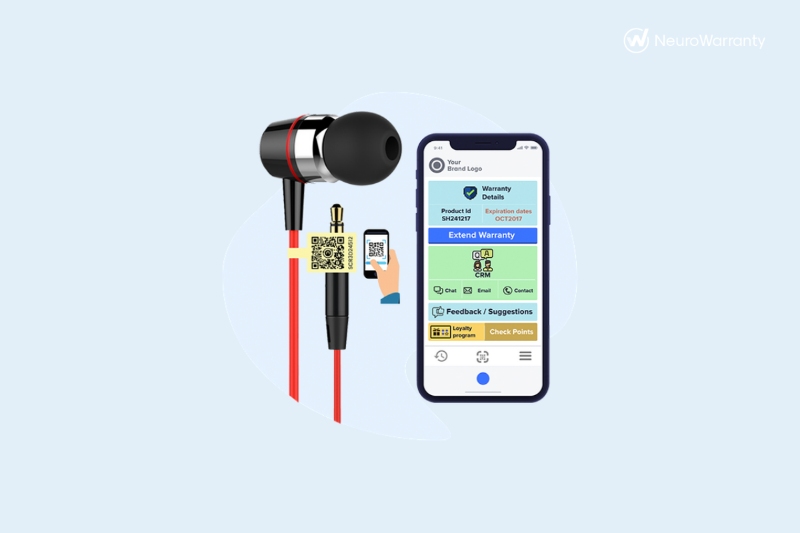
When consumers buy a particular product like a refrigerator, air conditioner, or laptop, every device usually comes with a warranty management card. The form used to be completed by customers and mailed back to the firm from which they purchased the item, but now you must complete it and leave it at the store when you purchase anything, such as when you purchase a mobile phone, in order to get your item.
Most influential organizations already have [warranty management software for a seamless and speedier client experience](https://www.dyrect.co/blog/best-warranty-management-software). But currently, warranty registrations are made easy where it may be done online. So, how can QR codes play a vital part in streamlining the product warranty registration process?
### What is product warranty registration?
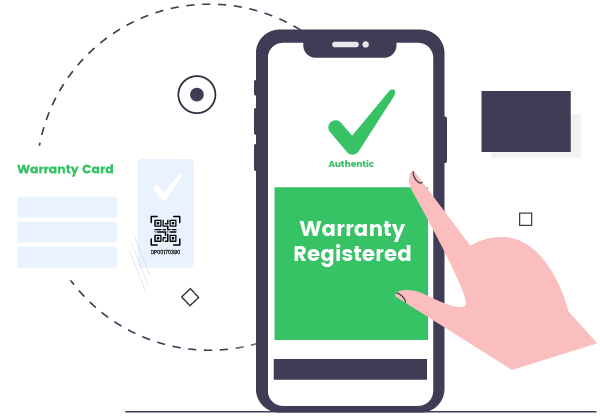
When any equipment is sold to a customer, a Product Warranty Registration (WR) is needed. While completing a warranty registration, all data is obtained and kept, including buyer/customer information, applied policies, and sales records. In the next step, all of the inventory is transferred from Stock to Retail.
### Why is product warranty registration essential?
Registration of new items collected by consumers can help manufacturers in delivering critical data or information about product updates, suggestions, activation of warranties, tracking usage and maintenance difficulties, and assistance alerts considering its safety warnings or product recollection.
Customers need to register their assets to ensure and protect their rights if anything goes terrible with their purchases. If you do not register your product, you may discover that you are not entitled to a product's replacement or repair if anything goes wrong in the warranty term.
## Manual warranty registration complications:
Even when consumers tap and visit the given link for online warranty registration, they need to fill out many areas, i.e., the serial number, their address, and their name. Manual warranty registration takes up a lot of time and may burden the client, creating havoc.
Due to the serial number being contained in the URL, purchasers will not enter it manually. This also eliminates the chance of entering the serial number incorrectly into the connection.
### Using QR codes to speed up warranty registration:
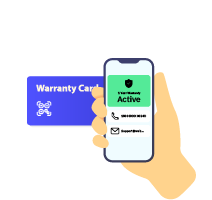
The product's serial number is an essential element of the warranty registration process. As a serial number is different for every other product, the firm or the manufacturer knows who purchased the product and when it was purchased, verifying it according to that knowledge. You may make the warranty registration procedure easier to complete online by using QR codes.
Rather than redirecting clients to your product registration page by yourself, you can build QR codes that direct clients to your product registration page, where they can register for your product in seconds or minutes. There are various most exemplary [warranty Management software](https://www.dyrect.co/guide/warranty-management-software) programs available that can be used to manage warranty registration responsibilities.
With the help of [NeuroWarranty](https://www.neurowarranty.com/), the procedure of registering a warranty has become much more simple. Scanning the QR code on the product while providing the necessary information and the invoice will result in the automated delivery of an email or to seeing daily. Additionally, it is critical to maintain a good contrast between the colors of your QR code.
## When creating your QR code, follow these best practices:
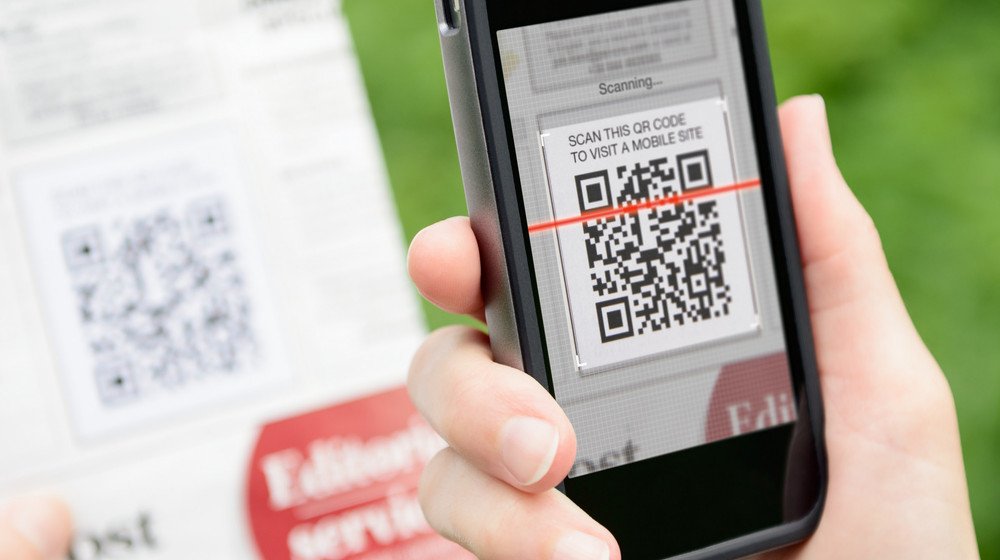
### Do not reverse the color of your QR code:
QR code readers are usually programmed to scan QR codes with a light background and a darker foreground QR color, just like the black and white QR codes that we are accustomed to seeing daily. Additionally, it is critical to maintain a good contrast between the colors of your QR code.
### Using a dynamic QR code can assist you:
Whenever you are producing a large number of QR codes for your URL together with a serial number of your goods, be sure you create them in a dynamic QR code format.
[Check out how a digital warranty solution like NeuroWarranty can help you manage your warranty QR codes at scale.](https://www.neurowarranty.com/blog/warranty-management-app-reduce-costs-and-automate-your-product-warranties-cl1g7op6l65941jlfkyb2vlqj)
Dynamic QR codes provides you the ability to customize your QR code. This means that if you uncover an issue in your data, you can immediately rectify it without reprinting your QR codes from the start.
**Make an SVG version of your QR code.**
When using the SVG format, you may resize your QR code in any manner you want without affecting its quality.
### Run a scan test to see how well your system is working:
Although it is usually good to test your QR codes before printing them, it is essential to check thoroughly if you have entered the correct data and if the codes can quickly scan well with other devices.
### The final words:
Customers will have a smoother and easier experience registering their product purchase if you use QR codes to facilitate warranty registrations. By utilizing the [NeuroWarranty software](https://www.neurowarranty.com/), it is possible to assure that the headache linked with manual warranty administration will be reduced to a minimum.
Regardless of where the customers are: at home while lounging on the sofa, at their place of employment if they have spare time, or somewhere else, the warranty management becomes an easy task. If you have any more queries about utilizing QR codes for warranty registration, please do not hesitate to contact us for extra information.
---
This blog is powered by Superblog. Visit https://superblog.ai to know more.
---
## Difference between Warranty & Guarantee | Everything you need to know
Author: Abhishek Agrawal
Author URL: https://www.neurowarranty.com/blog/author/abhishek-agrawal
Published: 2021-11-29
Meta Title: Difference between Warranty & Guarantee | Everything you need to know
Meta Description: A warranty is an agreement to offer free repair services for any problems that may develop with a product, while a guarantee is...
Tags: Warranty Management, Guarantee, Technology
Tag URLs: Warranty Management (https://www.neurowarranty.com/blog/tag/warranty-management), Guarantee (https://www.neurowarranty.com/blog/tag/guarantee), Technology (https://www.neurowarranty.com/blog/tag/technology)
URL: https://www.neurowarranty.com/blog/difference-between-warranty-and-guarantee-or-everything-you-need-to-know-ckwkny0px86301lnu70njmhn3
In this sense, the phrase warranty is extremely widely employed. It indicates a formal guarantee given to the customer about the status of the goods is truthful and says that the manufacturer will be liable for the repair or replacement if proven faulty.
## What is a warranty?
To get to know about the differences between Warranty and Guarantee, let's talk about Warranty first. According to the definition, a warranty is an agreement to offer free repair services for any problems that may develop with a product during the course of regular usage of the device within the warranty period. If the manufacturer does not guarantee replacement, then he promises to repair the product.
When a corporation is accountable for the product's functionality, there should be a minimum time range throughout which the product must function. This implies that the customer is covered against abrupt breakage or sudden faults with the goods. It makes no sense to pay for repairs if you have just purchased a high-priced refrigerator that stops operating a month later.
Consequently, companies provide guarantees with their products as a means of demonstrating their commitment to the long-term viability of their products. And today, generally, warranty management is managed by warranty management software, which has made lives simpler for various firms. NeuroWarranty gives a corporation an [alternative for manual warranty registration](https://www.neurowarranty.com/) by bringing digital warranty management.
## What is a Guarantee?

Guarantee is a step ahead of Warranty when the firm is so sure of their goods that they repair or replace the product. Shortly put, if a product faults with it, the manufacturer will first attempt to fix it, and if that is unsuccessful, it will provide a free replacement product.
Customer rights are enhanced by a guarantee, which indicates that the maker has made a promise about the product's content, quality, or performance. If the duty is not met, the manufacturer will replace or repair the product, or the money paid as consideration will be repaid, despite being only good for a specific period.
There are three parties involved in a guaranteed contract: surety, the primary debtor, creditor, where the manufacturer serves as a survey if the product's performance is below average.
### Critical distinctions between Warranty and Guarantee:
## Warranty
## Guarantee
Written agreements between two parties are known as warranties.
A guarantee is a verbally expressed promise.
The product can be repaired; no commitment of replacement of the product is provided to the consumer.
The product has an option of repair, but if the product can not have a repair, then a replacement would be given.
Warranty is a formal guarantee that the mentioned facts about the products are authentic and accurate, but if they malfunction, they can be fixed as well as repaired.
A refund or replacement will be issued if a product fails to meet acceptable quality standards. When a manufacturer provides a guarantee, it means that the manufacturer is making a promise to the client about the quality of the goods.
A product can not be refunded in a warranty.
A product can be refunded, or sometimes a replacement is made.
Warranty is usually given for products which are known for frequent breakdowns or any mechanical fault.
Example: Steaming Iron, washing machine.
A guarantee is given for the products which are reliable and durable and are debatable to have any mechanical breakdown or fault.
Example: Heavy engineering products.
Warranty is legal binding between manufacturer and consumer
Guarantee is a verbally expressed promise, hence no legal binding.
To keep the product's interest alive, the buyer must pay for the product's Warranty.
For Guarantee, no cost is needed, and it's totally free.
The Warranty's duration is longer.
There is no assurance that a product will last the same amount of time as another.
After the Warranty ends, an additional warranty can be given.
After the Guarantee ends, additional guarantees are rare, and instead of a guarantee, an additional warranty can be given.
Warranty is usually given for certain parts, but there may be some parts that may need payments for an additional warranty.
The Guarantee covers only some parts, and some parts might be covered by a warranty.
Warranty can be automated by warranty management software.
Customers are guaranteed satisfaction with a warranty from a manufacturer.
### Essential facts to know regarding warranty management and Guarantee:
As you have read above, differences between Warranty and Guarantee stand as variances in legal proposals. A customer can easily claim a repair of any product for free, but he cannot claim the replacement of the product as the company is not legally bound for a replacement.
While most firms know that it is cheaper to replace a product now than to deal with legal difficulties later, there is another essential point to be addressed. At the same time, one unhappy customer might result in a loss of 10 optimistic consumers owing to the unfavourable word of mouth.
If the customer is upset with the product, then a warranty may be turned into a guarantee, and a free replacement might be supplied to appease the customer. If the customer is not using the product in the correct manner while not following the rules and regulations provided by the corporation, the Warranty and Guarantee can be called void.
It is also conceivable that a complete product can never be covered under Warranty and the Warranty typically varies for various product sections.
### Final thoughts:
Studying the documents accompanying the Warranty or Guarantee is vital to understand what is covered under Warranty and Guarantee.
After the explanation about the differences between Warranty and guarantee above. To some extent, Guarantee and Warranty mirror each other since they both talk about the performance of the products, but they are not similar and have vast distinctions.
###
---
This blog is powered by Superblog. Visit https://superblog.ai to know more.
---
## Benefits of a warranty management solution | The Complete Guide
Author: Abhishek Agrawal
Author URL: https://www.neurowarranty.com/blog/author/abhishek-agrawal
Published: 2021-11-24
Meta Title: Benefits of a warranty management solution | The Complete Guide
Meta Description: Here are some of the most significant ways in which a warranty system solution can benefit your brand improve customer satisfaction - Speedy processes, Reduce the danger of fraud...
Tags: Digital Warranty Management, NeuroWarranty, Warranty Management Services
Tag URLs: Digital Warranty Management (https://www.neurowarranty.com/blog/tag/digital-warranty-management), NeuroWarranty (https://www.neurowarranty.com/blog/tag/neurowarranty), Warranty Management Services (https://www.neurowarranty.com/blog/tag/warranty-management-services)
URL: https://www.neurowarranty.com/blog/benefits-of-a-warranty-management-solution-or-the-complete-guide-ckwdap5pb86832vqeruly87sd
**When companies first started offering guarantees on their products, it was regarded to be a terrific way to boost revenues and gain clients’ loyalty.**
However, as the number of claims has progressively increased over time, managing the warranties in order to improve customer satisfaction has proven to be problematic.
Contents
- [Why Is Good Warranty Management Essential?](#why-is-good-warranty-management-essential)
- [What are the benefits of warranty management in terms of sales?](#what-are-the-benefits-of-warranty-management-in-terms-of-sales)
- [How does warranty management improve customer satisfaction?](#how-does-warranty-management-improve-customer-satisfaction)
For businesses, warranty programs save both time and money, as they reduce the need to respond to every complaint individually and increase efficiency across the board.
In this way, not only can businesses improve their own reputations, but also contribute to the development of the market as a whole.
**According to the results of a recent benchmark survey conducted by Warranty Week and published in Strategies for Growth, 58 percent of warranty professionals cited enhancing post-sales customer happiness as the major driver for greater warranty performance.**
This article is a complete guide on how warranty management systems work and why it’s essential to have one in place.
[A warranty control system](https://www.neurowarranty.com/) can provide many benefits to companies and their customers, not the least of which is the improved customer service that comes from faster and more accurate processing of warranty claims and support issues.
## **Why Is Good Warranty Management Essential?**

A [good Warranty System](https://www.neurowarranty.com/) is an important tool for companies that sell durable goods. It’s also a great way to demonstrate customer loyalty and commitment since it can increase customer satisfaction.
Providing customers with an effective warranty strategy is an important part of running a successful business.
[Professional software for warranty programs](https://www.neurowarranty.com/blog/warranty-management-app-reduce-costs-and-automate-your-product-warranties-cl1g7op6l65941jlfkyb2vlqj) can help keep your company compliant with federal regulations, reduce costs, and increase sales.
Customers expect vendors to stand behind their products, and a warranty is an obvious selling point.
But many small businesses neglect to offer warranties, either because they’re afraid of losing money if products break down, or because they have no idea how to manage a warranty program.
No matter why your business doesn’t offer a warranty, [good warranty system software](https://www.neurowarranty.com/) can fix that problem fast.
An effective warranty system also serves as a customer retention tool by extending product warranties and offering timely service in case of problems.
Helping customers save money on replacing broken or defective goods ensures they’ll come back for future purchases.
According to the state of the industry, 70% of customers say they've already decided to support a firm that provides excellent post-sale customer service.
## **What are the benefits of warranty management in terms of sales?**

Companies can use warranty system software to manage claims more efficiently in the following ways -
**Customization:** It offers manufacturers specific warranty software packages and can quickly generate solutions for other manufacturers. Custom warranty extractions can also be created by administrators using a set of basic parameters.
**Increase Brand Awareness:** Our digital warranty solutions can increase brand awareness by providing up-to-date information about your products to vendors, channels, and consumers.
**Get Market Insights:** By providing insights into your warranty process, your business can be better positioned to service its customer base, leading to increased sales.
**Improve Your Product:** Through proper warranty reporting, you’ll also gain valuable intelligence about what works (and what doesn’t) in terms of product warranties.
**Market Effectively:** These insights can be used for future product development and marketing campaigns.
**Improve Customer Experience:** Your warranty system process can be both your greatest strength and your greatest weakness when it comes to providing the best possible customer experience.
**Increase Customer Loyalty:** On one hand, if you manage warranty issues quickly and accurately, you can build customer loyalty and help ensure that they’ll be back again and again for their warranty needs. S
**Satisfy Customers:** On the other hand, if you fumble or ignore warranty issues and questions, you risk alienating customers who will take their business elsewhere in the future – and likely not come back after they’ve had a chance to test out your competitors’ offerings as well.
A [well-optimized warranty management](https://blog.neurowarranty.com/how-to-optimize-your-warranty-management-system-or-a-complete-guide-cku3mbacg61551pnc8r3ahp4h/) system allows you to improve your post-sales service, which leads to happier customers and bigger profits.
## **How does warranty management improve customer satisfaction?**

Here are some of the most significant ways in which a well-managed warranty system solution can improve customer satisfaction:
**Speedy processes:** A warranty management system can make it easier to keep track of each claim's status and process each stage more quickly.
Allowing the system to automate monotonous chores will free up time for your staff to focus on more important tasks and improve their talents.
**Reduce the danger of fraud:** Customers who are concerned about their data can rest easy knowing that a warranty software system reduces the chance of fraud.
Because all of the processes and rules are in place, as well as due to the most up-to-date technology, any problems or errors, such as fraudulent activity, are much easier to discover and stop. To know how you can stop warranty frauds more effectively, [click here](https://www.neurowarranty.com/blog/here-is-how-you-can-stop-warranty-frauds-faced-by-your-brand-cl202i0jv16301ll8aet2xuhl).
**Expense:** By automating claims and settlement processes, a management system can help you save money on administrative expenditures. Know more about how you can reduce your warranty claims cost - [How to reduce warranty claims cost](https://www.neurowarranty.com/blog/reduce-the-cost-of-your-product-warranty-claims-here-is-how-ckxiopr0204981ks7c5ibicfx).
**Improved customer service:** The manufacturer's database stores customer and product information directly. They have everything they need to manage claims, repairs, and replacements with ease.
With real-time data at your fingertips, you can simply track the status of each claim, keeping consumers informed and significantly improving satisfaction.
**Clearer insights:** With the help of warranty software, clearer insights and analysis data are available. This makes it much easier to keep track of any quality issues and gives you a clear picture of what customers want.
[Warranty management software](https://www.neurowarranty.com/) is an excellent way to strengthen customer connections, minimize costs, and preserve the value of your product.
**Closing Thought: According to Kolsky, One of the biggest causes for switching, according to 67 percent of consumers, is a terrible customer experience.**
Enhancing the customer experience during the warranty term and beyond can help you increase customer satisfaction and loyalty.
At NeuroWarranty, we provide top warranty management solutions that enhance customers’ post-sales experience by providing them with comprehensive and structured information on warranties offered by the company.
[**Warranty management solutions**](https://www.neurowarranty.com/) is a niche category dominated by enterprise-level players, which MSME-level businesses cannot afford. Affordable solution providers, on the other hand, give no other benefit than warranty management. [NeuroWarranty](https://www.neurowarranty.com/) offers several solutions at no additional cost, along with a super-efficient tool to manage your warrant system. Built-in CRM, customer data, cross-selling opportunities, independent identity, direct communication with the customers, and the pathway to grow and increase turnover are just some of the tangible benefits.
---
This blog is powered by Superblog. Visit https://superblog.ai to know more.
---
## Announcement - Grow your Brand with delightful after-sales Customer Experience
Author: Abhishek Agrawal
Author URL: https://www.neurowarranty.com/blog/author/abhishek-agrawal
Published: 2021-10-29
Tags: Digital Warranty Management, NeuroWarranty, Warranty Management, Consumer Data Collection, Warranty Management Services
Tag URLs: Digital Warranty Management (https://www.neurowarranty.com/blog/tag/digital-warranty-management), NeuroWarranty (https://www.neurowarranty.com/blog/tag/neurowarranty), Warranty Management (https://www.neurowarranty.com/blog/tag/warranty-management), Consumer Data Collection (https://www.neurowarranty.com/blog/tag/consumer-data-collection), Warranty Management Services (https://www.neurowarranty.com/blog/tag/warranty-management-services)
URL: https://www.neurowarranty.com/blog/announcement-grow-your-brand-with-delightful-after-sales-customer-experience-ckvc0dbxy63101oo3hqonzk8q

Firstly, I would like to thank you for taking out time to read this.
We are excited to share the story and motivation behind starting **[NeuroWarranty](http://www.neurowarranty.com/)**.
## **What is the problem❓**
> According to a Helpscout study, **_[80% of companies](https://aircall.io/blog/customer-happiness/how-to-measure-customer-satisfaction/) say they deliver “superior”_** customer service. However, only **8% of customers agree** with that assessment.
There is a huge disconnect between the brand and customer communication once the product is sold. Some of the issues are as below:
### 📧📞 **Broken Consumer Experience:**
Buying a product online is super easy, but getting warranty claims is a **PAINFUL and CUMBERSOME process**. It takes countless calls, emails for customer care to get the product repaired/ replaced. Customers can't keep a track of their product warranties and claims tracking. This leads to customer dissatisfaction and **lost brand trust.**
**📝 Managing Product Warranties :**
Brands usually rely on **excel sheets** or use **generic CRMs** to manage their warranty claims. This makes managing the warranties cumbersome and resource-intensive.
_and very importantly_
🧑 **No Consumer Data :**
Brands sell your products on marketplaces like Amazon, offline retail stores. And you don't get to access any customer data. Marketplaces like [Amazon uses sales data and bring competing products](https://www.reuters.com/investigates/special-report/amazon-india-rigging/) under their own brand name.
All of these results in **unhappy customers** 😞 **lost repeat sales** 📉
According to [reports](https://www.investopedia.com/terms/r/repeat-sales.asp),
> _By increasing customer retention by **just 5%,** a company’s profitability will increase by an **average of 75%**_
## 🏰 **What are we building?**
> NeuroWarranty help consumer brands **increase revenue** by providing **delightful post sales experience**.
We understand the importance of a **frictionless post-sales customer experience,** and NeuroWarranty is here to provide:
- One-touch Warranty Registration for Customers.
- Modern and Powerful to use Warranty Management System.
- Product Serialization Module.
- Consumer Data Collection (using warranty QR codes)
Check [here](http://www.neurowarranty.com) for more details.
## 🔄 How does it work?
NeuroWarranty provides an **out-of-the-box solution** for brand users to manage their brand warranties at a single place, and brands can manage and provide **delightful post-sales service**.
Here is the process:
**For Users:**
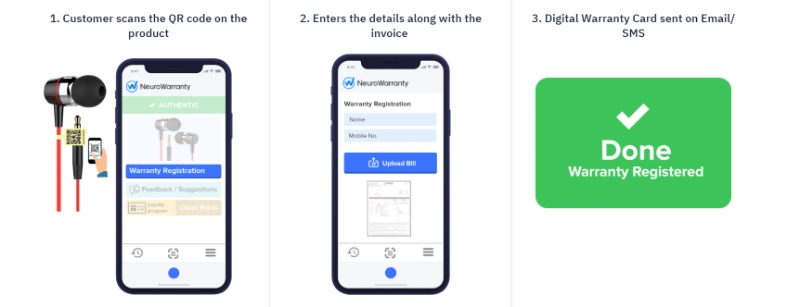
**Warranty Registration:**
1. User Buys a product (from any channel).
2. Scans the QR code on the product & Upload bill copy.
3. Warranty registered & receives digital warranty card (over the phone, email/ Whatsapp).
**Warranty Claims:** In case of fault user can **scan the QR code** again or **use a digital warranty card** or go to the **brand website** to seamlessly request and fulfill warranty claims.
**For Brands:**
- Collect and Manage all its Consumer Data
- Manage Product Warranties
- Settle Claims with ease
- Digitize Product Packaging
- Auto Communication with clients
and much more... (feature list [here](https://www.neurowarranty.com/features))
## 🏭 Who is the solution for?
Our solution will add exponential business value to small & medium businesses by providing product warranties. Specific industries include brands in **Consumer Electronics, Furniture, and Mattresses, Appliances and Hardware, Fitness and sporting equipment, Watch brands, Scooters, and e-bikes** industries.
So, if you are a consumer brand providing warranties, and like to take charge of your **Consumer data** and provide a **delightful after-sales consumer** experience, do [check us out](http://www.neurowarranty.com). We are sure you will be amazed to see the results. 🙌
Irrespective, here is a guide to link to help you set up [your Post Sales Warranty effectively](https://www.neurowarranty.com/).
---
This blog is powered by Superblog. Visit https://superblog.ai to know more.
---
## How to Optimize Your Warranty Management System | A Complete Guide
Author: Abhishek Agrawal
Author URL: https://www.neurowarranty.com/blog/author/abhishek-agrawal
Published: 2021-09-28
Meta Title: How to Optimize Your Warranty Management System | The Complete Guide
Meta Description: Follow these steps to Improve and Optimize Warranty Management Systems to get never seen before results - assessment, conceptualize advancement...
Tags: Digital Warranty Management
Tag URLs: Digital Warranty Management (https://www.neurowarranty.com/blog/tag/digital-warranty-management)
URL: https://www.neurowarranty.com/blog/how-to-optimize-your-warranty-management-system-or-a-complete-guide-cku3mbacg61551pnc8r3ahp4h
Warranty management software promises a guarantee on the quality and service of a particular product on behalf of the manufacturer or seller. There is a re-assurance in warranty management systems as they make customers feel safe against a risk that may arise in future. We say re-assurance because assurance was evident when they chose your product over others to begin with. But the majority of the existing warranty systems based on paper warranties can be very demanding and difficult to manage, both for you, and your customers this article aims to provide you with all the tips you need to know to optimize and improve your warranty management system.
Warranty management is a vital component of a caring and responsible organisation. It is important to view, access, track and solve a customer's grievance with your product. Not doing so can adversely affect your business by increasing customer dissatisfaction and loss of revenue.
However, managing warranty information manually can be extremely difficult and demanding. There is plenty of data and multiple departments involved in the process, such as engineering, field technicians, customer care, and sales. To maximize the efficiency of a warranty management solution, it must be automated, streamlined, easy to use, and integrate all aspects involved in the process.
Warranty management software can help businesses create, administer, process, and track warranty coverage throughout the product life cycle. We have enlisted some tips to optimize the right warranty management software for your organization.
## **Tips to optimize your warranty management software**
## Whether you have just decided to start using warranty management software or have been deploying one for some time, you can take it to the next level with these vital steps.

### **1\. Assessment**
It is essential to review the current state before advancing towards a new system and achieve its maximum value. To do this, you can ask these questions-
- Is your current warranty system easy to understand and manage?
- Can you assess the effectiveness of your current system to know its strengths and weaknesses?
- Are you still using paper warranty cards? Do you have initial customer data in place? Are your records automated and centralized? Do you have an older digital tool, and is it helping you? If not, why?
Listing down the pain areas and the cost of the current system will help you make a better decision for revamping it.

### **2\. Conceptualize advancement**
Once you have meticulously reviewed your current situation, map out the areas where you can make improvements. For instance, visualize an [automated process](https://www.neurowarranty.com/digital-warranty-management-software) that can get primary customer data like the date of purchase of a product, name of the customer, contact and product details to register each purchase in your system. If you have different manual methods to collect information, think of how you can consolidate data into one automated system accessible across the organization.

**3\. Discuss the merits of using a warranty management solution with your team**
Once you have enlisted the problems associated with your current warranty management solution, it is important to communicate how it hampers overall performance and keeps the team members from achieving more in other areas of their work as well. Encourage the employees to give inputs on how to improve the system and help them welcome a new approach to work on it.

### **4\. Envision a process-based system**
Think of an information and design-based solution that follows specific rules to get some details in the first transaction with the customer. In the long term, you will realize that the right beginning is crucial in efficiently solving a problem. For example, products and product categories need to be identified and then associated with fixed or variable warranty terms and conditions. Just like each customer has a unique identity, each product needs to have one that can be captured by a device at the click of a button to establish a unique transaction.
### **5\. Automated registration in the first interaction**
To solve a problem, the concerned parties must mutually accept and agree upon it. In the case of a warranty, it has to be created to be effective. There must be an automated registration with the necessary details of the product, warranty terms, and the customer recorded at the time of purchase to avoid discrepancies or conflicts in future. The registration can happen before, during or after the product installation, demonstration or training, initiating a record, and [providing access to customer data.](https://www.neurowarranty.com/collect-offline-consumer-data)
### **6\. A unified and mobile process -**
The warranty agreements, the current status of a claim, and information regarding service requests, etc., should be recorded and updated in such a way that they are accessible in real-time, even by field technicians outside the office. To achieve the same, [warranty management software](https://www.neurowarranty.com/digital-warranty-management-software) and the latest data should be accessible across devices. Doing this ensures that field engineers have all the information they need while moving between separate service requests, no ambiguity between the company representative and the customer and that customers are satisfied and trust the company.

### **7\. Identify, certify and improve employee skills**
A warranty management software that includes field engineers' skill set and certifications creates credibility among the customers. Technically aware B2B or B2C customers may sometimes demand paid service to be executed by a certified technician only. Additionally, the certification will motivate you to regularly train your employees, increasing employee retention and customer satisfaction.
### **8\. Communicate warranty expirations and renewals**
The duration between registration and warranty claim must be utilized to notify the customer regarding the expiry and renewal of a warranty. The customer should not be surprised and dissatisfied because of his inaction if he was reminded of the expiry and asked to renew. The warranty system across channels, including field technicians, must have the pricing policy to renew expired warranties. The field engineers must know whether the service request is billable or covered under warranty.

### **9\. Utilize the streamlined process to reduce backlog -**
Automating and centralising warranty claims reduces the number of claim issues and follow-ups resulting from delays or denials due to the absence of a proper system. Having trained and certified employees ensures that the correct data can be captured and used to execute pending warranty registrations.

### **10\. Add value with new services**
Your new warranty management tool may enable services that your previous warranty system could not. For instance, you may have a pending warranty claim where a customer must physically take a part of the product to an authorised dealer for repair or replacement. Your new [warranty system](https://www.neurowarranty.com/digital-warranty-management-software) could perhaps add a minimal travel charge for on-site service so the customer can get the warranty benefit at home. However, the warranty software will need to implement different line item rules for the manufacturer's warranty and supplemental warranty agreement. Nevertheless, this small addition can up your service game, especially when home service is now more important than ever.

### **11\. Identify the right warranty management software**
Once you have clarity on the features and help you are looking for, select the right warranty management software that solves your problem. If you think what you're looking for is complex, a customized solution may give higher return on investment. However, comprehensive warranty management solutions can save time and money for small and medium enterprises. You could look for [artificial intelligence-based warranty management software](https://www.neurowarranty.com/) to know process issues and gain new insights.
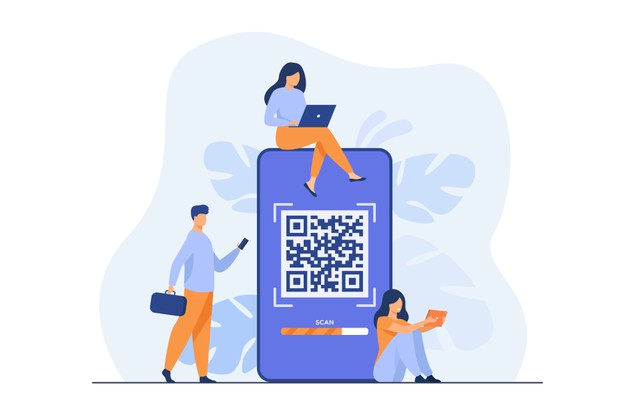
### **12\. Encourage a self-sufficient process**
You can provide the mechanism to register for the warranty management software to the customers with smart options like QR codes on the product. The customer can scan the QR code immediately after purchase and get the product registered via email or SMS. Thus, the company [receives customer data](https://www.neurowarranty.com/collect-offline-consumer-data) along with initiating self-registration effortlessly.
Choosing the right warranty management software can be daunting for companies with a limited budget and complex requirements. NeuroWarranty is an exhaustive warranty solution that can seamlessly integrate with your CRM or be customized to suit your needs. The QR-based **[Warranty Management Software](https://www.neurowarranty.com/)** not just helps optimize and automate the warranty process but works like magic in building your consumer engagement efforts.
---
This blog is powered by Superblog. Visit https://superblog.ai to know more.
---