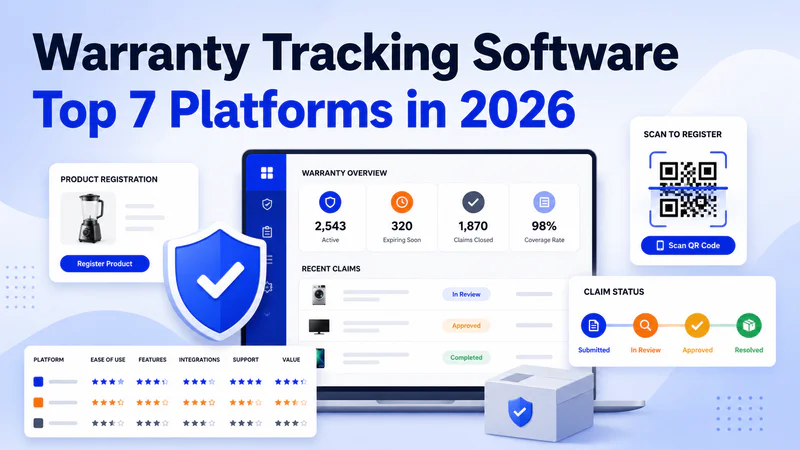
Your support inbox has 40 warranty emails. Half the customers bought on Amazon or in a store, so their orders sit nowhere in your system, and each claim starts with an agent asking for a receipt photo. Warranty tracking software fixes this by keeping one record for every product you've sold: who owns it, when coverage ends, and where every claim stands.
This guide covers how warranty tracking works for ecommerce brands, retailers and consumer product manufacturers. It explains how to track buyers who purchased outside your store, which six metrics matter, and how seven platforms compare.
TLDR
Warranty tracking software records who owns each product, when its warranty expires, and the status of every claim.
For brands and retailers selling through their own store, Amazon and physical retail, Dyrect is the most powerful warranty platform: it registers buyers from every channel, tracks claims end to end, and uses an AI agent to resolve routine warranty requests instantly.
What Is Warranty Tracking Software?

Warranty tracking software is a system that links every sold product to a verified owner, calculates when its warranty starts and ends, and follows each claim from submission to resolution. It replaces spreadsheets, shared inboxes and receipt hunts with one record your support, operations and product teams all use.
The software does four jobs:
Ownership capture: links each unit to an owner, purchase date, sales channel and serial number.
Coverage status: calculates expiry dates and flags warranties approaching the end of coverage.
Claim tracking: moves each claim through stages such as submitted, under review, approved, in repair, replaced and closed.
Reporting: rolls claim volume, failure reasons and resolution time up by SKU, channel and supplier.
Warranty Tracking vs Warranty Management
Most modern platforms cover both layers. Pick based on which problem costs your team more today.
Who Uses Warranty Tracking Software?
Three groups search for this software, each with a different problem:
Ecommerce brands that need warranty records for online buyers, plus the growing share who buy through Amazon and retail.
Retailers that receive warranty claims across many brands and need to track each one through to the supplier.
Consumer product manufacturers that sell through dealers and distributors and need ownership data they never receive from those channels.
IT and facilities teams tracking warranties on company-owned equipment need asset management software instead. This guide focuses on businesses tracking warranties they give to customers.
How to Track Warranties for Amazon and Retail Buyers
Buyers from your own online store arrive with an order record. Buyers from Amazon, Walmart, Best Buy or a dealer arrive as strangers to your systems, so your first contact is usually their claim.
Three methods close the gap:
QR codes on packaging or inserts. Buyers scan, enter their details and upload a receipt photo. One code works for every channel.
Serial number registration. The system checks each serial against your production list, which also blocks duplicate and counterfeit registrations.
Retail partner data. Some distributors share sell-through data you can import, depending on your agreements.
Collect owner name, email, phone, product, serial number, purchase date, proof of purchase and sales channel at registration. Capture the channel as a dropdown, since this one field later powers every channel-level report.
Six Warranty Metrics Every Brand Should Track

Calculate claim rate against units still under warranty, because dividing by every unit ever sold makes older products look healthier. Review the proof-of-purchase gap monthly, since a rising number points to a registration step buyers skip.
What to Look for in Warranty Tracking Software in 2026
Registration That Captures Buyers From Every Sales Channel
Your tracking covers as many buyers as your registration reaches. Look for QR registration on packaging, an embedded form for your online store and hosted pages for dealers, all feeding one database.
Ask vendors to show a QR-scan registration and a Shopify order landing in the same dashboard. Separate databases leave every channel outside your store undercounted.
AI That Resolves Routine Warranty Requests
Many warranty contacts are questions a product manual already answers, or claims that need the same three details collected every time. AI support agents now troubleshoot common issues, read receipts from photos and file complete claims before an agent opens the ticket.
Check that the AI answers from your own manuals and warranty terms, and that it hands complex cases to a human with the full conversation attached.
Serial Number, Receipt and Fraud Validation
Validation should confirm each serial exists in your production records, flag serials registered twice, and extract the purchase date and retailer from receipt uploads. Strong validation cuts duplicate payouts before approval, which matters most for electronics, appliances, e-bikes and other high-value products.
Claim Status Visible to Your Team and Your Customers
Every claim needs an owner, a stage and a timestamp. Customers should see the same status through a portal or automatic email, SMS and WhatsApp updates, which removes "any update?" emails from your queue.
Integrations With Your Store, Helpdesk and Marketing Tools
Look for native connections to Shopify, WooCommerce and BigCommerce; helpdesks such as Zendesk and Freshdesk; and marketing tools such as Klaviyo. Two-way sync keeps your team from copying data between systems.
Reporting by SKU, Channel and Supplier
Dashboards should answer the six metric questions above with filters for product line, channel, region and date. Supplier-level reporting gives you the evidence for cost recovery conversations with manufacturers.
List of 7 Best Warranty Tracking Software for Brands (2026)
1. Dyrect: The Most Powerful Warranty Tracking Platform for Multi-Channel Brands

Dyrect is a warranty registration, claims and AI support platform for consumer product brands and retailers. It tracks every product from the moment a buyer registers, whether they bought on your Shopify store, on Amazon or at a retail counter, through every claim and up to warranty expiry.
Three things set it apart:
Reach. It registers buyers from channels that share zero customer data with the brand.
Automation. Its AI agent resolves routine warranty support on its own.
Validation. It reads receipts and serial numbers automatically, so agents stop typing in purchase details by hand.
Brands using Dyrect include Burton, Fender Audio, Velotric, Clore Automotive, Diggs and Dow, and the company reports 500+ brands on the platform.
Omnichannel Registration That Tracks Amazon, Retail and Dealer Buyers
Online buyers register through a form embedded in Shopify, WooCommerce, BigCommerce, Wix or Squarespace. Amazon, retail and dealer buyers scan a QR code on the box, insert or label and register on a branded mobile page in under a minute.
Each registration records the owner, product, serial number, purchase date and sales channel. That gives you registration rate by channel from day one, and it gives your marketing team consented email and SMS contacts for buyers who were previously anonymous.
Velotric, an e-bike brand, used Dyrect registrations to build a first-party customer network across its dealer channel.
Dyrect AI: Warranty Support That Troubleshoots, Captures and Files Claims
Dyrect's Warranty Support AI Agent, currently in beta, handles the first contact on every warranty request. Here is what it does, by Dyrect's own description:
Troubleshoots first. It answers from your own product manuals, warranty terms and FAQs, and resolves issues that need no claim on the spot.
Works around the clock in any language. It runs 24/7 in the customer's language, across chat, the warranty portal and WhatsApp.
Files the claim when one is needed. It pulls up the customer's registration and purchase date.
Reads receipts automatically. The customer uploads a photo, and OCR extracts the retailer, purchase date, amount and serial number.
Checks for fraud. It cross-checks serial numbers, purchase dates and claim history, flagging duplicates before a human approves anything.
Triages and hands off. It classifies each issue by product, severity and complexity. Cases it can't resolve go to the right person with the full conversation and claim history attached.
Dyrect reports that the agent:
handles 80% of warranty support on its own
replies in under a minute
cuts cost per ticket from about $6 with manual handling to $0.50
The agent works with your existing helpdesk, and Dyrect states setup takes under 30 minutes.
Expiry Tracking, Digital Warranty Cards and Claims in One Record
You set warranty policies per product category, and Dyrect calculates every expiry automatically. Customers receive a digital warranty card by email or text and can check coverage, claim history, manuals and service centers from one product page.
Claims move through a ticketing workspace with item-level tracking by serial number, covering repair, replacement, refund and dealer or OEM chargebacks. Customers get automatic status updates by email, SMS or WhatsApp. Tickets sync with Zendesk, Freshdesk and Zoho Desk.
Diggs, a pet products brand, cut warranty costs by 30% in six months after moving claims to Dyrect.
G2 rating:4.8 ★ | Shopify App Store rating:5.0 ★
Best suited for: Ecommerce brands, retailers and manufacturers selling through any mix of their own store, marketplaces, retail chains and dealers.
Key Features
AI warranty support agent with brand-grounded troubleshooting and human handoff
OCR receipt and serial capture from a customer photo
AI fraud and duplicate detection before approval
Omnichannel registration via QR code, embedded forms and hosted pages
Per-category warranty policies with automatic expiry tracking
Claims ticketing with serial-level traceability, chargebacks and live status updates
Pros
Tracks marketplace, retail and dealer buyers alongside online customers
AI resolves routine requests and captures claim data with zero manual entry
Free plan and low entry tiers, with enterprise options for larger brands
Cons
The AI agent is in beta, so confirm current capabilities in a demo
Industrial OEMs running multi-tier supplier recovery inside SAP may prefer an ERP-native module
Pricing: Free plan, then $19/month (Registration), $49/month (Claims) and $149/month (Claims Pro) on the Shopify App Store, with custom plans on the pricing page.
2. NeuroWarranty: QR-Based Warranty Activation for Product Brands

NeuroWarranty is the earlier QR-based warranty product from the team behind Dyrect. Brands replace paper warranty cards with QR codes that customers scan to activate coverage, and the platform handles registration, claims submission and customer data collection.
Best suited for: Product brands in electronics, appliances and home goods moving from paper warranty cards to QR activation.
Key Features
QR code warranty registration and activation
Digital warranty cards
Claims submission and tracking dashboard
Customer data capture by product and channel
Pros
Simple scan-to-register experience for customers
Captures data from offline and retail buyers
Cons
AI support, OCR receipt capture and advanced claims workflows live in Dyrect
Fewer ecommerce integrations than newer platforms
Pricing: Custom.
3. Pega Warranty: Enterprise Claims Processing for Manufacturer Networks
Pega Warranty is part of the Pegasystems process automation suite. It handles claim validation, multi-tier approvals, supplier chargebacks, parts returns, repair orders and financial settlement for manufacturers whose claims pass through dealers and suppliers.
Best suited for: Large manufacturers with dealer networks and complex multi-party claim flows.
Key Features
Automated eligibility checks and multi-tier approvals
Repair order management for dealers and technicians
Supplier recovery and chargebacks
Recall campaign management
Pros
Handles multi-party claims between manufacturer, dealer and supplier
Deep CRM and ERP integration
Cons
Implementation takes months and needs dedicated technical resources
Customer-facing registration is minimal
Pricing: Enterprise quote.
4. SAP Warranty Management: Warranty Tracking Inside SAP ERP
SAP offers warranty management as a module within its ERP suite. It handles claim processing, entitlement checks, defect coding linked to Quality Management, and automatic financial postings, while SAP Advanced Claims Settlement adds multi-tier supplier recovery.
Best suited for: Enterprises already running SAP across finance, logistics and service.
Key Features
Claim processing with entitlement validation
Defect code catalogs linked to SAP Quality Management
Financial postings in SAP FI/CO
Analytics through SAP BW or SAP Analytics Cloud
Pros
Keeps warranty data in the same system as finance and logistics
Strong for multi-region manufacturing
Cons
Complex warranty setups need SAP ACS or custom development
Customer registration requires heavy configuration
Pricing: Part of SAP ERP licensing.
5. PTC Warranty: Warranty Cost Analytics for Industrial OEMs
PTC Warranty manages warranty policies, claims, returns and supplier recovery, with analytics linking warranty data to product quality. IDC named PTC a Leader in its 2024 MarketScape for warranty service management.
Best suited for: Industrial, automotive and electronics OEMs processing high claim volumes.
Key Features
Claims processing and contract management
Supplier recovery and chargebacks
Parts return tracking
Warranty and quality analytics
Pros
Analyst-recognized depth in warranty cost control
Covers the full chain from claim to supplier reimbursement
Cons
Enterprise implementation needs dedicated project resources
Consumer registration and post-purchase engagement are minimal
Pricing: Enterprise quote.
6. ReverseLogix: Warranty Returns and Repairs at Scale
ReverseLogix is a returns management system covering returns, warranty claims and repairs for B2C and B2B sellers. Warranty tracking sits inside a reverse logistics workflow with automated routing, multi-step repair tracking and warehouse inspection.
Best suited for: Brands with high volumes of warranty returns that end in physical repair or replacement.
Key Features
Self-service returns and warranty portals
Routing by warranty status and fault type
Multi-level repair tracking
Warehouse and inspection workflows
Pros
Strong depth in physical returns and repair operations
Handles B2C and B2B in one system
Cons
Setup typically needs dedicated resources
Registration and first-party data capture are lighter than warranty-first platforms
Pricing: Custom.
7. RenewityRMA: Configurable RMA Tracking for Manufacturers
RenewityRMA is a cloud RMA system for manufacturers handling returns, repairs and warranty service. Teams configure stages, fields and automation rules per product line, and customers track RMAs through a web portal.
Best suited for: Small and mid-size manufacturers running repair-heavy warranty service.
Key Features
Configurable RMA workflows
Customer RMA portal
Serial number and registered product tracking
Salesforce and Zendesk integrations
Pros
Published pricing
Adapts to your existing process
Cons
Limited ecommerce integrations
Configuration takes upfront time
Pricing:$299/month for three users or $599/month for five users.
How to Choose the Right Warranty Tracking Software
Before signing, run one real claim through each shortlisted tool. Use a buyer who purchased on a marketplace, and watch where data breaks, where agents switch tools and what the customer sees.
How Much Does Warranty Tracking Software Cost?

Entry level: free to $149/month, such as Dyrect's Shopify plans.
Mid-market: about $300 to $1,000+/month, such as RenewityRMA.
Enterprise: custom contracts for Pega, SAP and PTC, commonly $50,000 to $200,000+ a year.
Budget for QR code printing, data migration and integration work on top of the subscription. US manufacturers paid $30.37 billion in warranty claims in 2025, so even small reductions in duplicate payouts and handling time usually cover the software cost.
Frequently Asked Questions
What is warranty tracking software?
Warranty tracking software records who owns each product, when its warranty starts and ends, and the status of every claim. It replaces spreadsheets and email threads with one shared record. Brands, retailers and manufacturers use it to verify coverage fast, spot defect patterns and keep customers updated.
How do you track warranties for products sold on Amazon or in retail stores?
Print a QR code on the packaging or insert that opens a registration form. Collect the purchase date, retailer and a receipt photo, and validate the serial number. Every marketplace and retail buyer then gets a warranty record you can track like an online order.
How does AI help with warranty tracking?
AI agents troubleshoot common product issues using your manuals, read receipts and serial numbers from photos, and flag duplicate or suspicious claims. Dyrect's AI agent files the claim automatically when a fix fails, and routes complex cases to your team with the full history.
How do you track warranty expiry dates automatically?
Store a start date and coverage period for every registered product, and let the software apply start date + coverage period = expiry date. Set one start-date rule per category, then schedule reminders at 90, 60 and 30 days before expiry.
What warranty metrics should brands track?
Track six: registration rate by channel, claim rate by SKU, average resolution time, proof-of-purchase gap, upcoming expiries, and repeat claim rate. Together they show where buyers go untracked, which products fail, and where your process slows down.
Is there free warranty tracking software?
Dyrect offers a free Shopify plan covering warranty registrations, claims management, a self-serve warranty portal and digital warranty certificates. Paid plans start at $19/month.
When should a brand move warranty tracking off spreadsheets?
Most brands outgrow spreadsheets at around 100 claims a month, or as soon as they sell through more than one channel. Other signs: agents chasing receipts, several people editing one file, and customers emailing for claim updates.
What is the difference between warranty tracking and warranty management?
Warranty tracking covers visibility: ownership records, expiry dates, claim status and reports. Warranty management covers action: approvals, repair routing, replacements and supplier recovery. Dyrect, Pega and PTC cover both layers.